
1. Background
Despite considerable advances in medicine, cancer is still one of the most serious diseases of our era and the third leading cause of death, accounting for about 12% of mortalities worldwide (1). According to statistics released by the World Health Organization (WHO), about 70% of all cancer-related deaths occur in developing countries (2). Breast cancer is one of the most common types of cancer among women that accounts for nearly one-fifth of deaths in women aged 40 to 50 years (3). According to the Statistics Management Center of the Iranian Ministry of Health, breast cancer still ranks the first among all cancers in Iranian women (4).
Cancer patients receive physical therapies such as surgery, chemotherapy, and radiotherapy, but less attention is paid to their mental health. Breast cancer is the most psychologically serious cancer among women (5). Patients with this type of cancer have high levels of mental disorders ranging from depression, anxiety, and incompatibility with illness to anxiety disorders and death (6). Studies have shown that the incidence of cancer is associated with increased mental disorders such as depression, anxiety, and decreased quality of life (QoL) in patients (5).
Women with breast cancer who undergo surgery usually lose an organ that is a symbol of their gender, and this can negatively affect the woman’s mental image of her body, further leading to a decrease in her self-confidence and attractiveness, followed by anxiety, depression, and despair (4). Cancer patients experience varying degrees of depression, anxiety, and hopelessness. In addition, it is important to note that people with chronic and incurable physical illnesses are less happy (7). A study by Albertson et al. (8) on happiness in people with breast cancer also showed that decreased happiness was associated with increased pain and anxiety in these patients.
Happiness is usually defined as the feeling of joy and inner satisfaction of one’s life and is used as an umbrella term that covers the concepts related to a good life, which is now referred to as QoL and life satisfaction (9). Happiness is generally considered as a predictor of health status and longevity (5). Wnuk et al. (10) showed that patients with breast cancer who had a purpose in life had higher happiness.
Previous studies reported that not only the physical health of patients but also their mental health should be considered in the treatment process. This being so, psychological studies have taken different approaches to patient mental health. Karamozan et al. (11) showed that stress management is associated with improved self-efficacy and increased happiness in patients with breast cancer. However, some studies have found that the sadness and frustration of these patients are related to the purpose of life (12, 13).
Hope therapy is one of the cognitive therapies that follow an approach to positive psychology. It focuses on human capabilities and strengths, rather than weaknesses. Hope is positively correlated with self-worth and negatively associated with depression, anxiety, and sadness. Snyder, the founder of hope theory and hope therapy, considers hope as a process that individuals set goals, develop specific strategies by which to achieve those goals, and build and sustain the motivation to execute those strategies. According to Snyder, hope is not a passive emotional phenomenon that occurs only in the darkest moments of life (14, 15). Hope-based therapies have been shown to affect hope and health (16), the happiness of hemodialysis patients (17) and the elderly (18), and the self-efficacy of physically disabled men (19).
The incidence of breast cancer is on the rise and, according to the statistics released by the WHO, cancer deaths were expected to increase to more than 15 million people per year by 2020 (2). Women with breast cancer experience various aspects of mental health problems. Therefore, it seems that the biggest problem of these patients is sadness and despair (20), which results from the lack of meaning in life.
2. Objectives
Furthermore, as hope-based therapies are designed to add purpose and meaning to the patient’s life, the present study aimed to explore the effect of hope therapy-based training on the happiness of women with breast cancer in 2020.
3. Methods
This is a quasi-experimental study with a pretest-posttest design that had two groups of intervention and control. The research population included all patients with breast cancer referred to chemotherapy wards of two hospitals affiliated to the Zahedan University of Medical Sciences (Iran) in 2020. Participants were selected using convenience sampling techniques and randomly assigned to two groups of intervention (n = 50) and control (n = 50). The inclusion criteria were undergoing at least one chemotherapy course, being literate, no disease metastasis, no obvious mental disorders requiring frequent visits to a psychiatrist, no co-morbidity, and experiencing no crisis in the last 6 months in personal life such as divorce or the death of a spouse. The exclusion criteria were being absent in more than one session and the patient’s critical condition during the intervention.
The sample size was estimated as 45 subjects per group, based on the mean and standard deviation of the happiness score in Farnia et al.’s study (17) with a 95% confidence interval and 90% statistical test power. To ensure the adequacy of the sample size and to consider the possible drop out of the patients, the final sample size for each group was determined to be 50 persons (100 subjects in total) using the following formula:
Z1-α/2 = 1.96; S1 = 9.24;
In the present study, data were collected using two self-report instruments: (A) a demographic information form that assessed the participants’ age, education, duration of illness, number of children, family background, economic status, and whether the patient has undergone a mastectomy; (B) the Oxford Happiness questionnaire (21).
3.1. Oxford Happiness Questionnaire (OHQ)
It contains 29 items scored on a four-point Likert scale ranging from zero (“strongly disagree”) to 3 (“strongly agree”). The total score ranges from zero to 87. A higher score indicates a higher level of happiness (21). The psychometric properties of the questionnaire for use in Iran were assessed by Alipoor and Noorbala (22). They used factor analysis and face validity to determine the validity of the questionnaire. Besides, an assessment of the internal consistency of the items in the questionnaire showed that all 29 items had a high correlation with the total score. The Cronbach’s alpha for the questionnaire was 0.93, its split-half reliability index was 0.92, and its test-retest reliability after 3 weeks was 0.79 (22). The Cronbach’s alpha was calculated as 0.85 in the present study.
Hope therapy training is a treatment program that is developed based on Snyder’s theory to enhance positive thinking and strengthening goal-directed activities. Participants in the program first get familiar with the principles of hope theory, and they are then instructed on how to apply these principles in their lives. The participants learn: (1) how to set important, achievable, and measurable goals; (2) to identify multiple pathways for moving toward those goals; (3) to identify motivational sources and the interaction of each motivational barrier; (4) to review progress toward the goals; and (5) to modify the goals and pathways if needed (23). The content of this training program has been used in several studies. These studies have shown that hope therapy can improve the QoL, hope, and well-being of mothers with mentally retarded children (24), enhance the QoL and resilience of addicted women (25), and increase the life expectancy of AIDS patients (26).
After receiving a permit (code: IR.ZAUMS.REC.1399.083) from the Ethics Committee of Zahedan University of Medical Sciences and receiving an introduction letter, the researcher attended Khatam Al-Anbia and Ali-Ibn-Abi-Taleb (AS) hospitals in the city of Zahedan and made the required arrangements with the relevant authorities to attract their cooperation in conducting the study. Afterward, the researcher referred to chemotherapy wards and identified the patients who met the inclusion criteria. After providing some explanations about the research project and obtaining written consent from the participants, the researcher asked the patients in both groups to complete the demographic information form and the OHQ. Then, the patients in the intervention groups were divided into 11 groups (each with 4 - 5 members). Then, the hope therapy training program was held separately for each group in eight sessions (two sessions per week). Each training session lasted 45 - 60 minutes. The intervention program was held in the training room of each hospital by observing health protocols, including social distancing and wearing a mask. A vehicle was provided for the transportation of the patients. The patients participated in the program in the intervals between chemotherapy sessions.
The hope therapy-training program was led by a psychiatric nurse, and its contents included lectures, examples, and questions and answers with the patients, as detailed in Table 1. It should be noted that as the implementation of the intervention program coincided with the COVID-19 outbreak, the patients in the control group did not receive any intervention, and they received only the routine interventions. The questionnaires were completed again by the members of both groups one month after the intervention.
Table 1.
The Structure and Content of the Hope Therapy Sessions
| Session | Content | Description |
|---|---|---|
| 1 | Goal setting | The patients got familiar with the principles of Snyder’s theory. The main goal of the program was to change the patients’ attitudes to current life events and to help them achieve the goals set by them. They were also told the most important thing that can help change the current situation is their will. |
| 2 | Identifying motivational resources and the interactional effects of motivational barriers | The patients were asked to choose a clear goal according to their preferences and interests and fitting their abilities and talents. Then, the reason for choosing this goal was investigated to identify the motivational sources needed. |
| 3 | Determining ways to achieve goals | Some instructions were provided on how to start moving towards the goal and how to learn certain skills needed to achieve the goal. |
| 4 | Revising the progress toward the goal | The patients were asked to tell stories about their lives. It was tried to spark hope in the patients and remind them of its results. Then, the progress towards the goal was examined. The patients were also told that they can divide the main goal into smaller and more accessible goals. |
| 5 | Reviewing the goals and ways to achieve them and correcting them if necessary | The patients were instructed to use some strategies for dealing with the crisis through positive self-talk, visualizing hopeful images, humor, and socializing with friends. |
| 6 | Reviewing the progress toward the goal | Progress toward the goal was reviewed, and the patients were reminded that there may sometimes be a need to retreat, and this does not mean failure. The patients were also helped to remove the probable barriers on their path to achieving their goal or choose alternative paths. |
| 7 | Reviewing the first steps of the intervention | The patients’ positive emotions were reinforced, and they were taught to think about their life goals and ways to achieve them instead of negative thoughts. Besides, the activities needed to achieve the desired goals were specified. |
| 8 | Wrapping up the discussion and profiling hope | Some instructions were provided on how to strengthen one’s will through the do’s and don’ts to be taken into account by the patients, to enhance the patients’ resilience by developing capability and planning, and inducing positive emotions. Some strategies were instructed to the patients to help them continue on the path to the goal. A hope profile was developed by showing the path taken to achieve the goal and the progress that has been made so far in acquiring skills and achieving the goal. |
The data collected, before and after the intervention, were analyzed using SPSS (version 16) by descriptive statistics (mean and standard deviation) and inferential statistics (chi-square test, independent samples t-test, and paired samples t-test). Moreover, the Shapiro-Wilk test was used to check the normality of the data. All statistical procedures were performed at the significance level of P < 0.05.
4. Results
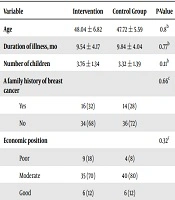
The mean age of patients in the intervention and control groups was 48.04 and 47.72, respectively. Most participants in both control (72%) and intervention (68%) groups had no family history of breast cancer. There was no statistically significant difference between the two groups concerning demographic variables (P > 0.05) (Table 2).
Table 2.
The Demographic Characteristics of Participants in the Two Groupsa
| Variable | Intervention | Control Group | P-Value |
|---|---|---|---|
| Age | 48.04 ± 6.82 | 47.72 ± 5.59 | 0.8b |
| Duration of illness, mo | 9.54 ± 4.17 | 9.84 ± 4.04 | 0.77b |
| Number of children | 3.76 ± 1.34 | 3.32 ± 1.39 | 0.11b |
| A family history of breast cancer | 0.66c | ||
| Yes | 16 (32) | 14 (28) | |
| No | 34 (68) | 36 (72) | |
| Economic position | 0.32c | ||
| Poor | 9 (18) | 4 (8) | |
| Moderate | 35 (70) | 40 (80) | |
| Good | 6 (12) | 6 (12) | |
| Education | 0.96c | ||
| Elementary school | 11 (22) | 10 (20) | |
| Middle school | 25 (50) | 26 (52) | |
| Diploma and higher | 14 (28) | 14 (24) | |
| A history of surgery | 0.84c | ||
| Yes | 25 (50) | 23 (46) | |
| No | 25 (50) | 27 (54) |
aValuea are expressed as mean ± SD.
bIndependent samples t-test.
cChi-square test.
According to the results, the mean score of happiness for patients in the intervention group increased from 70.68 ± 13.98 to 76.46 ± 11.86 after providing the intervention. Besides, the mean score of happiness for patients in the control group was 68.62 ± 13.98 before the study and decreased to 66.04 ± 12.76 after the study. The results of the independent samples t-test revealed no significant difference concerning the mean scores of happiness between the two groups before providing the intervention (P = 0.55). However, there were significant differences in the mean scores of happiness between the two groups after providing the intervention (P = 0.001). Furthermore, the results of the paired samples t-test showed that the mean scores of happiness for the participants in the intervention group increased significantly compared to their score before the intervention (P = 0.001), In contrast, a significant decrease was found in the mean score of happiness reported by the participants in the control group after providing the intervention compared to their happiness scores in the pre-intervention stage (P = 0.004) (Table 3).
Table 3.
A Comparison of the Mean Scores of Happiness in the Two Groups Before and After the Intervention
| Group | Stage | Pa | ||
|---|---|---|---|---|
| Pre-intervention, Mean ± SD | Post-intervention, Mean ± SD | Changes, Mean ± SD | ||
| Intervention | 70.68 ± 13.98 | 76.46 ± 11.86 | 5.78 ± 6.94 | 0.001 |
| Control | 68.62 ± 13.98 | 66.04 ± 12.76 | -2.58 ± 6.06 | 0.004 |
| Pb | 0.55 | 0.001 | 0.001 | |
aPaired samples t-test.
bIndependent samples t-test.
5. Discussion
The present study explored the effect of hope therapy training on happiness in women with breast cancer referred to the chemotherapy wards of two hospitals affiliated to the Zahedan University of Medical Sciences (Iran). The findings pointed to the effectiveness of hope therapy-based training on happiness in women with breast cancer. This finding was consistent with the results of previous studies. For instance, Farnia et al. (17) investigated the effectiveness of group hope therapy on the happiness of hemodialysis patients and showed that group-based hope therapy could increase happiness in dialysis patients. In another study, Mirzazadeh et al. (27) examined the effect of creativity therapy in promoting hope and happiness in women with breast cancer and showed that providing purposeful programs can promote hope and happiness in these patients. Furthermore, Sheykholeslami et al. (19) explored the effectiveness of hope therapy on the happiness of physically disabled men and reported that hope therapy could increase happiness in these patients. Motamedi et al. (28), who studied the community of the elderly, showed that group-based hope therapy was effective in increasing happiness and QoL in elderly women. Sotodehasl et al. (29) also examined the effect of hope therapy on the QoL of patients dependent on methadone maintenance treatment and showed that hope therapy was effective in improving the QoL of patients. It seems that hope therapy-based interventions, due to their steps and dynamics, have a positive effect on various psychological variables such as happiness and vitality.
Concerning the effectiveness of psychological therapies such as hope therapy, it can be argued that this intervention increases individuals’ positive self-concept and encourages them to actualize their positive potentials. This can increase hope for cancer patients who see themselves at the end of life and offer them a form of palliative care. In a similar vein, Dehghani et al. (25) evaluated the effectiveness of group-based hope therapy on the QoL and resilience of addicted women and showed that this intervention could increase hope and QoL of the participants, leading to increased self-confidence and encouraging the actualization of their potentially positive abilities. Ahmadian et al. (30) examined the effect of stress management training on reducing anxiety and promoting happiness and sexual intimacy in women with breast cancer and showed that psychological interventions, such as stress management and training, not only could reduce patients’ anxiety but also increased their happiness and sexual intimacy. Gonzalez-Hernandez et al. (31) examined the effect of compassion-based therapy on patients undergoing treatment for breast cancer and showed that psychological therapies play an important role in helping patients in accepting the disease. They also reported that the intervention increased their self-compassion and control over stress in cancer treatment (31). Manouchehri et al. (32) examined the effectiveness of hope therapy training on the use of positive strategies to cope with stress and showed that hope therapy training is one of the methods used to deal with stress.
Another notable finding of the present study was that the patients in the control group, who received only routine interventions, had a significantly lower happiness score at the end of the study. This finding implies that if the mental health of breast cancer patients is not taken into account, they will remain in a sad mood in the grieving process, which may complicate the treatment process (10).
One of the limitations of the present study was that the research sample did not include patients with disease metastasis, which probably has affected our results. Therefore, caution should be exercised in generalizing the results to patients with metastasis.
5.1. Conclusions
This study demonstrated that hope therapy training was effective in increasing happiness in women with breast cancer. Given that patients with breast cancer undergoing chemotherapy experience physical and psychological problems associated with the disease, hope therapy training can affect other psychological variables and promote hope in these patients. Accordingly, this training intervention can be incorporated into the care program implemented for these patients.