1. Background
Sometimes people actively get the needed information by searching information sources in the library, Internet, and reading magazines and newspapers. Sometimes they also seek information indirectly from their friends or the mass media such as radio and television. Health information, if documented and reliable, can help individuals in promoting and maintaining their health, especially in the diseases prevention (1).
Health information seeking behavior (HISB) is one of the areas of interest for both information science specialists and healthcare specialists. In the first view, technical issues and effective factors of HISB are considered. In the second view, information seeking behavior is a part of the issue of health literacy, meaning the capacity of the people to obtain, interpret and understand the basic health information and services necessary for decision making (2).
Improving the level of health is one of the important factors in promoting women's health (3). According to health statistics, women are more vulnerable to disease than men, and in addition to biological and physical characteristics, they are more affected by cultural, social, economic and political factors than men. For example, women are more vulnerable than men to HIV infection. Although life expectancy of women is more than men, physical diseases, especially non-fatal acute and chronic illnesses, and self-medication are more common in women than men (4). The most common diseases of women are osteoporosis, and cancers of the ovary, breast, and uterus. Middle age is the most traumatic period in a woman's life, during which many conditions such as menopause and a wide range of diseases occur. Providing education to inform women, as well as the availability of valid health information, helps women to identify and prevent various diseases (5).
In this regard, using simple and understandable language, targeting and repeating the information, using images and illustrations, encouraging women to ask questions, and finally using simple and understandable media, are effective strategies to promote health literacy (6).
The benefits of women's health literacy affect all life activities at home, work, and the community. It can also improve the quality of life of individuals and thus lead to equity and constant changes in public health (7). In other words, health literacy is an important element in a woman's ability to engage in health promotion and disease prevention activities for herself and her family (8). In the last two decades, researchers have focused more on the health information seeking (9-17). It seems that due to the organizational affiliations of researchers, most of them have paid attention to the study of their accessible communities (10, 18-22).
2. Objectives
The present study was conducted to investigate the health information seeking behavior of women aged 30 to 50 years in Kermanshah.
3. Methods
This was an applied descriptive-survey study. The statistical population according to the Iranian population and housing census in 2016, was 159822 women aged 30 to 50 years in Kermanshah and the sample size based on Cochran's formula was 383 people.
A researcher-made questionnaire was used to collect the data. The research questionnaire consisted of 30 questions, which evaluated information sources including doctors, print sources, national media, internet sources, social networks, and people around, in addition to demographic components. The five-point Likert scale was used to rating question from very low to very high.
Due to the outbreak of COVID-19, the questionnaire was distributed electronically in the spring of 2021. Accordingly, the link of the questionnaire was shared through the channels of Telegram social network for women. The validity of the questionnaire was confirmed by a panel of experts consisting of information and communication science specialists. Its reliability was also confirmed through Cronbach's alpha coefficient of 0.783. Data were analyzed using one-way analysis of variance (ANOVA) and independent t-test in SPSS software version 24.
4. Results
Table 1 shows the frequency and distribution of respondents in terms of demographic variables. The majority of participants (79.4%) were married. bachelor's degree was the most common among women (35%), and only 2.8% had a doctorate or higher.
Also, the monthly household income in 41% of respondents was 30 to 40 million Rial. More information about demographic is presented in Table 1.
Table 1.
Frequency and Distribution of Respondents According to Demographic Variables
| Variables | No. (%) |
|---|---|
| Marital status | |
| Married | 304 (79.4) |
| Non-married | 79 (20.6) |
| Monthly household income (million Rials) | |
| 20 - 30 | 56 (14.6) |
| 30 - 40 | 157 (41) |
| 40 - 50 | 113 (29.5) |
| More than 50 | 57 (14.9) |
| Education | |
| Under diploma | 53 (13.8) |
| Diploma | 86 (22.5) |
| Associate Degree | 32 (8.4) |
| Bachelor | 134 (35) |
| Master of science | 67 (17.5) |
| Doctorate | 11 (2.8) |
| Total | 383 (100) |
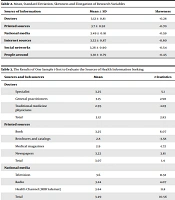
Table 2 shows that among the health information sources, the highest average scores belonged to Internet sources, national media, the people around, social networks, doctors, and printed sources, respectively. Also, the average of all variables was greater than the mean amount (i.e., 3). Finally, the skewness index for all variables was in the range of (-2, +2) and their elongation index was in the range of (-3, +3).
Table 2.
Mean, Standard Deviation, Skewness and Elongation of Research Variables
| Source of Information | Mean ± SD | Skewness | Elongation |
|---|---|---|---|
| Doctors | 3.12 ± 0.81 | -0.28 | 0.28 |
| Printed sources | 3.7 ± 0.92 | -0.70 | -0.11 |
| National media | 3.49 ± 0.91 | -0.59 | 0.33 |
| Internet sources | 3.52 ± 0.87 | -0.60 | 0.30 |
| Social networks | 3.26 ± 0.90 | -0.54 | 0.29 |
| People around | 3.38 ± 0.79 | -0.45 | 0.85 |
In the analytical section, the distribution of research variables was first tested using two indices of skewness and elongation. Then the research questions were answered. The results of one sample t-test to answer the research questions are provided in Table 3.
Table 3.
The Results of One Sample t-Test to Evaluate the Sources of Health Information Seeking
| Sources and Sub-sources | Mean | t-Statistics | P-Value |
|---|---|---|---|
| Doctors | |||
| Specialist | 3.25 | 5.1 | 0.001 |
| General practitioners | 3.15 | 2.98 | 0.003 |
| Traditional medicine physicians | 2.95 | -1.03 | 0.303 |
| Total | 3.12 | 2.83 | 0.005 |
| Printed sources | |||
| Book | 3.25 | 6.07 | 0.001 |
| Brochures and catalogs | 2.8 | -3.58 | 0.001 |
| Medical magazines | 2.9 | -1.72 | 0.086 |
| Newspapers | 3.22 | 3.81 | 0.001 |
| Total | 3.07 | 1.4 | 0.164 |
| National media | |||
| Television | 3.6 | 11.32 | 0.001 |
| Radio | 3.24 | 4.07 | 0.001 |
| Health Channel (IRIB Salamat) | 3.64 | 11.8 | 0.001 |
| Total | 3.49 | 10.56 | 0.001 |
| Internet sources | |||
| Website | 3.74 | 13.78 | 0.001 |
| Blogs | 3.21 | 3.94 | 0.001 |
| Databases | 3.59 | 9.62 | 0.001 |
| Total | 3.52 | 11.58 | 0.001 |
| Social networks | |||
| Telegram | 3.67 | 11.04 | 0.001 |
| 3.01 | 0.145 | 0.885 | |
| 3.09 | 1.76 | 0.079 | |
| People around | |||
| Family members | 4.04 | 19.84 | 0.001 |
| Colleagues | 3.17 | 3.32 | 0.001 |
| Friends | 3.15 | 2.83 | 0.005 |
| Relatives | 3.16 | 3.22 | 0.001 |
| Total | 3.38 | 9.44 | 0.001 |
Question 1: To what extent do women in Kermanshah use doctors to obtain their health information? As can be seen in Table 3, among the sources of health information related to doctors, the highest average belonged to specialists.
Question 2: To what extent do women in Kermanshah use print resources to obtain their health information? According to the Table 3, among the printed sources of health information, the highest average score belonged to books and newspapers, respectively, which were higher than the total average.
Question 3: How much do women in Kermanshah city use national media for acquiring their health information? As shown in Table 3, among the sources of health information from national media, the highest average belonged to the health channel which is known as Shabake Salamat in Iran, and national television and radio were in the next places, respectively.
Question 4: To what extent do women in Kermanshah use Internet resources to obtain their health information? According to the results presented in Table 3, among the Internet sources of health information, the highest average score was related to the website. Related databases and blogs were ranked next, respectively.
Question 5: To what extent do women in Kermanshah use social networks to obtain their health information? According to Table 3, among the social networks for health information seeking, the highest and significant average belonged to Telegram.
Question 6: To what extent do women in Kermanshah use people around them to obtain their health information? As shown in Table 3 among the sources of seeking health information in people around, the highest average belonged to family members.
The result of one sample t-test to answer the question that what is the purpose of seeking health information by women in Kermanshah is provided in Table 4. According to the results, knowing the type of diseases, knowing the methods of treating the diseases, knowing the methods of preventing the diseases, knowing how taking medicine, and knowing their health status were the most important goals of seeking health information in participants.
Table 4.
The Aim of Looking for Health Information
| Goals | Mean | t-Statistics | P-Value |
|---|---|---|---|
| Knowing the type of diseases | 3.92 | 17.88 | 0.001 |
| Knowing the methods of treating the diseases | 3.88 | 15.38 | 0.001 |
| Knowing the methods of preventing the diseases | 3.62 | 11.03 | 0.001 |
| Knowing how taking medicine | 3.54 | 10.01 | 0.001 |
| Knowing their health status | 3.25 | 5.04 | 0.001 |
Question 8: Is there a significant difference between seeking health information and demographic variables in Kermanshah women? The results of independent t-test and one-way ANOVA presented in Table 5 revealed that there was no significant difference between seeking health information among women in Kermanshah at different levels of demographic variables.
Table 5.
Status of Health Information Seeking According to the Demographic Variables
| Variation | t-Statistics | P-Value |
|---|---|---|
| Marital status | -1.29 | 0.20 |
| Education level | 0.90 | 0.48 |
| Monthly household income | 0.69 | 0.56 |
5. Discussion
This study aimed to investigate the HISB of women aged 30 to 50 years in Kermanshah. The results of the study showed that the main purpose of seeking health information in participants was knowing the type of diseases. Also, among the sources of health information, the most used were Internet sources, national media, people around, social networks, doctors, and printed sources, respectively.
Previous studies (9, 10, 17, 21, 23), have shown that people have searched for their health information more in Internet sources, which is consistent with the findings of this study.
Among the national media, the most use belonged to the health channel (Shabake Salamat). A study in South Korea (24) reported that people used radio more than other national media to receive health information, which is inconsistent with this study. The results of a systematic review (18) showed that people used television as the most common source of health information, consistent with a part of this study.
In the present study, family members were the most important source of acquiring health information among the people around. The results of a study showed that people received health information from their family and relatives (13), which is consistent with the results of this study.
Among the social networks, Telegram was the most used, consistent with other studies outside Iran (17, 25).
In the present study, among doctors, specialists were the most common source of seeking health information for women, consistent with the findings of a study in college students (11). Also, a study in elderly emphasized the effective role of doctors as a source of health information (12), consistent with this part of results.
Among the printed sources, books were the most used and brochures and catalogs were the least used was for obtaining health information, consistent with the results of other studies (16, 22, 24).
Among the goals of seeking health information in women, knowing the type and symptom of diseases has been the most frequent goal. Considering the spread of COVID-19 at the time of the present study, changing lifestyle, fear from the disease, and having some symptoms, this goal is justified for people. Previous studies have reported that most of the information searched was about treatment of diseases and personal health (13, 22, 26), which do not match the results of this section.
There was no significant difference in seeking health information according to demographic variables such as marital status, education level, income level and area of residence, consistent with the result of a study in college students (11). Inconsistently, in other studies (10, 15), age and level of education were related to seeking health information.
5.1. Conclusion
The main purpose of women of Kermanshah for health information seeking behavior was to know the type of diseases. Among the health information sources, the most use belonged to Internet sources (website), national media (health channel), people around (family members), social networks (telegram), doctors (specialists), and printed sources (books).
5.2. Limitations
Due to the Covid-19 pandemic, the samples were collected only from some Telegram channels and therefore, it may not be the exact representative of women living in Kermanshah Province.