1. Background
Low back pain is a disorder that affects the muscles, bones, and tissues of the lower back region (1). It is a condition that has received significant attention from researchers, as it can lead to disability more than other musculoskeletal disorders (2). Chronic low back pain is a type of pain in the lumbar and sacral region, which can radiate to other parts of the body. It can also result in abnormal movements of the spinal column. Among conservative treatments, therapeutic exercise, Mulligan, taping therapy, massage, and stretching are commonly used (3). Many women suffer from low back pain each year, and among the reasons for low back pain in women, anatomical factors and hormonal imbalances, such as menopause, are significant (4)
Research has shown that low back pain is often associated with movement-related factors, including muscle stiffness, muscle shortening, reduced muscle endurance, and strength (5). Repetitive, compensatory, and repetitive movements in the pelvic region can lead to increased mechanical loads on the lumbar vertebrae, resulting in increased pressure on muscles and the development of lumbar pathologies (6). Additionally, decreased or incorrect muscle flexibility can lead to changes in load distribution in the lumbar vertebrae, contributing to low back pain development (6). Extra movements can lead to additional mechanical loads on the lumbar spine, eventually causing muscle strain and lumbar pathologies (7). This is why the study of low back pain and the evaluation of the impact of various interventions on it are essential. Among various non-invasive treatments, Pilates exercise has received special attention due to its focus on recovery, correction of musculoskeletal disorders, and movement rehabilitation (8). Pilates exercise emphasizes the strengthening and stability of core muscles, as well as the flexibility and stability of the lower back muscles (9). Mulligan techniques, on the other hand, are a type of manual therapy that aims to provide rapid pain relief and increased range of motion. These techniques include passive joint mobilization by a therapist and active patient movements (10) one of the significant advantages of using Mulligan methods is the active involvement of the patient in the mobilization process, allowing for pain relief during treatment (11). Additionally, Kinesiotaping can be employed to suppress pain and correct biomechanical abnormalities (12). Kinesiotaping in the lumbar region can serve as a cost-effective method for correcting altered posture, reducing pain, supporting non-active lumbar and pelvic mechanics, and effectively contributing to the treatment of low back pain (13). The promotion of combined models, such as Pilates with Kinesiotaping, with the aim of stability, strength enhancement, muscle endurance, neural-muscular coordination improvement, and joint mobilization for less mobile joints, can significantly improve women's health, reduce treatment costs, enhance the productivity of employees, and improve the well-being of housewives (8).
2. Objectives
Therefore, the present study is conducted with the aim of comparing the effects of combined Pilates-Kinesio tape and Mulligan- Kinesio tape exercises on pain, hamstring muscle tightness, lumbar range of motion, and pelvic rotation in women with non-specific chronic low back pain.
3. Methods
3.1. Study Design and Participants
The current research method was semi-experimental with a pre-test and post-test design, which was implemented with two experimental groups. Using G.power software and assuming α = 0.05, effect size = 0.62 and β-1 = 0.90, 30 eligible women (35 - 65 years old) participated, and randomly in two groups were divided Pilates-Kinesio Tape-Sacral Lumbosacral Taping (n = 15) and Mulligan- Kinesio Tape-Sacral Lumbosacral Taping (n = 15) via a computer-generated permuted block randomization scheme. The criteria for entering the research included at least 12 weeks of continuous back pain, age range of 35 - 65 years, pain intensity on our visual pain scale between 3 - 6, sensitivity when bending forward (14). Also, the exclusion criteria from the research included pregnancy, referral of pain below the knee, canal stenosis, disc, inflammation, tumor, fractures, history of spine surgery, arthridromatoid, osteoporosis, people who do manual therapy (15).After completing the informed consent and data collection forms, participants were enrolled in the study.
3.2. Procedures
In the first session, participants were introduced to Pilate's principles such as breathing, concentration, core stability, smooth execution of movements, maintaining proper spinal and pelvic alignment during movements. The exercises included cat stretch, roll-up, hundred, saw, shoulder bridge, single-leg stretch, swimming, four-point kneeling, spinal extension, standing roll-down, warm-up for 10 minutes, and cool-down for 10 minutes. Initially, 6 - 8 repetitions were performed in the early sessions, which increased to 10 - 12 repetitions in later sessions. The speed of movements was coordinated with the movement rhythm (16).In Mulligan-Kinesio tape sessions, participants performed a 10-minute warm-up at the beginning and a 10-minute cool-down at the end of the session. Mulligan techniques included natural glide sustained accessory joint mobilization (SNAG) and stretching exercises with flexed knee (BLR Mulligan) which started with 3 repetitions in early sessions and increased to 10 repetitions in later sessions (17). Baseline testing included measurements of weight and height, and tests measuring pain, hip rotation, hamstring range of motion, and low back pain range of motion, as described below.
3.3. Mulligan: Natural Glide Sustained Accessory Joint Mobilization (SNAG)
Participants were asked to perform active movements of flexion, extension, and rotation of the lumbar vertebrae to determine which movement, when applied as passive movement to the vertebrae, causes the most pain. In the next step, participants were positioned in a way that their feet were on a specialized base. One part of the Mulligan belt was placed on the ASIS of the participant, and the other part of the belt was positioned on the hip and buttocks area of the therapist. The therapist's hypothenar area was placed on the lateral processes of the L4 lumbar vertebrae for joint mobility parallel to the plane of fast joints (cranial direction). Participants were asked to perform the forward bending movement when the therapist simultaneously applied force. After reaching the end of the range of forward bending, participants were asked to return to the initial position for maintaining cranial therapist mobility until the participant returned to the initial position. During the Mulligan technique, the participant should not feel pain (18).
3.4. Kinesio Taping
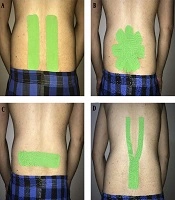
Taping was applied to the area of low back pain in the sacral region for both groups. Initially, a kinesiology tape allergy test was performed on the skin of all participants. In the second step, participants were fully bent forward to put the lumbar-sacral area in tension. Two tapes, approximately 30 cm in length, were attached longitudinally parallel to the spinal column and about 2 cm away from the vertebrae from the PSIS towards the top without stretching. Another two tapes, approximately 20 cm in length, were applied horizontally and star-shaped with a minimum of 50% tension to the painful area and participants were asked to keep the taped area on the lumbopelvic region for 3 days (19).
3.5. Statistical Analysis
The Shapiro-Wilk test was used to investigate the normality of data distribution; Thus, analysis of covariance (ANCOVA) test was used to analyze the data. Statistical tests were performed with SPSS version 26 software, and the significance level for all tests was considered P ≤ 0.05.
4. Results
The demographic characteristics of the participants (age, height, weight) are presented in Table 1.
Table 1.
Anthropometric Characteristics of the Participants a
| Variables | Pilates-Kinesio Tape (N = 15) | Mulligan-Kinesio Tape (N = 15) |
|---|---|---|
| Weight (kg) | 71.02 ± 5.91 | 69.88 ± 4.57 |
| Age (y) | 49.50 ± 8.66 | 47.00 ± 8.76 |
| Height (cm) | 162.76 ± 4.76 | 160.27 ± 5.32 |
| Body Mass Index (BMI) | 27.06 ± 2.17 | 27.29 ± 2.02 |
a Values are expressed as Mean ± SD.
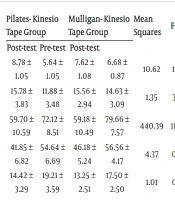
The results of covariance analysis showed that there is a significant difference between the effect of Pilates-Kinesiotype exercise and Mulligan Kinesiotype exercise in the variables of pain, hamstring stiffness and hip rotation (P < 0.05). Also, comparisons between pairs of groups showed that the reduction of pain and hip rotation in the Pilates-Kinesiotype training group was better than in the Mulligan-Kinesiotype group. But the hamstring range of motion (hamstring stiffness) was better in the Mulligan-Kinesiotype group than in the Pilates-Kinesiotype group. In addition, the results showed that there is no significant difference between the waist range of motion of the research groups (P > 0.05) (Table 2).
Table 2.
ANCOVA Test Results
| Variables | Pilates- Kinesio Tape Group | Mulligan- Kinesio Tape Group | Mean Squares | F | P | Eta Coefficient | ||
|---|---|---|---|---|---|---|---|---|
| Pre-test | Post-test | Pre-test | Post-test | |||||
| Pain (cm) | 8.78 ± 1.05 | 5.64 ± 1.05 | 7.62 ± 1.08 | 6.68 ± 0.87 | 10.62 | 11.91 | 0.023* | 0.31 |
| Hip Rotation (°) | 15.78 ± 3.83 | 11.88 ± 3.48 | 15.56 ± 2.94 | 14.63 ± 3.09 | 1.35 | 3.55 | 0.013* | 0.66 |
| Hamstring Range of Motion (°) | 59.70 ± 10.59 | 72.12 ± 8.51 | 59.18 ± 10.49 | 79.66 ± 7.57 | 440.39 | 11.04 | 0.019* | 0.21 |
| Forward Bending; Range of Motion (°) | 41.85 ± 6.82 | 54.64 ± 6.69 | 46.18 ± 5.24 | 56.56 ± 4.17 | 4.37 | 0.28 | 0.601 | 0.01 |
| Backward Bending; Range of Motion (°) | 14.42 ± 3.29 | 19.21 ± 3.59 | 13.25 ± 2.51 | 17.50 ± 2.50 | 1.01 | 0.53 | 0.473 | 0.02 |
| Lateral bending range of motion (°) | 26.64 ± 1.69 | 31.51 ± 2.05 | 26.37 ± 1.40 | 31.25 ± 2.26 | 5.91 | 0.46 | 0.506 | 0.02 |
| Lumbar rotation (°) | 12.85 ± 1.02 | 14.35 ± 0.63 | 12.81 ± 1.10 | 14.61 ± 0.61 | 0.25 | 0.75 | 0.351 | 0.03 |
Results of the analysis of covariance (ANCOVA) for comparing the two groups, Pilates- Kinesio tape and Mulligan- Kinesio tape, in the variables of pain, hip rotation, range of motion (hamstring-flexion, extension, lateral), and lumbar rotation (Table 2).
5. Discussion
The results of the current research showed that there is a significant difference in the effectiveness of Pilate's exercises with Kinesio tape and Mulligan protocols on nonspecific chronic low back pain in women (P < 0.05). It was also found that the Pilates- Kinesio tape group with a higher mean had better pain relief compared to the Mulligan- Kinesio tape group, which is consistent with the results of previous studies, including Reid et al. (20), Hayden et al. (21), Elgohary et al. (22), Lee et al. (23), Schmidt et al. (24), and the findings of the research by Pereira et al. (25).
Pilates exercise places a strong emphasis on maintaining the correct alignment of the spine and balances the forces acting on the body by normalizing the length and strength of body parts. This helps reduce abnormal pressures that lead to pain. Women with nonspecific low back dysfunction often have various movement restrictions, which affect their ability to perform daily routines. Impaired movement function can lead to disability and pain, as ineffective or inhibited muscles may disrupt movement coordination (26) the most important Pilates exercises include core stability exercises and proprioceptive exercises. Core stability exercises increase the proprioception of the lumbar pelvic region and enhance balance. The transverse abdominis muscle, which plays a significant role in controlling lumbo-pelvic stability, helps in controlling the stability of the lumbar area. As a critical feature, these stabilizing maneuvers can involve localized muscles with 10 - 20% of voluntary contractions. However, performing these maneuvers at higher levels of contraction can inhibit local muscles and activate global muscles. The abdominal cavity can be considered as a cylinder connecting the legs to the chest. As the muscles of the abdominal and pelvic region become stronger, the body's core stability increases, leading to increased intra-abdominal pressure and enhanced lumbo-pelvic stability, which can reduce pain (21).
Furthermore, Mulligan's SNAG technique improves the range of motion of the lumbar spine joint, eliminates pain, reduces joint dysfunction, and affects sympathetic activity. It has been shown that continuous tension on the capsule and structures surrounding the joint limits it. The use of the Mulligan SNAG technique releases the tension in the joint capsule, thus significantly improving the mobility of the lumbar spine vertebrae (27). Therefore, it can be said that Pilate's exercises, which include exercises to increase the range of motion of the joints, flexibility exercises, and joint mobility exercises, have a positive effect on the range of motion of the lumbar spine in women with chronic non-specific low back pain.
Kinesiotherapy affects the biomechanical properties and muscle function of muscle fiber structure and has a positive effect on increasing the range of motion (7). Based on the findings, it became clear that there is a significant difference in the effectiveness of Pilates exercises with kinesiotherapy and Mulligan on the rotation of the pelvis in women with chronic non-specific low back pain (P < 0.05). It was also found that the Pilates-Kinesiotherapy group had a higher average reduction in pelvic rotation compared to the Mulligan-Kinesiotherapy group, which is consistent with the results obtained in this study (7, 28, 29).
Jung et al. found that the activity of the internal/external oblique abdominal muscles was highest during leg flexion. Also, the activity of the serratus anterior muscle was significantly higher during leg flexion compared to shoulder blade protraction and swimming (7). There was no significant difference in the multifidus activity between swimming and kicking exercises. The pelvis angle during leg flexion was the smallest, and during standing flexion, it was the largest. Since the backward leg kick movement is performed on the stomach, both elbows, lower limbs, and pelvis are supported on the mat, making it the most stable base. However, standing flexion creates more instability as it has a smaller base of support than other Pilate's exercises, which may increase pelvic rotation by adding hip extension. In this study, many exercises, including bilateral leg kicks from the back in the deep flexion, bridge, star in the deep flexion, and single-leg stretch in the deep flexion, were designed to reduce pelvic rotation, ultimately proving more effective than the Mulligan technique in reducing pelvic rotation (7).
Individuals with non-specific low back pain dysfunction often have improper alignment of the spine and pelvis. Since pelvic alignment is related to the balance between the paired forces of hip flexor muscles and extensor muscles, along with the paired forces of abdominal muscles and hamstrings, Pilates, with its integrated and cohesive exercises, can be more effective in correcting pelvic rotation than the Mulligan technique. Pilates places a strong emphasis on maintaining proper spinal alignment and pelvic stability and control by normalizing the length and strength of various muscle groups. It corrects pelvic tilts and rotations. Pilates, through proper alignment of the pelvis and by increasing stability and lumbar control, reduces pelvic rotations. Additionally, kinesiotherapy has a positive impact on pelvic tilt and lateral angles and has a positive effect on pain in the SIJ (Sacroiliac Joint) and mid-buttock region (29).The results of Preece et al. (29) demonstrated an immediate reduction in anterior pelvic tilt after stretching the hip flexor muscles. While this suggests that the length of the hip flexor muscles may play a role in maintaining pelvic alignment in a standing position, there was a significant intra-individual variability in response to muscle stretching. In the present study, participants also included single-leg standing stretch exercises and deep sensory improvement exercises in their protocol, leading to a reduction in pelvic tilt. It appears that the temporary reduction in pelvic tilt in Stephen's study is due to the lack of exercises in the direction of improving deep sensory perception to maintain the reduction in tilt, similar to the Mulligan technique where exercises for improving deep sensory perception were not performed in this study (29).
Furthermore, since pelvic alignment is related to the balance between the paired forces of hip flexor and extensor muscles, as well as the paired forces of abdominal muscles and hamstrings, Pilates, with its integrated and cohesive exercises, was more effective than the Mulligan technique in reducing pelvic rotation in individuals with low back pain in this study (30).
We acknowledge that the current study had limitations that should be considered; The participants in this study were women, so these results may not be generalizable to everyone; And gender differences may play an important role in evaluated parameters.
5.1. Conclusions
In the present study, we investigated a comparison of combined pilates-kinesio tape and mulligan-kinesio tape exercises on pain, lumbar range of motion, hamstring strength, and pelvic rotation in women with Non-specific chronic low back pain. Due to the fact that mulligan and Pilate's exercises together with Kinesiotype have an effect on pain variables, hamstring stiffness and hip rotation, and each of mulligan and Pilate's exercises have different effectiveness. These exercises can be used in combination with Kinesiotype to help women with non-specific chronic back pain.