


1. Background
Volleyball, one of the world's most popular sports with over 800 million participants, ranks second only to football and is recognized as a favorite sport in more than 130 countries (1). This sport is played at various levels, from six-a-side indoor teams to two-person outdoor teams. Due to its explosive nature and demands for power, technique, and flexibility, volleyball poses challenges for athletes. Although generally perceived as safer compared to other contact team sports, it still carries risks of various injuries (2, 3). Despite being a non-contact sport, volleyball has been identified as the fourth most injury-prone sport in terms of injury prevalence.
Research has shown that the incidence rate of acute injuries in volleyball ranges between 2.6 and 3.8 injuries per 1,000 hours of play, with common injuries typically affecting the fingers, ankles, and knees (1, 4). In addition to acute injuries, overuse injuries are also prevalent among elite players, particularly in the shoulder, lower back, and knees (5, 6). These injuries not only result in physical consequences for the athletes but may also negatively impact teams, healthcare systems, and society at large (7). Therefore, implementing injury prevention strategies in volleyball is essential to mitigate potential risks and manage the negative outcomes associated with these injuries.
Given the complexity of risk factors, designing effective prevention strategies requires a detailed understanding of the prevalence, mechanisms, and contributing factors of injuries. In this regard, van Mechelen et al.'s four-stage model for sports injury prevention serves as a comprehensive framework. According to this model, identifying the prevalence and risk factors (stages 1 and 2) forms the foundation for designing effective preventive interventions (8, 9).
Preventing and managing sports injuries necessitates a thorough understanding of the risk factors and predictors that influence their occurrence. Among these, neuromuscular asymmetry has emerged as one of the most significant biomechanical variables that increase athletes' vulnerability to injuries (10). This phenomenon is observed across a spectrum of sports, including asymmetrical sports like volleyball, basketball, and football, as well as symmetrical sports such as running and cycling. Evidence suggests that a considerable percentage of volleyball players (27 - 34%) exhibit neuromuscular asymmetry (10-13), placing them at an elevated risk of lower-limb injuries. Furthermore, studies have reported asymmetries in the strength of knee extensor muscles among volleyball players, ranging from 5.28% to 11.24%, which significantly contribute to injury susceptibility (11-13).
The importance of this research is highlighted for several reasons. In the field of sports injury prevention, particularly in volleyball, disagreements persist regarding the role of inter-limb asymmetry in functional tests such as the Y-balance test and single-leg hop as predictors of injuries (14-16). Despite numerous studies, significant gaps remain in investigating the impact of this asymmetry on the occurrence of sports injuries (14, 16). Volleyball, as a popular and high-risk sport, requires identifying risk factors to reduce injuries and enhance athletes' performance (17, 18). This study aims to provide novel insights that can assist coaches, sports medicine specialists, and physiotherapists in designing injury prevention programs based on functional test results, ultimately reducing the incidence of injuries. The innovation of this research lies in examining the relationship between functional asymmetry and sports injuries and utilizing functional tests in injury prevention, which can contribute to developing more effective protocols and directly impact the health and productivity of athletes.
2. Objectives
This study aims to explore the relationship between neuromuscular asymmetry and athletic identity and their influence on sports injuries in volleyball players. The hypothesis is that greater neuromuscular asymmetry and a stronger athletic identity will be associated with a higher risk of sports injuries. Additionally, the study seeks to identify factors that can inform the development of effective injury prevention strategies and improve athletic performance.
3. Methods
3.1. Study Design and Participants
This research is a prospective study conducted over nine months from 2023 to 2024 in Kermanshah. The study aimed to investigate predictors related to neuromuscular asymmetry and athletic identity in the occurrence of sports injuries in volleyball players and to analyze the relationship between these factors and sports injuries.
The participants consisted of 101 amateur and professional volleyball players, both male and female, from Kermanshah, aged between 18 and 45 years. They were purposefully selected between June and September 2023. These individuals regularly participated in volleyball practices and competitions and were categorized into two groups based on their competitive level: Amateur and professional.
Inclusion criteria required participants to be at least 18 years old, actively competing at a competitive level, and regularly involved in volleyball. Exclusion criteria included pregnancy, anterior cruciate ligament injury, joint surgery or replacement, and failure to complete the research questionnaires.
3.2. Baseline Assessments
An online questionnaire was designed based on previous studies using Google Forms to collect personal information, exercise routines, and injury history. The electronic questionnaire link was distributed to volleyball players through communication platforms such as WhatsApp, Telegram, Instagram, and email, allowing participants to complete it at their convenience.
The questionnaire gathered details including height, weight, playing level, playing position, training duration and frequency per week, warm-up practices, and use of protective equipment. It also included questions regarding injury history to obtain comprehensive data on previous injuries.
After completing the initial questionnaire, participants filled out a sports identity questionnaire. They then participated in tests to assess limb symmetry, including the single-leg hop for distance, the 90-degree change of direction test, and the Y-dynamic balance test for the lower limbs. These tests were conducted for both the dominant and non-dominant legs, with each leg being tested three times. The best performance from each test was used for statistical analysis.
Participants were subsequently informed that every two weeks, they would receive a link to a questionnaire for tracking and reporting sports injuries. They were required to complete this injury tracking form over a nine-month period. At the end of the data collection phase, all information was documented in relevant forms for use in the statistical analysis of the study.
3.2.1. Single Leg Hop for Distance Test
The single-leg hop for distance test is widely recommended as a functional performance indicator in research studies, as it evaluates the integrated effects of neuromuscular control, strength, and confidence in the injured limb. This test requires minimal time and equipment, making it practical for various settings.
During the test, the participant stands on one leg with their hands placed on their hips. Using an explosive and powerful jump, they leap forward, aiming to land stably on the same leg. To ensure a valid attempt, the individual must avoid using the other leg or any other body part for support. The distance between the starting line and the point where the heel makes contact upon landing is measured and recorded as the test result (19).
Each participant performed the test three times on each leg, with the best result from the three attempts recorded for analysis.
3.2.2. 90-Degree Change of Direction Test
The 90-degree change of direction test is performed in a standing position in a sports hall, with one foot placed directly on the starting point. The test requires the athlete to cover a total distance of 10 meters. Initially, the participant runs 5 meters in a straight line, then executes a 90-degree turn around a cone, and finally sprints another 5 meters toward the finish line (Figure 1).
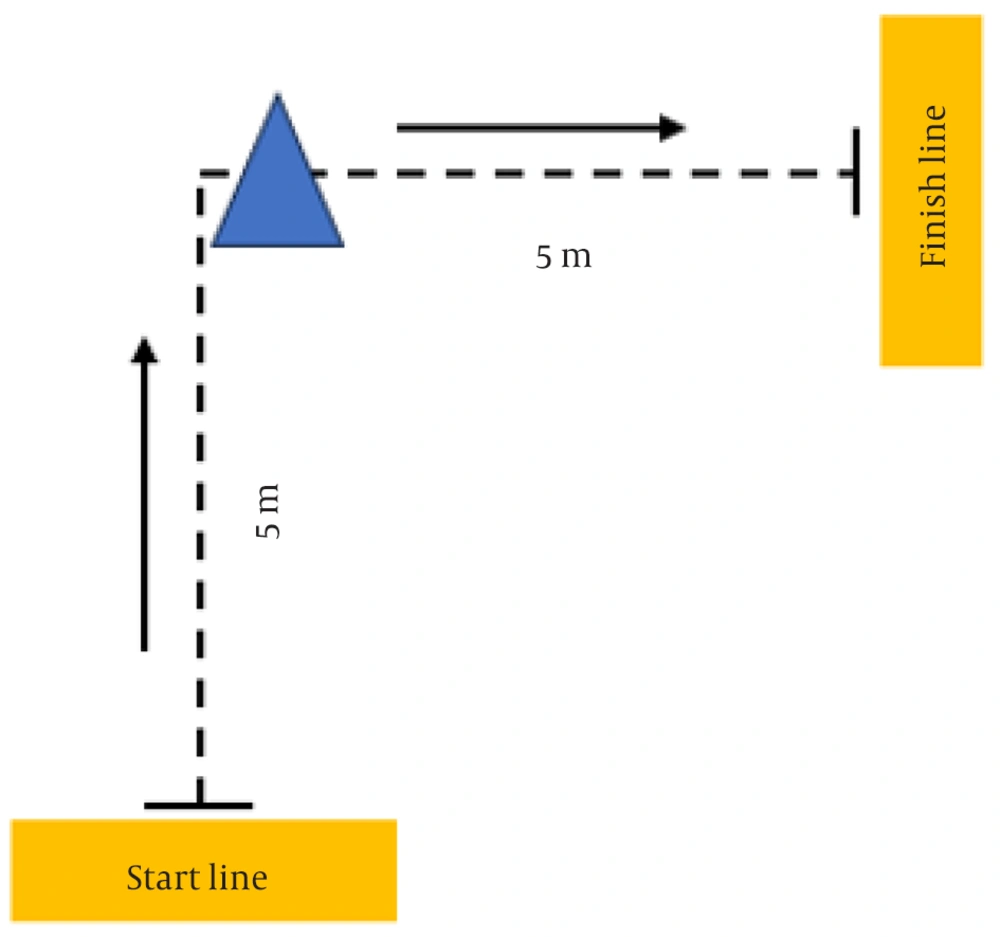
Figure 1.
90-degree change of direction test
This test is conducted for both the dominant and non-dominant legs, with each leg performing the test twice. The best performance from each trial is recorded for statistical analysis, ensuring reliability. A one-minute rest period is provided between each repetition to minimize fatigue (20).
3.2.3. Y Balance Test
The Y dynamic balance test for the lower limbs requires the participant to stand on one leg while reaching as far as possible with the other leg in three specific directions: Anterior, posterolateral, and posteromedial. These movements must be executed continuously without resting, and the weight-bearing foot must remain in contact with the ground throughout the test.
After completing all three directional reaches, the participant returns to a neutral standing position on both feet. The distance from the furthest foot contact point to the center of the test is measured in centimeters. Each participant performs the test three times in each direction, and the best recorded performance is used for statistical analysis (21).
3.3. Follow-up of Sports Injuries
In this study, sports injuries are recorded online using a pre-designed Google Form questionnaire. A sports injury is defined as any physical complaint experienced by a volleyball player as a result of participating in volleyball, regardless of whether medical attention is required or if it results in time lost from play.
Traumatic injuries are classified as those that occur suddenly due to a specific incident, whereas overuse injuries result from repetitive microtrauma without a clear identifiable cause. A player is considered injured until they receive medical clearance to return to training or competition (22).
3.4. Statistical Methods
Data analysis was performed using SPSS software, version 27, employing both descriptive and inferential statistical methods. Initially, an independent t-test and chi-square test were used to compare inter-limb symmetry in the Single Leg Hop, 90-degree change of direction, and Y dynamic balance tests between volleyball players who experienced injuries and those who did not.
To explore the relationship between these variables and sports injuries, univariate logistic regression analysis was applied. Assumptions for each test were verified, including normality for the t-test, independence for the chi-square test, and linearity for logistic regression. All statistical evaluations were conducted at a significance level of P ≤ 0.05.
4. Results
During the nine-month follow-up period, 38 out of 101 volleyball players (20.8%) sustained a total of 51 new injuries, averaging 1.34 injuries per player. The overall injury incidence rate during this period was 4.01 injuries per 1,000 hours of play, based on a total of 12,726 hours of practice and competition. Among these injuries, 56.7% were classified as acute, with an incidence rate of 2.28 injuries per 1,000 hours of play, while 43.3% were classified as overuse injuries, with a chronic injury incidence rate of 1.73 injuries per 1,000 hours of play.
The study found no significant differences between injured and non-injured volleyball players in demographic factors such as gender, age, height, weight, body mass index (BMI), sports experience, weekly training session frequency, and session duration (P > 0.05). However, a significant difference was observed in the history of previous injuries, with a higher percentage of injured players reporting past injuries compared to non-injured players (P = 0.04). Additionally, no significant difference was found regarding participation in other sports between the two groups (P > 0.05) (Table 1).
Table 1.Comparison of Participant Demographics Between Injured and Non-injured Groups
| Variables | Injured Volleyball Players (n = 38) | Non-injured Volleyball Players (n = 63) | Statistic | P-Value |
|---|---|---|---|---|
| Gender; No. (%) | ||||
| Female | 24 (63.2) | 38 (60.3) | χ2 = 0.29 | 0.82 |
| Male | 14 (36.8) | 25 (39.7) | ||
| Age (y) | 27.14 ± 9.33 | 27.66 ± 9.45 | t = 0.29 | 0.79 |
| Height (cm) | 182.78 ± 9.23 | 182.45 ± 10.99 | t = 0.15 | 0.89 |
| Weight (kg) | 71.56 ± 9.23 | 73.02 ± 10.84 | t = 0.67 | 0.50 |
| Body mass index (kg/m2) | 21.35 ± 1.75 | 21.93 ± 2.50 | t = 1.21 | 0.21 |
| Sport experience (y) | 9.36 ± 6.27 | 9.05 ± 6.36 | t = 0.24 | 0.80 |
| Weekly sessions (median, IQR) | 3 ± 1 | 4 ± 2 | Z = 0.92 | 0.36 |
| Session duration (minutes/session); (median, IQR) | 60 ± 15 | 60 ± 15 | Z = 0.62 | 0.53 |
| Participation in other sports (yes) | 18 (47.4) | 24 (38.1) | χ2 = 3.13 | 0.10 |
| Previous injury history (yes) | 16 (42.1) | 14 (22.2) | χ2 = 4.21 | 0.04 |
The comparison of results between injured and non-injured volleyball players revealed that in the single-leg hop for distance test, limb differences were significantly greater in the injured group (P = 0.02), but no significant difference was found in the percentage of asymmetry (P = 0.11). In the 90-degree change of direction test, there were no significant differences in either limb difference or asymmetry (P = 0.13 and P = 0.11). In the Y-dynamic balance test, no significant limb differences were observed across positions (P = 0.06 to P = 0.30), but the percentage of asymmetry was significantly higher in the injured group in the anterior position (P = 0.04). No significant differences were found in the posterolateral and posteromedial positions (P = 0.12 and P = 0.06). These findings suggest that specific tests and positions may be more effective in identifying injury-related asymmetries (Table 2).
Table 2.Comparison of Inter-limb Asymmetry in Single-Leg Hop, 90-Degree Change of Direction, and Y-Dynamic Balance Tests Between Injured and Non-injured Volleyball Players
| Variables | Injured (n = 38) | Non-injured (n = 63) | Statistic | P-Value |
|---|---|---|---|---|
| Single-leg hop for distance (cm) | ||||
| Limb difference | 11.73 ± 1.4 | 9.11 ± 1.4 | 2.30 | 0.02 |
| Percentage of asymmetry between limbs | 5.6 ± 1.2 | 5.2 ± 2.4 | 1.59 | 0.11 |
| 90-degree change of direction (seconds) | ||||
| Limb difference | 0.43 ± 0.32 | 0.31 ± 0.25 | 1.54 | 0.13 |
| Percentage of asymmetry between limbs | 14.7 ± 2.12 | 10.5 ± 8.8 | 1.59 | 0.11 |
| Y-dynamic balance (cm) | ||||
| Anterior direction | ||||
| Limb difference | 5.2 ± 2.5 | 3.8 ± 3.7 | 1.90 | 0.06 |
| Percentage of asymmetry between limbs | 7.1 ± 3.3 | 3.6 ± 0.5 | 2.42 | 0.04 |
| Posterolateral direction | ||||
| Limb difference | 7.4 ± 4.0 | 6.3 ± 3.6 | 1.12 | 0.30 |
| Percentage of asymmetry between limbs | 7.6 ± 2.8 | 6.4 ± 4.4 | 1.25 | 0.25 |
| Posteromedial direction | ||||
| Limb difference | 5.7 ± 3.9 | 4.7 ± 4.4 | 1.42 | 0.16 |
| Percentage of asymmetry between limbs | 7.5 ± 2.9 | 4.2 ± 4.4 | 1.92 | 0.06 |
Logistic regression analysis indicated that limb differences in the single-leg hop for distance test and the percentage of asymmetry in the Y-dynamic balance test (anterior position) were significant predictors of sports injuries in volleyball players. The regression model explained 2.5% to 9.1% of the variance in sports injury occurrence for the single-leg hop test and 1.4% to 7.4% for the Y-dynamic balance test (anterior position), with both models reaching statistical significance (P = 0.03 and P = 0.04, respectively). The odds ratio for each unit increase in limb asymmetry in both the Y-dynamic balance (anterior position) and single-leg hop for distance tests was 1.18, suggesting an 18% increased risk of sports injuries for each 1% increase in asymmetry in the Y-dynamic balance test or each centimeter of limb difference in the hop test (Table 3).
Table 3.Univariate Logistic Regression Analysis for Predicting Sports Injuries Based on Inter-limb Asymmetry in Volleyball Players
| Variables | B | S.E. | Wald | OR (95% CI) | P-Value |
|---|---|---|---|---|---|
| Limb difference in single-leg hop for distance test | 0.17 | 0.08 | 4.87 | 1.18 (1.02 - 2.37) | 0.03 |
| Percentage of asymmetry in Y-dynamic balance (anterior) | 0.17 | 0.08 | 4.1 | 1.18 (1.01 - 2.39) | 0.04 |
5. Discussion
The findings of the present study indicate that limb asymmetries in the single-leg hop for distance test and the percentage of asymmetry in the Y-dynamic balance test (anterior direction) are significant predictors of sports injuries in volleyball players. The odds ratio suggests that for every centimeter of limb asymmetry in the single-leg hop test and for each percentage increase in asymmetry in the Y-dynamic balance test (anterior direction), the likelihood of sustaining a new injury increases by 18%.
These results align with the study by Patterson et al. (13), as both highlight the relationship between limb asymmetries and sports injuries in volleyball players. Both studies demonstrate that limb asymmetries in functional tests, such as the single-leg hop and the Y-balance test, can serve as significant predictors of sports injuries. However, the present study differs from the findings of Brumitt et al. (12), as the Y-dynamic balance test was identified as a significant injury predictor in the current research, whereas Brumitt et al.'s study found no significant relationship with non-contact injuries. This discrepancy may stem from variations in injury types and participant characteristics.
Furthermore, the results of the present study contrast with those of Rowe (23), as limb asymmetries in the YBT were significant predictors of injuries in our study, while another study found no significant differences between injured and non-injured groups in YBT scores. Differences in test execution, sample size, and participant characteristics could explain this inconsistency. On the other hand, the present study is consistent with the findings of Brumitt et al. (11), as both studies emphasize the importance of poor performance in functional tests, such as the single-leg hop, as a predictor of sports injuries. In both studies, poor performance in these tests was identified as a risk factor for volleyball-related injuries.
The discrepancies between the present study and those conducted by Brumitt et al. (12) and Rowe (23) may be attributed to several factors, including differences in injury types (non-contact injuries in Brumitt et al.’s study versus general injuries in the present study), variations in participant characteristics (such as sample size, skill level, and gender differences), differences in test execution methods, and study design variations. Additionally, smaller sample sizes in some of the previous studies may have resulted in limited statistical power to detect significant relationships.
Several biomechanical factors may explain the observed findings. Muscle imbalances or joint instability can contribute to asymmetry and increase the risk of injury (11, 12). Such asymmetries may impair an athlete’s ability to generate force efficiently during movement, leading to increased stress on certain areas of the body (23). Additionally, poor limb coordination may cause compensatory movements that place excessive strain on the musculoskeletal system, making it more prone to injury (10). Individual variations in movement patterns, training background, and previous injury history may also play a role in influencing the results.
5.1. Practical Implication
Based on the study's findings, it is recommended that inter-limb asymmetry be regularly assessed using functional tests such as the single-leg hop for distance and the anterior reach of the Y-balance test to predict sports injuries in volleyball players. Since inter-limb asymmetry is a significant factor in injury occurrence, these assessments can help identify athletes at higher risk, allowing for targeted corrective interventions.
While functional and corrective exercises may contribute to injury prevention, further research is needed to confirm their effectiveness specifically for volleyball players. Additionally, increasing awareness among coaches and medical staff and integrating preventive assessments into sports programs could enhance injury management and improve athletic performance. However, more evidence is required to determine the long-term impact of these strategies.
5.2. Limitations
The present study is limited by its small sample size, exclusive focus on volleyball players, and lack of long-term evaluations of inter-limb differences in relation to sports injuries, which may restrict the generalizability of its findings. Additionally, reliance on self-reported responses and insufficient control over variables such as overall physical condition may reduce the accuracy of the results. The study also does not determine whether the observed asymmetry in volleyball players is a cause or a consequence of playing volleyball.
Future research should involve larger, more diverse samples, investigate the long-term effects of inter-limb differences, and explore the causal relationship between asymmetry and volleyball participation. Implementing targeted interventions, such as corrective exercises, to reduce asymmetry and assessing their impact on injury prevention would be valuable. Furthermore, examining functional differences under Y-balance test conditions could enhance the predictive accuracy of injury risk assessments.
The study also utilized the 90-degree change of direction test to assess agility and directional changes. While this test was selected for its ability to evaluate agility, it may not fully reflect the specific movement patterns in volleyball, which primarily involve various rapid movements and positional adjustments. Therefore, the relevance of this test to volleyball-specific movements could be questioned. Future studies may benefit from using tests more closely aligned with the unique demands of volleyball movement.
Additionally, the study did not differentiate the incidence rate of injuries based on training and competition, which could provide a more detailed understanding of injury patterns in different contexts. Addressing this aspect in future research could help develop more targeted injury prevention strategies.
5.3. Conclusions
This study highlights the significant relationship between inter-limb differences, asymmetry percentages, and the occurrence of sports injuries in volleyball players. The single-leg hop for distance test and the Anterior Reach of the Y-balance test were identified as meaningful predictors, with findings indicating an 18% increase in injury risk associated with higher inter-limb asymmetry in these tests. These results emphasize the importance of monitoring inter-limb asymmetry as part of injury prevention strategies.
Regular assessments and targeted interventions to address asymmetry in training programs could enhance the health and performance of volleyball players while reducing injury risks. Implementing individualized corrective exercises and neuromuscular training may further contribute to injury prevention and improve athletic longevity.


