
1. Background
Volleyball is a dynamic sport that requires exceptional neuromuscular coordination and simultaneous cognitive processing. Players must track the ball trajectory, anticipate opponents’ movements, and make tactical decisions while maintaining postural stability and generating explosive power (1-4). These multifaceted demands underscore the critical importance of understanding how cognitive and motor systems interact and integrate during sport-specific performance. The dual-task paradigm is a well-established methodological approach for evaluating the ability to perform cognitive and motor tasks concurrently (5, 6). This paradigm is grounded in theories of limited attentional capacity, which propose that cognitive and motor processes compete for shared neural resources (7, 8). Evidence suggests that dual-tasking typically results in performance decrements, known as “cognitive cost” (9, 10). The magnitude of this performance decrement is thought to reflect the efficiency of attentional resource allocation and the degree of motor automaticity achieved (11, 12). Cognitive errors occurring during dual-task conditions may therefore indicate inefficient allocation of attentional resources, insufficient automatization of motor patterns, or limited neuromuscular reserves.
In athletic populations, dual-task paradigms have revealed important distinctions between skill levels. Studies show that higher-skilled athletes typically exhibit smaller dual-task costs compared to less-skilled counterparts, suggesting superior attentional resource management and greater movement automaticity (13, 14). Elite athletes appear to possess more efficient sensorimotor control strategies that require less conscious supervision, thereby freeing attentional resources for concurrent cognitive processing. Conversely, athletes who struggle with dual-task performance may be operating closer to their capacity limits, with less efficient motor control requiring greater cortical involvement and leaving minimal reserves for additional cognitive demands.
In volleyball, working memory and attentional control have been shown to correlate positively with sport-specific performance in young players. In competitive play combined with explosive movements such as jumping, working memory demands increase substantially, as athletes must simultaneously process environmental information, plan motor actions, and execute precise movements. The tuck jump has emerged as a valid and reliable assessment tool for evaluating neuromuscular control, particularly in adolescent athletes and individuals at risk of anterior cruciate ligament (ACL) injury (15, 16). This plyometric movement mimics volleyball-specific jumping actions such as blocking and spiking. The tuck jump assessment (TJA) systematically evaluates movement quality across multiple biomechanical dimensions, including knee valgus, landing symmetry, trunk control, and lower-limb alignment (16). When combined with a concurrent cognitive task, such as sequential number recall, the tuck jump creates a dual-task condition that more closely approximates the cognitive-motor demands encountered during actual competition (17). This dual-task modification transforms the assessment from a simple motor screening tool into a probe of cognitive-motor integration capacity (4).
Postural control is a fundamental component of successful volleyball performance, supporting the efficient execution of serves, spikes, blocks, and defensive movements. The sensorimotor system, including proprioception, lower-limb strength, and postural control mechanisms, continuously integrates information to maintain stability. Under dual-task demands, however, postural strategies may shift, revealing deficits not evident in single-task assessments (3).
Despite growing recognition of the importance of cognitive-motor integration in sports, limited research has explored how cognitive performance during sport-specific dual-task execution relates to comprehensive baseline sensory-motor capacities in volleyball players. Most previous studies have examined cognitive and motor domains separately or have focused on dual-task costs within the dual-task condition itself (13, 18), rather than investigating whether dual-task cognitive performance reflects underlying differences in fundamental sensory-motor function measured under single-task conditions. Understanding these relationships is particularly important in young female volleyball players, who face an elevated risk of lower-limb injuries, including ACL tears and ankle sprains.
2. Objectives
The present study aimed to compare key sensory-motor indices, including knee and ankle proprioception, lower-limb strength, movement quality (TJA score), and postural control, between female volleyball players classified by their cognitive accuracy during a sport-specific dual-task assessment (tuck jump combined with sequential number recall). We hypothesized that athletes who committed cognitive errors during dual-task execution would demonstrate poorer baseline sensory-motor function across these domains when assessed under single-task conditions, reflecting underlying differences in neuromuscular capacity and sensory integration efficiency.
3. Methods
3.1. Study Design and Participants
This cross-sectional study was conducted between May and July 2024 at the Sports Science Laboratory of Bu-Ali Sina University, Hamedan, Iran. The study was approved by the Ethics Committee of Bu-Ali Sina University (IR.BASU.REC.1402.076) and conducted in accordance with the Declaration of Helsinki.
3.2. Sample Size Calculation
Sample size was calculated using G*Power software based on an independent samples t-test design. With an alpha level of 0.05, power of 0.85, and medium effect size (Cohen's d = 0.5), a minimum sample of 73 participants was required. To ensure adequate statistical power and account for potential dropouts, 85 female volleyball players were initially recruited, of whom 82 met the inclusion criteria and completed all assessments.
3.3. Participants
Eighty-two female volleyball players aged 18 - 23 years from university and club teams in Hamedan province participated in this study. Participants were recruited using convenience sampling from teams that provided written consent for their athletes' participation. Group classification was based on participants' cognitive performance during the dual-task TJA condition. Specifically, individuals who accurately recalled all five digits were placed in the “no cognitive error” group, while those with incorrect or incomplete recall were assigned to the “cognitive error” group. This classification relied solely on the cognitive recall result and was independent of the other variables studied (such as TJA score, proprioception, strength, and balance). To reduce bias, the assessor conducting the dual-task condition was different from other assessors, and all assessors were blinded to group allocation. Following completion of the dual-task TJA (19), participants were classified into two groups based on cognitive performance: Those without cognitive errors (accurate recall of all five numbers; n = 40) and those with cognitive errors (incorrect or incomplete recall; n = 42).
Inclusion criteria: (1) Female volleyball athletes aged 18 to 23 with intermediate to advanced playing skills; (2) BMI within the normal range; (3) minimum of three years of organized volleyball training (≥ 6 hours/week); (4) current participation in competitive volleyball at the university or club level; (5) no lower extremity or lumbar spine injuries within the past 12 months; (6) no history of lower limb surgery, including ACL reconstruction; (7) no history of neurocognitive disorders, mental health conditions, or concussion within the past 12 months. Exclusion criteria: (1) Voluntary withdrawal from study participation; (2) inability to complete all required assessments; (3) acute illness or injury at the time of testing.
3.4. Experimental Procedures
All assessments were conducted in a single 60-minute session in a temperature-controlled laboratory environment. A 3-to-5-minute rest period was provided between each assessment domain. All measurements were performed on the dominant leg, determined by asking participants which leg they would use to kick a ball.
3.4.1. Tuck Jump Assessment
The TJA was performed under two conditions: Single-task (motor only) and dual-task (motor+cognitive) (16). All participants first completed a standardized familiarization trial of the TJA protocol, during which the procedure was explained and practiced. Following this, they performed the dual-task TJA and then completed the single-task TJA in a fixed order. Given the short duration of the TJA (10 seconds) and the athletic background of participants, fatigue was considered unlikely to affect performance. To further minimize fatigue, a rest interval was provided between conditions, adjusted based on individual needs.
For the single-task condition, participants began in a standing position with feet shoulder-width apart. They were instructed to perform continuous vertical jumps for 10 seconds, bringing their knees toward the chest until thighs were parallel to the ground at peak jump height. Emphasis was placed on soft landings on the forefoot with an immediate transition to the next jump.
For the dual-task condition, the motor task remained identical, but a cognitive component was added using custom-designed software. Five random single-digit numbers (0-9) were sequentially displayed on a monitor positioned in front of the participant. Each number appeared for 2 seconds with no inter-stimulus interval. The sequence began with "Ready" (2 seconds), followed by "Go" (2 seconds), which signaled the start of jumping. Participants were required to memorize the number sequence while performing the tuck jumps and verbally recall the numbers immediately upon completion.
Performance was recorded using two synchronized digital cameras, positioned to capture frontal and sagittal planes. Video recordings were analyzed frame-by-frame using Kinovea software (20). Two trained evaluators, blinded to group allocation, independently scored each trial using the standardized 10-point TJA scoring criteria. Each technical error observed was scored as "1", with perfect technique scored as "0", yielding a total score range of 0-10 points (19).
3.4.2. Proprioception Assessment
Joint position sense was evaluated for knee extension and ankle dorsiflexion using a universal plastic goniometer with 1° resolution. The active angle reproduction method was employed. For the assessment of knee proprioception (21), participants sat on an examination desk with the tested leg hanging freely (knee flexion). The target angle of 60° knee extension was passively achieved by the examiner, held for 5 seconds, and then returned to the starting position. After a 5-second pause, participants actively reproduced the target angle while blindfolded. The absolute angular error was calculated as the target angle minus the reproduced angle. For the assessment of ankle proprioception, participants remained in the same seated position with the knee extended, and the target angle of 10° dorsiflexion was established following the same protocol (22). Three trials were performed for each joint, with 30-second rest intervals. The mean absolute error across trials was calculated for analysis.
3.4.3. Muscle Strength Testing
Isometric muscle strength was measured using a calibrated handheld dynamometer (MMT, North Coast Medical, USA). The device was calibrated using a 10-kg weight before and after each testing session to ensure accuracy. Each muscle group was tested three times with 5-second maximal voluntary contractions and 30-second rest intervals. Standardized verbal encouragement was provided. The value across three trials was recorded and normalized to body weight (strength/body weight × 100%). The mean of three trials was calculated for final analysis. Muscle strength assessments were conducted in accordance with standardized protocols (23-26).
For hip strength testing, abduction was evaluated with the participant positioned in side-lying, with the test leg uppermost and the hip maintained in a neutral position. A pillow was placed between the legs, and the dynamometer pad was applied 5 cm proximal to the lateral femoral condyle, while the pelvis was stabilized using a strap. Adduction was assessed in the same side-lying position, with the non-tested leg flexed to 90°. The dynamometer pad was positioned 5 cm proximal to the medial femoral condyle of the tested leg, which was kept in a neutral position.
For knee strength testing, quadriceps strength (extension) was measured with the participant seated at the edge of a table, the knee flexed to 90°. The dynamometer was placed on the anterior surface of the distal tibia, approximately 5 cm proximal to the ankle joint, with the thigh stabilized. Hamstring strength (flexion) was tested in the same seated position. In this case, the dynamometer was applied to the posterior surface of the distal tibia to resist knee flexion, with consistent stabilization of the thigh maintained.
3.4.4. Postural Control Assessment
Static balance was evaluated using a pressure platform system (FootScan, RSscan International, Belgium), sampling at 2000 Hz. Participants performed a single-leg stance on their dominant leg for 30 seconds under two visual conditions: Eyes open (focusing on a target 3 meters away) and eyes closed. Each trial was performed for each condition with 60-second rest intervals (27).
3.5. Statistical Analysis
Data normality for all variables was assessed using the Shapiro-Wilk test. When the assumption of normality, homogeneity of variance-covariance matrices (Box’s M test), and absence of multicollinearity were met, a MANOVA was conducted to compare groups with cognitive errors and those without across the dependent variables. Effect sizes were calculated using partial eta squared and interpreted as small (0.01), medium (0.06), or large (0.14). Statistical significance was set at P < 0.05. All analyses were performed using IBM SPSS Statistics, version 27.
4. Results
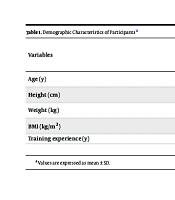
A total of 82 female volleyball players were included. No significant differences between groups were observed in demographic variables (P > 0.05; Table 1).
Table 1.
Demographic Characteristics of Participants a
| Variables | Without Cognitive Error Group (N = 40) | With Cognitive Error Group (N = 42) | P-Value |
|---|---|---|---|
| Age (y) | 20.45 ± 1.72 | 20.26 ± 1.96 | 0.620 |
| Height (cm) | 161.71 ± 4.23 | 162.50 ± 4.98 | 0.444 |
| Weight (kg) | 57.02 ± 10.42 | 58.83 ± 10.76 | 0.442 |
| BMI (kg/m2) | 21.81 ± 3.72 | 22.17 ± 3.93 | 0.671 |
| Training experience (y) | 7.08 ± 1.73 | 6.38 ± 1.63 | 0.066 |
a Values are expressed as mean ± SD.
In the TJA, players with cognitive errors demonstrated significantly higher error scores compared to those without errors (P < 0.001; η2p = 0.400, large effect; Table 2). For proprioception, the knee extension angle reproduction error was significantly higher in the cognitive error group (P = 0.026; η2p = 0.061, medium effect). However, the ankle dorsiflexion error was significantly lower in the cognitive error group (P = 0.001; η2p = 0.177, large effect), indicating better accuracy in this joint.
Table 2.
Between-Groups Comparisons of Tuck Jump Score, Proprioception, and Muscle Strength
| Variables | Mean ± SD | F-Value | P-Value | Partial Eta Squared |
|---|---|---|---|---|
| TJA | 53.238 | 0.001 a | 0.400 | |
| TJA scores | ||||
| Without the cognitive error group | 2.65 ± 1.35 | |||
| With cognitive error group | 4.81 ± 1.33 | |||
| Proprioception (joint angle reproduction error) | ||||
| Knee-extension (degrees) | 5.179 | 0.026 a | 0.061 | |
| Without the cognitive error group | 2.71 ± 1.56 | |||
| With cognitive error group | 3.68 ± 2.20 | |||
| Ankle-dorsi flexion (degrees) | 17.171 | 0.001 a | 0.177 | |
| Without the cognitive error group | 2.85 ± 1.77 | |||
| With cognitive error group | 4.73 ± 2.27 | |||
| Muscle dtrength (%BW) | ||||
| Knee flexors | 0.458 | 0.501 | 0.006 | |
| Without the cognitive error group | 39.73 ± 5.20 | |||
| With cognitive error group | 40.69 ± 7.40 | |||
| Knee extensors | 8.700 | 0.004 a | 0.098 | |
| Without the cognitive error group | 58.63 ± 4.86 | |||
| With cognitive error group | 54.86 ± 6.53 | |||
| Hip adductors | 4.146 | 0.045 a | 0.049 | |
| Without the cognitive error group | 28.01 ± 6.25 | |||
| With cognitive error group | 25.01 ± 7.03 | |||
| Hip abductors | 9.296 | 0.003 a | 0.104 | |
| Without the cognitive error group | 33.80 ± 5.39 | |||
| With cognitive error group | 30.19 ± 5.33 |
Abbreviation: TJA, tuck jump assessment.
a significant difference between groups.
In terms of muscle strength, athletes without cognitive errors had significantly greater knee extensor strength (P = 0.004; η2p = 0.098, medium to large effect), hip adductor strength (P = 0.045; η2p = 0.049, small to medium effect), and hip abductor strength (P = 0.003; η2p = 0.104, medium to large effect). No group differences were observed for knee flexor strength (P = 0.501; η2p = 0.006, negligible effect).
For static balance with eyes open, no significant differences were found between groups across center of pressure (CoP) parameters (all P > 0.05; Table 3). Under eyes-closed conditions, significant between-group differences were observed in traveled distance (P = 0.042; η2p = 0.051, small to medium effect), ellipse area of CoP (P = 0.031; η2p = 0.057), and ellipse secondary axis (P = 0.041; η2p = 0.051). However, the ellipse principal axis did not differ significantly between groups (P = 0.158; η2p = 0.025).
Table 3.
Between-Groups Comparisons of Postural Control Parameters
| Variables | Mean ± SD | F-Value | P-Value | Partial Eta Squared |
|---|---|---|---|---|
| Static balance test/open eyes | ||||
| Traveled distance (mm) | 0.262 | 0.610 | 0.003 | |
| Without the cognitive error group | 564.05 ± 198.44 | |||
| With cognitive error group | 543.67 ± 160.86 | |||
| Ellipse area of CoP (mm2) | 1.414 | 0.238 | 0.017 | |
| Without the cognitive error group | 47.45 ± 20.07 | |||
| With cognitive error group | 54.74 ± 33.44 | |||
| Ellipse principal axis (mm) | 0.439 | 0.510 | 0.005 | |
| Without the cognitive error group | 11.45 ± 3.42 | |||
| With cognitive error group | 12 ± 4.04 | |||
| Ellipse secondary axis (mm) | 0.006 | 0.939 | 0.000 | |
| Without the cognitive error group | 5.48 ± 0.93 | |||
| With cognitive error group | 5.50 ± 1.85 | |||
| Static balance test/closed eyes | ||||
| Traveled distance (mm) | 4.261 | 0.042 a | 0.051 | |
| Without the cognitive error group | 982.93 ± 262.56 | |||
| With cognitive error group | 1096.81 ± 236.835 | |||
| Ellipse area of CoP (mm2) | 4.807 | 0.031 a | 0.057 | |
| Without the cognitive error group | 141.73 ± 47.57 | |||
| With cognitive error group | 163.90 ± 44.02 | |||
| Ellipse principal axis (mm) | 2.035 | 0.158 | 0.025 | |
| Without the cognitive error group | 17.63 ± 4.70 | |||
| With cognitive error group | 18.98 ± 3.84 | |||
| Ellipse secondary axis (mm) | 4.308 | 0.041 a | 0.051 | |
| Without the cognitive error group | 10.85 ± 2.46 | |||
| With cognitive error group | 12.21 ± 3.39 |
Abbreviation: CoP, center of pressure.
a significant difference between groups.
5. Discussion
This study compared baseline sensory-motor function and postural control between female volleyball players classified by cognitive performance during dual-task execution. Athletes who committed cognitive errors during the combined tuck jump and memory recall task showed poorer movement quality, greater proprioceptive deficits, reduced lower-limb strength, and impaired postural control under eyes-closed conditions. These findings suggest that dual-task cognitive errors may reflect broader neuromuscular and sensory integration limitations rather than isolated cognitive deficits. Higher TJA scores in the cognitive error group, under single-task conditions, indicate reduced movement automaticity. Efficient motor execution typically relies on automatized motor programs requiring minimal attentional input (28, 29). Athletes with less automatic control may depend more on conscious supervision, leaving fewer cognitive resources for concurrent tasks. This aligns with motor learning theories emphasizing reduced cortical involvement and increased subcortical efficiency in skilled performers (30, 31). The observed deficits may stem from less efficient neural processing in regions like the supplementary motor area and prefrontal cortex, which support both motor planning and cognitive control (32).
Proprioceptive errors in knee and ankle joint position sense further highlight sensory integration inefficiencies. Accurate proprioception depends on peripheral input and central processing in the somatosensory cortex, cerebellum, and parietal lobe (33, 34). Deficits in these systems compromise internal models of body position, increasing reliance on attentional monitoring and reducing capacity for cognitive tasks (9, 35). Moreover, proprioceptive processing shares neural substrates with working memory and attention, particularly in the posterior parietal cortex, suggesting resource competition during dual-task scenarios (36, 37). In volleyball, where rapid adjustments to unpredictable stimuli are essential, impaired proprioception may hinder dynamic stability and increase cognitive load (38).
Strength deficits in knee extensors and hip abductors/adductors, but not flexors, suggest selective neuromuscular limitations. These muscles are critical for jumping, landing, and frontal plane control (39, 40). Weakness in these areas increases joint loading and requires greater conscious effort to maintain movement quality (41, 42). Athletes with lower strength may experience greater peripheral fatigue and rely more on central drive, reducing attentional reserves for cognitive tasks (43). Additionally, reduced strength may reflect suboptimal motor unit recruitment and synchronization, demand more cortical involvement, and diminish automaticity (44, 45). These inefficiencies likely contribute to dual-task interference.
The lack of significant differences in knee flexor strength is also informative. Hamstring function is often more closely associated with reactive stabilization and eccentric control during rapid deceleration, whereas the quadriceps and hip muscles play more prominent roles in active force production and frontal plane control during vertical jumping tasks (46). The selective nature of the observed strength deficits thus aligns with the specific motor demands of the TJA and volleyball-specific movements.
Postural control analysis revealed no group differences with eyes open, but significantly greater sway in the cognitive error group when eyes were closed. This suggests an over-reliance on visual input and impaired integration of proprioceptive and vestibular cues. According to the sensory reweighting framework, healthy systems flexibly adjust input weighting based on availability (47-50). Athletes with proprioceptive deficits may lack this adaptability, leading to instability when visual feedback is removed. These athletes must allocate additional attentional resources to sensory monitoring and postural control, reducing the capacity available for cognitive tasks (51, 52). Moreover, postural control engages overlapping neural networks with working memory and executive function, particularly in the prefrontal cortex and cerebellum (53, 54). Athletes with less efficient postural control strategies may experience greater neural resource competition when cognitive demands are added, explaining why proprioceptive and balance deficits correlate with dual-task cognitive errors. The cerebellum, in particular, plays a crucial role in both motor coordination and cognitive processing, including working memory and attention (55). Reduced cerebellar efficiency could thus contribute to both postural instability and dual-task interference.
These findings parallel joint position sense deficits and point to reduced somatosensory fidelity as a shared mechanism underlying dual-task difficulties. The cerebellum and prefrontal cortex, which support both postural control and cognitive functions like working memory (32, 36, 53, 56), may be less efficient in athletes with cognitive errors. This could result in neural resource competition and reduced capacity for dual-task performance. Overall, the cognitive error group appears to operate near their sensorimotor capacity limits, requiring greater attentional supervision and leaving minimal reserves for additional cognitive processing. In contrast, athletes without cognitive errors demonstrate more robust sensorimotor foundations, enabling better dual-task performance.
These findings support the use of dual-task paradigms as sensitive probes of underlying sensorimotor capacity. Athletes who perform well in isolated tests but struggle under dual-task conditions may harbor hidden vulnerabilities that emerge under complex sport demands. Practically, dual-task assessments can help identify at-risk athletes and guide targeted interventions. Training programs should incorporate strength development for quadriceps and hip muscles, proprioceptive drills, balance tasks under varied sensory conditions, and dual-task exercises that challenge both cognition and motor control. Such training may enhance movement automaticity, cognitive-motor integration, and attentional capacity, reduce injury risk, and improve performance. Importantly, cognitive errors during dual-task scenarios may reflect sensorimotor limitations rather than pure cognitive dysfunction. Athletes struggling with these tasks may benefit more from foundational neuromuscular and sensory training than from isolated cognitive interventions.
This study has limitations. Its cross-sectional design precludes causal inference; longitudinal and interventional studies are needed to test whether improving strength, proprioception, or movement quality enhances dual-task performance. Convenience sampling limits generalizability to other populations, and replication across diverse groups is warranted. Measurement precision could be improved using advanced technologies like isokinetic dynamometry, motion capture, and EMG. The cognitive task used, sequential number recall, was simple and reliable but may not reflect sport-specific cognitive demands. Future studies should incorporate ecologically valid tasks involving anticipation and decision-making. Finally, proposed neural mechanisms remain speculative without direct neurophysiological measures; future research should include neuroimaging or electrophysiological techniques to validate these interpretations.
5.1. Conclusions
This study highlights that cognitive errors during dual-task performance are not merely isolated lapses in attention but reflect deeper limitations in sensorimotor integration, neuromuscular strength, and movement automaticity. Female volleyball players who struggle with dual-task demands exhibit a distinct profile of proprioceptive deficits, reduced lower-limb strength, and impaired postural adaptability, factors that collectively compromise their ability to manage complex motor-cognitive challenges. These findings underscore the value of dual-task assessments as sensitive indicators of underlying motor control capacity and suggest that training programs should move beyond isolated physical or cognitive drills to embrace integrated approaches that enhance cognitive-motor coordination. By targeting foundational sensorimotor systems, coaches and clinicians may not only improve athletic performance but also reduce injury risk in high-demand sports environments.