
1. Background
The identification the useful effect and possible risk of resistance training with weights has continued uninterrupted in the past decades. Scientific findings shows that the resistance training can improve muscle strength, body composition and bone density (1). Moreover pervasive evidence shows that the regular resistance training even has useful effect on cardiovascular diseases associated with risk factor such as blood pressure and the levels of lipoproteins (2). Exercise training adaptations related to oxidative stress are the new approaches have opened to the effects of resistance training. Metabolism produces free radicals in cells continually that may be harmful to cellular structures and macromolecules. The free radicals are very active because of unpaired electron in their outside layer; so can reacts with macromolecules to oxidase and decaying them (3). This molecules based having oxygen or nitrogen divided to oxygen or nitrogen oriented free radicals. Human body and other creatures to diminish the harmful effect of free radicals have been equipped with group work called antioxidant system (4) antioxidant system include of endogenous enzymatic and no enzymatic such as glutathione (GSH), glutathione peroxidase, superoxide dismutase and catalase and edible antioxidant such as C and E vitamins and beta-carotene; protective effects of these vitamins have been proved by numerous studies (5). Endogenous antioxidants naturally are syntheses by body; their syntheses and activity are affected by the level of exercise training (6). Those antioxidants supplied by nourishment can increase the rate of cleaning of free radicals and decrease oxidative stress level (6). Sometimes antioxidant system can be defeated by free radicals and the situation so called oxidative stress will be provide (5). This situation is the sign of free radicals conquest in front of body antioxidant protective system. Oxidative stress conduces oxidation and decadence in body macromolecules and cellular structure (6). Numerous studies have proved that oxidative stress causes oxidation of proteins, lipids and nucleic acids (7). For assessment of oxidative stress variety of indices are used consist of measurement of free radicals, oxidized molecules and antioxidant levels. The increase in free radicals and oxidized molecules are the sign of increase in oxidative stress and the increase in antioxidant levels is the sign of decrease in oxidative stress (8).
Various exercise training such as resistance training can reinforce antioxidant system and palliate oxidative stress levels. Praise showed that 14 weeks of resistance training increases the mitochondrial enzymes and decreases the nucleic acid oxidation (9). In the other study Hendrickson showed oxidative stress can initiate type 2 diabetes and resistance training can reduce oxidative stress levels and reduce the probable of diabetes by incrementing of insulin s receptors (10). Blomber showed the resistance training reduced the level of oxidative stress such as MDA and H2O2 in young men (11).
Exercise increases the rate of metabolism and progressive production of free radicals in one side and increases the body antioxidant in the other side (7). Various resistance training protocols leads to different and sometimes inconsistent results. While Demence showed one session of resistance training induces significant increase in thiobarbituric acid-reactive substances (TBARS) in trained men, Sahlin didn’t find any significant change in free radical level after one session of resistance training (12). Whoever the effect of one session of resistance training in many studies has been reviewed, the chronic effect of resistance trainings have been less examined; in the other hand the finding in this area is somehow inconsistent; while Azizbeigi and coworker showed the resistance training like aerobic and parallel training can increase the blood levels of glutathione peroxides and superoxide dismutase, Margonis reported significant increase in blood level of MDA after a long period of resistance training in young men (13). Also Jen‐Fang Liu showed the one week of resistance training increase the blood level of MDA in young weight lifter women (14). Inconsistent and little finding in this area and the importance of training timing to achieve the safe training intensity and avoid from dangerous sudden increase in training intensity, this research was done with two experimental group that one of them trained with moderated intensity in the entire course of training while the other group increased the volume and intensity of training once every three weeks throughout the study.
2. Methods
This was experimental and applied study that was done with two experimental and one control group. The research subject were 36 untrained and healthy young men from 17 to 21 years old which studied in Islamic Azad university of Kermanshah and were volunteer to participate in research design. The subjects didn’t have any regular training experience in the past three mounts and with the supervision of trainer, ovoid from any form of exercise except the research plan exercise. Based on the result of health questioner and clinical signs in the beginning of study, they were safe physically and emotionally and in terms of body mass index (BMI) were in natural amplitude (18.5 to 24.5). At the beginning of study, the complete oral explanation about the exercise program in terms of technique, benefits and probable dangers was offered then after completing the testimonial, questioner and physical activity level forms, subjects were randomly divided in three groups of 12 people. Three days before the beginning of training course, the subjects for the anthropometrical measurement came to gym. After the measuring anthropometrical indices, they received the nutrition register form and complete this across three day before sampling with all foods consumed for measuring quality and quantity of diet in terms of total calories and the absolute value and relative share of macromolecules with N4 nutritional software supplied for this purpose. Subjects were banned from any supplements and drugs during the research. One day before the training course, after night rest and fasting position, the subjects come to laboratory at 9 o'clock and 10 cc bloods was obtained from anticubital vein. The samples were transferred under -4 to keep place immediately.
The training protocol consists of three three-weeks courses resistance training with free weight; the first course involved three days of resistance training in week with 60 percent of maximum strength consist of three sets for each movement and each set consists of 12 repetitions with 90 seconds rest between them. Maximum strength measured with one maximum repetition from following equation 1RM = weight (kg) (× 1 + (0.033 × number of repetition)) in the begging of each week and the weights were selected based that. While one off the experimental group (moderate resistance training) continue this protocol in throughout the course of research and just increased the training intensity(the percentage of 1RM) to the extent of 5 percent once every three weeks as an overload, the other experimental group (progressive resistance training) increased the intensity and training load each once three weeks as follow; the second course (fourth weeks to eighth week) consists of 4 set with 70 percent of 1RM for 4 days in week and the third course (seventh to ninth week) consists of 5 sets with 80 percent of 1RM for 6 days in week. The Selected movements were 6 multijoint consist of leg press, squat, leg curling, standard barbell curl chest press and standing barbell press. Upper and lower body movements were done alternatively. Ten minutes in the beginning and in the end of exercise were dedicated to warm up and cold down. During 72 houses after the last training session, subject nutritional data were registered by themselves in absolute rest state for future analysis with N4 software; in the end of third day, the blood samples were taken from all subject in experimental and control group under the standard condition accomplished in pre test. The samples immediately taken to laboratory under -4°C conditions then centrifuged for 5 minutes with the speed of 2500 rpm for the seclusion of serum then the obtained serum divided to 8 micro tube and transported to -80°C freezer. The GSH measurement was take placed based colorimetric reaction between GSH and reactive substance. First 80 micro liter serums was added to test tubes then 20 µL reactive substance was added to each tube; after mixing, the liquids were centrifuged for 10 minutes with 4500 rpm; after that 10 µL soluble was transferred to micro plate tube wells and 200 µL reactive substance was added to that; then obtained substance after 5 minutes was transferred to Elisa reader apparatus and the wells optical observation in 412 nm was read. The MDA was measured by colorimetric reaction, based reaction between MDA and tiobarbituric acid in temperature of 90 to 100°C. The 50 µL of serum samples was transported to test tubes and 50µlreactive substance and 1 µL coursing color substance were added to that; the test tubes were transferred to hot water until changed to pink; after 1 hour this compound transported to ice water and was centrifuged for 10 minutes with the speed of 3500 rpm; the amount of 200 µL of the upper part of liquid was transferred to micro plate wells ;eventually the plate transferred to Elisa reader and the wells optical observation was read in 450 nm. The 8-IsoP was measured by Elisa sandwich method and two antibodies; first, the floor of the wells was wearing with anti-IsoP antibody then the serum samples was added to that; then centrifuged for 60 minutes. The washing steps for eliminate extra enzymes continued and then A and B substance (causing color solution) were added; the reaction was stopped by adding acid and the wells transferred to Elisa reader; the wells optical observation in 450 nm was read. The regression profile was compiled by excel software.
The descriptive statistic involve mean and standard deviation were used for describing subject specifies in the beginning of study; kolmogorovsmirnov test was used for normal distribution of data. In the inferred statistics the ANCOVA was used and in the case of significant difference, Bonferroni test was conducted. All calculations was done by spss software 16 in the level of P < 0.05.
3. Results
In the Table 1, the descriptive characteristic of subject in the begging of research and in Table 2, the changes in research dependent variable, across the study are showed.
Table 1.
Descriptive Characteristic of Subject in the Begging of Researcha
| Variable | Moderate Group | Progressive Group | Control Group |
|---|---|---|---|
| Age, y | 19 ± 0.95 | 19.1 ± 1.26 | 19.8 ± 0.99 |
| Height, cm | 174 ± 4.22 | 175 ± 3.08 | 174 ± 4.01 |
| Weight, kg | 33.69 ± 15.6 | 68.33 ± 5.56 | 67.55 ± 6.59 |
| BMI, kg/m2 | 19.91 ± 95.5 | 19.78 ± 1.41 | 19.57 ± 1.34 |
aValues are expressed as mean ± SD.
Table 2.
The Change in Research Dependent Variable Across the Studya
| Variable | Group | |
|---|---|---|
| IsoP-8, mL.ng | Pre Test | Post-Test |
| Moderate training | 140.6 ± 4.17 | 109.99 ± 6.65b |
| Traininggrossivetprog | 141.5 ± 4.32 | 85.2 ± 4.96b,c |
| Control | 139.58 ± 3.48 | 136 ± 6.62 |
| MDA, µMolar | ||
| Moderate training | 138.85 ± 3.41 | 104.35 ± 2.52b |
| Progressive training | 137.25 ± 5.20 | 104.35 ± 2.5b |
| Control | 135.08 ± 4.37 | 107.77 ± 3.78 |
| GSH, µMolar | ||
| Moderate training | 350.94 ± 5.6 | 369.33 ± 36.78 |
| Progressive training | 348.04 ± 7.07 | 353.7 ± 23.67 |
| Control | 346.58 ± 7.6 | 346.73 ± 8.31 |
aValues are expressed as mean ± SD.
bIs the symptom of significant difference between post test of control group and experimental groups was measured by ANCOVA and Bonferroni post hoc test.
cIs the symptom of significant deference between post tests of experimental group was measured by ANCOVA and Bonferroni post hoc test.
Based the results of Table 2 and Figure 1, after 9 weeks of resistance training the significant difference in serum 8-IsoP values from pre test to post test was observed. The serum levels of 8-IsoP in experimental groups was declined significantly but the ample of this declination was more in progressive resistance training (39.88 VS 21.71) SO the significant difference was observed between two experimental groups in post test values. As well as the values serum of MDA was declined in both experimental groups with similar trend and no significant difference between post test values was observed. The increase in GSH of serum in both experimental groups was not significant.
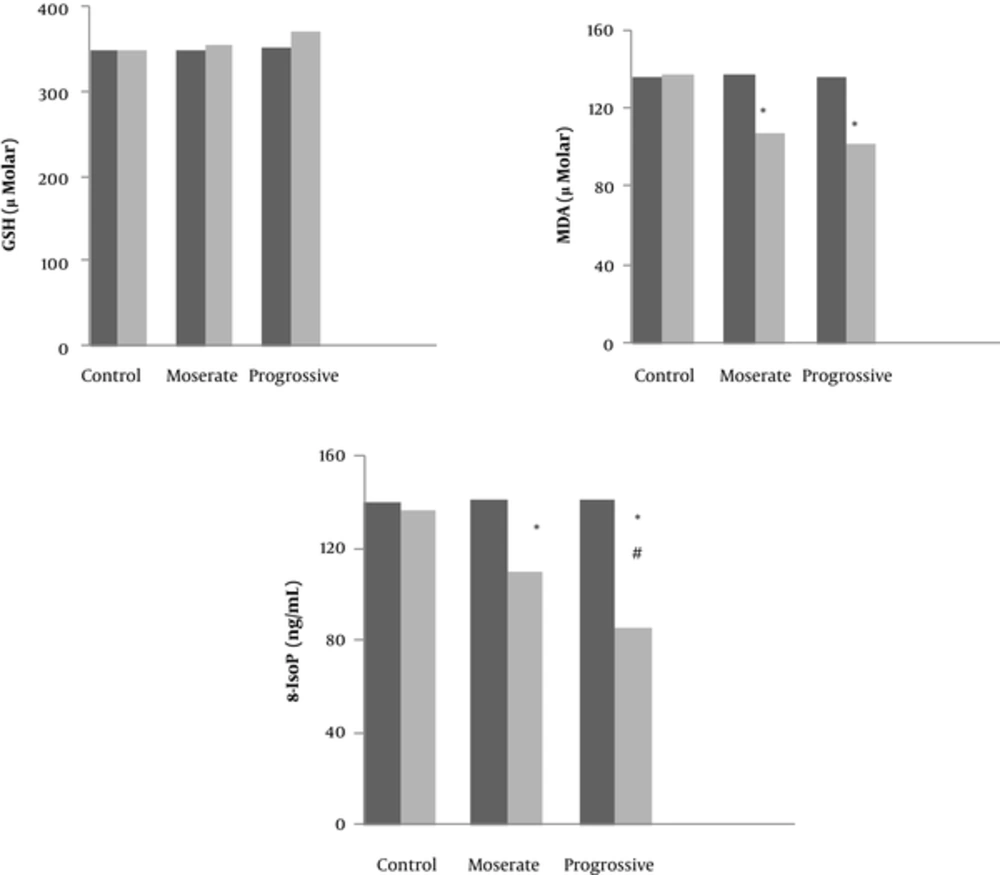
Figure 1.
The change in research dependent variable across the study. The data were shown by mean ± SD. The * is the symptom of significant difference between post test of control group and experimental groups was measured by ANCOVA and Bonferroni post hoc test. The # is the symptom of significant deference between post tests of experimental group was measured by ANCOVA and Bonferroni post hoc test.
Moreover the analyze of nutritional data by nutrition4 soft ware showed although the amount of total celeries content and absolute quantity of nutritional macromolecules increased significantly, the quality and the relative share of nutritional macromolecules were same when three day nutritional question before sampling was compared.
4. Discussion
The long period of resistance training can produce compatibilities that changed the physiological body responses toward oxidative stress situation produced by physical training in rest and exercise state. Whoever the one session of intense physical activity increased the oxidative stress marker (15, 16), the long period of resistance training can so to change the physiological body response to oxidative stress situation that the ample of oxidative stress and production of free radicals and oxidative productions decrease in rest and physical activity state. Research finding, however usually support from the reduction effect of long period of resistance training (17, 18), some researches signify to lack of change (19) and even the increase of oxidative stress, on the effect of long periods of resistance training (14). This inconsistent results may be the result of different conditions of training periods, in terms of intensity and training duration or the different subject conditions in terms of the nutrition situations and the amount of mental stress tolerated (14). So for achieving helpful compatibilities the load and intensity of resistance training in terms of the amount of weight, number of sets, number of day training as well as the nutritional situations must be considered in training program. The periods of very intense training without enough rest and proportionate nutrition in addition to occurrence of overtraining or overreaching syndrome, may lead to disproportionate increase in oxidative stress indices (13).
The change in oxidative stress body response after long periods of exercise training arising from decrease in free radicals production in numerous synthetic ways such as the linkage in respiratory electron system, xanthine oxidase reaction arising from ischemic- reperfusion phenomenon and migration of immune cells to inflamed and damaged muscle cells caused by severe muscle contraction especially eccentric muscle contraction in one hand and the increase none enzymatic antioxidant synthesis such as glutathione and enzymatic antioxidant such as glutathione peroxidase and superoxide dismutase and other in the other hand (17). After creating the adaptations, in the face of the next physical training, although the production of free radicals increased (not as much as before compatibility), the production and the activity of various antioxidants increased (17). The net results of these changes may lead to attenuate the body oxidative stress response in rest and physical activity state.
For the body oxidative stress assessment, there are various factor; the most important of them are the enzymatic and none enzymatic compound such as glutathione, C and E vitamins , glutathione peroxidase and superoxide dismutase; increase and the macro molecules oxidative products such protein and lipid (17).
In this study, the compartment of pre test and post test by means of paired t test showed that the lipid oxidative indices (MDA, 8-IsoP) decreased significantly but the increase in GSH, from pre test to post test was insignificant. This results was consistent with the finding of Vincent, Ceci and Azizbeigi and with the finding of Margonis, Ogonovszky and Jen‐Fang (20, 21). In this study, the using of long period of resistance training, proportionate training load and enough rest were the important factor that reduces oxidative stress. With regard to insignificant increase in GHS as an antioxidant factor, it seems to the change in oxidative state be more depend on the process related to the reduction of free radicals in various different path and the increase in antioxidant production at least, is less important; whoever all antioxidant changes were not measured in this study and my some other important antioxidants increased and we didn’t measured.
Hewer reducing in free radicals production in two major path involve the leakage electrons from electron transport chain and xanthine oxidase reaction seem to be more possible path, but the change in this path requires physiological adaptations not be achieved by resistance training. Reducing in free radicals production in electron transport chain depends on increasing in number of mitochondria and the amount and activity of mitochondrial enzymes that mostly affected by aerobic training although some researches advocated from the significant effect of resistance training on the number of mitochondria and mitochondrial enzymes (22); in the other hand reducing in free radicals production from xanthine oxidase reactions depend incretion in capillary that seems to be more affected by aerobic training again. Increment in capillary reduces scheme- reperfusion reaction and production of free radicals from this way. So however this path is most responsible of the production of free radicals in one session of heavy resistance activity in that blood flow is blocked and opened alternatively, in direction of reduce in free radicals production by long period of resistance training is less affected.
The positive relationship between inflammation and oxidative stress indices after resistance training indicates that at least some of the oxidative stress may be caused by immune cell migration to damaged muscle tissues especially after eccentric resistance training (23). The appearance of oxidative stress 48 hours after training is the indicator of inflammatory damages. The reduction of oxidative stress 48 hours after training may be caused by muscle resistance toward inflammatory damages are created by long period of resistance training. Since the antioxidant levels measured 72 hours after the end of training, this reductions may be created by reduction of immune cell migration and inflammatory damages reactions to muscle cells. Moreover improvement in muscle tissues resistance may be induces reduction in disruption in iron and zinc carrier proteins (23).
In this study the increment in GHS level after 9 weeks of resistance training wasn’t significant and this finding was inconsistent with numerous previous studies (1, 2, 4). This may be caused by difference in time sampling in this study toward inconsistent studies, because in all inconsistent studies blood sampling take placed in very time closer to the termination of training prides (immediately or extremely 24 hours after termination of training). Moreover we didn’t measure all antioxidant that some of them may be increased. however the MAD and 8-IsoP level decreased from pre test to post test in both groups but the rate of decrease was more about 8-IsoP, in a way that the compartment of post test with ANCOWA showed the significant difference about this factor and declination of 8-IsoP was more in progressive resistance group toward moderate resistance group; whereas the difference between post test MDA amount was not significant. This result may be caused by lower sensitivity of MDA measurement method or more stability of 8-IsoP in body fluids. This result can show that the 8-IsoP is the better marker to predict lipid peroxidation than MDA. 8-IsoP and MDA are both the production of lipid peroxidation that has different synthetic ways. MDA is the produce of unsaturated lipid with more than two dual bond produced by the degradation of hydro lipids (24) while isoprostanes are the other lipid peroxidation that are produced by direct effect of free radicals on Arachidonic acid independent of cyclooxygenase enzyme effect. 8-IsoP is the most abundant isomer that rarely be studied in investigations (25).
Because of the nutritional effect on oxidative stress respond, the content of subject food, in terms of quantization (all the calories and total macromolecules consumed) and qualities (the relative share of nutritional macromolecules) was analyzes by N4 software during three days before blood sampling in rest state that considered for this purpose. The result of nutritional analyze showed that despite the increase in all consumed calorie and quantity of all macromolecules that was natural change caused by increased energy requirement in effect of training, the quality of subject food in terms of the relative share of various macromolecules was unchanged during study. This finding may reflect this idea that nutritional factor was not effective in oxidative stress.
4.1. Conclusions
Overall this finding show that the resistance training for long period can reduce oxidative stress level in rest state and progressive resistance training in that the load and the intensity of training gradually increased is more effective than moderate resistance training with steady state of load and intensity in improvement of oxidative stress compatibility.