
1. Background
A challenging process in heart failure (HF) is its proper management by patients (1). In many countries, the development of patient-based health plans involves a significant contribution from health resources to better care for patients (2-4). There is some evidence that disease management programs in patients with HF can be effective in reducing mortality, suffering and length of hospital stay (5). Therefore, it is necessary to consider human factor approach to improving the health status and quality of care in patients with HF (6).
HF is a common chronic progressive costly disease characterized by an impairment in function or pumping of the heart, recognized as one of the most common and complex health issues worldwide (7-9). HF disrupts the blood oxygenation process and limits the patient’s ability to expel waste materials, especially water, which can lead to serious injury to the patient (10). In addition, HF has a significant effect on the patient’s physical functioning due to symptoms such as weight gain, shortness of breath, weakness, fatigue, and swelling of the feet (11, 12), which can affect patient’s emotional function due to the psychological consequences of the disease (13).
In patients with HF, patient’s mental status is affected by long-term treatment, rehospitalization, inability of the patient in social life, and complications of the disease (14, 15), and ultimately, psychological distress and ill-humouredness increase in them (16). Therefore, HF can deteriorate quality of life and decrease self-esteem by disturbing patient’s mental balance (17). Self-esteem is defined as “one’s overall evaluation of one’s worth, based on the positive and negative self-perceptions that make up one’s self-concept” (18). Self-esteem has a personal meaning and affects various aspects of their lives (19). Patient imagery and emotion regulation are two important components of cognitive and emotional processes that greatly impact patients with HF (20). These two components can be affected by patients’ self-esteem. Therefore, a sensible way to improve the condition of patients with HF is to improve their self-esteem.
Human factors approach and group training to maintain health and HF management have been considered for interventions worldwide (21). Learning through a group discussion is one of the most popular techniques in education, where ideas are exchanges on a particular topic among individuals within a group (22). In group discussions, members participate in discovering solutions to the issues being discussed by a trainer, and this increases the motivation of the group to learn. Given the low self-esteem of patients with HF due to the complications of the disease, we designed this study to use group discussion to improve self-esteem in patients with HF.
2. Objectives
Our goal in this research was to obtain information about the impact of interventional education through a group discussion on the self-esteem of patients with HF attending Imam Ali Cardiovascular Hospital in Kermanshah, Iran.
3. Methods
3.1. Study Design
This quasi-experimental study recruited patients with HF presenting to Imam Ali Cardiovascular Hospital in Kermanshah, Iran, from June to September 2016. A total of 80 patients with HF were selected using convenience sampling method. The inclusion criteria included cardiac dysfunction recorded in echocardiography report, functional classes III and IV of New York Heart Association (NYHA), ejection fraction ≤ 40%, a diagnosis of HF at least 6 months before, age range of 18 - 65 years old, and literacy to read and write Persian language. Patients did not enter the study if they suffered from a coexisting, severe, chronic debilitating disease, if they had a psychiatric diagnosis or auditory and visual impairment, if they had a private nurse or specialized education about self-esteem, if they had a valve replacement in the last 6 months or were expected to have such a treatment within 3 months, and if the patient was dissatisfied with giving information. Patients were also excluded the from the study if they did not attend more than 25% of the classes or were reluctant to continue the study.
After selecting patients and obtaining written consent, they were randomly assigned to 2 equal groups of control and intervention. The intervention group received 8 sessions of educational intervention through a group discussion (one session per week). The educational intervention included intensive, systematic and planned training on the consequences of HF in the daily life of patients, led by a researcher nurse (23), the effect of self-esteem on improving patients’ condition and how to increase the level of self-esteem in these patients.
3.2. Data Collection
At the time of registration, clinical data of patients were collected from their medical information records. This information included patient’s medical history, laboratory information, comorbidities, NYHA classification, left ventricular ejection fraction, and medication prescribed. At the same time, the patient was interviewed to collect demographic data including age, gender, marital status, socio-economic status, social support and living conditions, following Jaarsma et al. (24).
To assess self-esteem in patients with HF, Rosenberg self-esteem scale (RSES)was used. This instrument consists of 10 items with 4-point Likert scale (0 = strongly agree, 1 = agree, 2 = disagree, 3 = strongly disagree). Five items from RSES assess the individual’s positive feelings about themselves, and 5 other items assess the individual’s negative feelings about themselves (25). To rate responses, 5 items that express positive feelings are returned to their values, and their score is added to the other 5 items that express negative feelings. Therefore, following the method used by Poorgholami et al. (26), each person received a score ranging from 0 to 30, which respectively represent the best and the worst value for individual self-esteem. In a study by Rajabi and Bohloul (27) in Shahid Chamran University, validity and reliability of RSES was confirmed for Iranian society with 0.85 Cronbach alpha.
First, all patients with HF, in both control and intervention groups filled out RSES. The intervention group was then subjected to 8 sessions of educational intervention through a group discussion (weekly sessions for two months). One month later, all patients with HF filled out RSES again.
3.3. Data Analysis
R-3.2.3 software was used to analyze the data. Kolmogorov-Smirnov test was used to examine the data distribution, and the Levene’s test was used to examine the homogeneity of variance. Reporting and describing variables were performed through descriptive statistics (frequency and percentage, mean and standard deviation (SD)). Independent t-test, chi-square test, Mann-Whitney test and covariance analysis were used for statistical analysis of variables. The acceptable probability level was α = 0.05.
4. Results
4.1. Demographics and Clinical
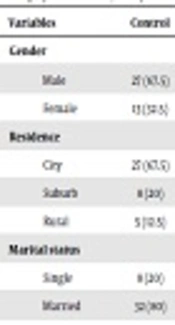
The results of this study revealed no significant differences between the two groups in terms of demographic and clinical (normal ejection fraction) variables (P < 0.05). Of the total 80 patients surveyed, 61.2% (49 persons) were male, with 27 men in the control group and 22 men in the intervention group, while 38.8% (31 persons) were female, with 13 women in the control group and 18 women in the intervention group. The description of other demographic variables (place of residence, marital status, occupational status, education and income status) in the patients is presented in Table 1. Mean ± SD of patients’ age in the control and intervention groups was 58.6 ± 6.9 and 57.3 ± 8, respectively. The mean ± SD of the normal ejection fraction in the control and intervention groups was 26.5 ± 8 and 25.8 ± 7.6, respectively (Table 2).
Table 1.
Comparison of Patients in the Control and Intervention Groups Based on Demographic Variables (Chi-Square Test)
| Variables | Control | Intervention | Total | P Value |
|---|---|---|---|---|
| Gender | 0.025 | |||
| Male | 27 (67.5) | 22 (55) | 49 (61.2) | |
| Female | 13 (32.5) | 18 (45) | 31 (38.8) | |
| Residence | 0.60 | |||
| City | 27 (67.5) | 26 (65) | 53 (66.2) | |
| Suburb | 8 (20) | 6 (15) | 14 (17.5) | |
| Rural | 5 (12.5) | 8 (20) | 13 (16.3) | |
| Marital status | 0.19 | |||
| Single | 8 (20) | 3 (7.5) | 11 (13.8) | |
| Married | 32 (80) | 37 (92.5) | 69 (86.2) | |
| Occupation | 0.89 | |||
| Employee | 15 (37.5) | 13 (32.5) | 28 (35) | |
| Services | 12 (30) | 13 (32.5) | 25 (31.2) | |
| Self-employed | 13 (32.5) | 14 (35) | 27 (33.8) | |
| Education level | 0.92 | |||
| Primary | 28 (70) | 28 (70) | 56 (70) | |
| High school | 8 (20) | 10 (25) | 18 (22.5) | |
| Academic | 4 (10) | 2 (5) | 6 (7.5) | |
| Income, Rials | 0.83 | |||
| ≤ 10 Million | 19 (47.5) | 18 (45) | 37 (46.2) | |
| > 10 Million | 21 (52.5) | 22 (55) | 43 (53.8) |
Table 2.
Comparison of Patients in the Control and Intervention Groups Based on Age and Normal Ejection Fraction (t-Test)
| Variables | Control | Intervention | P Value | ||||||
|---|---|---|---|---|---|---|---|---|---|
| N | Min | Max | Mean ± SD | N | Min | Max | Mean ± SD | ||
| Age | 40 | 38 | 65 | 58.6 ± 6.9 | 40 | 22 | 65 | 57.3 ± 8 | 0.41 |
| Ejection fraction | 40 | 10 | 35 | 26.5 ± 8 | 40 | 10 | 35 | 25.8 ± 7.6 | 0.67 |
4.2. Self-Esteem
The results of covariance analysis indicated a significant difference between patients’ self-esteem after educational intervention (P < 0.001) by controlling patients’ self-esteem before intervention. After educational intervention, the mean ± SD of self-esteem score in the control and intervention group was 12.45 ± 4.9 and 10.9 ± 4.4, respectively (Table 3). Nonparametric analysis of covariance for dimensions of self-esteem scale (value, individual ability and satisfaction) revealed that by controlling patients’ self-esteem in these dimensions before intervention, there was a significant difference between patients’ self-esteem after educational intervention (P < 0.001). Table 4 shows patients’ self-esteem in the control and intervention groups according to three dimensions of self-esteem scale.
Table 3.
Comparison of Patients’ Self-Esteem in Control and Intervention Groups with Control of the Effect of Patients’ Self-Esteem Before Intervention (Covariance Analysis)
| Groups | Before | After | P Value |
|---|---|---|---|
| Control | 11.78 ± 4.6 | 12.45 ± 4.9 | 0.001 |
| Intervention | 12.03 ± 5.3 | 10.9 ± 4.4 |
Table 4.
Comparison of Patients’ Self-Esteem in Control and Intervention Groups According to Their Dimensions with Control of the Effect of Patients’ Self-Esteem Before Intervention (Nonparametric Analysis of Covariance)
| Dimensions of Self-Esteem | Before | After | P Value |
|---|---|---|---|
| Value | 0.001 | ||
| Control | 4.1 ± 1.85 | 4.4 ± 2 | |
| Intervention | 4.6 ± 2.3 | 4.05 ± 1.9 | |
| Individual ability | 0.001 | ||
| Control | 4.2 ± 1.7 | 4.3 ± 1.8 | |
| Intervention | 4.02 ± 1.8 | 3.7 ± 1.6 | |
| Satisfaction | 0.002 | ||
| Control | 3.5 ± 1.8 | 3.7 ± 1.9 | |
| Intervention | 3.4 ± 1.7 | 3.15 ± 1.5 |
5. Discussion
In this study, there was a significant difference between patients’ self-esteem in the control and intervention group after intervention (P < 0.001), and educational intervention through a group discussion improved patients’ self-esteem. In the intervention group, the mean level of patients’ self-esteem improved from 12.03 before intervention to 10.90 after intervention, while in the control group, the mean level of patients’ self-esteem in the end (12.45) was worse than that at the beginning of the study (11.8). This may be explained as education helps patients with HF better understand their physical condition, and thus become more compatible with their life challenges. Therefore, learning through a group discussion improves their self-concept, changes their lifestyle, and improves their perspective on their condition and thus increases their self-esteem. In conformity with our results, Poorgholami et al. (26) conducted a study on patients undergoing hemodialysis in Motahari Hospital in Jahrom, Iran, and concluded that level of patients’ self-esteem significantly increased through education and intervention.
We observed a significant difference between the scores of different dimensions of self-esteem in the control and intervention groups after intervention (P < 0.001). Educational intervention through a group discussion increased the mean of patients’ self-esteem in terms of value, individual ability and satisfaction in the intervention group by 0.55, 0.23, and 0.25, respectively. Improving the patient’s understanding of their condition improves their mental condition, which can lead to their adapting to the limitations and thereby enhancing their sense of value. Guillon et al. (28) studied the relationship between self-esteem and psychiatric disorders in adolescents, and found that these disorders were related to their low self-esteem, and appropriate treatment interventions can be effective to improve their self-esteem.
Our interpretation of the results of this study is that education reduces the gap between self-perceived and self-ideal in patients in the intervention group, which increased their individual ability. Rahimi et al. (29) examined the effect of applying continuous care model on self-esteem of the hemodialysis patients, and they found that it had a positive effect on self-esteem levels. As one of the educational topics in the intervention group was having a sense of self-control in relation to the present condition, this could lead to an increase in the sense of satisfaction in them. Sanaie et al. (30), by studying the effect of family-centered empowerment on self-efficacy and self-esteem of the patients undergoing coronary bypass graft surgery, concluded that sense of empowerment increases self-esteem in these patients.
5.1. Conclusions
Patients with HF usually feel weakness, inability and lack of control over their physical condition due to complications of the disease, unavailability and isolation, and all these feelings can affect their self-esteem. Therefore, the development of new educational methods and interventions for treating these patients is very important. In this study, interventional education through a group discussion was effective in improving the level of self-esteem in patients with HF and significantly improved the overall score of self-esteem among patients in the intervention group. All dimensions of self-esteem scale (value, individual ability and satisfaction) of patients in the intervention group were significantly improved as before the intervention. Therefore, it is recommended that educational interventions through a group discussion be considered to improve the self-esteem of these patients in designing and planning interventions.