


1. Context
Late December 2019, the Wuhan seafood market witnessed clusters of illnesses that were initially mistaken for pneumonia. The illness was later discovered to be caused by a novel virus. The International Committee on Taxonomy of viruses (ICTV) renamed the novel Coronavirus as SARS-CoV-2 having identified it as a sister virus to SARS coronavirus (1). On February 11, 2020, the World Health Organization (WHO) named the disease caused by this novel virus, COVID-19 (2).
Transmission of COVID-19, like other infections is a complex interaction between infective agents, susceptible hosts and the environment (3). For a person to transmit a disease, they need to have been previously exposed to, replicate and shed the infectious agent (4). The transmission of COVID-19 was reported to have started at a Seafood Market in Wuhan, China predominantly through droplets from coughing and sneezing (5). SARS-CoV-2 droplets is less than five microns in diameter (6). It can be in the air for up to three hours and travel across two meters while still maintaining its pathogenicity (6). The virus can also spread by touching contaminated surfaces and then mucous membranes such as eyes, nose or mouth without washing hands with soap and water or alcohol based sanitizer. Aside human-human transmission, animal-human transmission may also be possible although it has not yet been proven scientifically (7). This virus is very contagious and spreads rapidly across all countries and regions of the world. Preventive measures such as personal hygiene, physical distancing and wearing of face mask have been employed worldwide to curb the spread since there has been no definitive treatment.
Mass gatherings are potential grounds for outbreaks of the COVID-19 transmission and an understanding of this transmission will help in reducing the spread of the virus. Schools, markets, and religious centres are covered by definition of mass gathering according to WHO (8). The most prominent gatherings are religious in nature (9) making the transmission of COVID-19 in religious gathering a crucial issue to assess. It was discovered that mass gathering events such as religious events, music, markets, schools, sporting and other mass gathering have been the wellspring of infectious diseases transmission globally (10) .
This is because these gatherings are usually congested thereby facilitating the spread of infectious agents like SARS-COV-2 via droplets. For instance, the first case in the world was reported in a market, the first case in Latin America coincide with a popular annual Carnival in Brazil and the index case in Iran started in a city that attracts Shiite Muslim pilgrimages for religious purpose (11, 12). Due to efficacy of public gatherings in the transmission of COVID-19, closure of schools, markets, religious centers, stadia and entertainment centres are part of first line of action by governments in different countries in order to reduce the spread and protect lives of citizens. This research aims to review available evidences to assess the level of the transmission of COVID-19 in schools, religious gatherings and markets.
2. Evidence Acquisition
This review assesses available evidences, including journal articles, books, country reports, the World Health Organization (WHO) reports, and other reports and web pages on issues pertaining to the transmission of SARS-CoV-2 in public gatherings which include schools, markets and religious gatherings. Literature search for relevant medical literature in biomedical databases such as PubMed and Google Scholar was conducted with the following key terms: “School”, “Market”, “Transmission”, “Religion”, “COVID-19”, and “Mass gathering”. Paper selections were conducted by reviewing titles and abstracts for the keywords and using supplemental references obtained from the reference lists of the papers. No restriction on date of publication was applied during the literature search. Only publications in English language were included in the study, and studies which did not include mass gatherings of schools, markets and religious centres were excluded.
3. Results
3.1. Transmission of SARS-CoV-2 In Schools
School closure has been used as a tool in curtailing the transmission of the virus in children and young adults. Approximately 1.6 billion students in 191 countries had ceased attending school due to this policy (13). School closure is believed to reduce contacts between students and are based on evidence and assumptions from influenza outbreaks that this contact reduction interrupts transmission (14). This was evidently effective in controlling the influenza pandemics because children were important in influenza transmission, have high hospitalization rates and severe outcomes from influenza (15, 16). However, it is unclear whether this measure is effective in coronavirus outbreaks for which transmission dynamics appears to be different.
Studies have opined that COVID-19 is less prevalent in children and that children are mostly asymptomatic or experience milder symptoms when compared with adults (17, 18). Since studies have indicated viral shedding in asymptomatic children, they are not completely excluded in viral transmission (19). However, they do not play a significant role in the virus transmission, compared to influenza (19).
A study of SARS-CoV-2 in Australian schools shows low case rate and secondary infections among children and staffs attending educational facilities throughout the epidemic first wave of COVID-19 pandemic (20). It further indicated that while transmission between staff and from staffs to children was apparent, transmission among children or from children to adults (staffs), as it is known in influenza, was unlikely, although could not be excluded. In another study, an infected child linked to a cluster of COVID-19 cases in France attended three schools while symptomatic, but did not transmit the virus to any of the close contacts (21). In some of the previous coronavirus outbreaks, evidence suggests that transmission in schools was very low or absent (22). Data from the SARS outbreak in mainland China, Hong Kong and Singapore suggest that school transmission played no substantial role in the outbreak and that school closure did not contribute to control of infection transmission (15).
These findings indicate that school children may not play a significant role in SARS-CoV-2 transmission. It further suggests that schools may not be a high risk setting for SARS-CoV-2 transmission between children or between staffs and children (23).
It is nonetheless noteworthy that age is an important predictor of infection and severity. A testing in Iceland showed that children under 10years were less likely to test positive compared to other age groups (24). This finding supports the assertion that children aged 2 - 10 years have a low rate of infections and consequently a marginal role in spreading the disease. Hence, there may be a linear relationship between age and the virus susceptibility and transmission.
There are several explanatory hypotheses for the low transmission of the virus in children and in schools. Since children account for only less than 2% of total COVID-19 cases, hypothesis have pointed to the low case reported to be due to the insufficient rate of test performed in children, mainly because most of them are asymptomatic (25). The incidence of children increasing with age has been related to the increased range of activities of older children and increased contact with COVID-19 patients (17). The low prevalence of the virus in children has also been linked to the protection of children by parents and the small range of activities of children (17). Some other theories point to differences in immune responses (26) and age-dependent expression of the ACE 2 virus receptor (27). However, there is no concrete explanation for the reason of lower prevalence of COVID-19 among school children compared to adults. And available findings are insufficient to ascertain the level of significance of the relationship. There is need for further studies that assesses the transmission of SARS-CoV-2 in high schools and colleges where the majority of students are adults.
3.2. Transmission of SARS-CoV -2 Religious Gatherings
With increase in the global spread of COVID-19 cases, transmission associated with places of worship from countries like Singapore, South Korea, Iran and Malaysia were reported (28). Religious gatherings are prone to close contact, therefore creating risk of chain transmission and potential super spreading of SARS-COV-2 (29). The virulence of SARS-COV-2 makes every gathering not excluding religious gathering a potential danger to public health (30). Although worship centres are seen to serve as a significant outlet where people find strength and direction, express solidarity and intensify community cohesion and relationship, they are however an effective platform for SARS-COV-2 transmission (28). Intimacy and cordial relationship are the order of the day in any religious gathering as people share love and blessings thereby facilitating human-human transmissions through close contacts and droplets in air (31). The increase of transmission in Brunei Darussalam was traced to a religious event in Malaysia that was attended by asymptomatic carriers (22).
Another 71 cases were connected to a mega church in California, US (32). Furthermore, a priest succumbed to COVID-19 after attending several religious meeting including a religious festival in another city in northwestern India (33, 34) also reported a religious gathering that was linked to a large number of cases (2500) in France, after people came from other places outside the country to Converge on Christian Open Door church in Mullhouse, a city of 100,000 on France’s borders with Germany and Switzerland. It was then referred to as the epicenter of the outbreak in France as at March 9, 2020 (35). Recently after the easing of lockdown in Germany, BBC reported that more than 40 churchgoers who attended church service in Germany had contracted SARS-CoV-2 (36). Religious myths about COVID-19 being a punishment for sinners or a trial from devil are believed by some religious institutions thereby disregarding preventive measures stated. Hence, this facilitates transmission of SARS-CoV-2 in different religious gatherings across the world. There is need for further studies to ascertain the difference in transmission rate with age group in religious gatherings.
3.4. Transmission of SARS-CoV -2 in Markets
The COVID-19 outbreak started at the Huanan Seafood Wholesales Market in Wuhan, South China in December, 2019 and spread widely within the market before it was isolated (5). Market can be regarded as a public place where buyers and sellers from different areas exchange transactions of goods and services. Informal market settings and sometimes formal markets are often densely populated and characterized by movement, person-person contact and also person-surface contacts which are the main routes of transmission of the virus. Transmission of COVID-19 is via droplet, usually during close contact with an infected person. Unlike some other infections, COVID-19 can not only be spread by symptomatic carriers but also asymptomatic and presymptomatic persons (37, 38). Besides, asymptomatic and presymptomatic cases are believed to be responsible for most of the spread of SARS-CoV-2 because of the pathophysiology of the infection (39, 40). The COVID-19 outbreak started at the Huanan Seafood Wholesales Market in Wuhan, South China in December, 2019 and spread widely within the market before it was isolated (5). Before the closure of the Huanan seafood market, more than half of reported cases in Wuhan were related to the seafood market (19). In a study in China, it was discovered that the reproduction number, R, for human-to-human transmission decreased after the closure of the Huanan Seafood Wholesale Market from 2.37 (95% CrI: 2.08-2.71) to 2.25 (95% CrI: 1.94 - 2.57) (40). This shows the magnitude of transmission of SARS-CoV-2 in the market before the mitigating strategies were implemented.
The absence of ventilator systems in some markets allow droplets and aerosols to stay longer in the air space. Hence, poor ventilation increases the viral concentration in markets compared to outdoor environments thereby facilitating the spread of SARS-CoV-2 in market places. Shopkeepers are mostly at risk of infection because of longer exposure time in markets and close contacts with different consumers. The virus has been found to be present on impermeable surfaces like plastic, nylon and stainless steel for up to 3 to 4 days after inoculation and lesser on permeable surfaces like carton (6). These are often present in market places for goods packaging and signify potential spread of the virus in market places even without person-person contacts.
Particle size, temperature, humidity and wind are factors that may influence the biological half-life of SARS-CoV2 on surfaces and in the atmosphere and consequently contribute to the rate of transmission within the market (5). There are limited studies to identify the level of transmission of SARS-CoV-2 in markets. However, closure of market places except sales of essential goods like food is one of the commonest mitigation strategies adopted by countries. In addition, movement restrictions and prohibition of economic and social activities have also helped in curtailing the spread of the virus in many countries and regions.
4. Conclusions
Although gatherings (school, markets and religious gatherings) are seen to be vital to our daily lives, evidence from this study has shown that they may be a threat to public health in the face of this COVID-19 crisis, as most of these gatherings may escalate the transmission of the virus. Comparatively, there may be no safer gathering, as there are scientific evidences of transmissions in the three gatherings and the virus spreads virulently even from asymptomatic carriers. However, based on the current evidences, it may be deduced that the risk of transmission of SARS-CoV-2 seems least in schools and higher in religious centres or informal markets.
Transmission in the three gatherings may be linked together constituting a chain of transmission of the virus (Figure 1). Hence, suspension of gatherings like these in times of health crises is for the safety of humanity as epidemics like SAR-COV-2 know no borders. We therefore encourage the government to ensure strict compliance to COVID-19 protocols in schools, markets and religious gatherings during COVID-19 pandemic and any subsequent infectious disease outbreak in future. There is a need for primary researches that assess the risk of transmission of SARS-CoV-2 virus in tertiary institutions, where there is a greater population of adult students. Also, we suggest conducting primary researches to assess the relationships between mass gatherings and spread of COVID-19 and the efficacy of their restrictions or ban.
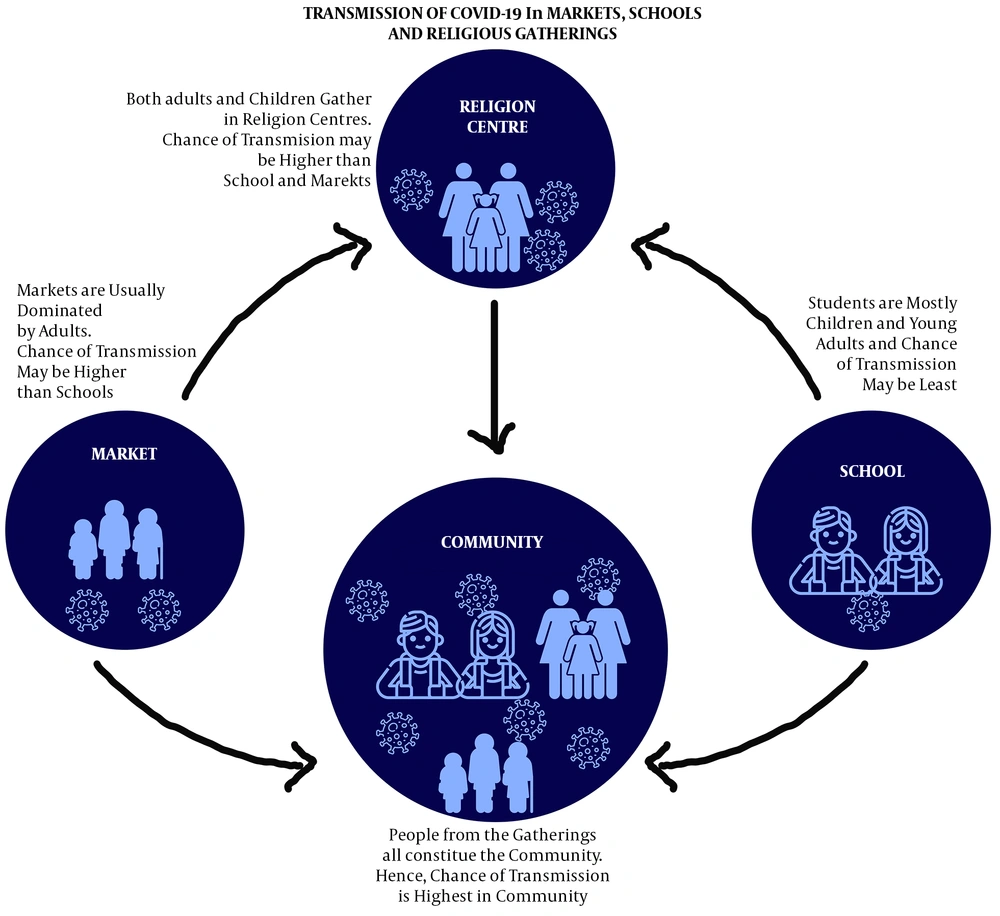
Figure 1.
Shows the possible chain of transmission and risk between school, market and religious gathering in relation to the community.


