


1. Background
Colon cancer, or colorectal cancer (CRC), is a severe type of cancer with high incidence and mortality rates in developed countries (1, 2). The World Health Organization’s 2018 report stated that colon cancer accounted for 694,000 of the total cancer deaths worldwide, making it the fourth most prevalent type of cancer and the second leading cause of cancer-related mortality (3). CRC is the third most common cancer in Iranian men (standardized incidence: 8.1 - 8.3 per 100,000) and the fourth most common cancer in women, with a standardized incidence of 6.5 to 7.5 per 100,000 (4). Diagnosis of cancer can significantly influence the mental health and well-being of patients. Even individuals without a history of psychiatric conditions are at an increased risk of developing common mental disorders following a cancer diagnosis (5, 6). Generally, the probable adverse consequences of diseases pose a major clinical challenge for cancer patients. Moreover, studies have indicated that comorbidity is an essential prognostic factor for cancer patients (7).
Colon cancer causes several social and psychological problems and responses, such as denial, anger, and feelings of guilt, which eventually lead to the patient’s psychological coherence collapse (8). Antonovsky introduced the sense of coherence (SOC) concept in 1970 and defined this construct as one’s orientation to life (9). The SOC is, in fact, a global human orientation that expresses one’s level of stable and dynamic self-confidence and comprises the senses of comprehensibility, manageability, and meaningfulness (10). Comprehensibility is a cognitive variable that results from a person perceiving the information received in a coherent, structured, and comprehensible manner to make the person feel that all life situations are predictable and comprehensible. A person’s manageability refers to their perception that they have sufficient resources to meet their demands and obligations. The sense of meaningfulness refers to how a person perceives the meaning of their lives and assures them that their fight against reality is worth the required effort and commitment (11). Sense of coherence can explain why a person with a chronic illness can endure high levels of stress and remain healthy (12). In this regard, Winger et al. (13) noted that a strong SOC protects perceived health among cancer patients. Another study on patients with brain metastases found that a stronger SOC was related to a higher quality of life (14).
Psychodynamic group psychotherapy has been widely used as another treatment modality to alleviate psychological distress and improve physical function in chronic patients (15). The group contributes to symptom reduction and gives members a sense of belonging, purpose, hope, altruism, and meaning during the therapy. Group therapy offers the group members unique growth opportunities in addition to alleviating symptoms (16). Psychodynamic therapy incorporates many of the fundamental assumptions and concepts of other psychoanalytic therapies and emphasizes psychological defenses, the impact of unconscious motives on individual and group behaviors, the pervasiveness of mental conflicts, and the evolutionary perspective on personality. In this approach, the therapist seeks to improve interpersonal learning and increase the participants’ self-perception through group members' interactions, heightening their sensitivity to group dynamics and interpersonal conflicts (17).
The five influential factors in group therapy sessions are the formal theory of change, the dynamics of the group, the structural aspects of the group, the characteristics of the group members, and the characteristics of a group leader. These variables collectively define the group process and provide information on the shape and performance of the group (18). In addition, the presence of other members enhances the likelihood of self-disclosure, facilitating the observation of internal issues (17) and leading to a therapeutic alliance. An alliance includes a relational bond and an agreement on goals and tasks. In a healthy therapeutic alliance, the patient feels sufficiently safe to share personal and perhaps shaming information, accept new information, and even disagree with the therapy team (19). According to Coco et al. (20), cohesive group members do not feel isolated. Alliances are reciprocal relationships in which group members influence and change each other. Hojjati et al. (21) demonstrated that integrated psychodynamic group therapy enhanced self-knowledge among women with depression.
Aminifar et al. (22) demonstrated short-term psychodynamic therapy’s efficacy in enhancing youths’ integrative self-knowledge. Andalibi et al. (23) discovered that psychodynamic group psychotherapy and mindfulness-based stress reduction were influential in improving cancer patients’ emotional processing. Ridenour et al. (24) reported that psychodynamic psychotherapy tried to develop operationalized constructs for measuring the increased self-development and the therapeutic mechanisms of action that facilitated these changes and enhanced the individual’s sense of inner coherence (20). Marmarosh et al. (16) found that group psychotherapy was as effective as individual therapy for various disorders, such as anxiety, depression, grief, eating disorders, and schizophrenia.
Despite the review of the presented theoretical principles and the importance of cancer as a fatal disease, no systematic study has been conducted to date concerning the effect of psychodynamic group psychotherapy on the components of SOC among patients with colon cancer.
2. Objectives
Based on the issues outlined above, the main objective of the current study was to evaluate the effectiveness of psychodynamic group therapy on the SOC of coherence among patients with colon cancer.
3. Methods
This quasi-experimental study was conducted using a pretest-posttest design, a control group, and a 45-day follow-up on all patients with colon cancer visiting the Poursina-Hakim Treatment Center in Isfahan, Iran, during the spring of 2022. Then, 28 patients were selected using convenient sampling who were randomly assigned to the psychodynamic group therapy (experimental group, n = 14) and the control group (n = 14) (Figure 1). The adequacy of the sample size was confirmed through G*Power software (effect size = 1.15; power test = 0.90; ɑ = 0.05). The inclusion criteria were: (1) A diagnosis of colon cancer by a specialist or as documented in the patient’s medical record at Poursina-Hakim Treatment Center, (2) being over the age of 18, (3) stage II or higher stages of the disease, (4) middle school education or higher, (5) knowledgeable about the disease, and (6) voluntary consent and willingness to participate in the research. The exclusion criteria included: (1) Acute physical conditions resulting from disease or medical treatments such as chemotherapy or radiation therapy, (2) acute psychiatric disorder and inability to respond to questions, and (3) failure to attend more than two sessions. The patients in the psychodynamic therapy group attended 12 in-person sessions, each lasting 100 minutes once or twice a week over two months. The treatment intervention sessions in psychodynamic therapy groups were conducted by the first author at Poursina Hakim Health Centers in Isfahan. The control group did not receive any intervention. The psychodynamic therapy sessions, which were based on Shay et al.’s (25) protocol, are outlined in Table 1.
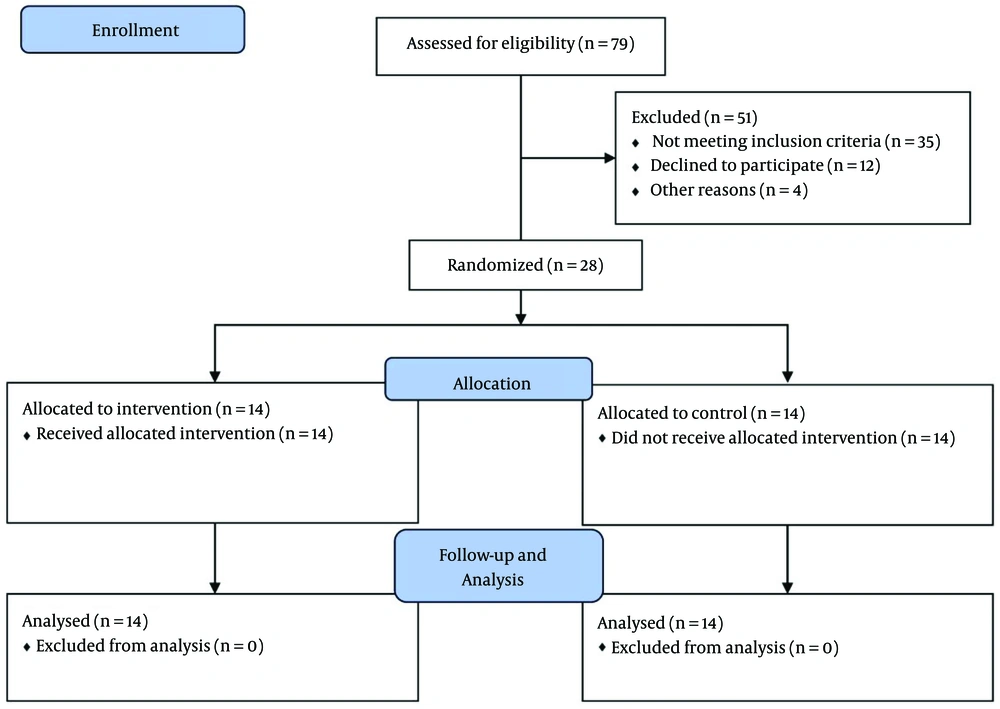
Figure 1.
Flow-chart of the selected participants
Table 1.Summary of Psychodynamic Group Therapy Sessions
| Sessions | Session Contents |
|---|---|
| 1 | Briefing the group on the goals and rules, therapy duration, and group agreements, introduction of group members, and an explanation of what has brought the members to the group |
| 2 - 7 | As required, each of the following will be addressed: Examining patients’ resistance to emotional intimacy with the therapist and with the other members of the group (caused by, for example fear of violation of one’s privacy), identifying and clarifying the defense mechanisms employed by the patients to escape from anxiety and emotions, identifying and working on anxiety in the patients, regulating anxiety, etc., and identifying emotions and experiencing them in the group |
| 8 - 12 | Evaluating the members’ insight into their intrapsychic issues (which is among the goals of psychodynamic group therapy), a review and summation, end of the sessions, posttest |
3.1. Instruments
3.1.1. The Sense of Coherence Scale
Antonovsky (26) developed the SOC Scale with 29 items to assess the degree of control over stress using three essential components: Comprehensibility (11 items), manageability (10 items), and meaningfulness (8 items). Each item is scored on a seven-point Likert scale, ranging from 1 (never) to 7 (always). The minimum and maximum total scores are 29 and 203. The Cronbach’s alpha for the Persian version of the SOC scale was 0.77 (27). The participants completed Antonovsky’s SOC scale in the pretest, posttest, and follow-up stages. In this study, the Cronbach’s alpha of SOC Scale was 0.89.
3.2. Statistical Analyses
The research data were analyzed using descriptive statistics (measures of central tendency including mean and measures of variability such as standard deviation) and inferential statistics. The repeated measures ANOVA was conducted in SPSS software version 26 to investigate the study objective.
4. Results
The mean age of the patients with colon cancer was 53.64 ± 8.31 years in the control group and 57.14 ± 9.52 years in the psychodynamic therapy group. Ten (35.7%) participants were male, and 18 (64.3%) were female. Additionally, 12 (42.86%) of them had a middle school diploma, seven (25.0%) had a high school diploma, six (21.43%) had a bachelor’s degree, and three (10.71%) had a master’s degree or higher. The descriptive statistics revealed that the patients in the psychodynamic therapy group experienced increases in their mean posttest and follow-up scores for comprehensibility, manageability, and meaningfulness compared to their mean pretest scores (Table 2).
Table 2.The Mean and Standard Deviation (SD) of the Components of the Sense of Coherence in the Psychodynamic Therapy and Control Groups a
| Variables | Psychodynamic Therapy Group | Control Group |
|---|---|---|
| Comprehensibility | ||
| Pretest | 32.42 ± 5.98 | 37.28 ± 9.00 |
| Posttest | 40.57 ± 7.20 | 36.28 ± 7.22 |
| Follow-up | 42.21 ± 8.34 | 37.14 ± 5.09 |
| Manageability | ||
| Pretest | 32.14 ± 7.16 | 34.92 ± 4.21 |
| Posttest | 36.92 ± 9.57 | 35.14 ± 6.52 |
| Follow-up | 34.71 ± 7.27 | 33.42 ± 8.47 |
| Meaningfulness | ||
| Pretest | 31.14 ± 6.16 | 28.92 ± 5.58 |
| Posttest | 37.57 ± 7.53 | 29.50 ± 4.38 |
| Follow-up | 35.35 ± 6.48 | 32.28 ± 6.09 |
a Values are expressed as Mean ± SD.
A repeated measures ANOVA was employed to examine the within-group effects. Mauchly’s sphericity test results indicated that Mauchly’s values were not significant for the components of comprehensibility (W = 0.99, P = 0.875), manageability (W = 0.91, P = 0.318), and meaningfulness (W = 0.82, P = 0.096). Therefore, the assumption of sphericity was satisfied for all three components. The results of Levene’s test confirmed that the assumption of homogeneity of variances was met for the post-test and follow-up scores of all three components.
Table 3 indicates significant within-group differences in the comprehensibility (F = 7.76, P = 0.001) and meaningfulness (F = 3.67, P = 0.032) components concerning the measurement stages. There were also significant differences among the three measurement stages. The significance of the interaction effects of time × group was confirmed by the calculated F value for the comprehensibility component (F = 7.18, P = 0.002).
Table 3.Results of Repeated Measures ANOVA to Investigate Between-Group Effects on the Components of the Sense of Coherence
| Variables | SS | df | MS | F | P | η2 | Power |
|---|---|---|---|---|---|---|---|
| Comprehensibility | |||||||
| Time | 411.92 | 2 | 205.96 | 7.76 | 0.001 | 0.23 | 0.93 |
| Time × group | 381.16 | 2 | 190.58 | 7.18 | 0.002 | 0.21 | 0.91 |
| Error | 1380.23 | 52 | 26.54 | ||||
| Manageability | |||||||
| Time | 97.02 | 2 | 48.51 | 1.45 | 0.244 | 0.053 | 0.29 |
| Time × group | 88.02 | 2 | 44.01 | 1.31 | 0.277 | 0.048 | 0.27 |
| Error | 1738.95 | 52 | 33.44 | ||||
| Meaningfulness | |||||||
| Time | 248.85 | 2 | 124.42 | 3.67 | 0.032 | 0.12 | 0.65 |
| Time × group | 140.09 | 2 | 70.04 | 2.06 | 0.137 | 0.07 | 0.40 |
| Error | 1762.38 | 52 | 33.89 |
Bonferroni post hoc test was used to perform pairwise comparisons between group means at the different measurement stages for the dependent variables (Table 4). The results revealed that the mean pretest score for the comprehensibility component differed significantly from those of the posttest (P = 0.042) and follow-up (P = 0.003). However, no significant difference was found between the mean post-test and follow-up scores for this component. Regarding the meaningfulness component, only the difference between the mean pretest and posttest scores was significant (P = 0.021). In contrast, there was no significant difference between the mean pretest and follow-up scores or between the mean posttest and follow-up scores. The psychodynamic group therapy effectively increased colon cancer patients’ comprehensibility, and this effect remained stable over time. Moreover, this intervention effectively enhanced the meaningfulness of life for cancer patients, but its impact was not sustained over time.
Table 4.Bonferroni Post-hoc Test for Paired Comparison of the Components of the Sense of Coherence
| Variables | Phase A | Phase B | Mean Difference (A - B) | SE | P |
|---|---|---|---|---|---|
| Comprehensibility | Pretest | Posttest | -3.57 | 1.35 | 0.042 |
| Follow-up | -5.32 | 1.45 | 0.003 | ||
| Posttest | Follow-up | -1.75 | 1.33 | 0.599 | |
| Meaningfulness | Pretest | Posttest | -3.50 | 1.19 | 0.021 |
| Follow-up | -3.78 | 1.66 | 0.094 | ||
| Posttest | Follow-up | -0.29 | 1.75 | 0.990 |
5. Discussion
The present study aimed to evaluate the effectiveness of psychodynamic group therapy on the components of the SOC in patients with colon cancer. The results indicated that psychodynamic group therapy was effective in enhancing the comprehensibility and meaningfulness of life among patients with colon cancer. However, the treatment effect remained stable for the comprehensibility component over time, whereas its effect was not stable over time for the meaningfulness component. The results of the present study are consistent with those of Hojjati et al. (21) and Aminifar et al. (22), who reported that psychodynamic therapy effectively improves empathy and self-compassion.
The unconscious motives of individual and group behavior and the pervasiveness of psychological conflicts affect clinical disorders in psychodynamic sessions with a focus on psychological defense. Psychoanalytic group therapy aims to improve the interaction between the group members and enhance knowledge about group dynamics and intrapsychic conflicts of individual members (28). In psychodynamic therapy, the experience of emotions leads to adaptive and healthy self-knowledge and clear attention to current experiences (experiential self-knowledge). The patient’s ability to unlock their unconscious and experience past emotions in the central dynamic sequence leads to the acquisition of self-knowledge from past experiences, known as reflective self-knowledge (23). Patients’ use of defense mechanisms while exploring their emotions causes their current problems. Defenses automatically and unconsciously cover up anxiety-inducing aspects of reality and feelings.
When the patient’s defenses hinder their ability to perceive reality accurately, they cannot respond adaptively. Consequently, the patient fails to comply with the treatment process and experiences increased negative feelings (29). In this approach, the treatment goal for the patient is to withstand all of their defenses against experiencing emotions and experience their emotions with maximum intensity. Hence, the challenge about defenses involves three distinct steps: (1) Identifying and clarifying the defenses, (2) inciting the patient against their defenses, and (3) applying pressure on and challenging the patient to abandon the defenses. The therapist provokes the patient against them after identifying and clarifying the defenses the patient objectively and practically uses (25). The therapist should clarify the consequences of using these defenses and the self-destructive outcomes resulting from their use by introducing suitable interventions and then, in various ways, challenging such defenses (30).
The patients develop a sense of comprehensibility and meaningfulness by describing successful coping experiences with past-tense situations, discussing how to overcome the situation, and directly confronting the negative emotions caused by the disease (22). Indeed, meaningfulness determines how the patient views their lives and creates the confidence that fighting the disease is worth the effort and continuing the treatment process until complete recovery.
The eight primary forms of guiding interventions in psychodynamic group therapy responsible for therapeutic success are structure maintenance, open facilitation, guided facilitation, interpretation, non-response, action, modeling, and self-disclosure (21). The group serves as a platform for the participants to make their transfer materials available, share their conflicts and stressful experiences with others, (23) their resistance to emotion, and reveal inefficient defense mechanisms by engaging in self-disclosure. Thus, patients can cope with stressful stimuli caused by the disease and cultivate successful coping experiences, psychological coherence, and health.
5.1. Limitations
One of the limitations of this study is that its findings are specific to patients with colon cancer, and caution should be exercised in generalizing these results to patients with other special and chronic diseases. Considering the nature of the statistical population, which was patients with colon cancer, the researchers had a hard time attracting the participants to participate in the study. Furthermore, due to the nature of the research subject and the inclusion criteria, random sampling was not feasible; therefore, convenience sampling was used. This intervention should be conducted on other patients with chronic and special conditions.
5.2. Conclusions
Psychodynamic group therapy influences the patients’ comprehension of the current circumstances and the meaningfulness of life and helps their psychological adaptation. Psychodynamic group therapy potentially affects the internal coherence of people with colon cancer and promotes their adjustment and mental health. Based on the results, it is recommended to hold psychodynamic group therapy courses in clinics and medical centers for cancer patients to enhance their coherence and alleviate their psychological disorders.


