
1. Background
Family relationships are important determinants of psychological well-being and emotional security (1). However, this critical structure is highly vulnerable to severe relational transgressions, with spousal infidelity representing one of the most traumatic disruptions a couple can experience (2). Infidelity shatters trust, violates relationship boundaries, and causes profound psychological distress, particularly for the betrayed partner. For married women affected by spousal infidelity, the aftermath often includes a range of emotional and cognitive challenges, including depressive symptoms, anxiety, and a profound loss of self-worth (3). This betrayal not only destabilizes the marital bond but also triggers long-lasting psychological consequences that substantially impair quality of life and interpersonal functioning (4).
One of the most devastating consequences of infidelity is marital burnout, a state of physical, emotional, and psychological exhaustion resulting from chronic relational stress (5). According to Pines, marital burnout occurs when couples realize that their relationship can no longer provide meaning or fulfill their core emotional needs. In the context of infidelity, women often experience marked emotional depletion and a profound sense of hopelessness about the future of their marriage. This emotional fatigue reduces their capacity for intimacy and conflict resolution, leading to a vicious cycle of alienation and resentment and, ultimately, a breakdown of marital affection that threatens the relationship’s survival (6).
Furthermore, the trauma of infidelity significantly exacerbates dysfunctional communication beliefs within the marital dynamic (7). Based on the framework developed by Eidelson and Epstein (8), dysfunctional communication beliefs are irrational and unrealistic cognitive assumptions about how partners should interact and understand each other. Women who have experienced betrayal often develop maladaptive cognitive patterns, such as the belief that disagreement is inherently destructive or that partners should be able to read each other’s minds without explicit communication (9). These distorted cognitive frameworks hinder effective problem-solving and emotional expression. Consequently, victims of infidelity often engage in destructive communication cycles characterized by defensiveness, criticism, and emotional withdrawal, which further impede the relationship recovery process (10).
Beyond immediate relational dynamics, infidelity profoundly affects a woman’s general life orientation, a concept closely tied to dispositional optimism and pessimism (11). Scheier and Carver define life orientation as a generalized expectancy of positive or negative future outcomes (12). After the betrayal of infidelity, women frequently experience a marked cognitive shift from optimism to a pervasive sense of pessimism. The disruption of fundamental relationship assumptions often leads to a cynical worldview in which victims anticipate future failures and emotional pain not only in their marriage but also across broader life domains (13). This negative life orientation diminishes resilience, reduces proactive coping strategies, and substantially impairs the psychological capacity to recover from relational trauma (14).
To address these complex psychological wounds, various clinical approaches have been explored, and forgiveness-based therapy has emerged as a particularly useful approach to infidelity recovery (15). Grounded in the theoretical model of Gordon and Baucom, this therapeutic approach does not equate forgiveness with condoning, excusing, or forgetting the betrayal. Rather, it is a structured process aimed at facilitating emotional healing and cognitive reframing (16). The model typically progresses through stages that include absorbing the impact, searching for meaning, and moving forward. Previous research indicates that forgiveness-based interventions can reduce depressive symptoms, alleviate anger, and improve relational satisfaction among betrayed partners (17). By guiding women to process trauma constructively, this therapy helps reduce vindictive motivations and fosters emotional liberation, thereby creating a pathway toward either relationship restoration or healthy individual recovery (18).
Despite the well-established severe effects of infidelity on marital stability and individual well-being, comprehensive studies that simultaneously address emotional exhaustion, cognitive distortions, and general life orientation remain limited. Targeted interventions are needed that not only address specific relational trauma but also restore victims’ broader cognitive and emotional functioning. Addressing marital burnout, correcting dysfunctional communication beliefs, and fostering a positive life orientation are essential steps in the holistic recovery of women traumatized by spousal betrayal (19).
2. Objectives
This study aimed to evaluate the efficacy of forgiveness-based therapy in reducing marital burnout and dysfunctional communication beliefs and improving life orientation among women who had experienced spousal infidelity.
3. Methods
3.1. Design and Participants
This study employed a quasi-experimental design with pretest, posttest, and three-month follow-up assessments and included experimental and control groups. The target population comprised all married women who sought psychological counseling at private clinics in Guilan province, Iran, due to spousal infidelity during 2023 - 2024. Using purposive sampling, 60 eligible women were selected and randomly allocated to the experimental group (n = 30) or the control group (n = 30).
Randomization was performed using a computer-generated sequence by an independent researcher, and allocation concealment was ensured using sequentially numbered, opaque, sealed envelopes. The sample size was calculated a priori using G*Power version 3.1 for a mixed-design repeated-measures analysis of variance. Assuming a medium-to-large effect size (f = 0.35), α = 0.05, power = 0.80, and a correlation of 0.5, a minimum of 52 participants was required. Allowing for attrition, 60 women were recruited. All participants completed the study, with a 100% retention rate and no missing data.
The inclusion criteria were willingness to participate, provision of written informed consent, residency in Guilan, ongoing cohabitation with the spouse, no previous similar interventions, no concurrent psychological treatment, absence of spousal substance abuse, and no new infidelity incidents in the previous year. Participants were screened using the Minnesota Multiphasic Personality Inventory-2 short form, and those with severe clinical profiles were excluded. Missing more than two sessions also resulted in exclusion.
The study was not prospectively registered in a clinical trial database because it was conducted within routine clinical practice. Ethical approval was obtained from the Ethics Committee of Islamic Azad University, Ahvaz Branch (IR.IAU.AHVAZ.REC.1402.045). All participants provided written informed consent after receiving full information about the study procedures, risks, benefits, and the right to withdraw.
3.2. Procedure
After sample selection and randomization, all participants completed baseline pretest questionnaires. The experimental group then received an eight-week forgiveness-based therapy intervention, whereas the control group was placed on a waiting list and received the same intervention after the three-month follow-up assessment. This design enabled assessment of the true treatment effect relative to no treatment while ensuring that the control group was not permanently denied access to a potentially beneficial intervention.
The intervention was delivered by two licensed clinical psychologists, each with more than eight years of experience in couple therapy and trauma recovery. Both therapists received specialized training in the Gordon and Baucom forgiveness model and adhered to a structured treatment manual adapted from the original protocol. To ensure treatment fidelity, 30% of randomly selected sessions were audio-recorded and reviewed during weekly supervision meetings with the research team.
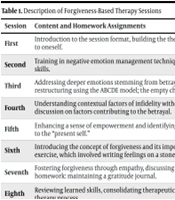
Sessions were conducted in a group format, with two groups of 15 participants each, and lasted 90 minutes weekly. Missed sessions were rescheduled individually within the same week. Posttest assessments were administered to both groups immediately after the intervention, followed by a three-month follow-up assessment. Detailed session content is presented in Table 1.
Table 1.
Description of Forgiveness-Based Therapy Sessions
| Session | Content and Homework Assignments |
|---|---|
| First | Introduction to the session format, building the therapeutic alliance, administering screening tools, emotion-mapping exercises, and homework: writing a letter to oneself. |
| Second | Training in negative emotion management techniques, including breathing exercises and the “relaxation box,” and focusing on enhancement of self-soothing skills. |
| Third | Addressing deeper emotions stemming from betrayal, including shame and worthlessness; group discussion on the impact of infidelity on self-image; cognitive restructuring using the ABCDE model; the empty chair technique; and the self-esteem mirror. |
| Fourth | Understanding contextual factors of infidelity without self-blame, explaining the concept of meaning, nonjudgmental narrative reconstruction, and guided discussion on factors contributing to the betrayal. |
| Fifth | Enhancing a sense of empowerment and identifying personal strengths through group discussion; homework: writing a letter from the “empowered future self” to the “present self.” |
| Sixth | Introducing the concept of forgiveness and its importance for mental health, group discussion on barriers to forgiveness, and the symbolic “releasing resentment” exercise, which involved writing feelings on a stone and releasing it. |
| Seventh | Fostering forgiveness through empathy, discussing the impact of forgiveness on personal functioning, the “gift of forgiveness” using positive affirmations, and homework: maintaining a gratitude journal. |
| Eighth | Reviewing learned skills, consolidating therapeutic gains, discussing relapse prevention, administering posttest evaluations, and formal termination of the therapy process. |
3.3. Instruments
The study used three standardized self-report questionnaires.
The Couple Burnout Measure (CBM), developed by Pines, is a 20-item scale that assesses marital burnout across three dimensions: physical exhaustion, such as chronic fatigue and sleep problems; emotional exhaustion, such as depression and hopelessness; and psychological exhaustion, such as feelings of worthlessness and anger toward the spouse. Higher scores indicate greater marital burnout. The Persian version of the CBM has demonstrated acceptable psychometric properties, with a Cronbach’s alpha of 0.85 and a validity coefficient of 0.72.
The Relationship Beliefs Inventory (RBI), developed by Eidelson and Epstein (8), measures irrational and maladaptive beliefs about marital relationships. This 40-item instrument is rated on a 6-point Likert scale ranging from 0, completely false, to 5, completely true. The total score reflects the overall level of dysfunctional relationship beliefs. The scale includes five subscales: disagreement is destructive, mind-reading expectations, partners cannot change, sexual perfectionism, and sexual differences. The Persian version showed good reliability, with a Cronbach’s alpha of 0.77.
The Revised Life Orientation Test (R-LOT), developed by Scheier and Carver (12), assesses dispositional optimism versus pessimism. This 10-item scale yields a total score ranging from 0 to 24, with higher scores indicating greater optimism. The Persian adaptation has demonstrated adequate reliability, with a Cronbach’s alpha of 0.74, and validity.
3.4. Data Analysis
Quantitative data were analyzed using SPSS version 26. Descriptive statistics were used to summarize demographic variables. A mixed-design repeated-measures analysis of variance was conducted to evaluate the main effects of time and group and the group × time interaction. Before analysis, assumptions of normality were assessed using the Shapiro-Wilk test, homogeneity of variances using Levene’s test, and sphericity using Mauchly’s test with Greenhouse-Geisser correction. Analyses were performed on an intention-to-treat basis with no missing data, and pairwise comparisons used the Bonferroni correction.
4. Results
The present study included 60 married women affected by spousal infidelity who were randomly allocated to an experimental group receiving forgiveness-based therapy and a control group, with 30 participants in each group. The mean age was 37.81 years (SD = 6.22) in the experimental group and 36.56 years (SD = 5.64) in the control group. There was no statistically significant between-group difference in age (P > 0.05), confirming baseline demographic comparability. All 60 participants completed the pretest, posttest, and three-month follow-up assessments, yielding a 100% retention rate with no attrition or missing data. Table 2 presents descriptive statistics, including means and standard deviations, for the study variables across the three assessment phases.
Table 2.
Descriptive Statistics of Research Variables Across Assessment Phases a
| Variables | Pre-test | Post-test | Follow-up |
|---|---|---|---|
| Marital burnout | |||
| Forgiveness-based therapy | 104.73 ± 7.31 | 97.66 ± 7.41 | 99.16 ± 6.89 |
| Control | 105.36 ± 6.81 | 106.23 ± 7.31 | 103.49 ± 6.47 |
| Dysfunctional communication beliefs | |||
| Forgiveness-based therapy | 157.36 ± 9.94 | 91.17 ± 9.94 | 99.76 ± 9.25 |
| Control | 159.13 ± 9.49 | 153.95 ± 1.92 | 163.15 ± 9.77 |
| Life orientation | |||
| Forgiveness-based therapy | 6.70 ± 2.03 | 8.23 ± 2.01 | 7.81 ± 2.23 |
| Control | 6.00 ± 1.72 | 5.63 ± 1.67 | 6.09 ± 1.74 |
a Values are expressed as mean ± SD
Before the main analyses, the assumptions of the mixed-design repeated-measures analysis of variance were evaluated. Normality was confirmed using the Shapiro-Wilk test (P > 0.05). Homogeneity of variances was supported by Levene’s test (P > 0.05). Mauchly’s test indicated a violation of sphericity for some variables; therefore, the Greenhouse-Geisser correction was applied as necessary.
Table 3 presents the results of the mixed-design repeated-measures analysis of variance. Significant group × time interaction effects were observed for all three variables, indicating that changes over time differed significantly between the experimental and control groups. The large effect sizes (η2 = 0.73 - 0.79) indicate substantial practical significance of the forgiveness-based therapy intervention.
Table 3.
Mixed-Design Repeated-Measures Analysis of Variance for the Effects of the Intervention
| Variables | SS | df | MS | F | P | η2 |
|---|---|---|---|---|---|---|
| Marital burnout | ||||||
| Time | 3371.34 | 1 | 3371.34 | 398.98 | 0.001 | 0.72 |
| Group × time | 3249.81 | 2 | 1624.91 | 192.24 | 0.001 | 0.73 |
| Dysfunctional communication beliefs | ||||||
| Time | 862.42 | 1 | 862.42 | 251.70 | 0.001 | 0.64 |
| Group × time | 2395.48 | 2 | 1197.74 | 349.56 | 0.001 | 0.79 |
| Life orientation | ||||||
| Time | 128.36 | 1 | 128.36 | 570.71 | 0.001 | 0.77 |
| Group × time | 137.08 | 2 | 68.54 | 304.75 | 0.001 | 0.78 |
Table 4 summarizes between-group differences in change scores from pretest to posttest and from pretest to follow-up, along with 95% confidence intervals and the results of pairwise comparisons. Pairwise comparisons with Bonferroni correction confirmed that improvements in the experimental group were statistically significant from pretest to posttest and were largely maintained at the three-month follow-up (P < 0.001), whereas no significant changes were observed in the control group.
Table 4.
Between-Group Differences in Mean Change Scores and Pairwise Comparisons
| Variables and Time Interval | Mean Difference (Experimental - Control) | 95% CI | P |
|---|---|---|---|
| Marital burnout | |||
| Pre-test to post-test | -8.60 | [-11.23, -5.97] | 0.001 |
| Pre-test to follow-up | -6.33 | [-8.85, -3.81] | 0.001 |
| Dysfunctional communication beliefs | |||
| Pre-test to post-test | -65.70 | [-71.85, -59.55] | 0.001 |
| Pre-test to follow-up | -58.62 | [-64.90, -52.34] | 0.001 |
| Life orientation | |||
| Pre-test to post-test | 2.50 | [1.85, 3.15] | 0.001 |
| Pre-test to follow-up | 1.72 | [1.12, 2.32] | 0.001 |
5. Discussion
The present study aimed to investigate the efficacy of forgiveness-based therapy for marital burnout, dysfunctional communication beliefs, and life orientation among women who had experienced spousal infidelity. The findings indicated that the intervention was associated with significant improvements across all three psychological domains. These results are largely consistent with previous research demonstrating the benefits of forgiveness-based interventions following relational betrayal.
Regarding the first major finding, the therapy was associated with a significant reduction in marital burnout in the experimental group. This outcome may be attributed to the core mechanisms of forgiveness therapy, which help individuals process deep-seated anger, resentment, and emotional exhaustion stemming from betrayal. This finding aligns with Chen and Sari (17), who reported that forgiveness interventions significantly reduced marital distress and emotional exhaustion. Similarly, the large effect size observed in the current study (η2 = 0.73) supports the potential clinical relevance of forgiveness-based approaches for marital outcomes.
Furthermore, the intervention was associated with a substantial reduction in dysfunctional communication beliefs. This result is consistent with Azhdari et al. (20), who highlighted the role of forgiveness in correcting dysfunctional relationship cognitions, and with Gordon et al. (9), who emphasized the importance of cognitive restructuring in recovery from infidelity. The sustained improvement at the three-month follow-up suggests that forgiveness-based therapy may produce more enduring changes in maladaptive schemas than brief supportive interventions alone.
A significant enhancement in life orientation, or dispositional optimism, represents another important finding of this study. This improvement supports the findings of Laaser et al. (14) and Kasprzak et al. (18), who linked forgiveness processes to posttraumatic growth and more positive future expectancies following relational betrayal. By fostering a renewed sense of agency, the intervention appears to help counter the pessimistic outlook commonly observed after infidelity (13).
Although the overall pattern of results is consistent with the broader literature on forgiveness-based approaches for infidelity recovery (15, 16, 19), some nuances warrant attention. For instance, the exceptionally large effect sizes in the present study may partly reflect the cultural context of the Iranian sample, in which collectivist values and religious frameworks may enhance receptivity to forgiveness processes. Future cross-cultural research is needed to determine the extent to which these findings generalize beyond this setting.
Although the findings are promising, this study has notable limitations. The sample consisted exclusively of women from a single geographic and cultural region in Guilan province, Iran, thereby limiting the generalizability of the results to men, other demographic groups, and different cultural contexts. In addition, reliance on self-report questionnaires may have introduced response biases, such as social desirability. Although the sample size was justified by power analysis and yielded large effect sizes, future studies with larger and more diverse samples are recommended. The absence of an active control group, such as one receiving another form of therapy, also limits the ability to attribute improvements specifically to forgiveness-based components rather than to nonspecific therapeutic factors.
In interpreting these results, caution is warranted. Although the observed changes were statistically significant and associated with large effect sizes, clinical significance should be examined further in future research using established minimally important difference criteria. The quasi-experimental nature of the design further necessitates careful interpretation regarding causality.
5.1. Conclusions
The findings indicate that forgiveness-based therapy is an effective psychological intervention for women who have experienced severe trauma due to spousal infidelity. The structured program significantly reduced marital burnout and dysfunctional communication beliefs while promoting a more positive life orientation. These improvements were largely sustained at the three-month follow-up. By facilitating healthy processing of anger and betrayal, the intervention appears to interrupt destructive emotional cycles and support posttraumatic growth. Integrating forgiveness-based protocols into clinical and family counseling services offers a promising evidence-based approach. Future research with larger and more diverse samples and active control groups is recommended to confirm these results.