
1. Background
Respiratory diseases, which are commonly associated with lung disease, comprise a group of conditions that impair lung function and are generally divided into two categories: Infectious and non-infectious (1, 2). Various risk factors contribute to the occurrence of respiratory infections, including environmental factors (3) and viruses such as Influenza, respiratory syncytial virus (RSV), parainfluenza, adenovirus, human rhinoviruses, and measles, which are known as the main causes of respiratory tract infections (4-8). In addition to viruses, bacteria such as Haemophilus influenzae, Staphylococcus aureus, and Mycoplasma pneumoniae, as well as fungi and parasites, can also be risk factors for respiratory diseases (9-11). According to various studies, the prevalence of respiratory diseases (both infectious and non-infectious) varies worldwide (12, 13).
The RSV accounts for 33.1 million acute lower respiratory tract infections and 3.2 million RSV-related hospital admissions, resulting in 118,200 deaths in children under five years of age worldwide (14-16). According to the World Health Organization (WHO), in Iran, 4,545 confirmed influenza cases were reported during 2019 - 2020, of which 1,032 patients tested positive. These included 824 cases with Flu B and others with Flu A, consisting of 79 cases with H1N1, 4 cases with H3N2, and 125 cases without a specified subtype (4).
Considering the high rate of spread of respiratory diseases throughout the world and the lack of proper control, these diseases impose enormous financial and physical burdens on health care systems (17). Controlling respiratory diseases, collecting sufficient data, and reducing their risks require knowledge acquired through research. However, due to limitations in resources and human power for research, priorities should be considered, and research with superior priority must be selected (18-21).
So far, various studies have been conducted worldwide on the prioritization of research related to respiratory diseases (17, 22). This prioritization may differ in each country depending on local circumstances and the epidemiological status of infectious respiratory diseases. For example, in a study conducted in 2016 in Portugal, the principal research priorities in the field of asthma included early diagnosis, lung function tests, use of inhalation therapy, and adherence to treatment (23).
In Iran, a study conducted in 2014 identified eight main domains of health economics. In order of priority, these included the human resources market, health equity, cost-income and service delivery center productivity, privatization, financing and insurance, economic evaluation of health technology, supply and demand of health care services, and payment methods (24). The priorities considered in that study were not disease-specific, including respiratory diseases, and were examined in the broader field of health economics. However, the results of other studies in Iran or globally could generally be somewhat helpful during the initial investigation to determine the main domains.
Therefore, different approaches and methods are applied to determine research priorities; however, the selection of an appropriate method depends essentially on the type of disease (17). Since each method has qualitative aspects or limitations, combining different methods enhances the quality and accuracy of the study findings (25).
2. Objectives
The present study aimed to determine research priorities in respiratory tract diseases in Iran by combining structured study methods, survey mapping, expert opinion, and focused group discussion.
3. Methods
3.1. Study Setting
This sequential exploratory mixed-method study was carried out from June 2018 to January 2019 with a group of researchers from various fields of medical science at the Infectious and Tropical Diseases Research Center of Isfahan University of Medical Sciences. The study combined qualitative and quantitative methods, conducted in three separate and consecutive phases. Since the study begins with an exploratory and qualitative phase and progresses to a quantitative phase in a sequential manner, it is referred to as a "sequential exploratory mixed-method study" (26).
3.1.1. The First Phase: Involved the Search Strategy
The respiratory infection research strategy was conducted in two steps: A structured search of international documents and expert group discussions. To identify all domains and sub-domains of respiratory disease research, documents including guidelines, procedures, and reports from international databases such as the WHO, Centers for Disease Control and Prevention (CDC), National Library of Medicine (NLM), Infectious Disease Society of America (IDSA), and National Institutes of Health (NIH) were reviewed using MeSH terms and other keywords. Additionally, published studies on research priorities in respiratory diseases were searched in databases such as the Cochrane Library, Medline, Embase, PubMed, Scopus, Ovid, UpToDate, Web of Science, NICE, and SIGN using relevant keywords (Appendix 1 in Supplementary File). All types of studies were included in this research, and the keyword searches were conducted in all parts of the papers over a ten-year period (2008 - 2018). An initial draft of the search strategy was prepared, and the domains, sub-domains, and fields were identified. Finally, the search strategy was revised and localized for Iran through three sessions of focus group discussions (FGDs) with experts in infectious diseases, pulmonology, bacteriology, virology, mycology, parasitology, and epidemiology.
3.1.2. The Second Phase: Involved Iranian Studies on Respiratory Infections
A structured review of Iranian studies published in each domain and sub-domain of the respiratory infection research strategy was performed independently for each field using PubMed, Web of Science, Scopus, as well as Iranian databases. Considering MeSH terms, keyword searches (Appendix 1 in Supplementary File) were conducted across all parts of the papers. All types of studies were eligible for inclusion over a ten-year period. For each study, various characteristics were extracted, including the year of conduction and publication, study location, study population, methodological features (such as study type, sampling method, sample size, intervention, exposure), key findings, and targeted parameters. In the subsequent stage, the quality of the studies was assessed using a two-part scoring system. The first score was assigned based on the "evidence-based studies pyramid", ranging from 9 to 1: Meta-analyses of RCTs or experimental studies (9), RCTs or experimental studies (8), meta-analyses of cohort studies (7), cohort studies (6), meta-analyses of case-control studies (5), case-control studies (4), meta-analyses of cross-sectional studies (3), cross-sectional studies (2), and case reports or case series (1) (27, 28). The second quality score was calculated by adding the "impact factor" (IF) to the inverse of the "scientific classification of journals" (1/Q) (29). Based on the total score obtained from these two metrics, the articles were categorized into three quality levels: Low (score below the median), medium (score between the median and third quartile), and high (score above the third quartile). All articles, regardless of quality level, were retained in the study.
3.1.3. The Third Phase: Involved the Domains and Sub-domains
The prioritization of respiratory infection domains and sub-domains in Iran was conducted through expert scoring using a structured checklist. Scoring for each sub-area was based on five items. For the criteria of importance, necessity, feasibility, and cost-effectiveness, a score ranging from 1 to 5 was assigned. Additionally, based on the number of articles available in each sub-area, a score ranging from 1 to 5 was also considered. In the first round, experts and specialists interested in participating were selected from each research field. The researcher-designed checklists were then distributed to determine the ranking of identified priorities in relation to the main research topics and to conduct initial screening. The responses were collected, similar comments were merged, and the outcomes were summarized in the form of charts and tables. In the second round, a checklist containing the preliminary assessment of research priorities was sent via email to all participants. Along with an explanation of the initial research results, participants were asked to review the listed priorities and submit their suggestions within one week. Ultimately, all comments and feedback were compiled and analyzed.
4. Results
Research domains and sub-domains of respiratory infections were defined across six distinct fields: Bacteria, viruses, fungi, parasites, clinical respiratory diseases, and nosocomial respiratory infections (Table 1). A multidimensional research strategy for respiratory infections was developed, incorporating the dimensions of prevention, treatment and care, epidemiology, technology, finance, guidelines, policy, ethics, insurance, and immunopathology. These dimensions formed the rows of the research framework. The columns were designed as follows: (1) Target population – categorized into individuals with underlying diseases, specific occupations, the general population, pregnant individuals, immunocompromised individuals, and travelers; (2) laboratory studies – designated for in vitro investigations. The "underlying disease" column was further sub-divided by age group: Infant, children, adult, elderly, and an additional "all age groups" column. Similarly, the "pregnancy" column was divided into the first, second, and third trimesters, along with an additional column labeled "undetermined".
Table 1.
Respiratory Infectious Diseases Studies Mapping by Area, Domain and Quality
| Areas/Domains | Clinical | Bacteria | Fungi | Nosocomial | Parasite | Virus | Total | ||||||||||||||||||
|---|---|---|---|---|---|---|---|---|---|---|---|---|---|---|---|---|---|---|---|---|---|---|---|---|---|
| Total | Quality a | Total | Quality a | Total | Quality a | Total | Quality a | Total | Quality a | Total | Quality a | ||||||||||||||
| Low | Medium | High | Low | Medium | High | Low | Medium | High | Low | Medium | High | Low | Medium | High | Low | Medium | High | ||||||||
| Prevention | 10 | 1 | 5 | 4 | 4 | 2 | 1 | 1 | 0 | - | - | - | 7 | 0 | 6 | 1 | 1 | 1 | 0 | 0 | 16 | 4 | 4 | 8 | 38 |
| Treatment and care | 16 | 7 | 5 | 4 | 33 | 11 | 20 | 2 | 10 | 10 | 0 | 0 | 1 | 0 | 1 | 0 | 1 | 1 | 0 | 0 | 14 | 8 | 3 | 3 | 75 |
| Epidemiology | 25 | 19 | 4 | 2 | 76 | 47 | 24 | 5 | 19 | 19 | 0 | 0 | 14 | 11 | 2 | 1 | 2 | 1 | 1 | 0 | 95 | 66 | 18 | 11 | 231 |
| Technology | 5 | 2 | 2 | 1 | 2 | 1 | 0 | 1 | 0 | - | - | - | 0 | - | - | - | 1 | 0 | 0 | 1 | 5 | 0 | 2 | 3 | 13 |
| Financial | 0 | - | - | - | 0 | - | - | - | 0 | - | - | - | 0 | - | - | - | 0 | - | - | - | 2 | 0 | 1 | 1 | 2 |
| Guideline | 0 | - | - | - | 1 | 1 | 0 | 0 | 0 | - | - | - | 0 | - | - | - | 0 | - | - | - | 0 | - | - | - | 1 |
| Policy | 0 | - | - | - | 0 | - | - | - | 0 | - | - | - | 0 | - | - | - | 0 | - | - | - | 0 | - | - | - | 0 |
| Ethics | 0 | - | - | - | 0 | - | - | - | 0 | - | - | - | 0 | - | - | - | 0 | - | - | - | 0 | - | - | - | 0 |
| Insurance | 0 | - | - | - | 0 | - | - | - | 0 | - | - | - | 0 | - | - | - | 0 | - | - | - | 0 | - | - | - | 0 |
| Immunopathology | 0 | - | - | - | 18 | 5 | 13 | 0 | 0 | - | - | - | 0 | - | - | - | 0 | - | - | - | 5 | 0 | 3 | 2 | 23 |
| Diagnosis | 4 | 4 | 0 | 0 | 17 | 13 | 3 | 1 | 3 | 1 | 1 | 1 | 5 | 3 | 2 | 0 | 0 | - | - | - | 24 | 16 | 4 | 4 | 53 |
| Total | 60 | 33 | 16 | 11 | 151 | 80 | 61 | 10 | 32 | 30 | 1 | 1 | 27 | 14 | 11 | 2 | 5 | 3 | 1 | 1 | 161 | 94 | 35 | 32 | 436 |
a The articles were into low, medium, and high categories based on score quality.
Initially, 3,506 information sources — including articles, reports, case reports, instructions, and guidelines — were identified in relation to respiratory infection research priorities, as part of efforts to develop a research plan for respiratory infections in Iran. These sources were collected through advanced searches of both national and international information databases. After removing 394 duplicate entries, a total of 3,112 information sources were retained for investigation. Subsequently, an experienced research team prepared an initial draft of the research priorities by identifying relevant fields, domains, and sub-domains pertaining to respiratory infection research. This search strategy was reviewed and refined through four specialized sessions involving domain-specific experts. As a result, six main fields (bacteria, fungi, viruses, parasites, clinical diseases, and nosocomial infections), 11 domains, and 42 sub-domains were finalized and localized for Iran. These findings are presented in Table 2.
Table 2.
Domains and Subdomain of Respiratory Infections Research Priority in Iran
| Domains | Subject Score a (1 - 50) | Subject Mean Score (1 - 50) | Subdomain Mean Score (1 - 50) | Overall Subdomain Rank | Overall Domain Rank | ||||
|---|---|---|---|---|---|---|---|---|---|
| Importance | Necessity | Feasibility | Cost-effectiveness | Studies Mapping | |||||
| Guideline | 1 | ||||||||
| Development and adaptation | 49.20 | 2 | |||||||
| Prevention | 48 | 50 | 48 | 50 | 50 | 49.2 | |||
| Diagnosis | 48 | 50 | 48 | 50 | 50 | 49.2 | |||
| Treatment | 48 | 50 | 48 | 50 | 50 | 49.2 | |||
| Evaluation of implementation | 50 | 50 | 50 | 50 | 50 | 50 | 50.00 | 1 | |
| Epidemiology | 2 | ||||||||
| Typing of etiologic agents-resistance genes | 40 | 26 | 22 | 20 | 48 | 31.2 | 31.20 | 20 | |
| Efficacy of vaccination | 42 | 38 | 28 | 38 | 44 | 38 | 38.00 | 18 | |
| Complication/outcome | 44 | 44 | 42 | 40 | 50 | 44 | 44.00 | 8 | |
| Emerging/re-emerging | 47.8 | 5 | |||||||
| SARS | 49 | 49.5 | 43 | 49 | 47 | 47.5 | |||
| MERS | 49 | 48 | 44 | 49 | 47 | 47.4 | |||
| Influenza | 50 | 50 | 48 | 49 | 50 | 49.4 | |||
| Other agents | 48 | 48 | 45 | 43 | 50 | 46.8 | |||
| Surveillance | 48.80 | 3 | |||||||
| Registry | 50 | 50 | 48 | 46 | 50 | 48.8 | |||
| Antibiotic registry | 50 | 50 | 48 | 46 | 50 | 48.8 | |||
| Mortality | 48 | 48 | 44 | 44 | 50 | 46.8 | 46.80 | 6 | |
| Prevalence/incidence | 48 | 48 | 48 | 48 | 50 | 48.4 | 48.40 | 4 | |
| Insurance | 46 | 46 | 36 | 42 | 50 | 44 | 44.00 | 8 | 3 |
| Diagnosis | 50 | 50 | 34 | 36 | 44 | 42.8 | 42.80 | 10 | 4 |
| Financial | 5 | ||||||||
| Prevention | 48 | 36 | 34 | 40 | 50 | 41.6 | 41.60 | 12 | |
| Care and treatment | 48 | 36 | 34 | 38 | 50 | 41.2 | 41.20 | 13 | |
| Diagnosis | 48 | 38 | 34 | 38 | 50 | 41.6 | 41.60 | 12 | |
| Research | 50 | 40 | 40 | 40 | 50 | 44 | 44.00 | 8 | |
| Treatment and care | 6 | ||||||||
| Treatment | 41.90 | 11 | |||||||
| Pharmacological | 50 | 46 | 36 | 32 | 50 | 42.8 | |||
| Non-pharmacological | 47 | 45 | 33 | 30 | 50 | 41 | |||
| Care | 48 | 48 | 44 | 42 | 48 | 46 | 46.00 | 7 | |
| Severity assessment | 46 | 34 | 40 | 40 | 48 | 41.6 | 41.60 | 12 | |
| Prognosis | 42 | 42 | 38 | 38 | 48 | 41.6 | 41.60 | 12 | |
| Drug side effects | 42 | 38 | 30 | 38 | 48 | 39.2 | 39.20 | 17 | |
| Ethics | 46 | 44 | 30 | 32 | 50 | 40.4 | 40.40 | 14 | 7 |
| Prevention | 8 | ||||||||
| Interventions | 44 | 44 | 30 | 32 | 48 | 39.6 | 39.60 | 15 | |
| Education | 42.93 | 9 | |||||||
| Community | 48 | 48 | 34 | 40 | 48 | 43.6 | |||
| Patient | 36 | 38 | 40 | 40 | 48 | 40.4 | |||
| Personnel | 44 | 44 | 44 | 44 | 48 | 44.8 | |||
| Immunoprophylaxis | 35.80 | 19 | |||||||
| Active | 48 | 48 | 34 | 24 | 42 | 39.2 | |||
| Passive | 36 | 40 | 24 | 20 | 42 | 32.4 | |||
| Policy | 39.50 | 16 | 9 | ||||||
| Education | 50 | 42 | 34 | 38 | 50 | 42.8 | |||
| Treatment | 50 | 46 | 34 | 38 | 50 | 43.6 | |||
| Research | 50 | 46 | 34 | 38 | 50 | 43.6 | |||
| Others | 30 | 25 | 20 | 15 | 50 | 28 | |||
| Immunopathology | 32 | 28 | 12 | 20 | 44 | 27.2 | 27.20 | 21 | 10 |
| Technology | 11 | ||||||||
| Vaccine development | 34 | 18 | 18 | 18 | 42 | 26 | 26.00 | 22 | |
| New method | 34 | 18 | 18 | 18 | 42 | 26 | 26.00 | 22 | |
a Scoring 1 to 5 for each sub-area was based on 5 items of importance, necessity, feasibility, cost-effectiveness, and the number of articles.
In addition, during the mapping phase of relevant respiratory infection studies, the results shown in Figure 1 indicate that 1,175 studies were initially retrieved through structured and advanced searches conducted in Iran. After removing duplicates and reviewing article abstracts and full texts, 436 studies were selected for final inclusion.
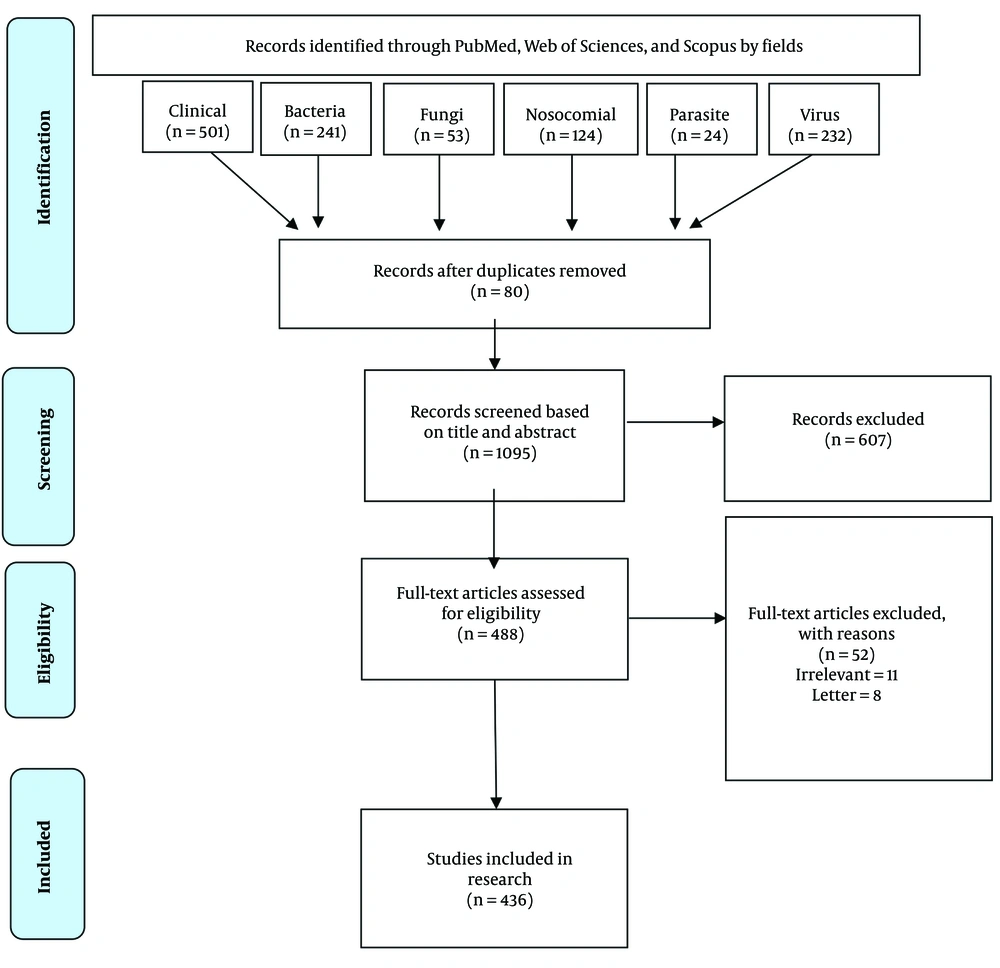
Figure 1.
Follow-up diagram of systematic review
The results showed that most studies were conducted on bacteria (36.6%) and viruses (35.6%), while only about 1% of the investigations — the lowest proportion — were focused on parasites. Following the inclusion of selected studies, research gaps in the field of respiratory infections were identified. According to the findings, although more than 50% of the recorded research involving patients with respiratory infections referred to Iranian health centers and hospitals was conducted in the field of epidemiology, and 17.1% addressed disease treatment, there was no evidence found concerning health policies, ethics, or insurance-related topics. Additionally, only three studies were found in the fields of research guidelines and investments: One study on bacteria related to research guidelines and two studies on viruses related to investment. The findings also indicated that immunopathological topics were exclusively addressed in the contexts of bacterial and viral infections. Furthermore, analysis across all fields considered in this study confirmed that the fewest studies were related to parasites, followed by fungi. In terms of study quality levels (Table 1), approximately 13% of studies were categorized as high quality, 29% as medium quality, and 58% as low quality.
Finally, the examined domains and sub-domains were scored and prioritized following discussions conducted in specialized sessions. Among the main fields, research focused on the proper design and evaluation of guidelines (educational, diagnostic, and therapeutic) and epidemiological studies were ranked first and second in priority, respectively. In contrast, studies in the fields of technology and immunopathology received the lowest rankings across all evaluated indices, including importance, necessity, feasibility, and cost-effectiveness.
Among the sub-fields considered in this study, the highest rankings were assigned as follows: (1) Guidelines assessment, (2) guidelines design, (3) research related to surveillance systems; and (4) studies on disease incidence and prevalence. These rankings are presented in Table 2 and illustrated in Figure 2.
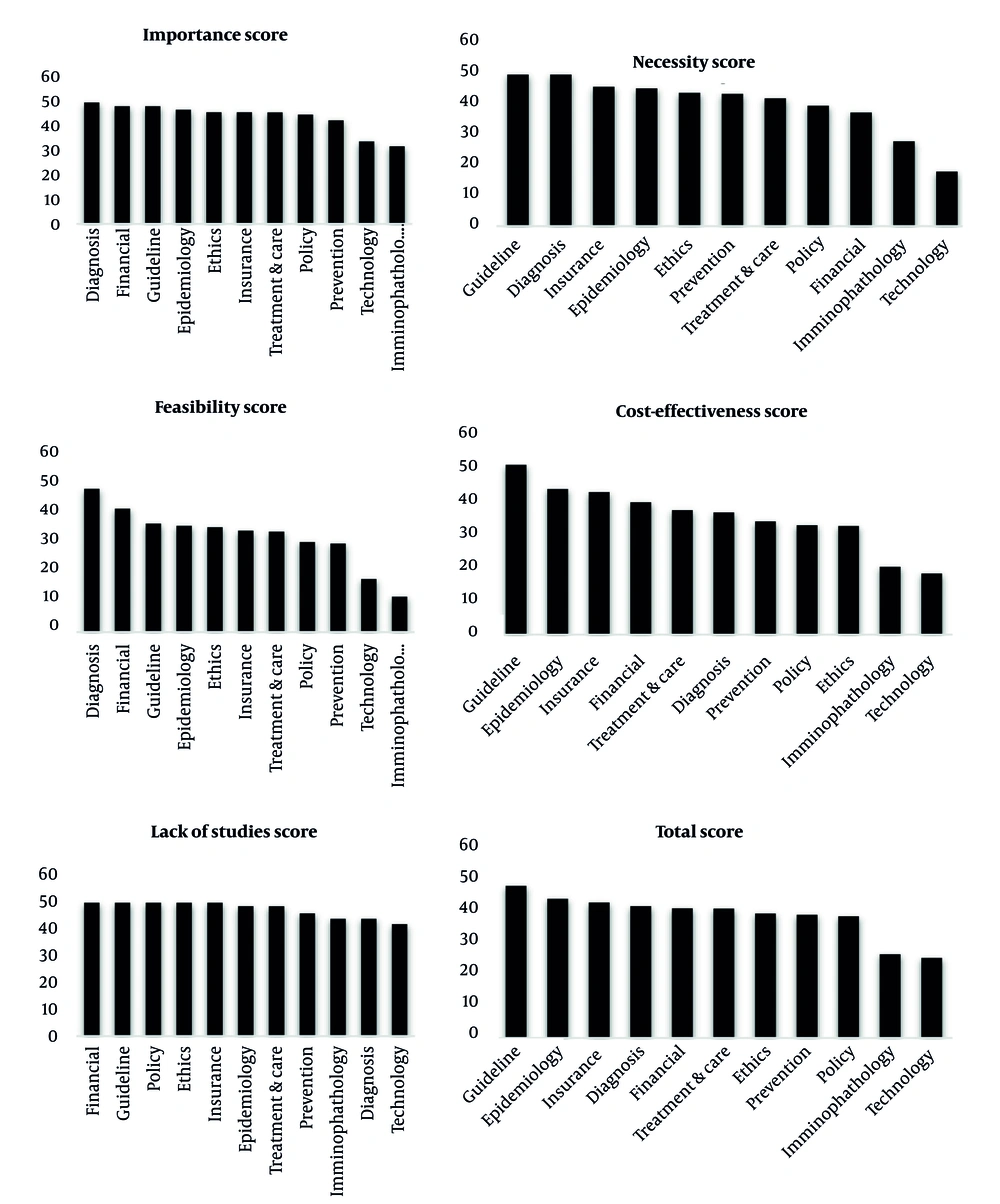
Figure 2.
Ranking domains of respiratory infections research priority in Iran based on importance, necessity, feasibility, cost-effectiveness, and studies mapping
5. Discussion
5.1. Research Focus
For respiratory infection research in Iran, 11 domains and 42 sub-domains were approved. The majority of studies were conducted on bacteria and viruses, while the fewest were on parasites and fungi. This distribution reflects the fact that bacteria and viruses play a more significant role than parasites and fungi in causing respiratory infections. One study highlighted the importance of viral and bacterial infections in the progression of chronic obstructive pulmonary disease (COPD). Another study demonstrated that most respiratory infections result from the interaction between bacteria and viruses. Consequently, a substantial portion of research on prevention, treatment, epidemiology, and control of respiratory infections has been focused on bacteria and viruses (30, 31). More than half of the research was conducted in the field of epidemiology, while no studies were identified concerning health policies, ethics, or insurance. However, identifying these significant gaps in policy-making, ethical considerations, and insurance coverage is critical. Expanding on how these gaps affect patient care and public health outcomes would strengthen this area of inquiry (32). In terms of study quality, more than half of the reviewed studies were classified as low quality, while only about one-fifth were considered high quality. Research on the proper design and evaluation of guidelines and on epidemiological studies were ranked as the first and second priorities, respectively. In contrast, research in the fields of technology and immunopathology received the lowest rankings.
The major fields for research in respiratory infections were classified based on infectious pathogenic factors, including fungal, bacterial, viral, and parasitic agents. However, clinical studies were considered an independent field due to the substantial volume of research dedicated specifically to that area. Additionally, given the significance of nosocomial infections, this was also treated as a separate field. As for laboratory-related research, because of its extensive overlap with the six identified fields, it was integrated within each of them accordingly.
From a mapping perspective, the highest concentration of studies was observed in the field of epidemiology, totaling 231 studies. Subsequent research priorities were, in descending order: Treatment and care, diagnosis, prevention, immunopathology, technology, finance, and guidelines. Notably, no studies were recorded in the areas of policy, insurance, or ethics. Considering the macro-policies of the country — which emphasize epidemiologic studies — this focus is aligned with national health priorities. In many countries, the foundation of health policy and procedures is based on findings from epidemiological research. The prioritization of interventions typically follows the identification of key and urgent health issues, after which appropriate preventive strategies are developed. In this framework, treatment is not the primary focus but rather follows the establishment of preventive measures (26). Therefore, the predominance of epidemiologic studies, followed by those related to treatment, appears to be a logical and policy-aligned trend.
Mapping studies conducted in Iran have revealed that a relatively low number of investigations have been carried out in the fields of fungal and parasitic respiratory infections. Although these two groups of pathogens are less frequently involved in respiratory infections, they hold particular importance due to their potentially lethal impact on immunocompromised patients, such as those with HIV. Therefore, there is a strong recommendation to conduct further research on these pathogenic agents in Iran (24). Immunopathology studies were found to be limited exclusively to the bacterial and viral domains. Notably, based on expert opinion assessments, the fields of technology and immunopathology were ranked as the lowest priorities when evaluated across all indices, including importance, necessity, feasibility, and cost-effectiveness. This prioritization appears logical, as further research efforts should be directed toward afflictions caused by more commonly encountered microorganisms.
5.2. Policy Gaps
The results revealed a significant gap in the domains of policy-making, guidelines, ethics, and insurance — a gap that is evident across all fields. It appears that the core principles of medical ethics — respect for patient rights, the principle of non-maleficence (do no harm), beneficence toward clients, and justice in health — have been largely overlooked. However, to assess the depth and evolution of this issue, a comprehensive analysis of trends in ethical studies is necessary to determine whether there has been an upward trajectory in attention to these areas. One possible explanation for the current neglect could be the increasing focus on managing chronic diseases and improving life expectancy, which may have redirected research priorities. With rising public health literacy, it is anticipated that ethical considerations will gain more prominence, leading to advancements in policy-making. In the future, this could foster the development of foundational, ethically informed guidelines. Conducting field research in this area will be a necessary precursor to codifying such policies. Moreover, the absence of dedicated categorizations or classifications for studies related to policy-making may partly explain the underrepresentation of this field in the current research. This is particularly significant given that every study conducted in a university, hospital, or healthcare facility inherently operates within the framework of institutional or national policies. Therefore, it is essential to analyze these policies, critically evaluate their effectiveness, and identify suitable models that can be adopted or adapted to improve public health outcomes.
5.3. Quality of Studies
The results indicated that the majority of studies on respiratory infections were not of high quality. Most of the dominant studies were observational in nature, including cross-sectional, cohort, and case-control designs. These methods are commonly used to investigate disease etiology. However, each study type follows a specific quality assessment checklist. Key elements such as accurate reporting, proper analysis in relation to the research hypothesis, identification and management of potential biases, and the structure of the report itself were among the most critical factors affecting study quality. While high-quality studies are especially valuable in guiding evidence-based decision-making in healthcare, this does not imply that studies of average or lower quality should be excluded from review. In this study, we retained all studies regardless of quality level, as is standard practice in systematic review methodologies (33). All findings were analyzed and discussed to ensure a comprehensive understanding of the research landscape.
Although the preparation of guidelines was ranked as the top research priority, the creation of a robust surveillance system and accurate disease case registration may, in practice, hold even greater importance. Without reliable case recording, it is impossible to obtain accurate information on the health status of the community. Consequently, it becomes unfeasible to develop or evaluate guidelines that reflect real-world conditions. For effective prioritization of health issues, knowledge of disease frequency, manifestations, and prevalence is essential. Cross-sectional studies, in particular, are instrumental in this regard. They are designed to help allocate human and financial resources by estimating the prevalence of health problems. These studies support the comparison and prioritization of issues, which in turn informs the distribution of relevant budgets to address them.
5.4. Emerging Diseases
At the time of performing this study, attention to emerging diseases, and particularly viral diseases, was situated in the fifth rank, but perhaps greater attention should have been paid. If this study were to be performed now, people’s viewpoints in scoring would be different, because we are now confronting the COVID-19 pandemic, which has unexpectedly caused significant harm to the physical, mental, and economic aspects of the community and government. Therefore, we can say that at different times and in different geographical regions, the priorities can vary, and this is the main provision for successful management and policy.
5.5. Strength and Limitation of the Study
Utilizing the findings of studies can help identify research priorities and requirements that need prompt attention. Consequently, limited financial and human resources can be allocated more effectively. Review studies play an essential role in health and treatment decision-making by relying on the results of previously conducted research. What this study reveals is the importance of epidemiological studies, followed closely by clinical studies, both of which were found to be strongly interconnected. However, the prioritization of research may vary in different communities, depending on factors such as the type of prevailing health problems, the acute or chronic nature of health consequences, allocated budgets, national macro policies, and public compliance.
One of the limitations of the present study was the lack of free access to all published articles in journals related to respiratory infections. Another limitation was the lack of cooperation from some relevant experts in participating in the survey and in scoring the studies. A methodological limitation of the study was the low quality of many of the studies considered. However, since no meta-analysis had been conducted in this field, these studies were included in our review.
5.6. Conclusions
The results of this study can serve as a suitable model for researchers in the field of respiratory infections. Considering the specific conditions of the country, it is advisable to prioritize epidemiological studies, along with the design and evaluation of guidelines. Although the preparation of guidelines was identified as the top priority, this does not imply that the creation of a surveillance system and proper recording of disease cases is of lesser importance. Without accurate case recording, it is impossible to obtain reliable information about the health status of the community. A call to action is suggested for researchers and policymakers to address the identified gaps and to prioritize funding for under-researched areas, particularly in the context of emerging infectious diseases.