
1. Background
Gastric cancer (GC) is the fourth most common cause of cancer-related deaths worldwide and the fifth most prevalent type of cancer. By 2040, the global burden of this disease is expected to increase by 62%, despite declining incidence rates (1, 2). Patients with stomach adenocarcinoma have an overall 5-year survival rate of only 20% - 30%, even after undergoing potentially curative surgery (3). Risk factors for GC include both non-modifiable and modifiable elements. Non-modifiable factors comprise age, sex, and race, while controllable factors include Helicobacter pylori infection, smoking, and diets high in nitrates and nitrites. Rare risk factors include a history of mucosa-associated lymphoid tissue (MALT) lymphoma, previous stomach surgery, and pernicious anemia. A family history of GC and certain inherited cancer syndromes also increase risk. Among these, hereditary diffuse GC carries the highest risk, leading to an 80% chance of developing cancer. Other syndromes associated with lower risk include Lynch syndrome, hereditary breast and ovarian cancer syndrome, Li-Fraumeni syndrome, familial adenomatous polyposis, and Peutz-Jeghers syndrome (4, 5).
The primary factors in selecting a treatment plan are disease stage, biomarker status, and the physician’s clinical judgment. In cases of early-stage disease (stage II or lower), tumor resection is prioritized over systemic chemotherapy (6). For more advanced stages, treatment typically involves partial or total gastrectomy along with removal of nearby lymph nodes, with chemotherapy or radiotherapy added depending on the extent of metastasis (7, 8). Current guidelines do not recommend surgery for Stage IV patients unless the tumor is symptomatic. Gastrectomy may be considered for palliative purposes to alleviate symptoms such as pain, bleeding, or obstruction, but is not advised for asymptomatic cases. Nevertheless, total or subtotal gastrectomy can enhance quality of life by relieving symptoms such as vomiting, hematemesis, and melena, and by facilitating improved dietary intake and a return to normal daily activities (9).
Neoadjuvant chemotherapy (NACT) refers to any preoperative chemotherapy regimen designed to shrink primary tumors and eliminate microscopic metastatic lesions, thereby increasing the likelihood of complete microscopic tumor excision or converting unresectable tumors into resectable ones (10, 11). Landmark studies, namely the MAGIC trial using the epirubicin, cisplatin, and 5-fluorouracil (ECF) regimen and the FNCLCC/FFCD ACCORD trial using the cisplatin and 5-fluorouracil (CF) regimen, have been conducted in the context of perioperative chemotherapy for resectable GC (12). Following these studies, the use of chemotherapy before and during surgery has become one of the accepted strategies to achieve optimal treatment outcomes. The epirubicin, oxaliplatin, and capecitabine (EOX) and docetaxel, cisplatin, and 5-fluorouracil (TCF) regimens are considered effective approaches for NACT in advanced and inoperable stages of GC (13, 14). Despite multiple evaluations, a universally accepted standard regimen for NACT in patients with advanced GC has not been established.
2. Objectives
The pressent study aimed to compare the response rate and side effects of the EOX chemotherapy regimen with those of the TCF regimen in the NACT of GC patients.
3. Methods
This pilot randomized clinical trial (non-inferiority design) was conducted on 40 patients with GC who were referred to the hematology-oncology clinic of Velayat Educational and Therapeutic Hospital, Qazvin, Iran, during 2023 - 2024. The study procedures were approved by the Ethics Committee of Qazvin University of Medical Sciences, Qazvin, Iran (IR.QUMS.REC.1403.286). The clinical trial registration code is IRCT20210703051769N2 (link: https://irct.behdasht.gov.ir/search/result?query=IRCT20210703051769N2). After explaining the study objectives, the cooperation process, and the roles of both researchers and participants, written informed consent was obtained from all participants. To confirm the diagnosis of GC, patients underwent endoscopy, pathological examination, abdominal and chest computed tomography (CT), and endosonography.
Inclusion criteria included patients aged over 18 years with the following conditions: Normal bone marrow function (hemoglobin ≥ 10 g/dL, absolute neutrophil count ≥ 3000/μL, platelet count ≥ 100000/μL), normal renal function [glomerular filtration rate (GFR) ≥ 45 mL/min/1.73 m2], normal liver function [serum bilirubin ≤ 1.5 × upper normal limit (UNL); SGOT and SGPT ≤ 2.5 × upper permissible limit (UPL); alkaline phosphatase ≤ 5 × UNL], and ventricular ejection fraction (VEF) ≥ 55%. Exclusion criteria included: Patients under 18 years of age, patients with metastatic disease, patients with severe dysphagia preventing the administration of oral chemotherapy, individuals with abnormal bone marrow function (hemoglobin < 10 g/dL, absolute neutrophil count < 3000/μL, platelet count < 100000/μL), renal dysfunction (GFR < 45 mL/min/1.73 m2), liver dysfunction (serum bilirubin > 1.5 × UNL; SGOT, SGPT > 2.5 × UPL; alkaline phosphatase > 5 × UNL), and VEF < 55%. Eligible patients were randomized into two intervention groups using WinPep software. The first group received the EOX treatment regimen (epirubicin 50 mg/m2 on day 1, oxaliplatin 130 mg/m2 on day 1, and capecitabine 625 mg/m2, BD, from day 1 through day 21), while the second group received the TCF treatment regimen (docetaxel 75 mg/m2 on day 1, cisplatin 75 mg/m2 on day 1, and 5-fluorouracil 750 mg/m2 from day 1 through day 5) for three cycles. As this was a pilot study, each group included 20 patients. The allocation sequence was concealed using sealed opaque envelopes. When each patient enrolled in the study, the corresponding envelope was opened, and the assigned treatment was administered accordingly. Both the patient and the physician responsible for treatment and endosonography were blinded to the treatment group. The CONSORT flowchart is presented in Figure 1.
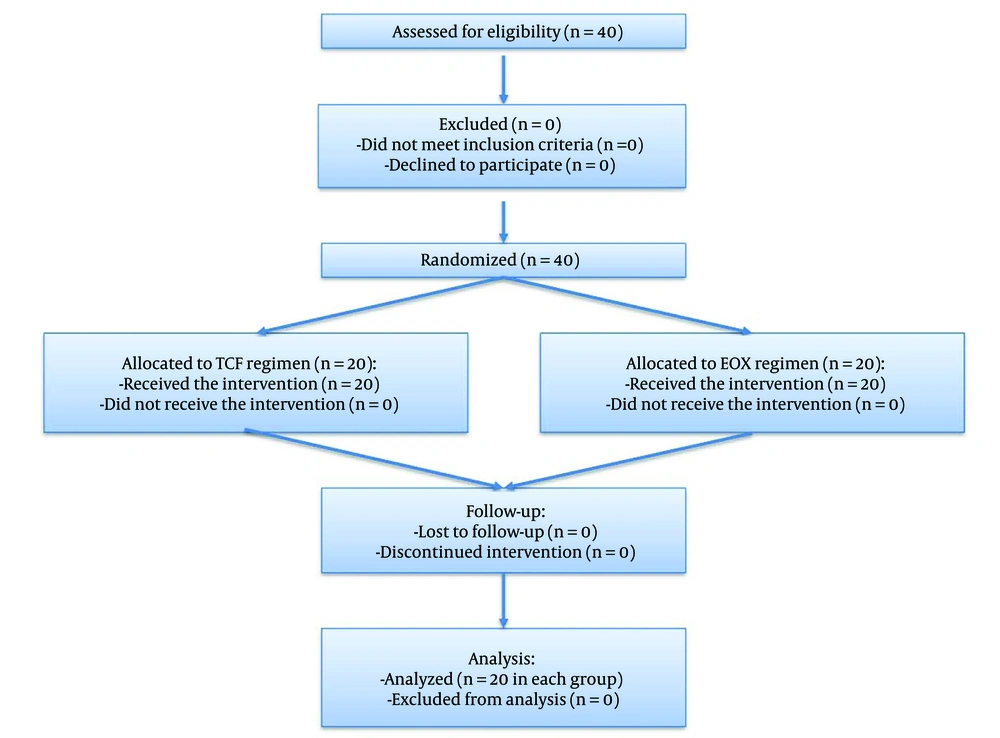
Figure 1.
CONSORT flowchart
The results at the end of the study were compared between the two groups based on treatment response. A checklist, developed with input from academic faculty members of the Hematology-Oncology Department at Qazvin University of Medical Sciences, was used to collect demographic information and laboratory results. Demographic data included age and sex, while treatment-related complications — such as neutropenia, nausea, and vomiting — were also recorded. Data analysis was performed using SPSS software version 19. Both descriptive and inferential statistical methods were employed. Descriptive statistics included frequency and percentage. To evaluate the study objectives, inferential statistics were applied, including the chi-square test, linear-by-linear association test, and the Wilcoxon signed-rank test. A P-value of less than 0.05 was considered statistically significant.
4. Results
In total, there were 23 male patients (57.7%) and 17 female patients (42.5%). In the EOX treatment group, the sex distribution included 12 males (60%) and 8 females (40%), while the TCF treatment group comprised 11 males (55%) and 9 females (45%). There was no significant difference between the two groups in terms of sex distribution (P = 0.749). The overall mean age of the patients was 63 ± 11.4 years. The average age in the EOX group was 62 ± 10.3 years, while in the TCF group it was 63.7 ± 12.5 years. No significant age difference was found between the two groups (P = 0.654) (Table 1).
Table 1.
Demographic and Baseline Information a
| Characteristics | EOX (N = 20) | TCF (N = 20) | P-Value |
|---|---|---|---|
| Age | 62 ± 10.3 | 63.7 ± 12.5 | 0.654 |
| Gender | 0.749 | ||
| Male | 12 (60) | 11 (55) | |
| Female | 8 (40) | 9 (45) |
Abbreviations: EOX, epirubicin, oxaliplatin, and capecitabine; TCF, docetaxel, cisplatin, and 5-fluorouracil.
a Values are expressed as No. (%) or mean ± SD.
A significant difference was observed between the two groups in terms of TNM stage before the intervention (P = 0.014). However, after the intervention, no significant difference was noted between the two groups (P > 0.05). Based on the pre-and-post-intervention results within each group, the EOX regimen had a greater impact on disease stages T3N1M0 and T3N2M0, whereas the TCF regimen was more effective for T3N2M0 and T4N2M0 stages. Despite these observations, the Wilcoxon test indicated that the changes within each group were not statistically significant (P > 0.05) (Table 2).
Table 2.
Comparison of Stage of the Disease According to TNM Between Two Treatment Groups Before and After Treatment Intervention a
| TNM | TCF | EOX | P-Value Before | P-Value After | ||
|---|---|---|---|---|---|---|
| Before | After | Before | After | |||
| T2N0M0 | - | - | - | 1 (5) | 0.014 | 0.965 |
| T2N1M0 | - | 7 (35) | - | 6 (30) | ||
| T2N2M0 | - | 1 (5) | - | - | ||
| T3N0M0 | - | 1 (5) | - | 2 (10) | ||
| T3N1M0 | 1 (5) | 4 (20) | 7 (35) | 1 (5) | ||
| T3N2M0 | 6 (30) | 2 (10) | 7 (35) | 4 (20) | ||
| T3N3M0 | 2 (10) | - | 1 (5) | 1 (5) | ||
| T4N1M0 | 3 (15) | - | 2 (10) | 2 (10) | ||
| T4N2M0 | 6 (30) | 4 (20) | 3 (15) | 3 (15) | ||
| T4N3M0 | 2 (10) | 1 (5) | - | - | ||
| Wilcoxon sign-rank test | Z = -1.28, P = 0.198 | Z = -1.04, P = 0.306 | - | - | ||
Abbreviations: TCF, docetaxel, cisplatin, and 5-fluorouracil; EOX, epirubicin, oxaliplatin, and capecitabine.
a Values are expressed as No. (%).
Regarding overall staging, there was a significant difference between the two groups before the intervention (P = 0.04); however, this difference was not present after the intervention (P > 0.05). Within each group, the EOX regimen showed a greater effect on stage IIIA disease, while the TCF regimen had a more pronounced effect on stages IIIC and IIIB. According to the Wilcoxon test, the changes within each group were statistically significant (P < 0.05) (Table 3).
Table 3.
Comparison of Stage of the Disease Between Two Treatment Groups Before and After Treatment Intervention a
| Stages | TCF | EOX | P-Value Before | P-Value After | ||
|---|---|---|---|---|---|---|
| Before | After | Before | After | |||
| IB | - | - | - | 1 (5) | 0.04 b | 0.634 |
| II | - | 8 (40) | - | 9 (45) | ||
| IIIA | 7 (35) | 7 (35) | 14 (70) | 5 (25) | ||
| IIIB | 3 (15) | - | 2 (10) | 1 (5) | ||
| IIIC | 10 (50) | 5 (25) | 4 (20) | 4 (20) | ||
| Wilcoxon sign-rank test | Z = -3.6, P = 0.000 b | Z = -3.5, P = 0.000 b | - | - | ||
Abbreviations: TCF, docetaxel, cisplatin, and 5-fluorouracil; EOX, epirubicin, oxaliplatin, and capecitabine.
a Values are expressed as No. (%).
b P < 0.05 was considered statistically significant.
There was no significant difference between the two groups in terms of the degree of differentiation before and after the intervention (P > 0.05). Based on the results within each group, the TCF regimen had a greater impact on poorly differentiated changes, while the EOX regimen had a more notable effect on moderately differentiated changes. However, according to the Wilcoxon test results, the changes before and after the intervention were statistically significant only in the TCF group (P = 0.025) (Table 4).
Table 4.
Comparison of the Degree of Differentiation Between Two Treatment Groups Before and After Treatment Intervention a
| Histology | TCF | EOX | P-Value Before | P-Value After | ||
|---|---|---|---|---|---|---|
| Before | After | Before | After | |||
| Poor | 7 (35) | 5 (25) | 6 (30) | 6 (30) | 0.382 | 0.692 |
| Moderate | 11 (55) | 10 (50) | 8 (40) | 5 (25) | ||
| Well | 2 (10) | 5 (25) | 6 (30) | 9 (45) | ||
| Wilcoxon sign-rank test | Z = -2.2, P = 0.025 | Z = -1.7, P = 0.083 | - | - | ||
Abbreviations: TCF, docetaxel, cisplatin, and 5-fluorouracil; EOX, epirubicin, oxaliplatin, and capecitabine.
a Values are expressed as No. (%).
According to the results of the chi-squared test, there was no significant difference between the two groups regarding post-intervention complications (P > 0.05). Nevertheless, overall, complications following chemotherapy — particularly nausea and vomiting — were observed less frequently in patients treated with the EOX regimen (Table 5).
Table 5.
Comparison of Complications Between Two Treatment Groups After the Intervention a
| Complications | TCF | EOX | P-Value After |
|---|---|---|---|
| Neurtropenia | 0.978 | ||
| No | 11 (55) | 12 (60) | |
| Yes | 9 (45) | 8 (40) | |
| Nausea and vomiting | 0.333 | ||
| No | 6 (30) | 10 (50) | |
| Yes | 14 (70) | 10 (50) |
Abbreviations: TCF, docetaxel, cisplatin, and 5-fluorouracil; EOX, epirubicin, oxaliplatin, and capecitabine.
a Values are expressed as No. (%).
5. Discussion
Recent studies have shown that NACT in many patients with inoperable GC is associated with improved quality of life and a reduction in cancer-related symptoms (15). Despite these findings, there is currently no universally accepted standard chemotherapy regimen for advanced GC (16). Accordingly, the present study aimed to compare the response rate and side effects of the EOX and TCF chemotherapy regimens for NACT in patients with GC referred to Velayat Educational and Therapeutic Hospital, Qazvin, Iran.
The results of our study indicated that, prior to the intervention, there was a significant difference between the two groups in terms of TNM classification and disease stage. However, no significant differences were observed between the groups after the intervention. The EOX regimen was more effective in patients with disease stages T3N1M0, T3N2M0, and IIIA, whereas the TCF regimen had a greater impact on stages T4N2M0, T3N2M0, IIIB, and IIIC. Furthermore, there was no significant difference between the two groups regarding the degree of differentiation before and after the intervention. Nonetheless, the TCF regimen was more effective in inducing changes in poorly differentiated tumors, while the EOX regimen had a greater effect on moderately differentiated tumors. Although there has been ongoing research into GC treatment interventions in recent years, few studies have directly compared the effectiveness of treatment regimens such as EOX versus TCF. For example, Samiei et al. evaluated the effectiveness of the EOX regimen as NACT in patients with locally advanced gastric or gastroesophageal junction cancer. Among 28 patients, 75% experienced tumor downstaging, with resectability improving from 28.5% before treatment to 82.1% after treatment. Most patients transitioned from stage III to stage II following therapy. The most common complication associated with this regimen was grade III and IV neutropenia, occurring in 25% of patients. Overall, the tolerability of the regimen was favorable, with a significant therapeutic response and a reduction in disease stage (17). In another study, Ilhan-Mutlu et al. compared the effectiveness and safety of the TCF regimen with the modified EOX (mEOX) regimen in patients with upper gastrointestinal adenocarcinoma. The DCF regimen demonstrated a higher response rate (28% vs. 10%) and a longer time-to-progression (26 weeks vs. 20 weeks) compared to mEOX. However, overall survival was similar between the two groups — 54 weeks for DCF versus 52 weeks for mEOX. These findings suggest that both regimens have comparable efficacy, although DCF may offer a slight advantage in terms of response and disease progression (18). In the present study, there was no significant difference between the EOX and TCF regimens in terms of treatment response. One possible explanation for this outcome could be the differences in disease stage at baseline. In our study, the disease stage differed significantly between the two groups before the intervention, although there was no significant difference in the degree of tumor differentiation.
In a clinical trial conducted by Ahmadzadeh et al., the effectiveness and safety of the modified DCF (mDCF) and EOX regimens were evaluated in 40 patients with advanced GC. The median survival was 14 months in the mDCF group and 15 months in the EOX group, with no statistically significant difference between them. Progression-free survival was slightly better in the EOX group, though this difference was also not significant. Toxicity and side effects were similar in both treatment arms (19). These findings are consistent with the results of the present study.
The current study also demonstrated that, although no statistically significant difference was observed between the two groups in terms of post-intervention complications, the overall incidence of chemotherapy-related side effects was lower with the EOX regimen. In our study, neutropenia occurred less frequently in the EOX group (40%) compared to the TCF group (45%). In a clinical trial by Xiang et al., the efficacy and safety of the EOX regimen were investigated in Chinese patients with advanced GC. Among 48 patients, the overall response rate was 51.1%, including two complete responses and 22 partial responses. The median progression-free survival was 6.5 months, and the median overall survival was 10.4 months. Grade III–IV neutropenia was reported in 22.9% of patients, while non-hematological toxicities included alopecia (18.9%), nausea (8.3%), and vomiting (6.3%) (20). Ochenduszko et al. compared the effectiveness and safety of the EOX and mDCF regimens in patients with advanced HER2-negative gastric or gastroesophageal cancer. Their findings showed that the median overall survival was 9.5 months in the EOX group and 11.9 months in the mDCF group, although this difference was not statistically significant. Progression-free survival was similar between the two groups (6.4 vs. 6.8 months). The mDCF regimen demonstrated a higher two-year survival rate (22.2% vs. 5.2%) without significantly increasing toxicity. However, the EOX regimen was associated with higher rates of nausea (34.5% vs. 15.4%), thromboembolic events (13.8% vs. 7.7%), abdominal pain (13.8% vs. 7.7%), and grade 3 - 4 neutropenia (72.4% vs. 50.0%). On the other hand, EOX resulted in lower rates of anemia (44.8% vs. 61.5%), mucositis (6.9% vs. 15.4%), and peripheral neuropathy (6.9% vs. 15.4%) compared to the mDCF regimen (21).
Although the differences between these studies were not statistically significant, the higher incidence of neutropenia observed in the TCF group in our study may be attributed to the lack of granulocyte colony-stimulating factor (G-CSF) administration during the early stages of neutropenia and limitations in G-CSF management. Previous studies have explored this issue, and their findings regarding complications are consistent with those of our study. In a study by Shah et al., the safety and efficacy of an mDCF regimen were compared with the standard DCF regimen in patients with metastatic gastric or gastroesophageal junction adenocarcinoma. The mDCF regimen exhibited lower toxicity rates compared to standard DCF, resulting in fewer hospitalizations. The six-month progression-free survival rate was 63% for mDCF versus 53% for standard DCF, while median overall survival was significantly improved in the mDCF group (18.8 vs. 12.6 months). The most common side effects in the mDCF group included neutropenia (56%), leukopenia (44%), and thromboembolism (20%) (22). Another study comparing DCF and mDCF in metastatic GC further confirmed that mDCF offers a better toxicity profile. Specifically, the incidence of grade III–IV neutropenia was significantly lower with mDCF (13.6%) compared to DCF (48.2%). Other adverse events were also reduced with mDCF, including anemia (4.5% vs. 21.2%), nausea (13.6% vs. 44.7%), and vomiting (4.5% vs. 31.8%). Despite the differences in toxicity, response rates and survival outcomes were similar between the two regimens, with no statistically significant differences in progression-free or overall survival. These findings support the conclusion that mDCF is associated with reduced toxicity while maintaining comparable efficacy to standard DCF (23).
5.1. Conclusions
In summary, the results of our study indicate that both TCF and EOX chemotherapy regimens demonstrate comparable efficacy in the treatment of advanced GC. However, the EOX regimen was associated with a lower incidence of side effects. Based on these findings, both regimens can be considered viable first-line treatment options, with the choice tailored to the patient's clinical condition and tolerance to chemotherapy. To strengthen the evidence base, future studies with larger sample sizes are recommended, along with comprehensive evaluations of both short-term and long-term complications associated with these regimens.
![The Phase 2 Study of "(TOX) Preoperative Chemotherapy" Response Rate and Side Effects in [Locally Advanced Operable Gastric Adenocarcinoma] Patients With Docetaxel, Oxaliplatin and Capcitabine](https://brieflands.com/journals/ijcm/articles/80420/figures/thumbnail.webp)