


1. Background
In December 2019, the coronavirus disease 2019 (COVID-19) was first reported in Wuhan, China, and has grown rapidly into a global pandemic (1-3). Although most COVID-19 cases are mild or without symptoms, some patients experience serious conditions such as viral pneumonia, acute respiratory distress syndrome (ARDS), or failure of multiple organs (4). The clinical parameters, including older age, high blood pressure (hypertension), diabetes, and pre-existing heart conditions, have been recognized as the major risk factors that make people more vulnerable to the development of severe forms of COVID-19. These agents can weaken the immune system or cause chronic inflammation, making it harder for the body to fight the viral infection effectively (5).
In addition to clinical parameters, growing evidence suggests that genetic factors, including single nucleotide polymorphisms (SNPs), play an important role in determining the severity of COVID-19. Single nucleotide polymorphisms are common genetic variations in the human genome which can be implicated in the immune response to SARS-CoV-2 infection by influencing the host's susceptibility, resistance, and severity of COVID-19 (6, 7). Recent genome-wide association studies (GWASs) have enabled the detection of the most frequent SNPs in genes implicated in the immune response to SARS-CoV-2 infection (8, 9).
The interferon (IFN) signaling pathway, crucial for antiviral immunity, has gained attention due to its involvement in the early immune response against viral infections (10, 11). Type I interferons (IFN-I), particularly IFNα and IFNβ, activate immune responses through their receptors (IFNAR1 and IFNAR2) (12), triggering downstream pathways that inhibit viral replication and promote the expression of IFN-stimulated genes such as oligoadenylate synthase (OAS) proteins (13-15). The OAS family, consisting of the OAS1, OAS2, and OAS3 genes, encodes antiviral proteins that activate RNase L, resulting in the degradation of cellular and viral RNA, inhibition of protein synthesis, and prevention of viral replication (16). Furthermore, IFN-Is are crucial components of the innate antiviral defense, acting through the Janus kinase-signal transducer and activator of transcription (JAK-STAT) pathway via the IFNAR2 receptor to induce antiviral gene expression (17). Disruption of this signaling, particularly by SARS-CoV-2, may contribute to inadequate immune responses and increased disease severity (18, 19).
Notably, SNPs in the IFNAR2 gene, encoding the IFN-α/β receptor, and the OAS3 gene have been associated with increased risk of severe outcomes (8, 20, 21). Recently, rs2236757 in the IFNAR2 gene (chr21q22.1) and rs10735079 in a gene cluster encoding OAS1, OAS2, and OAS3 (chr12q24.13) have been introduced as candidate SNPs associated with severe COVID-19 (8). These SNPs may influence antiviral responses, but studies show conflicting results regarding their impact on COVID-19 severity, leaving their exact role unclear.
Therefore, this study aims to investigate the association between clinical risk factors and COVID-19 severity, as well as evaluate the potential contribution of two immune-related SNPs, rs2236757 in the IFNAR2 gene and rs10735079 in the OAS3 gene. We sought to determine whether these immune-related genetic variations contribute to the severity of COVID-19, and to provide further insight into their potential role in discovering the host response to SARS-CoV-2 infection.
2. Methods
2.1. Study Participants
This case-control study included 315 COVID-19 patients who were ≥ 18 years old and diagnosed with SARS-CoV-2 virus infection using a quantitative reverse transcriptase-polymerase chain reaction (qRT-PCR) test on nasal and pharyngeal swab specimens. Subjects were classified into two groups based on disease severity. The non-severe (control) group consisted of 209 cases with mild or moderate symptoms, such as fever, hypoxia, or viral pneumonia, but not meeting the criteria for severe disease. These patients had an oxygen saturation (SpO₂) ≥ 93% and were not hospitalized. The severe (case) group included 106 patients with a respiratory rate ≥ 30 breaths per minute, oxygen saturation ≤ 90%, or those requiring either invasive or non-invasive mechanical ventilation. These patients were admitted to the infectious units or intensive care units (ICU) of Booalisina and Velayat Hospitals in Qazvin between June 2020 and January 2021.
2.2. Ethics Statement and Data Collection
After the approval of the study protocol by the medical ethics committee of Qazvin University of Medical Sciences (registration ID: IR.QUMS.REC.1400.452), all the patients were informed about the particulars of the study and signed informed consent prior to sample acquisition or inclusion in the study. Individuals who received any COVID-19 vaccination were excluded from the study. Patient clinical data including demographic characteristics, symptoms, comorbidities, and outcomes were collected using a well-structured questionnaire from their medical records or through interviews with patients or their companions, and all information was kept strictly confidential.
2.3. Sampling and DNA Extraction
Genomic DNA was extracted from 2 mL of peripheral whole blood samples gathered from all participants in ethylenediaminetetraacetic acid (EDTA)-containing tubes, using the SinaClon DNA isolation kit according to the manufacturer's instructions. The quantity of isolated genomic DNA was determined spectrophotometrically at A260, while its quality was evaluated by the A260/280 ratio and confirmed by 1% agarose gel electrophoresis.
2.4. IFNAR2 rs2236757 and OAS3 rs10735079 Genotyping
The genotypes of the IFNAR2 rs2236757 and OAS3 rs10735079 SNPs were determined using the simple and low-cost tetra-amplification refractory mutation system-polymerase chain reaction (T-ARMS-PCR). This method uses one pair of outer primers [forward outer (FO) and reverse outer (RO)] as an internal control and allele-specific inner primers [forward inner (FI) and reverse inner (RI)] that generate distinct fragment sizes to differentiate homozygous and heterozygous genotypes. Primer sequences (Table 1) were designed using the Primer1 tool (22) and validated for specificity using BLAST and oligo-analyzer software.
Table 1.Sequences and Melting Temperatures of the IFNAR2 rs2236757 and OAS3 rs10735079
| SNP/Primers | Primers Sequence | Size (bp) | Tm (℃) |
|---|---|---|---|
| IFNAR2 rs2236757 (A/G) | |||
| OF | 5'-ATAAGTGTATGTAGGTGTAGTTTTCTGA-3' | 28 | 61.52 |
| OR | 5'-AGACTTTATTACTGCTTGCTCATCACTG -3' | 28 | 61.71 |
| IF | 5'-CAAATCCCAAAAGAGATTAAGGCATA -3' | 26 | 57.99 |
| IR | 5'-TCATTAAGACTGAGAATTTCATTTAGATGC -3' | 26 | 55.33 |
| OAS3 rs10735079 (G/A) | |||
| OF | 5'-ACTTGTTCCAGACAAAGGCAGAGAAACC-3' | 28 | 67.48 |
| OR | 5'-GTCTGTCCCACTAGACACACTTCTAAGC-3' | 28 | 68.52 |
| IF | 5' -GTTGTTAGCAGTAGGGTCCTGGGGCCA-3' | 23 | 57.99 |
| IR | 5'-ATACAAGATTTTGCAGTATTCTGGTGTC-3' | 25 | 57.53 |
Abbreviations: SNP, single nucleotide polymorphism; OF, outer forward primer; OR, outer reverse primer; IF, inner forward primer; IR, inner reverse primer.
Polymerase chain reaction (PCR) reactions were performed in a 15 μL volume containing template DNA, Taq polymerase, Master Mix, and optimized concentrations of outer and inner primers. Touchdown PCR protocols were applied for both SNPs to enhance amplification specificity. For rs2236757 and rs10735079, cycling conditions included an initial denaturation at 95°C, followed by touchdown cycles with gradually decreasing annealing temperatures, and final extension steps at 72°C.
To validate the genotyping result, outer-primer PCR products from a subset of samples were subjected to Sanger sequencing, which fully confirmed the T-ARMS-PCR results.
2.5. Statistical Analysis
R software analysis (version 4.4.1) was used for statistical analysis. To assess the Hardy-Weinberg equilibrium (HWE) for genotype distributions, the chi-square (χ2) test was employed. The frequencies of alleles and genotypes were compared between subject groups using Bayesian logistic regression. Odds ratios (ORs) with 95% confidence intervals (CIs) were calculated to investigate the relationship of two polymorphisms with COVID-19 severity. To characterize quantitative data, variables with normal distribution are shown as mean ± standard deviation (SD). A P-value less than 0.05 was set as the significance level. Haploview software was utilized to evaluate HWE and linkage disequilibrium. To determine if genotype frequencies deviated from those expected under HWE, the χ2 test was employed.
3. Results
3.1. Clinical and Demographic Findings
Table 2 summarizes the demographic and clinical characteristics of the study groups, analyzed using the t-test and chi-squared test. Overall, 315 patients with SARS-CoV-2 infection, including 209 non-severe COVID-19 patients and 106 severe COVID-19 patients (ICU group), were evaluated in this study. The mean ± SD age values of non-severe and severe patients were 36.50 ± 11.18 and 62.80 ± 15.70 years, respectively. Our results showed the odds of disease severity increased with increasing age (OR = 1.14, 95% CI = 1.11–1.18, P < 0.0001). Gender distribution did not differ significantly between non-severe and severe cases (P = 0.414). Also, underlying diseases such as hypertension (36.84%), diabetes (27.66%), and cardiovascular disease (17.02%) were significantly more frequent in the ICU group and were strongly associated with COVID-19 severity (P < 0.001). In the univariate analysis of clinical symptoms, the prevalence of cough and shortness of breath was considerably higher in the severe group (82.61% vs. 55.5%, OR = 3.81, P < 0.001). Interestingly, fever was significantly more common in non-severe COVID-19 patients (70.33% vs. 34.07%, OR = 0.22, P < 0.001). In addition, smoking was significantly less common among severe patients (20.38% vs. 5.32%, OR = 0.22, P = 0.002).
| Variables (Parameters) | Non-severe (N = 209) | Severe (N = 106) | OR (95% CI) | P-Value |
|---|---|---|---|---|
| Age (y) | 36.50 ± 11.18 | 62.80 ± 15.70 | 1.14 (1.11, 1.18) | < 0.001 |
| Gender | 0.82 (0.51, 1.32) | 0.414 | ||
| Male | 120 (56.34) | 53 (51.46) | ||
| Female | 93 (43.66) | 50 (48.54) | ||
| BMI (kg/m2) | 26.56 ± 4.18 | 24.33 ± 4.21 | 0.86 (0.69, 1.04) | 0.14 |
| Diabetic | 4 (1.89) | 26 (27.66) | 19.88 (7.43, 69.19) | < 0.001 |
| Hypertension | 10 (4.72) | 35 (36.84) | 11.78 (5.7, 26.42) | < 0.001 |
| Cardiovascular diseases | 9 (4.25) | 16 (17.02) | 4.63 (2, 11.35) | < 0.001 |
| Fever | 147 (70.33) | 31 (34.07) | 0.22 (0.13, 0.37) | < 0.001 |
| Cough and dyspnea (shortness of breath) | 111 (55.5) | 76 (82.61) | 3.81 (2.12, 7.19) | < 0.001 |
| Smoking | 43 (20.38) | 5 (5.32) | 0.22 (0.07, 0.53) | < 0.002 |
Abbreviations: OR, odds ratio; CI, confidence interval.
a Values are expressed as No. (%) or mean ± SD unless otherwise indicated.
b 315 COVID-19 patients were separated into two groups: Severe who were admitted to the ICU, and non-severe. The association of clinical parameters and COVID-19 severity was explored.
3.2. Genotype and Allele Frequencies of the Studies Single Nucleotide Polymorphisms
The genotyping of rs2236757 and rs10735079 polymorphisms was performed using Tetra-ARMS PCR with specific primers and confirmed by Sanger sequencing (Figure 1).
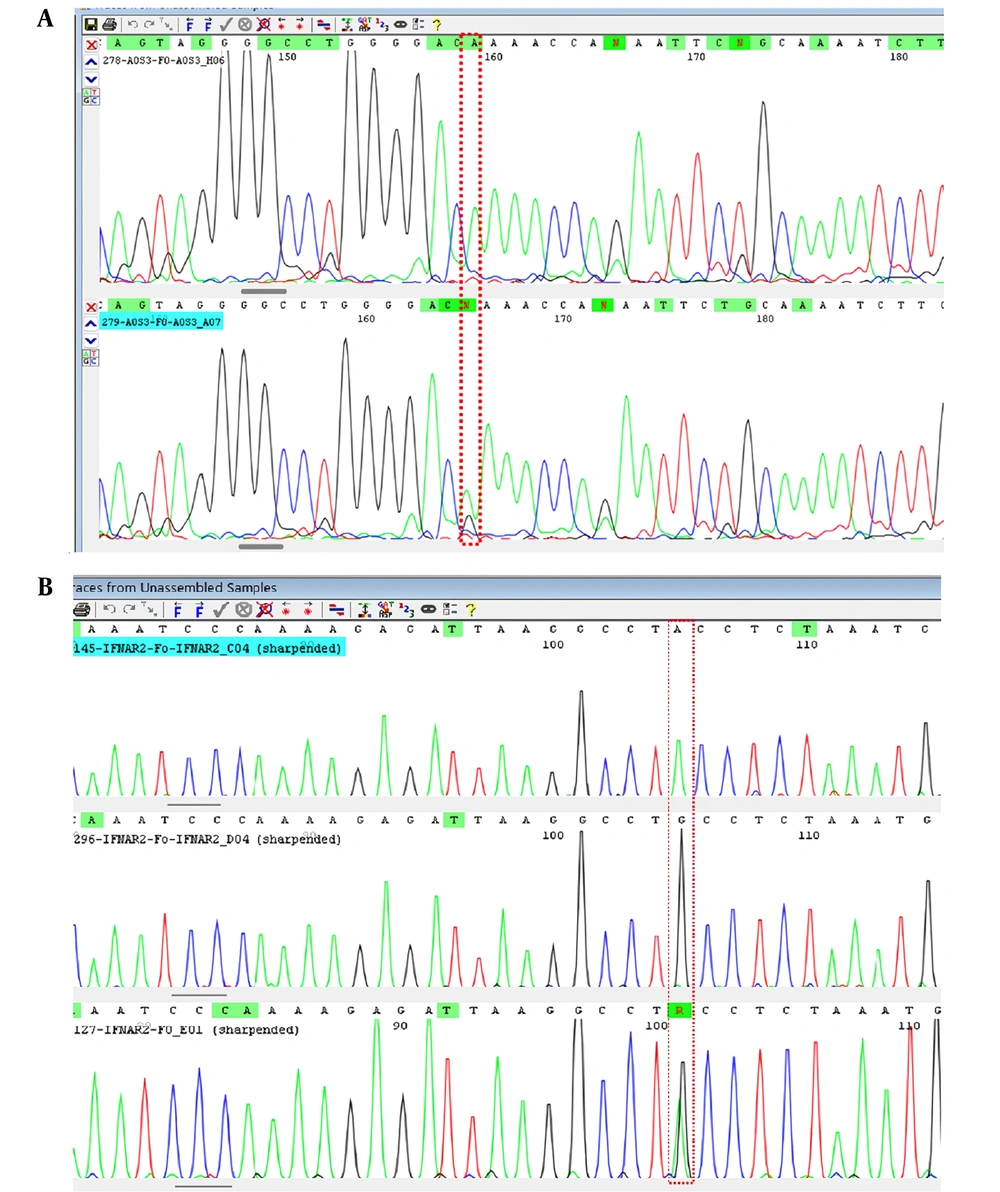
Figure 1.
Confirmation of the results of rs2236757 (A) and rs10735079 (B) polymorphisms by the sequencing method
Table 3 displays the frequency and distribution of alleles and genotypes for the rs2236757 G > A and rs10735079 A > G variants in non-severe and severe groups. As shown in Table 3, there were no statistically significant differences in the distribution of IFNAR2 rs2236757 genotypes and alleles between non-severe and severe patients. All studied SNPs were in Hardy-Weinberg equilibrium (P > 0.05). Furthermore, calculated ORs for the rs10735079 A > G variation revealed that this polymorphism is not associated with severe COVID-19. However, the G (minor) allele of rs10735079 A > G was non-significantly more common in COVID-19-severe participants compared to the non-severe group (OR = 1.17, 95% CI = 0.834 - 1.642, P = 0.355). Bayesian logistic regression analysis also showed no significant association of either variant, or their interaction, with disease severity (all P > 0.4).
Table 3.Genetic Association Analysis of IFNAR2 and OAS3 Polymorphisms with Severity in COVID-19 Patients a
| Genotype/Allele | Non-severe (N = 209) | Severe (N = 106) | OR (CI 95%) | P-Value |
|---|---|---|---|---|
| rs2236757_IFNAR2 | ||||
| GG b | 40.67 (85) | 41.51 (44) | - | - |
| GA | 48.8 (102) | 47.17 (50) | 0.948 (0.581, 1.538) | 0.8293 |
| AA | 10.53 (22) | 11.32 (12) | 1.047 (0.477, 2.279) | 0.8975 |
| G b | 65.07 (272) | 65.09 (138) | - | - |
| A | 34.93 (146) | 34.91 (74) | 1 (0.71, 1.419) | 0.9958 |
| rs10735079_OAS3 | ||||
| AA b | 25.38 (50) | 23.08 (24) | - | - |
| AG | 44.67 (88) | 41.35 (43) | 1.014 (0.556, 1.847) | 0.9675 |
| GG | 29.95 (59) | 35.58 (37) | 1.296 (0.69, 2.418) | 0.4162 |
| A b | 47.72 (188) | 43.75 (91) | - | - |
| G | 52.28 (206) | 56.25 (117) | 1.17 (0.834, 1.642) | 0.3559 |
Abbreviations: OR, odds ratio; CI, confidence interval.
a Values are expressed as No. (%) unless otherwise indicated.
b Baseline level.
4. Discussion
The severity and clinical outcomes of COVID-19 vary among patients, influenced by demographic factors and underlying health conditions. In addition, host genetic differences have been shown to play an important role in the severity of the disease. In recent studies, polymorphisms related to the immune response have been investigated to better understand susceptibility to severe forms of COVID-19 (23). Although GWAS reports have suggested a possible association between variants in the IFNAR2 and OAS3 genes (which are important in antiviral immune pathways) and disease severity, population-based findings in this area remain unclear, highlighting the need for further studies.
In this study, to better understand the factors affecting disease severity, we first examined clinical and demographic variables such as age, comorbidities, and respiratory symptoms in 315 Iranian patients with COVID-19 (confirmed by qRT-PCR) in two groups: Non-severe and severe (admission to ICU). We then investigated the role of two important genetic polymorphisms-rs2236757 in the IFNAR2 gene and rs10735079 in the OAS3 gene.
Analysis of 209 non-severe and 106 severe cases revealed that older age, underlying diseases like diabetes, hypertension, and cardiovascular disorders, as well as symptoms such as cough and shortness of breath (dyspnea), were significantly associated with COVID-19 severity. These findings indicated a notable clinical difference between the two groups. In line with our findings, previous studies report that underlying conditions contribute to a substantial proportion of severe COVID-19 cases worldwide (24). In a study by Guan et al. in China, from 1,590 COVID-19 patients, 399 (25.1%) had at least one underlying disease, and 130 (8.2%) had two or more. The most common comorbidities in these patients were hypertension (16.9%), diabetes (8.2%), heart disease (3.7%), and chronic kidney disease (1.3%) (25). Also, in another study by Hashemi-Shahri et al. on 413 COVID-19 patients in Iran, underlying diseases, including cardiovascular, liver, and lung diseases, hypertension, and rheumatism, were identified as risk factors for developing severe forms of COVID-19 (19). A systematic review and meta-analysis of 28 studies (6,270 patients) reported that approximately 41% of patients had underlying diseases, which were significantly associated with worse outcome. The strongest associations were observed for cerebrovascular disorders, cardiovascular diseases, chronic lung disease, cancer, diabetes, and hypertension (26). Consistent with these data, our study also demonstrated that clinical comorbidities play a dominant role in determining COVID-19 severity. These clinical characteristics therefore appear to contribute more substantially to disease progression, whereas, as shown in the following section, the investigated SNPs did not exhibit a comparable effect.
When we examined the association between rs2236757 and rs10735079 with COVID-19 severity, our findings showed the G allele of rs10735079 appeared to be more prevalent in severe cases, but this association was not significant. Furthermore, neither the OR analysis nor the interaction between these two variants showed a significant association with disease severity. Although an OR > 1 for rs10735079 indicated a trend towards an increased risk of severe COVID-19. In line with our results, the A allele of the rs2236757 polymorphism has been reported to be associated with reduced COVID-19 severity in 954 patients studied, supporting a protective role for this variant (27). In a study by Dieter et al. in a Brazilian population, similar to our results, no significant differences were observed in the distribution of rs2236757 between non-severe and severe COVID-19 patients. There was also no significant difference between survivors and non-survivors. However, in non-white patients, the AA genotype was associated with more severe clinical outcomes, indicating a possible role of ethnicity in the impact of this polymorphism (28). Similarly, another study on 154 participants found no significant difference in the genotype distribution of rs10735079 in the OAS3 gene (P = 0.091), although it reported a significant association between rs2236757 and COVID-19 severity and symptoms such as shortness of breath and sore throat (P = 0.001) (16). Also, a large study by Pairo-Castineira et al. with 2,244 patients admitted to ICU in the United Kingdom also reported different results, finding that the rs10735079 polymorphism in the OAS1/OAS2/OAS3 gene cluster as well as the A allele of the rs2236757 gene were significantly associated with increased COVID-19 severity (8), which is in contrast to the results of our study.
These conflicting results suggest that although these polymorphisms may play a role in immune-related pathways, their individual or combined effects may be modulated by other genetic or environmental factors. Alternatively, our study sample size may not have been sufficient to detect genetic effects. In the current study, some limitations were found that should be addressed in future research. Healthy and deceased individuals were not included in this study, and therefore no comparisons were made between them. Also, further studies including different ethnicities and larger sample sizes are recommended to confirm this finding.
4.1. Conclusions
Our findings revealed that clinical factors such as older age, diabetes, hypertension, and dyspnea were significantly associated with COVID-19 severity. In contrast, no statistically significant associations were observed for the genetic polymorphisms rs2236757 (IFNAR2) and rs10735079 (OAS3). However, the higher frequency of the rs10735079 OAS3 GG genotype in severe cases suggests a potential trend that warrants further consideration. Given the complexity of host-virus interactions, it is likely that disease severity is influenced by a broader network of genetic variants. Therefore, examining additional SNPs across immune-related genes could provide a more comprehensive understanding of genetic susceptibility to COVID-19. Future studies with larger and more ethnically diverse cohorts, alongside functional analyses, are recommended to clarify the role of these and other variants, and to investigate their biological impact on antiviral immune responses.


