
Cover image of the article: Inflammatory Bowel Disease: An Updated Review of Diagnosis, Management, and Emerging Therapies

Image Credit:J Inflamm Dis

Inflammatory Bowel Disease: An Updated Review of Diagnosis, Management, and Emerging Therapies

Authors

Mohammadamin Eslami SamarinMohammadamin Eslami Samarin ORCID1, 2, Ehsan MohsenikhahEhsan Mohsenikhah ORCID1, Ali Asghar HemmatiAli Asghar Hemmati ORCID3,*, Yeganeh MazaheriYeganeh Mazaheri ORCID4

Abstract

Context:

Inflammatory bowel disease (IBD), comprising Crohn’s disease and ulcerative colitis, is a chronic, relapsing inflammatory disorder of the gastrointestinal tract with a rising global burden. Despite an expanding therapeutic armamentarium, many patients fail to respond or lose response, and endoscopic remission remains elusive. Therefore, clinicians need a clear understanding of how the newest agents are positioned and what treatments are in development.

Evidence Acquisition:

This narrative review, prepared in accordance with the SANRA recommendations, is based on literature available through October 2026. PubMed/MEDLINE, Scopus, Web of Science, and ClinicalTrials.gov were searched using combinations of disease terms with development and mechanism terms; reference lists were screened, and congress abstract books were hand-searched. Randomised trials at phase 2 or later, their extensions, prospective cohorts, guidelines, and mechanistic studies were eligible; case reports, editorials, non-English publications, and abstracts without data were excluded. The search returned 3111 records. Target, phase, endpoint, safety, and stated limitations were extracted; no quantitative synthesis was performed.

Results:

Diagnosis still relies on endoscopy with biopsy, although faecal calprotectin and other biomarkers increasingly inform treatment targets and drug selection. Beyond conventional agents, the development pipeline is organized by pathway: TL1A/DR3 blockade is closest to approval and may also address fibrosis; oral IL-23 receptor antagonism yields induction rates comparable with those of subcutaneous p19 antibodies; selective JAK1 inhibition aims to reduce class toxicity; TNFR1-sparing TNF blockade, oral α4-integrin antagonists, and RIPK1 inhibitors offer more selective approaches; and strategies targeting cAMP/PKA, PD-1, PSGL-1, NLRX1, IL-7R, and miR-124 remain at an early stage. Dual-target combinations produced the largest induction effects reported to date. The evidence is limited by uneven development, non-interchangeable endpoints, and scarce head-to-head data.

Conclusions:

IBD therapy is moving from broad immunosuppression toward pathway-specific, biomarker-guided treatment. Clinicians should systematically position and sequence agents, treat to objective targets, and remain vigilant for infection when advanced therapies are combined; the most promising agents remain investigational.

How to Cite:Eslami Samarin M, Mohsenikhah E, Hemmati AA, Mazaheri Y. Inflammatory Bowel Disease: An Updated Review of Diagnosis, Management, and Emerging Therapies. J Inflamm Dis. 2026;30(3):e174989. doi: https://doi.org/10.69107/jid-174989

1. Context

Inflammatory bowel disease (IBD) comprises two chronic, relapsing inflammatory conditions of the digestive tract, Crohn’s disease (CD) and ulcerative colitis (UC) (1). UC causes continuous colorectal inflammation with bloody diarrhoea and urgency, whereas CD is transmural, may involve any segment and typically shows skip lesions and complications such as strictures, fistulas and perianal disease (2-4). IBD has stabilised in industrialised countries while rising steeply elsewhere, a pattern attributed to environmental factors acting on a genetic background of susceptibility (5); genetic evidence now also links specific gut microbial taxa and circulating metabolites to disease risk (6). Because it affects young adults, the relapsing course, long-term treatment and risk of surgery burden patients and health-care systems (7).
Treatment has evolved substantially over the past two decades. Biologics targeting TNF-α, integrins, and interleukins, as well as oral small molecules such as JAK inhibitors and sphingosine-1-phosphate receptor modulators, have supplemented and, in many patients, superseded corticosteroids, aminosalicylates, and immunomodulators (8-10). Yet about one third of patients do not respond to a given agent, many lose response over time, and endoscopic remission remains elusive (11, 12). This therapeutic ceiling sustains an active treatment pipeline and underscores the need for clinicians to understand the pathways targeted by the newest agents (5, 13).

2. Evidence Acquisition

This narrative review follows the SANRA recommendations (14) and does not generate primary data. PubMed/MEDLINE, Scopus, Web of Science, and ClinicalTrials.gov were searched through October 2026, with priority given to the most recent evidence for each agent; reference lists of retrieved reviews were also screened. Disease terms were combined with development and mechanism terms (TL1A, IL-23, JAK, TNF, integrin, α4β7, MAdCAM-1, RIPK1, cAMP, PD-1, PSGL-1, NLRX1, IL-7R, miR-124, extracellular vesicles, drug repurposing), and major congress abstract books were hand-searched. Randomised trials at phase 2 or later, their extensions, prospective cohorts, guidelines, and mechanistic studies were eligible; case reports, editorials, non-English publications, and abstracts without data were excluded. Target, phase, endpoint, safety, and stated limitations were recorded for each agent; no quantitative synthesis was performed. The core search returned 3111 records, from which the sources cited here were selected.

3. Results

Table 1.
Comparative Evidence Map of the Agents Reviewed (Selected Agents) a
AgentTargetPhaseKey Efficacy SignalMain Limitation
TulisokibartTL1APhase 3Remission 25% vs 1.5% placeboCompanion-diagnostic design
DuvakitugTL1A (DR3-sparing)Phase 2bRemission 36 – 48% vs 20%Phase 2b only
AfimkibartTL1APhase 250% endoscopic improvement at week 5682% anti-drug antibodies
IcotrokinraIL-23 receptor (oral)Phase 2bResponse 63.5% vs 27%Phase 2b in IBD
IvarmacitinibJAK1Phase 3Response 43.9 – 46.3% vs 26.8%No head-to-head data
Carotegrast methylα4-integrinApproved (Japan)Response 45% vs 21%Less gut-selective
OntamalimabMAdCAM-1Phase 3 (stopped)Positive phase 2 (TURANDOT)Terminated for commercial reasons
ABBV-668 / eclitasertibRIPK1Phase 2Epithelial necroptosis blockadeResults awaited
OrismilastPDE4 (cAMP)Phase 2aRemission in one thirdGastrointestinal intolerance
OmilancorLANCL2 (cAMP/PKA)Phase 2Remission 30.4% vs 3.7%Subgroup analysis
LusvertikimabIL-7R (CD127)Phase 2Remission 22% vs 4%Abstract data; lymphopenia
ObefazimodmiR-124Phase 3Durable maintenanceModest phase 2b induction
Guselkumab + golimumabIL-23p19 + TNFPhase 2bResponse 83.1% vs 74.6% / 61%Infection risk unclear
Vedolizumab + upadacitinibα4β7 + JAKPhase 2Endoscopic remission 37.5% vs 15.1%Open-label design
a Agents are grouped by the pathway they target; efficacy signals are the figures reported by the cited studies and are not comparable across trials. Abbreviations: DR3, death receptor 3; FC, faecal calprotectin; IL, interleukin; JAK, Janus kinase; MAdCAM-1, mucosal addressin cell adhesion molecule 1; PDE4, phosphodiesterase 4; RIPK1, receptor-interacting protein kinase 1; TL1A, TNF-like ligand 1A; TNF, tumour necrosis factor; UC, ulcerative colitis.

3.1. Diagnosis

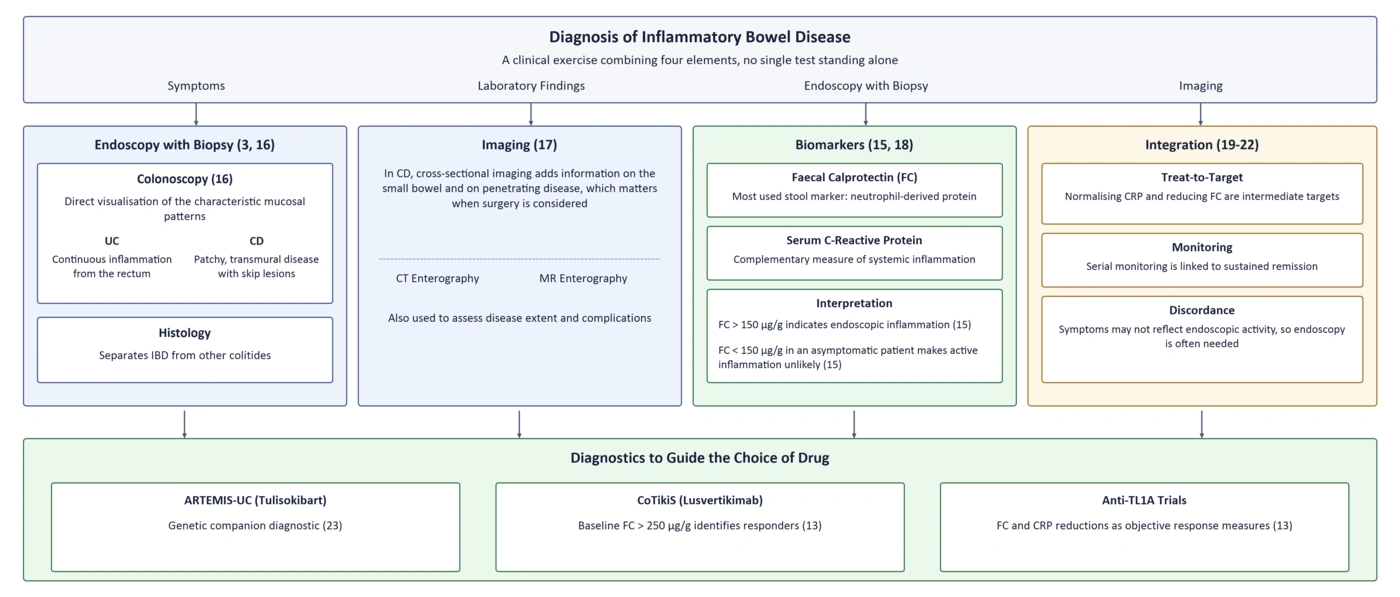
Diagnosis combines symptoms, laboratory findings, endoscopy with biopsy and imaging (Figure 1). Endoscopy with histology remains the reference standard (3, 15): it shows continuous rectal inflammation in UC or patchy, transmural disease with aphthous ulcers in CD (16) and distinguishes IBD from other colitides, while cross-sectional imaging adds information on the small bowel and penetrating disease (17). Faecal calprotectin (FC) is the most used stool marker, with serum C-reactive protein (CRP) as a complement (18); an FC > 150 µg/g indicates endoscopic inflammation, whereas a value < 150 µg/g in an asymptomatic patient makes active inflammation unlikely (15). Normalising CRP and reducing FC are intermediate targets in treat-to-target paradigms (19-21), and serial monitoring is associated with sustained remission (22). Biomarkers are also entering drug selection: ARTEMIS-UC used a genetic companion diagnostic (23), and in CoTikiS a baseline FC > 250 µg/g identified the patients who benefited most (13).
Integrated diagnostic framework and disease activity assessment in inflammatory bowel disease.
Figure 1.
Integrated diagnostic framework and disease activity assessment in inflammatory bowel disease.

3.2. Management and Standard of Care

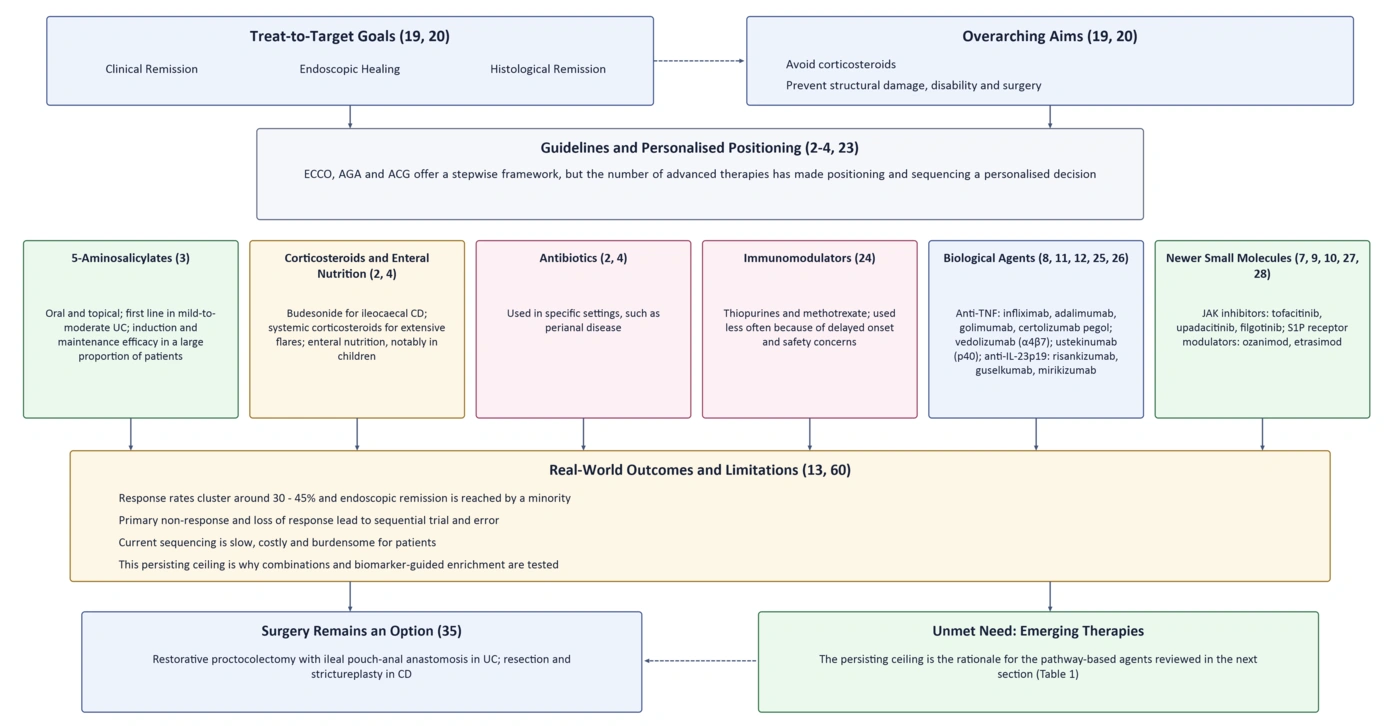
Treatment goals have shifted from symptom control to objective endpoints—clinical, endoscopic, and increasingly histological remission—to avoid corticosteroids and prevent disability and surgery (19, 20). ECCO, AGA, and ACG guidelines offer a stepwise framework (Figure 2), but the growing number of advanced therapies has made their positioning and sequencing more personalized (2-4, 23). Oral and topical 5-aminosalicylates remain first-line treatments for mild-to-moderate UC (3), whereas budesonide, corticosteroids, enteral nutrition, and, for perianal disease, antibiotics are used in CD (2, 4); thiopurines and methotrexate are used less often because of their delayed onset and safety concerns (24). In moderate-to-severe disease, anti-TNF agents first demonstrated that endoscopic healing was achievable, vedolizumab added a gut-selective option (8), and ustekinumab further expanded the treatment choices (11, 12, 25). Anti-IL-23p19 antibodies (risankizumab, guselkumab, mirikizumab) (26-28), JAK inhibitors (tofacitinib, upadacitinib, filgotinib) (7, 9, 29), and sphingosine-1-phosphate receptor modulators (ozanimod, etrasimod) (10, 30) followed.
Management and standard of care in inflammatory bowel disease, and the unmet need that drives the emerging therapies.
Figure 2.
Management and standard of care in inflammatory bowel disease, and the unmet need that drives the emerging therapies.
Treatment also reaches beyond the bowel wall: in a cross-sectional analysis, anti-TNF-α therapy was independently associated with lower bone mineral density, with osteoporosis observed in 65.5% of patients versus 20.7% of those receiving azathioprine-based regimens (31). In children, disease severity fell markedly after infliximab induction (32).

3.3. Emerging Therapies by Molecular Pathway

3.3.1. The TL1A/DR3 Axis

TL1A, a TNF superfamily member encoded by TNFSF15, is the most advanced of the new targets, and TNFSF15 variants have long been linked to IBD (33). Expressed mainly by antigen-presenting cells after Toll-like receptor stimulation, TL1A binds death receptor 3 on lymphocytes, recruits TRADD, TRAF2, and RIP1, and drives NF-κB, MAPK, Th1, Th17, and innate lymphoid responses (34). Through TGF-β1/Smad3 signaling in myofibroblasts, it also promotes collagen deposition and fibrosis, which no approved biologic addresses (35). Both ligand and receptor are upregulated in inflamed gut, suggesting a relatively gut-specific target (13).
Tulisokibart reached phase 3: in ARTEMIS-UC, clinical remission was about 25% versus just over 1.5% with placebo (23). Duvakitug, which spares the TL1A–DcR3 pathway, produced remission in 36% and 48% of patients at 450 and 900 mg, respectively, versus 20% with placebo (33). Afimkibart showed 50% endoscopic improvement and 36% remission at week 56 in TUSCANY-2, but the anti-drug antibody rate was 82% in phase 2a (13). Extended half-life constructs (XmAb942, SPY002) and the p40×TL1A bispecific RO7837195 are earlier in development (34). No head-to-head data are available, and long-term safety is unknown.

3.3.2. The IL-23/Th17 Pathway

The IL-23/Th17 axis has been validated by p19 antibodies (26-28, 36), and IL23R variants were among the first strong associations with IBD (37). IL-23 signals through JAK2/TYK2 and STAT3/STAT4 to stabilize pathogenic Th17 responses (38). Icotrokinra (JNJ-2113), a first-in-class oral macrocyclic peptide that antagonizes the IL-23 receptor without affecting IL-12, achieved a clinical response in 63.5% of patients versus 27% with placebo at week 12 in the phase 2b ANTHEM-UC trial (39, 40); it is approved for plaque psoriasis but remains investigational in IBD. Picankibart (IBI112) met the phase 2 primary endpoint in Chinese patients with UC (13). Oral blockade thus matches the induction rates of subcutaneous p19 antibodies; phase 3 data are awaited.

3.3.3. JAK/STAT Signalling

Tofacitinib and upadacitinib established JAK inhibition as the foundation of oral IBD therapy (9, 29), and development now targets selectivity because IL-6, IFN-γ, IL-13, and the γc cytokines converge on JAK1 (41). Ivarmacitinib (SHR0302), a selective JAK1 inhibitor, achieved a week-8 response in 43.9 - 46.3% of patients versus 26.8% with placebo in phase 2 UC, with a reassuring short-term safety profile; a phase 3 programme is under way (13). Whether selectivity improves the class risk–benefit ratio, as assessed by herpes zoster, venous thromboembolism, and cardiovascular events, remains unproven.

3.3.4. TNF/TNFR Signalling

Anti-TNF antibodies neutralize both soluble and membrane TNF, and this broad activity has a cost (42). TNFR1 drives NF-κB, MAPK, apoptosis, and necroptosis, whereas TNFR2 mediates Treg survival and tissue repair. Balinatunfib (SAR441566), an oral molecule that stabilizes the asymmetric form of soluble TNF, blocks TNFR1 while sparing TNFR2 and is being studied in a phase 2 trial in UC that is recruiting about 204 patients; no efficacy data are yet available (13).

3.3.5. Gut Homing and Integrins

Vedolizumab showed that blocking lymphocyte traffic to the gut is effective and safe (8); the challenge is to reproduce this effect orally. Migration depends on α4β7 binding to MAdCAM-1 and α4β1 binding to VCAM-1. Carotegrast methyl (AJM300), an oral α4-integrin antagonist that blocks both integrins, produced a 45% week-8 response versus 21% with placebo in phase 3 and became the first orally available α4-integrin antagonist to be approved (43, 44). MORF-057 and emvistegrast are more α4β7-selective; MORF-057 lowered the histopathology score by 6.4 points, with 31.4% remission at week 52 (13). Targeting the ligand instead, ontamalimab was positive in the phase 2 TURANDOT trial, although the phase 3 programme was terminated for commercial reasons (45). Safety, rather than efficacy, remains an unresolved issue for the class.

3.3.6. RIPK1 and Necroptosis

Attention is also shifting from immune cells to the epithelium (46). RIPK1 is central to epithelial cell death: TNFR1 and NOD1/NOD2 signals drive the RIPK1/RIPK3 complex to phosphorylate MLKL and trigger necroptosis, a lytic form of cell death that releases damage-associated molecular patterns and amplifies inflammation (47). Excessive mucosal necroptosis has been implicated in refractory IBD (5). The oral RIPK1 inhibitors ABBV-668 and eclitasertib are undergoing or have completed phase 2 trials in UC, with results pending, whereas the earlier inhibitor GSK2982772 did not separate from placebo (13).

3.3.7. Activating Endogenous Anti-Inflammatory Pathways

A parallel strategy engages endogenous anti-inflammatory machinery rather than blocking mediators, and much of this strategy converges on cAMP/PKA (48). Orismilast, a PDE4 inhibitor that raises cAMP, produced remission in one third of patients in phase 2a, with notable gastrointestinal intolerance (13); PL-8177, an oral melanocortin-1 receptor agonist that induces IL-10 and suppresses NF-κB, produced remission in 33% of patients versus none receiving placebo (49); and omilancor, a gut-restricted LANCL2 agonist that couples cAMP/PKA to IL-2/STAT5, stabilizes mucosal FOXP3+ regulatory T cells (50) and produced remission in 30.4% of patients versus 3.7% with placebo in the active-disease subgroup (13).
Rosnilimab, a PD-1 agonist antibody, depletes PD-1-high pathogenic helper T cells, and enrollment in the phase 2 ROSETTA trial in UC has been completed (51); leiolizumab engages PSGL-1 to induce exhaustion of activated effector T cells, and a phase 2a study is ongoing in biologic-refractory UC (52); and the NLRX1 agonist amelenodor produced a response in 8 of 11 patients versus none receiving placebo, although the program was stopped (13). Lusvertikimab, an anti-CD127 antibody that blocks the IL-7 survival signal, produced remission in 22% (450 mg) and 16% (pooled arms) of patients versus 4% with placebo at week 10 in CoTikiS, with the greatest benefit among patients with a baseline FC > 250 µg/g (53, 54). Obefazimod (ABX464) increases miR-124, which suppresses STAT3 and boosts IL-22, and its durable maintenance makes it one of the most advanced oral agents (53, 54).

3.3.8. Dual-Target Combinations

Combining two targets may raise the ceiling. In VEGA, guselkumab plus golimumab achieved a clinical response at week 12 in 83.1% of patients with UC, compared with 74.6% with guselkumab and 61% with golimumab (55), and the DUET programmes are extending evaluation of the combination. When trafficking blockade was combined with intracellular inhibition, vedolizumab plus upadacitinib achieved endoscopic remission in 37.5% versus 15.1% with vedolizumab alone and clinical remission in 65% versus 35.6% (56). Two biologics used together in refractory CD had already shown a favorable benefit–risk balance (57), and co-formulated antibodies are being developed for quarterly dosing (34). These are proof-of-principle studies, none of which was powered to assess infection.

3.3.9. Drug Repurposing and Cell-Free Therapy

A FAERS pharmacovigilance analysis found lower-than-expected reporting of IBD with dulaglutide (ROR 0.181), liraglutide (0.419), empagliflozin (0.400), metformin (0.446), and sitagliptin (0.460) (58). Metformin acts through AMPK and NF-κB, GLP-1 receptor agonists through cAMP/PKA, and SGLT2 inhibitors through AMPK and Nrf2 (59). These signals are hypothesis-generating and may be most relevant in the presence of coexisting metabolic disease. In preclinical studies, orally administered lyophilised mesenchymal stromal cell-derived extracellular vesicles reduced disease activity and restored barrier integrity in DSS colitis (55, 56), but clinical translation remains years away.

3.4. Synthesis of the Evidence and Its Limitations

Taken together, agents in late development are no longer variations on TNF blockade but engage distinct nodes, from TL1A/DR3 and the IL-23 receptor to epithelial cell death and endogenous circuits such as cAMP/PKA, PD-1, PSGL-1, NLRX1, IL-7R, and miR-124 (13, 48). The ceiling persists: response rates cluster around 30 - 45%, endoscopic remission is achieved by a minority, and differences from placebo are modest (13, 60), which is why combinations and biomarker-guided enrichment are being tested. Compared with recent pipeline reviews and guidelines (2-5, 13, 24), this review is organized by pathway, places inhibitory strategies alongside activating strategies, and links diagnostics to drug choice.
Several gaps limit the conclusions. Development is uneven; several compounds are known mainly from congress abstracts; endpoints range from clinical to histological, are assessed at weeks 8 to 52, and are not interchangeable; multi-drug-refractory patients, older patients, pregnant women, and children are under-represented; head-to-head trials are almost absent; immunogenicity remains an obstacle; and programs have been stopped for futility or commercial reasons. Literature selection was author-driven and restricted to English-language publications, and no formal quality appraisal was undertaken. Therefore, the evidence is best read as a map of mechanisms and development status rather than as a ranking of efficacy.

4. Conclusions

The therapeutic landscape of IBD is increasingly shaped by two complementary strategies: blocking key pro-inflammatory pathways—TL1A/DR3, IL-23/Th17, JAK/STAT, TNF/TNFR1, RIPK1, and α4β7-mediated gut homing—and enhancing endogenous regulatory pathways, such as cAMP/PKA, PD-1, PSGL-1, NLRX1, IL-7R, and miR-124. Together, these strategies are moving treatment toward a pathway-specific and personalized approach.
The contribution of this review lies in its presentation: agents in development through 2026 are assembled into a pathway-based map showing their stage, key efficacy signal, and main limitation (Table 1), and diagnostics are linked to drug choice. Positioning and sequencing now determine outcomes more than the number of available drugs, and choices should be guided by objective targets (20, 22, 60). Biomarker-guided selection is becoming feasible, as demonstrated by the ARTEMIS-UC companion diagnostic and the benefit of lusvertikimab at a baseline FC > 250 µg/g (12, 60, 61). The combinations that produced the largest induction effects also make infection risk a practical concern, supporting screening for tuberculosis and hepatitis B, vaccination before treatment, and surveillance when two advanced agents are used (23, 62, 63).
For internists, the value lies in the framework of available and imminent mechanisms, bearing in mind that decisions reach beyond the intestine (29); for infectious disease specialists, it lies in the immunogenicity of the antibody classes, the infection signal of dual-target therapy, and the lymphopenia seen with IL-7 receptor blockade; for patients, it lies in oral options that avoid injections, longer remission with treatments that also address fibrosis, and less corticosteroid exposure, hospitalization, and surgery; and for the health sector, it lies in the services that position and sequence advanced therapies, in pharmacy and health-technology assessment, and in trial design. These agents remain largely investigational and do not replace guideline-based care.
Footnotes

  • AI Use Disclosure:Claude was used for minor text editing in the abstract section.

  • Authors' Contribution:MES contributed to the conception and design of the review, literature search, analysis and interpretation of the literature, manuscript drafting, and figure preparation.EM contributed to the literature search, analysis and interpretation of the literature, manuscript drafting, and preparation and refinement of the figures.AH contributed to the conception and design of the review, critical revision of the manuscript for important intellectual content, and overall supervision of the study.YM contributed to the literature search, analysis and interpretation of the literature, manuscript drafting, and figure preparation.

  • Conflict of Interests Statement:MES, EM, AH, and YM have no relevant funding or research support, financial interests, stock or share ownership, consultation fees, or patents. The authors have no relevant personal or professional relationships or unpaid organizational memberships, and none of the authors is an editorial board member or reviewer of this journal.

  • Funding/Support:This narrative review received no specific funding or financial support from public, commercial, or non-profit organizations.

References

  • 1.
    Xia B, Crusius J, Meuwissen S, Peña A. Inflammatory bowel disease: Definition, epidemiology, etiologic aspects, and immunogenetic studies. World J Gastroenterol. 1998;4(5):446-458. [PubMed ID: 11819343]. [PubMed Central ID: PMC4767749]. https://doi.org/10.3748/wjg.v4.i5.446.
  • 2.
    Torres J, Bonovas S, Doherty G, Kucharzik T, Gisbert JP, Raine T, et al. ECCO guidelines on therapeutics in Crohn's disease: Medical treatment. J Crohns Colitis. 2020;14(1):4-22. [PubMed ID: 31711158]. https://doi.org/10.1093/ecco-jcc/jjz180.
  • 3.
    Rubin DT, Ananthakrishnan AN, Siegel CA, Sauer BG, Long MD. ACG clinical guideline: Ulcerative colitis in adults. Am J Gastroenterol. 2019;114(3):384-413. [PubMed ID: 30840605]. https://doi.org/10.14309/ajg.0000000000000152.
  • 4.
    Lichtenstein GR, Loftus EV, Isaacs KL, Regueiro MD, Gerson LB, Sands BE. ACG clinical guideline: Management of Crohn's disease in adults. Am J Gastroenterol. 2018;113(4):481-517. [PubMed ID: 29610508]. https://doi.org/10.1038/ajg.2018.27.
  • 5.
    Petronio L, Dal Buono A, Gabbiadini R, Migliorisi G, Privitera G, Ferraris M, et al. Drug development in inflammatory bowel diseases: What is next? Pharmaceuticals (Basel). Pharmaceuticals (Basel). 2025;18(2):190. [PubMed ID: 40006003]. [PubMed Central ID: PMC11858795]. https://doi.org/10.3390/ph18020190.
  • 6.
    Ge C, Zhu L, Lu Y, Huo L, Sun MX, Zheng JZ, et al. Causal relationship between gut microbiota, serum metabolites and inflammatory bowel disease: A Mendelian randomization study. Jundishapur J Microbiol. 2025;18(4). e159080. https://doi.org/10.5812/jjm-159080.
  • 7.
    Feagan BG, Danese S, Loftus EV, Vermeire S, Schreiber S, Ritter T, et al. Filgotinib as induction and maintenance therapy for ulcerative colitis (SELECTION): A phase 2b/3 double-blind, randomised, placebo-controlled trial. Lancet. 2021;397(10292):2372-2384. [PubMed ID: 34090625]. https://doi.org/10.1016/s0140-6736(21)00666-8.
  • 8.
    Feagan BG, Rutgeerts P, Sands BE, Hanauer S, Colombel JF, Sandborn WJ, et al. Vedolizumab as induction and maintenance therapy for ulcerative colitis. N Engl J Med. 2013;369(8):699-710. [PubMed ID: 23964932]. https://doi.org/10.1056/nejmoa1215734.
  • 9.
    Sandborn WJ, Su C, Sands BE, D'Haens GR, Vermeire S, Schreiber S, et al. Tofacitinib as induction and maintenance therapy for ulcerative colitis. N Engl J Med. 2017;376(18):1723-1736. [PubMed ID: 28467869]. https://doi.org/10.1056/nejmoa1606910.
  • 10.
    Sandborn WJ, Feagan BG, D'Haens G, Wolf DC, Jovanovic I, Hanauer SB, et al. Ozanimod as induction and maintenance therapy for ulcerative colitis. N Engl J Med. 2021;385(14):1280-1291. [PubMed ID: 34587385]. https://doi.org/10.1056/nejmoa2033617.
  • 11.
    Sands BE, Sandborn WJ, Panaccione R, O'Brien CD, Zhang H, Johanns J, et al. Ustekinumab as induction and maintenance therapy for ulcerative colitis. N Engl J Med. 2019;381(13):1201-1214. [PubMed ID: 31553833]. https://doi.org/10.1056/nejmoa1900750.
  • 12.
    Feagan BG, Sandborn WJ, Gasink C, Jacobstein D, Lang Y, Friedman JR, et al. Ustekinumab as induction and maintenance therapy for Crohn’s disease. N Engl J Med. 2016;375(20):1946-1960. [PubMed ID: 27959607]. https://doi.org/10.1056/nejmoa1602773.
  • 13.
    Bertin L, Massano A, Redavid C, Scarpa M, Ruffolo C, Angriman I, et al. Advancing therapeutic frontiers: A pipeline of novel drugs for UC management. Front Gastroenterol (Lausanne). 2026;5:1747118. [PubMed ID: 41822012]. [PubMed Central ID: PMC12952356]. https://doi.org/10.3389/fgstr.2026.1747118.
  • 14.
    Baethge C, Goldbeck-Wood S, Mertens S. SANRA – a scale for the quality assessment of narrative review articles. Res Integr Peer Rev. 2019;4(1):5. [PubMed ID: 30962953]. [PubMed Central ID: PMC6434870]. https://doi.org/10.1186/s41073-019-0064-8.
  • 15.
    Lutz M, Horst S, Caldera F. Applying biomarkers in treat-to-target approach for IBD. Curr Gastroenterol Rep. 2025;27(1):41. [PubMed ID: 40540152]. [PubMed Central ID: PMC12181204]. https://doi.org/10.1007/s11894-025-00991-7.
  • 16.
    Hong SM, Baek DH. Diagnostic procedures for inflammatory bowel disease: Laboratory, endoscopy, pathology, imaging, and beyond. Diagnostics (Basel). 2024;14(13):1384. [PubMed ID: 39001273]. [PubMed Central ID: PMC11241288]. https://doi.org/10.3390/diagnostics14131384.
  • 17.
    Wang YD, Zhang RN, Mao R, Li XH. Inflammatory bowel disease cross-sectional imaging: What's new? United European Gastroenterol J. 2022;10(10):1179-1193. [PubMed ID: 36461914]. [PubMed Central ID: PMC9752287]. https://doi.org/10.1002/ueg2.12343.
  • 18.
    Clough J, Colwill M, Poullis A, Pollok R, Patel K, Honap S. Biomarkers in inflammatory bowel disease: A practical guide. Ther Adv Gastroenterol. 2024;17:17562848241251600. [PubMed ID: 38737913]. [PubMed Central ID: PMC11085009]. https://doi.org/10.1177/17562848241251600.
  • 19.
    Mosli MH, Zou G, Garg SK, Feagan SG, MacDonald JK, Chande N, et al. C-reactive protein, fecal calprotectin, and stool lactoferrin for detection of endoscopic activity in symptomatic inflammatory bowel disease patients: A systematic review and meta-analysis. Am J Gastroenterol. 2015;110(6):802-819. [PubMed ID: 25964225]. https://doi.org/10.1038/ajg.2015.120.
  • 20.
    Turner D, Ricciuto A, Lewis A, D'Amico F, Dhaliwal J, Griffiths AM, et al. STRIDE-II: An update on the Selecting Therapeutic Targets in Inflammatory Bowel Disease (STRIDE) Initiative of the International Organization for the Study of IBD (IOIBD): Determining therapeutic goals for treat-to-target strategies in IBD. Gastroenterology. 2021;160(5):1570-1583. [PubMed ID: 33359090]. https://doi.org/10.1053/j.gastro.2020.12.031.
  • 21.
    Ananthakrishnan AN, Adler J, Chachu KA, Nguyen NH, Siddique SM, Weiss JM, et al. AGA clinical practice guideline on the role of biomarkers for the management of Crohn’s disease. Gastroenterology. 2023;165(6):1367-1399. [PubMed ID: 37981354]. https://doi.org/10.1053/j.gastro.2023.09.029.
  • 22.
    Colombel JF, Panaccione R, Bossuyt P, Lukas M, Baert F, Vaňásek T, et al. Effect of tight control management on Crohn's disease (CALM): A multicentre, randomised, controlled phase 3 trial. Lancet. 2017;390(10114):2779-2789. [PubMed ID: 29096949]. https://doi.org/10.1016/s0140-6736(17)32641-7.
  • 23.
    Sands BE, Feagan BG, Peyrin-Biroulet L, Danese S, Rubin DT, Laurent O, et al. Phase 2 trial of anti-TL1A monoclonal antibody tulisokibart for ulcerative colitis. N Engl J Med. 2024;391(12):1119-1129. [PubMed ID: 39321363]. https://doi.org/10.1056/nejmoa2314076.
  • 24.
    Magro F, Gionchetti P, Eliakim R, Ardizzone S, Armuzzi A, Barreiro-de Acosta M, et al. Third European evidence-based consensus on diagnosis and management of ulcerative colitis. Part 1: Definitions, diagnosis, extra-intestinal manifestations, pregnancy, cancer surveillance, surgery, and ileo-anal pouch disorders. J Crohns Colitis. 2017;11(6):649-670. [PubMed ID: 28158501]. https://doi.org/10.1093/ecco-jcc/jjx008.
  • 25.
    Hashash JG, Abou Fadel CG, Rimmani HH, Sharara AI. Biologic monotherapy versus combination therapy with immunomodulators in the induction and maintenance of remission of Crohn’s disease and ulcerative colitis. Ann Gastroenterol. 2021;34(5):612-624. [PubMed ID: 34475731]. [PubMed Central ID: PMC8375659]. https://doi.org/10.20524/aog.2021.0645.
  • 26.
    Louis E, Schreiber S, Panaccione R, Bossuyt P, Biedermann L. Colombel J-F, et al. Risankizumab for ulcerative colitis: Two randomised clinical trials. JAMA. 2024;332(11):881-897.
  • 27.
    Sandborn WJ, D'Haens GR, Reinisch W, Panés J, Chan D, Gonzalez S, et al. Guselkumab for the treatment of Crohn’s disease: Induction results from the phase 2 GALAXI-1 study. Gastroenterology. 2022;162(6):1650-1664. [PubMed ID: 35134323]. https://doi.org/10.1053/j.gastro.2022.01.047.
  • 28.
    D'Haens G, Dubinsky M, Kobayashi T, Irving PM, Howaldt S, Pokrotnieks J, et al. Mirikizumab as induction and maintenance therapy for ulcerative colitis. N Engl J Med. 2023;388(26):2444-2455. [PubMed ID: 37379135]. https://doi.org/10.1056/nejmoa2207940.
  • 29.
    Danese S, Vermeire S, Zhou W, Pangan AL, Siffledeen J, Greenbloom S, et al. Upadacitinib as induction and maintenance therapy for moderately to severely active ulcerative colitis: Results from three phase 3, multicentre, double-blind, randomised trials. Lancet. 2022;399(10341):2113-2128. [PubMed ID: 35644166]. https://doi.org/10.1016/s0140-6736(22)00581-5.
  • 30.
    Sandborn WJ, Vermeire S, Peyrin-Biroulet L, Dubinsky MC, Panes J, Yarur A, et al. Etrasimod as induction and maintenance therapy for ulcerative colitis (ELEVATE): Two randomised, double-blind, placebo-controlled, phase studies. Lancet. 2023;401(10383):1159-1171. [PubMed ID: 36871574]. https://doi.org/10.1016/s0140-6736(23)00061-2.
  • 31.
    Shokati Eshkiki Z, Akbari A, Eghbalmanesh M, Pishgar E. Anti-TNF-α therapy on bone mineral density in patients with inflammatory bowel disease: An expanded cross-sectional analysis. Shiraz E Med J. 2026;27(4). e168706. https://doi.org/10.5812/semj-168706.
  • 32.
    Dara N, Hosseini A, Zarinfar Y, Shojaei F, Dara A, Tajalli S, et al. Comparing disease severity before and after infliximab treatment in children with inflammatory bowel disease (2015 - 2020) at a tertiary center. Arch Pediatr Infect Dis. 2026;14(1). e159828. https://doi.org/10.5812/apid-159828.
  • 33.
    Yamazaki K, McGovern D, Ragoussis J, Paolucci M, Butler H, Jewell D, et al. Single nucleotide polymorphisms in TNFSF15 confer susceptibility to Crohn's disease. Hum Mol Genet. 2005;14(22):3499-3506. [PubMed ID: 16221758]. https://doi.org/10.1093/hmg/ddi379.
  • 34.
    Meylan F, Davidson TS, Kahle E, Kinder M, Acharya K, Jankovic D, et al. The TNF-family receptor DR3 is essential for diverse T cell-mediated inflammatory diseases. Immunity. 2008;29(1):79-89. [PubMed ID: 18571443]. [PubMed Central ID: PMC2760084]. https://doi.org/10.1016/j.immuni.2008.04.021.
  • 35.
    Bach SP, Mortensen NJ. Ileal pouch surgery for ulcerative colitis. World J Gastroenterol. 2007;13(24):3288-3300. [PubMed ID: 17659667]. [PubMed Central ID: PMC4172708]. https://doi.org/10.3748/wjg.v13.i24.3288.
  • 36.
    D'Haens G, Panaccione R, Baert F, Bossuyt P, Colombel JF, Danese S, et al. Risankizumab as induction therapy for Crohn's disease: Results from the phase 3 ADVANCE and MOTIVATE induction trials. Lancet. 2022;399(10340):2015-2030. [PubMed ID: 35644154]. https://doi.org/10.1016/s0140-6736(22)00467-6.
  • 37.
    Duerr RH, Taylor KD, Brant SR, Rioux JD, Silverberg MS, Daly MJ, et al. A genome-wide association study identifies IL23R as an inflammatory bowel disease gene. Science. 2006;314(5804):1461-1463. [PubMed ID: 17068223]. [PubMed Central ID: PMC4410764]. https://doi.org/10.1126/science.1135245.
  • 38.
    Moschen AR, Tilg H, Raine T. IL-12, IL-23 and IL-17 in IBD: Immunobiology and therapeutic targeting. Nat Rev Gastroenterol Hepatol. 2019;16(3):185-196. [PubMed ID: 30478416]. https://doi.org/10.1038/s41575-018-0084-8.
  • 39.
    Knight B, Tammara B, Modi NB, Dallas S, Mardirosian S, Wang J, et al. Translational pharmacokinetics of icotrokinra, a targeted oral peptide that selectively blocks interleukin-23 receptor and inhibits signaling. Dermatol Ther (Heidelb). 2025;15(9):2495-2520. [PubMed ID: 40629250]. [PubMed Central ID: PMC12354395]. https://doi.org/10.1007/s13555-025-01454-7.
  • 40.
    Jairath V, Siegmund B, Surace L, Erondu N, Chen M, Chachu K, et al. Efficacy and safety of icotrokinra, a targeted oral peptide that selectively blocks IL-23 receptor activation, in moderately to severely active ulcerative colitis. Am J Gastroenterol. 2025;120(10S2):S312.
  • 41.
    Salas A, Hernandez-Rocha C, Duijvestein M, Faubion W, McGovern D, Vermeire S, et al. JAK–STAT pathway targeting for the treatment of inflammatory bowel disease. Nat Rev Gastroenterol Hepatol. 2020;17(6):323-337. [PubMed ID: 32203403]. https://doi.org/10.1038/s41575-020-0273-0.
  • 42.
    Billmeier U, Dieterich W, Neurath MF, Atreya R. Molecular mechanism of action of anti-tumor necrosis factor antibodies in inflammatory bowel diseases. World J Gastroenterol. 2016;22(42):9300-9313. [PubMed ID: 27895418]. [PubMed Central ID: PMC5107694]. https://doi.org/10.3748/wjg.v22.i42.9300.
  • 43.
    Yoshimura N, Watanabe M, Motoya S, Tominaga K, Matsuoka K, Iwakiri R, et al. Safety and efficacy of AJM300, an oral antagonist of α4 integrin, in induction therapy for patients with active ulcerative colitis. Gastroenterology. 2015;149(7):1775-1783. [PubMed ID: 26327130]. https://doi.org/10.1053/j.gastro.2015.08.044.
  • 44.
    Matsuoka K, Watanabe M, Ohmori T, Nakajima K, Ishida T, Ishiguro Y, et al. AJM300 (carotegrast methyl), an oral antagonist of α4-integrin, as induction therapy for patients with moderately active ulcerative colitis: A multicentre, randomised, double-blind, placebo-controlled phase 3 study. Lancet Gastroenterol Hepatol. 2022;7(7):648-657. [PubMed ID: 35366419]. https://doi.org/10.1016/S2468-1253(22)00022-X.
  • 45.
    Vermeire S, Sandborn WJ, Danese S, Hébuterne X, Salzberg BA, Klopocka M, et al. Anti-MAdCAM antibody (PF-00547659) for ulcerative colitis (TURANDOT): A phase 2, randomised, double-blind, placebo-controlled trial. Lancet. 2017;390(10090):135-144. [PubMed ID: 28527704]. https://doi.org/10.1016/S0140-6736(17)30930-3.
  • 46.
    Appiah JK, Hayat U, Garg N, Asante R, Donneyong E, Haider MU, et al. Emerging therapies in inflammatory bowel disease: A comprehensive review. J Clin Med. 2025;14(17):6119. [PubMed ID: 40943878]. [PubMed Central ID: PMC12428888]. https://doi.org/10.3390/jcm14176119.
  • 47.
    Günther C, Martini E, Wittkopf N, Amann K, Weigmann B, Neumann H, et al. Caspase-8 regulates TNF-α-induced epithelial necroptosis and terminal ileitis. Nature. 2011;477(7364):335-339. [PubMed ID: 21921917]. [PubMed Central ID: PMC3373730]. https://doi.org/10.1038/nature10400.
  • 48.
    Degterev A, Ofengeim D, Yuan J. Targeting RIPK1 for the treatment of human diseases. Proc Natl Acad Sci U S A. 2019;116(20):9714-9722. [PubMed ID: 31048504]. [PubMed Central ID: PMC6525537]. https://doi.org/10.1073/pnas.1901179116.
  • 49.
    Dodd J, Jordan R, Makhlina M, Barnett K, Roffel A, Spana C, et al. A novel oral formulation of the melanocortin-1 receptor agonist PL8177 resolves inflammation in preclinical studies of inflammatory bowel disease and is gut restricted in rats, dogs, and humans. Front Immunol. 2023;14:1083333. [PubMed ID: 36891301]. [PubMed Central ID: PMC9986545]. https://doi.org/10.3389/fimmu.2023.1083333.
  • 50.
    Leber A, Hontecillas R, Zoccoli-Rodriguez V, Bassaganya-Riera J. Activation of LANCL2 by BT-11 ameliorates IBD by supporting regulatory T cell stability through immunometabolic mechanisms. Inflamm Bowel Dis. 2018;24(9):1978-1991. [PubMed ID: 29718324]. [PubMed Central ID: PMC6241665]. https://doi.org/10.1093/ibd/izy167.
  • 51.
    Siakavellas SI, Bamias G. Checkpoint inhibitor colitis: A new model of inflammatory bowel disease? Curr Opin Gastroenterol. 2018;34(6):377-383. [PubMed ID: 30157044]. https://doi.org/10.1097/mog.0000000000000482.
  • 52.
    Tinoco R, Carrette F, Barraza ML, Otero DC, Magaña J, Bosenberg MW, et al. PSGL-1 is an immune checkpoint regulator that promotes T cell exhaustion. Immunity. 2016;44(5):1190-1203. [PubMed ID: 27192578]. [PubMed Central ID: PMC4908967]. https://doi.org/10.1016/j.immuni.2016.04.015.
  • 53.
    Bourreille A, Kierkus J, Corallo F, Reinish W. OP36 Lusvertikimab, a first-in-class IL7 receptor antagonist, in moderate to severe Ulcerative Colitis: Results of a multicenter, randomized, placebo-controlled phase II study. J Crohns Colitis. 2025;19(Suppl 1):i71-i72. https://doi.org/10.1093/ecco-jcc/jjae190.0036.
  • 54.
    Reinisch W, Kierkus J, Corallo F, Bourreille A. P0916 Lusvertikimab is efficacious in severe ulcerative colitis (UC) patients with high fecal calprotectin (FCP): Results from the CoTikiS study. J Crohns Colitis. 2025;19(Suppl 1):i1723. https://doi.org/10.1093/ecco-jcc/jjae190.1090.
  • 55.
    Feagan BG, Sands BE, Sandborn WJ, Germinaro M, Vetter M, Shao J, et al. Guselkumab plus golimumab combination therapy versus guselkumab or golimumab monotherapy in patients with ulcerative colitis (VEGA): A randomised, double-blind, controlled, phase 2, proof-of-concept trial. Lancet Gastroenterol Hepatol. 2023;8(4):307-320. [PubMed ID: 36738762]. https://doi.org/10.1016/S2468-1253(22)00427-7.
  • 56.
    Yao J, Wu H, Wu L, Yu Q, Cao X, Xie T, et al. Combined upadacitinib and vedolizumab as 8-week induction therapy for moderate-to-severe ulcerative colitis: A multicenter, randomized controlled trial. Clin Gastroenterol Hepatol. 2026:S1542. [PubMed ID: 42173298]. https://doi.org/10.1016/j.cgh.2026.05.010.
  • 57.
    Apolit C, Campos N, Vautrin A, Begon-Pescia C, Lapasset L, Scherrer D, et al. ABX464 (Obefazimod) upregulates miR-124 to reduce proinflammatory markers in inflammatory bowel diseases. Clin Transl Gastroenterol. 2023;14(4). e00560. [PubMed ID: 36573890]. [PubMed Central ID: PMC10132720]. https://doi.org/10.14309/ctg.0000000000000560.
  • 58.
    Vermeire S, Solitano V, Peyrin-Biroulet L, Tilg H, Danese S, Ehrlich H, et al. Obefazimod: A first-in-class drug for the treatment of ulcerative colitis. J Crohns Colitis. 2023;17(10):1689-1697. [PubMed ID: 37129565]. https://doi.org/10.1093/ecco-jcc/jjad067.
  • 59.
    Honap S, Dignass A, Jairath V, Magro F, Danese S, Peyrin-Biroulet L. Obefazimod (ABX464) for Moderate-to-Severe Crohn’s disease: Clinical development of a novel oral therapeutic approach. Expert Opin Emerg Drugs. 2026;31(3):73-77. [PubMed ID: 42322247]. https://doi.org/10.1080/14728214.2026.2693032.
  • 60.
    Kessel C, Lavric M, Weinhage T, Brueckner M, de Roock S, Däbritz J, et al. Serum biomarkers confirming stable remission in inflammatory bowel disease. Sci Rep. 2021;11(1):6690. [PubMed ID: 33758351]. [PubMed Central ID: PMC7988138]. https://doi.org/10.1038/s41598-021-86251-w.
  • 61.
    Moore CB, Bergstralh DT, Duncan JA, Lei Y, Morrison TE, Zimmermann AG, et al. NLRX1 is a regulator of mitochondrial antiviral immunity. Nature. 2008;451(7178):573-577. [PubMed ID: 18200010]. https://doi.org/10.1038/nature06501.
  • 62.
    Koukos G, Polytarchou C, Kaplan JL, Morley-Fletcher A, Gras-Miralles B, Kokkotou E, et al. MicroRNA-124 regulates STAT3 expression and is down-regulated in colon tissues of pediatric patients with ulcerative colitis. Gastroenterology. 2013;145(4):842-852. [PubMed ID: 23856509]. [PubMed Central ID: PMC4427058]. https://doi.org/10.1053/j.gastro.2013.07.001.
  • 63.
    Vermeire S, Hébuterne X, Tilg H, De Hertogh G, Gineste P, Steens JM, et al. Induction and long-term follow-up with ABX464 for moderate-to-severe ulcerative colitis: Results of phase IIa trial. Gastroenterology. 2021;160(7):2595-2598. [PubMed ID: 33662385]. https://doi.org/10.1053/j.gastro.2021.02.054.

Copyright

Copyright © 2026, Journal of Inflammatory Diseases. This open-access article is available under the Creative Commons Attribution 4.0 (CC BY 4.0) International License (https://creativecommons.org/licenses/by/4.0/), which allows for the copying and redistribution of the material only for noncommercial purposes, provided that the original work is properly cited.

Similar Articles

30
Jun
2026
Targeted Biologic and Cellular Therapies for Systemic Lupus Erythematosus: Current Evidence and Future Perspectives

Targeted Biologic and Cellular Therapies for Systemic Lupus Erythematosus: Current Evidence and Future Perspectives

Reyhaneh Taheri,
Cobra Moradian

Taheri R, Moradian C. Targeted Biologic and Cellular Therapies for Systemic Lupus Erythematosus: Current Evidence and Future Perspectives. J Adv Immunopharmacol. 2026;6(2):e173131. doi: https://doi.org/10.69107/jai-173131

30
Sep
2025
Baricitinib in Dermatology: Expanding Therapeutic Horizons Beyond Alopecia Areata

Baricitinib in Dermatology: Expanding Therapeutic Horizons Beyond Alopecia Areata

Prateek Nayak,
Priyanka Kowe,
Nandhetha Sreenivaasan

Nayak P, Kowe P, Sreenivaasan N. Baricitinib in Dermatology: Expanding Therapeutic Horizons Beyond Alopecia Areata. J Skin Stem Cell. 2025;12(3):e166700. doi: https://doi.org/10.5812/jssc-166700

24
Aug
2015
Assessment of Consensus-Based Pharmacological Therapies in Irritable Bowel Syndrome

Assessment of Consensus-Based Pharmacological Therapies in Irritable Bowel Syndrome

Seyed Reza Abtahi,
Parvin Zareian

Abtahi SR, Zareian P. Assessment of Consensus-Based Pharmacological Therapies in Irritable Bowel Syndrome. J Arch Mil Med. 2015;3(3):e30057. doi: https://doi.org/10.5812/jamm.30057

25
Jan
2017
Pharmacological Approach for Managing Pain in Irritable Bowel Syndrome: A Review Article

Pharmacological Approach for Managing Pain in Irritable Bowel Syndrome: A Review Article

Longtu Chen,
Sheikh J. Ilham,
Bin Feng

Chen L, Ilham SJ, Feng B. Pharmacological Approach for Managing Pain in Irritable Bowel Syndrome: A Review Article. Anesth Pain Med. 2017;7(2):e42747. doi: https://doi.org/10.5812/aapm.42747

31
Jan
2026
Comparing Disease Severity Before and After Infliximab Treatment in Children with Inflammatory Bowel Disease (2015 - 2020) at a Tertiary Center

Comparing Disease Severity Before and After Infliximab Treatment in Children with Inflammatory Bowel Disease (2015 - 2020) at a Tertiary Center

Naghi Dara,
Amirhossein Hosseini,
Yasaman Zarinfar,
Faezeh Shojaei,
Arshia Dara,
Saleheh Tajalli
,et al.

Dara N, Hosseini A, Zarinfar Y, Shojaei F, Dara A, et al. Comparing Disease Severity Before and After Infliximab Treatment in Children with Inflammatory Bowel Disease (2015 - 2020) at a Tertiary Center. Arch Pediatr Infect Dis. 2026;14(1):e159828. doi: https://doi.org/10.5812/apid-159828

More by these authors

Mohammadamin Eslami SamarinPubMedScholar
Ehsan MohsenikhahPubMedScholar
Ali Asghar HemmatiPubMedScholar
Yeganeh MazaheriPubMedScholar
Share
Cited by
Metrics