
1. Background
Non-alcoholic fatty liver disease (NAFLD) as one of the most common non-communicable diseases in developed countries has affected about 20 to 30% of the adult population. This rate reaches up to 80% in fat people (1). The incidence of fatty liver is expected to increase in the future (2). In Asia, the prevalence of this disease varies between 12 to 24% by age, sex, place of residence, and people race. In the general population of Iran, the prevalence of NAFLD varies between 2.9 to 1.7%, which is 55.6% in patients suffering from type 2 diabetes mellitus (3). To define NAFLD, there should be some evidence of liver steatosis, or by imaging, histology and the absence of secondary factors for collecting the liver fat such as high alcohol consumption, long-term usage of osteotogenic drugs or hormonal disorders (4). The significance of NAFLD is due to the destruction of liver cells, which begins with a wide spectrum of liver steatosis, and in the absence of early diagnosis and proper treatment, it can lead to an advanced and irreversible liver disease called cirrhosis (5), non-alcoholic steatohepatitis, fibrosis, and even liver cancer, which its treatment is liver transplantation (6).
Cardiovascular diseases are the most common causes of death in patients suffering from NAFLD. Liver biopsy is a gold standard to describe liver tissue changes in patients with NAFLD. The management of NAFLD should include liver disease treatment as well as metabolic-related compounds such as obesity, hyperlipidemia, and diabetes. According to various studies, the high prevalence of NAFLD is associated with epidemic obesity and inertia. Increasing inactive periods can have a potential role in the development or incidence of fatty liver (7). For this reason, the treatment of this disease mainly focused on behavioral change and lifestyle interventions, including diet, increasing physical activity, and weight loss (8, 9).
Dehghan et al. showed in their study that most patients suffering from fatty liver have moderate physical activity; therefore, they recommend lifestyle changes and physical activity interventions along with a diet to ameliorate fatty liver (10). Among the risk factors of the incidence of this disease, the relationship between nutritional habits and the incidence of this disease has been demonstrated in various studies (11). In all patients, the use of natural antioxidants such as fruits and vitamins C and E is effective under physician supervision (12). Vitamin E is located in the adipose layer of the cell wall and the cell, thus preventing cell wall destruction. This vitamin is the most important factor for having a strong immune system, healthy skin and eyes but still all its benefits and risks are not well known (13). Saturated fatty acids have only one carbon to carbon chain in the hydrocarbon column. These facts cause the hypothalamus inflammation and lead to metabolic complications such as obesity (14).
Tran's fatty acids in foodstuffs are produced due to bacterial metabolism (dairy products) and hydrogenation (margarine) and may play a role in NAFLD (15). Cigarette smoking has been clearly identified as a risk factor for hepatocellular carcinoma and accelerates the process of chronic liver disease, including liver hepatitis A and C and biliary insufficiency (16). The results of a study by Jung et al. (2019) showed that smoking in Korean men, women, and the elderly contributes to the development of NAFLD (17). Also, the results of Liu et al. study (2013) that was conducted on 2,961 Chinese people showed that those people who smoke very much and burn more than 40 cigarettes per day are more likely to have NAFLD than non-smokers (18). Owing to the increasing rate of NAFLD in most communities, including Iran, as well as considering that this disease can be prevented and treated, and leads to liver failure if left untreated and carries the risk of death.
2. Objectives
The aim of this study was to compare body mass index (BMI), smoking, vitamin E consumption and type of oil consumed by patients with NAFLD with non-alcoholic patients.
3. Methods
3.1. Setting and Sample
The present study was a retrospective case study in which 120 patients referred to the ultrasound unit of Shohaday Ashayer Hospital affiliated to Lorestan University of Medical Sciences in 2018 were studied. The participants were non-randomly divided into case (n = 61) and control (n = 59) groups. Inclusion criteria were complete satisfaction to participate in the study, age between 18 - 65 years, and having a written report of liver ultrasound and exclusion criteria were alcohol users, pregnant women, patients undergoing chemotherapy, patients with hepatic impairment, hepatitis B and C, patients with renal failure and on dialysis, patients with heart failure, thyroid disease, hemochromatosis, pancreatitis and Cushing's syndrome. The research was approved and supported by the Islamic Azad University of Khorramabad Branch and receiving the code of ethics and the necessary coordination with the officials of the hospital in question. The researchers were present in the ultrasound unit for 12 days and after performing liver ultrasound in the patients referred, those who met the inclusion criteria were included in the study. It should be noted that the diagnosis of fatty liver was made based on a written ultrasound report. The questionnaires were completed by the patients and if the patient was not able to fill in the questionnaire, the researchers asked the questions orally and entered them into the questionnaire.
3.2. Instruments
Data collection tools included a three-part questionnaire. The first part was about the demographic characteristics of gender, age, education, marital status, economic status, and place of residence. The second part is related to the written answer of liver ultrasound (NAFLD was considered regardless of its grade) and the third part is related to questions about height, weight, BMI, vitamin E consumption per week, smoking status per day, and oil consumption.
3.3. Data Analysis
In order to analyze the data, SPSS-23 software and descriptive statistical methods of frequency, percentage, mean and standard deviation were used. Also, in order to compare the variables in the case and control groups, independent t-test, Mann-Whitney U test, and Fisher's exact test were used. The significance level was considered 0.05.
4. Results
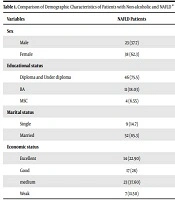
In this study, 120 patients referred to the ultrasound ward of Khorramabad Nomadic Martyrs Hospital were examined, of whom 61 were in the case group and 59 were in the control group. Of the total patients participating in the study, 51 (44.2%) were male and 69 (55.8%) were female. There was no statistically significant difference in the frequency distribution of patients with NAFLD by sex (P = 0.9830). The mean age of the participants in the case group was 44.11 (age range 18 - 65 years) and in the control group was 39.12 (age range 23 - 65 years). Most of the research units were 82 people (68.33%) in terms of education at the undergraduate and postgraduate levels. There was no statistically significant difference in the frequency of patients with non-alcoholic and NAFLD (P < 0.05). Also, 28 (23.3%) participants were single and 92 (76.7%) were married. There was no statistically significant difference in the frequency distribution of patients with fatty liver and non-fatty liver (P > 0.05). There was no statistically significant difference in the frequency of patients with non-alcoholic and NAFLD (P < 0.05) (Table 1).
Table 1.
Comparison of Demographic Characteristics of Patients with Non-alcoholic and NAFLD a
| Variables | NAFLD Patients | No Affected with Nonalcoholic Fatty Liver Patients |
|---|---|---|
| Sex | ||
| Male | 23 (37.7) | 28 (47.4) |
| Female | 38 (62.3) | 31 (52.55) |
| Educational status | ||
| Diploma and Under diploma | 46 (75.5) | 36 (61) |
| BA | 11 (18.03) | 12 (20.35) |
| MSC | 4 (6.55) | 11 (18.65) |
| Marital status | ||
| Single | 9 (14.7) | 19 (32.20) |
| Married | 52 (85.3) | 40 (67.80) |
| Economic status | ||
| Excellent | 14 (22.90) | 11 (18.70) |
| Good | 17 (28) | 13 (22) |
| medium | 23 (37.60) | 26 (44) |
| Weak | 7 (11.50) | 9 (15.30) |
Abbreviations: BA, bachelor for administration; MSC, master of science.
a Values are expressed as No. (%).
In patients with NAFLD, the mean ± standard deviation (SD) of BMI was 29.33 ± 4 4.01 and in non-alcoholic patients, the mean ± SD of BMI was 24.9 ± 3.02. The mean BMI of patients with NAFLD was significantly higher than non-alcoholic patients (P = 0.003). In patients with non-alcoholic fatty liver, the mean ± SD of daily smoking was 0.385 ± 1.02 and in patients with non-alcoholic fatty liver was 0.496 ± 1.1. There was no statistically significant difference in smoking between the two groups with and without NAFLD (P < 0.05). In patients with NAFLD, the mean ± SD of vitamin E consumption per week was 0.216 ± 1.21 and in patients with no-effected nonalcoholic fatty liver was 0.119 ± 1.29. There was no statistically significant difference in the amount of vitamin E consumption between the two groups with and without NAFLD (P < 0.05) (Table 2).
Table 2.
Comparison of BMI, Smoking, Vitamin E Consumption and Type of Oil Consumed by Patients with Non-alcoholic and NAFLD
| Variables | NAFLD Patients | No Affected with Nonalcoholic Fatty Liver Patients | P-Value | ||||
|---|---|---|---|---|---|---|---|
| Mean ± SD | Maximum | Minimum | Mean ± SD | Maximum | Minimum | ||
| BMI | 24.6 ± 3.02 | 44.5 | 19.00 | 29.34 ± 4.01 | 44.8 | 20.4 | 0.003 |
| Cigarette smoking | 0.696 ± 1.1 | 20 | 0 | 0.385 ± 1.02 | 15 | 0 | 0.680 |
| Vitamin E intake | 0.119 ± 1.29 | 4 | 0 | 0.216 ± 1.21 | 7 | 0 | 0.420 |
In patients with non-alcoholic fatty liver, the highest percentage (95.01%) used other oils and in patients with non-alcoholic fatty liver, the highest percentage (74.57%) used other oils. According to Fisher's exact test, a statistically significant difference was observed in the frequency distribution of the type of oil consumed by patients with NAFLD (P = 0.014). Patients with non-alcoholic fatty liver used other oils more than patients with non-alcoholic fatty liver (Table 3).
Table 3.
Comparison of the Type of Oil Consumed by Patients with Non-alcoholic and NAFLD a
| Type of Oil Consumed | NAFLD Patients | No Affected with Nonalcoholic Fatty Liver Patients | P-Value Fisher's Exact Test |
|---|---|---|---|
| Olive oil | 7 (11.87) | 1 (1.6) | 0.014 |
| Sesame oil | 8 (13.56) | 2 (3.3) | |
| Other oils | 44 (74.57) | 58 (95.01) |
a Values are expressed as No. (%) unless otherwise indicated.
5. Discussion
In the present study, BMI, smoking, vitamin E consumption, and the type of oil consumed by patients with NAFLD were compared with non-patients. Based on the findings of this study, BMI was higher than normal in both groups with and without NAFLD, but was significantly higher in patients with NAFLD; 29.34 VS. 24.6 (P = 0.003), respectively. This finding was consistent with the findings of other studies. The results of Dehghan et al (2015) study that compared the BMI of patients with NAFLD with nonalcoholic showed that the mean BMI of patients was higher than non-patients, 32.8 VS. 24.4, respectively (P < 0.05) (10).
The findings of Tayyem et al. (2019) showed that patients with NAFLD have a higher BMI than the non-alcoholic group (19). Anderson et al. (2015) also reported in a meta-analysis study that increasing BMI would significantly increase NAFLD (20). Anika Nier et al. also found in their study that BMI in children with NAFLD is higher than in children without NAFLD (21). In a study examining the risk factors for NAFLD, Moradi Kohanki et al. concluded that there was a significant relationship between BMI and NAFLD grade (22). Although in some studies, the chance of infection in people with BMI was lower than in the present study (23), in most studies, the increase in BMI was evident in patients with fatty liver. Obesity is therefore considered one of the most important risk factors for NAFLD (24).
The results of the present study showed that the daily smoking rate was 0.385 and 0.696 in patients with non-alcoholic and NAFLD, respectively, and there was a statistically significant difference in the average daily smoking rate of patients with NAFLD (P = 0.680). The findings of the present study were consistent with most studies and only in a small number of non-directional studies. Hyun-Suk Jung et al. (2018) in their study that examined smoking and the risk of developing NAFLD concluded that smoking is associated with an increased risk of NAFLD (17). But the results of a study by Chavez-Tapia et al. (2006) on 933 patients in a teaching hospital in Mexico showed that there was no association between smoking and NAFLD (25). A cross-sectional study by Shen et al. (2017) also showed no association between smoking and NAFLD (26). Therefore, smoking cannot play a major role in the development of NAFLD; however, smoking has pathophysiological effects on the liver (27). Also, the findings of the present study showed that the weekly intake of vitamin E in patients and non-patients with NAFLD was 0.216 and 0.119, respectively. The mean vitamin E intake of patients with non-alcoholic fatty liver disease was not statistically significant compared with non-alcoholic fatty liver disease (P = 0.420). The results of the study by Nobili et al. (2006) showed that taking vitamin E with vitamin C reduces alanine transaminase (ALT) (28). Different studies have reported different and contradictory results on the effect of vitamin E consumption in the prevention and treatment of NAFLD (12, 29, 30).
Considering that in the present study, the consumption of vitamin E in patients with and without NAFLD was not significantly different, so the consumption of high amounts of vitamin E should be used with caution. Because there is a risk of hemorrhagic stroke and death with high doses (31). The findings of the present study compared the oil consumption of patients with non-alcoholic and NAFLD showed that the consumption of other oils (unhealthy oils) was higher in patients with NAFLD than non-patients (95.01 VS. 74.57%), respectively, and patients with this disease used less olive and sesame oil. These findings were consistent with other studies. Various studies have shown that there is a direct link between the consumption of saturated fats and the incidence of NAFLD (32, 33). The role of these fatty acids in increasing the risk of insulin resistance and cardiovascular disease by increasing cholesterol, triglyceride, and inflammatory factor of CRP (C-reactive protein) and lowering HDL (high-density lipoprotein) suggests that these fatty acids may be fatty liver involved. Some dietary sources of trans fatty acids include margarine, butter, and commercial frying oils (34).
Various studies have shown that in patients with NAFLD, weight loss and adherence to a proper diet along with physical activity is one of the most appropriate treatments (35). Sesame oil can reduce the activity of the enzyme phosphatidate phosphohydrolase; thus reducing the rate of hepatic triglyceride synthesis and consequently reducing the risk of fatty liver in hypercholesterolemic diets. The study of Heydarian et al. (2013) showed a significant decrease in the mean plasma antioxidant capacity in the group with high cholesterol diet compared to the control group (36). According to the findings of the present study and other studies, it seems that the type of oil consumed has a significant effect on the development of NAFLD. One of the limitations of the research was the illness of some patients who tried to get information from attendant patients. Also, one of the limitations beyond the researcher's authority was the researcher's presence in completing the questionnaire.
5.1. Conclusion
In general, body mass index, healthy diet, and lack of saturated fatty acids, non-smoking, and consumption of antioxidants are modifiable factors in the development of NAFLD that can be easily modified by lifestyle changes. Given today's lifestyle that leads to inactivity and weight gain, educational interventions to change attitudes and increase awareness of risk factors for NAFLD seem necessary. It is recommended to use healthier oils such as olive oil and sesame oil in the daily diet of people, and in addition to modifying the oil consumption, proper physical activity and weight loss are also recommended. Smoking as a risk factor, as well as the use of vitamin E to prevent and treat NAFLD, requires further studies with a larger sample size. It is recommended to take vitamin E with a doctor's prescription and supervision. It is suggested that the prevalence of alcoholic fatty liver disease be studied in a similar study. It is also recommended to study the risk factors for NAFLD and the effect of diet, exercise and a variety of vitamins in causing this disease.