
1. Background
Burn is a type of skin or tissue damage caused by friction, cold, heat, radiation, chemicals, or electrical sources. It can have local and systemic effects (1). A high percentage of all injuries worldwide are due to burns. It is the fourth most common injury after accidents, fractures, and interpersonal violence (2). Over 300,000 people die annually from burn injuries (3). Adequate examination and administration of effective minerals and hormones are essential for these patients (4). Severe burns that lead to hospitalization in the intensive care unit (ICU) cause hemodynamic instability, increase the need for calories and macronutrients, and cause an exponential rise in the market for micronutrients. At the time of burns, due to severe and sudden shocks and injuries, the balance of electrolytes and fluids and the balance of nitrogen in the body become negative. Therefore, nutritional needs increase, especially in the first week after the burn. Patients must receive many fluids in the first 24 hours, according to Parkland's formula (5), and, as a result, we are faced with a complex complement. Many people who suffer from burns may have some previous degrees of nutrient insufficiency and chronic illnesses. Patients with chronic or debilitating diseases often become malnourished upon entering health care or hospital care (6). Without proper nutritional support, malnourished patients become more malnourished, especially intermittently in hunger, and surgical intervention should be considered. If left untreated, malnutrition can lead to prolonged recovery and complications from illness and surgery. It also increases hospitalization time and the associated costs (7). Hypercatabolic status is a physiological condition caused by various stimuli through mediators such as burns in the body. Metabolic stress is associated with progressive and sometimes severe depletion of protein and fat reserves, as well as changes in carbohydrate metabolism and increased extracellular volume. Some metabolic conditions improve with nutritional support to some extent, but almost all require other interventions to reduce or improve the disease (8). In the meantime, the excretion of minerals is significant. Because of their essential role in the body, minerals can exacerbate oxidative stress and increase inflammatory factors. This increases inflammation and exacerbates malnutrition due to insufficient enteral and parenteral feeding, which can increase indicators such as the simplified acute physiology score (SAPS II, an instrument to measure the severity of the disease in patients admitted to the ICU), which ultimately causes the patient’s death (9).
Essential minerals, including zinc, selenium, and iron, are important in humoral immunity, cellular immunity, immune responses, defense against damaged tissues, thyroid function, and wound healing (4). According to studies, the level of these minerals in the body during the burn process and the critical condition is reduced greatly as urinary excretion increases, or the proteins carrying these minerals decrease, as well as due to metabolism. The level of these minerals will likely decline, and the improvement in the patient's condition due to the critical role of these minerals can greatly help repair damaged tissues and wounds and alleviate infection (10, 11). In addition, administering minerals to burn patients has been associated with increased blood flow and improved antioxidant status, reduced lung infections, and accelerated wound healing (12). Traditionally, nutritional support in critically ill patients has been considered ancillary care aiming to maintain the body's muscle mass, preserve the immune function, and stop metabolic complications (13). In patients with burns, the levels of vitamins A, B, C, and D and metals such as iron, copper, selenium, and zinc are reduced, which can diminish the efficiency of the immune system and decelerate wound healing. Decreased muscle system function has also been noted (14). The Institute of Enteral and Parenteral Nutrition in the United States advises that burn patients receive the vitamins and minerals their body needs but notes that more studies should be conducted on how and how much of these substances the patients should take (15). Lack of proper nutrition among patients admitted to the ICU can be hazardous. Malnutrition among ICU patients may lead to increased inflammatory factors, a weakened immune system, infection, sepsis, and premature death (14). Applying early nutrition therapy support, especially the use of timely and fast enteral nutrition, is an important strategy that can mitigate the complications of the disease, reduce the length of stay at the ICU, and improve the general condition of the patient (16).
The thyroid gland is one of the most important endocrine glands in the body, whose primary functions are to regulate the body's basal metabolism and energy. Thyroid hormones include T3, T4, and TSH. They play a significant role in the body's growth by regulating metabolism and the immune system. Therefore, their functional impairment is closely related to the mortality of patients in the ICU (17). In conditions such as burns, changes occur in the function of thyroid hormones. Additionally, patients' needs for minerals are too high because of increased body metabolism. Due to the increased loss of minerals, it is necessary to check the status of these hormones in the patients (18). Minerals like zinc and selenium are critical for patients due to their roles and importance in metabolism and wound healing. Moreover, the amount of mineral reduction and the required prescription dose are yet to be determined. In burn hospitals in Iran, the number of elements is not prescribed more than usual (i.e., non-burn patients), and many studies have shown this (19). Furthermore, the level of thyroid hormones, improving the condition of the desired minerals in burn patients, and their effect on the patients are yet to be examined.
2. Objectives
This study checked the status of the existing minerals (iron, zinc, and selenium) and evaluated the serum levels of thyroid hormones in patients admitted to the ICU burn ward of Taleghani Hospital (Ahvaz, Iran).
3. Methods
This cross-sectional study (IR.AJUMS.REC.1398.911) was conducted on 24 patients admitted to the ICU of Taleghani Hospital in Ahvaz, of whom 15 (62.5%) were men and 9 (37.5%) were women. The inclusion criteria were: Age above 18 years, being hospitalized for at least 72 hours in the burn ICU, not suffering from chronic diseases (e.g., diabetes, high blood pressure, and chronic kidney disease), not suffering from disorders such as hypothyroidism, hyperthyroidism, tumors, and osteopathy diseases, and consent for participation. The exclusion criteria were pregnancy, hemodynamic instability, increased serum lactate, and death.
Blood samples were taken on the first, third, and fifth days of hospitalization. Zinc, selenium, iron, T3, T4, and TSH were measured from the patient's serum. ELISA kits (Bioactiva Diagnostica GmbH, Homburg, Germany) were used to measure thyroid hormones. Laboratory tests were performed at the Academic Jihad Center, Ahvaz. Serum samples were prepared using a wet digester (Microwave Digestion System, USA). Containers used in the digestion and testing were washed with 5% Deconex® detergent, then rinsed in 30% nitric acid, and remained overnight after rinsing. Immediately before the test, the dishes were removed from the acidic solution, rinsed twice with deionized water, and dried under a laminar hood. A microwave oven (Milestone, USA) was used to shorten the digestion time. Five mL of a 3-volume mixture of H2O2 and HNO3 (ratio 1:2) was added to each sample container. After 10 minutes in room air, the dishes were placed in the microwave; then, the number of metals in the prepared solutions was measured by inductively coupled plasma atomic emission spectroscopy (ICP-OES).
3.1. Sample Size Calculation and Sampling Methods
The sample size was based on the findings of Berger and Shenkin (20). Using the statistical software MedCalc, the sample size was determined as 24 cases, with a power of 80% and an error of 5%.
The sample size was calculated using the following formula:
(α/2 - 1) - z = 1.96, (β - 1) - z = 1.645, 1 - [(DS)] = 6.79, 2 - [(DS)] = 6.35, 1 - µ = 50.51, 2 - µ = 44.63.
Mean (standard deviation) and frequency (percentage) were used to describe the quantitative variables. The Kolmogorov-Smirnov test was used to check the normality of the distribution of the quantitative variables. The correlation of the qualitative variables was checked using the chi-square test, and the correlation of the quantitative variables was checked using Spearman's correlation analysis. A t-test was used to compare the means of the two groups with the standard value. The generalized estimating equation (GEE) test was used to investigate the effect of time and compare the two groups. All the statistical analyses were performed in SPSS v. 22 (IBM Corp., Armonk, NY, USA).
4. Results
Information about the patients is presented in Table 1.
Table 1.
Frequency Distribution of the Patients According to Age, Percentage of Burn, and Length of Stay in the Intensive Care Unit
| Variables | Mean ± SD |
|---|---|
| Age | 42.13 ± 15.54 |
| Percentage of burns | 55.83 ± 18.29 |
| Length of staying in ICU | 15.86 ± 11.93 |
Abbreviations: ICU, intensive care unit; SD, standard deviation.
No statistically significant difference was observed after controlling the effect of age and time in three stages on thyroid hormones (T3, T4, TSH). The results are presented in Table 2.
Table 2.
Average Serum Level of Thyroid Hormones (T3, T4, TSH) on the First, Third, and Fifth Days
| Variables (ng/dL) | Mean ± SD | P-Value |
|---|---|---|
| T3 | 0.51 | |
| First day | 0.36 ± 0.88 | |
| Third day | 0.29 ± 0.83 | |
| Fifth day | 0.37 ± 0.88 | |
| T4 | 0.94 | |
| First day | 1.83 ± 5.1 | |
| Third day | 1.14 ± 4.8 | |
| Fifth day | 1.03 ± 5.01 | |
| TSH | 0.79 | |
| First day | 1.83 ± 2.06 | |
| Third day | 1.96 ± 2.4 | |
| Fifth day | 1.89 ± 2.1 |
Abbreviation: SD, standard deviation.
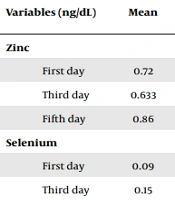
A nonparametric one-sample t-test was used to compare the averages of the three minerals (iron, zinc, and selenium) with the standard serum average of these minerals in the studied times, and the results are presented in Table 3.
Table 3.
Comparison of the Averages of the Studied Elements on the First, Third, and Fifth Days with the Standard Serum Average of the Elements
| Variables (ng/dL) | Mean | The Standard Average of the Elements | P-Value |
|---|---|---|---|
| Zinc | 0.81 | ||
| First day | 0.72 | 0.04 | |
| Third day | 0.633 | 0.003 | |
| Fifth day | 0.86 | 0.945 | |
| Selenium | 0.69 | ||
| First day | 0.09 | 0 | |
| Third day | 0.15 | 0 | |
| Fifth day | 0.11 | 0 | |
| Iron | 1.68 | ||
| First day | 2.47 | 0.2 | |
| Third day | 1.83 | 0.7 | |
| Fifth day | 1.2 | 0.56 |
The nonparametric Spearman’s correlation analysis was performed to investigate the relationship between the length of stay in the ICU, zinc, iron, and selenium, and the results are shown in Tables 4 and 5.
Table 4.
Correlation Between the Average of Minerals (Iron, Zinc, Selenium) in Three Days and the Length of Intensive Care Unit Stay
| Variables | Zinc | Iron | Selenium |
|---|---|---|---|
| Length of ICU stay | |||
| Correlation coefficient | 0.251 | 0.387 | 0.407 |
| P-value | 0.259 | 0.075 | 0.060 |
Abbreviation: ICU, intensive care unit.
Table 5.
Correlation Between the Averages of T3, TSH, and T4 in Three Days and the Length of Intensive Care Unit Stay
| Variables | T3 | T4 | TSH |
|---|---|---|---|
| Length of ICU stay | |||
| Correlation coefficient | 0.227 | 0.679 | 0.129 |
| P-value | 0.365 | 0.002 | 0.611 |
Abbreviation: ICU, intensive care unit.
5. Discussion
Burns are associated with serious physical injuries that affect almost every organ and result in significant mortality (21). Scientists believe that in burn patients, the amount of vitamins A, C, E, and D and metals such as iron, copper, selenium, and zinc decreases. The side effects of this reduction include diminished efficiency of the immune system, reduced speed of wound healing, and decreased function of the neuromuscular system (22).
The present study investigated the serum levels of mineral salts (zinc, selenium, and iron) and thyroid hormones (T3, T4, and TSH), nutritional intake, and the length of ICU stay among burn patients in Taleghani Hospital, Ahvaz. This study showed that changes occurred in iron, zinc, and selenium mineral salts during the investigated days. Still, these changes were not statistically significant. In the level of thyroid hormones, changes were observed during the measurements performed on the investigated days, but no statistically significant difference was shown. A significant correlation was observed between the standard average of serum zinc and its average measured on the first and third days. No significant relationship was observed between the standard average of serum iron and its average measured in the three days. Still, a significant relationship was observed in the case of selenium. Besides, no significant relationship was observed between iron, zinc, selenium, T3, TSH, and the length of stay in the ICU, and there was a significant relationship only for T4. The study by Kostina et al. also showed that the decrease in serum zinc level continues until the days after the burn (23). These results were in line with the 2022 study in which mineral salts of 62 burn patients were examined for 8 days after the burn. The serum level of zinc, selenium, and copper in the patients was lower than the standard serum level (4). The study by Lee et al. on the serum concentration of zinc, copper, selenium, and manganese during 14 days determined that the serum concentration of zinc and selenium during ICU admission was lower than the normal serum values; the concentration zinc during care had an inverse relationship with mortality, and patients with high serum concentration of zinc had lower mortality. Still, no significant relationship was observed regarding selenium (24). In a 1988 study, the results showed that the amount of zinc decreases in burn patients, but after a few days, it will be within the normal range (25). In the present study, no correlation was found between the amount of zinc and the length of hospitalization. In a study, the results showed that the amount of zinc in patients is not related to the length of hospitalization (26). In the present study, the results revealed no statistically significant difference between selenium values at different times; another study reported that the serum level of selenium decreased until the tenth day after the burn (27). Examining the average serum iron level on the examined days showed that on the first day after the burn, an increase in the serum iron level was observed compared to the average serum standard, which is probably related to strong hemolysis and the release of iron from red blood cells (4). However, the iron level decreased on the third day. There was no statistically significant difference between the standard average of iron serum and the average obtained on the measured days. Although there was an inverse relationship between iron and the length of hospitalization in the ICU (negative correlation coefficient), a statistically significant relationship was observed.
This study evaluated changes in T3, T4, and TSH levels on the first, third, and fifth days. No statistically significant difference was observed between T3, T4, and TSH values at different times. Although there was no significant difference in the level of thyroid hormones, studies have indicated that these hormones have a significant relationship with the mortality rate in the ICU. Survival and death were related to the level of T3, so the concentration of T3 in those who died was low; however, the concentration of T3 was increased in the patients who survived. In fact, the level of thyroid hormones in patients admitted to the ICU is a predisposing factor; it predicts the death of patients admitted to the ICU (28). There was no statistically significant relationship between T3, TSH, and the length of ICU stay, but the relationship between T4 and the length of ICU stay was significant. This means that with an increase in T4, the length of ICU stay increases, and vice versa. Unfortunately, studies in this field are insufficient, especially in burn patients.
In this study, for the first time, the combination of mineral salts and thyroid hormones was examined in burn ICU patients, and the elements were measured with the newest and most accurate method. The small size of the sample and financial limitations were the limiting factors in this study.
5.1. Conclusions
Changes occur in the serum level of micronutrients in burn patients, affecting the body's physiological conditions and decreasing the speed of recovery. Nevertheless, the results of this study revealed that the changes in the levels of iron, zinc, and selenium during the investigated days were not statistically significant, and there was no significant difference in the level of thyroid hormones during the measurements. In some cases, the amount of the examined elements was lower than their serum standard average, but this relationship was significant only for selenium. Additionally, there was no significant relationship between iron, zinc, T3, TSH, and the length of stay in the ICU, and this relationship was positive and significant only for T4.