
1. Background
Bipolar disorder is one of the most common mood disorders and is considered among the most debilitating psychological conditions. In addition to affecting performance, it significantly impacts interpersonal interactions and the overall quality of life of the patient (1). Bipolar disorder is categorized into two types: Type I and type II, as well as cyclothymic disorder (2). In recent years, there has been increasing attention on the diagnosis of bipolar disorder (3). According to the World Health Organization, in 2000, bipolar disorder was ranked as the sixth leading cause of lifelong disability among individuals aged 15 to 44 years (4). Studies suggest that the prevalence of bipolar disorder is approximately 1% (5). Type II bipolar disorder typically begins in late adolescence or early adulthood, with an average onset age between 20 and 30 years, slightly later than type I bipolar disorder but earlier than major depressive disorder (6).
There is limited evidence regarding gender differences in bipolar disorder, though some clinical samples suggest that type II bipolar disorder is more common in women than men, with a high risk of suicide. About one-third of individuals with type II bipolar disorder report a history of attempting suicide during their lifetime. It appears that the lifetime prevalence of suicide attempts is similar in both type I and type II bipolar disorder (32.4% and 36.3%, respectively) (7).
Emotional intelligence is one of the key factors that plays a crucial role in the development of various psychological conditions (8). Emotional intelligence refers to the ability, capacity, or skill to understand, assess, and manage one's own and others' emotions, encompassing the knowledge and control of emotions (9). One critical component of emotional intelligence is emotion regulation. However, there is a lack of experimental studies providing evidence that confirms the association between emotion dysregulation and bipolar disorder (10). Emotional dysregulation is thought to be one of the factors contributing to vulnerability to bipolar disorder. Psychological literature suggests that emotional regulation is a significant factor in determining successful performance in both health and social interactions (11). Emotion plays a central role in all affective disorders, with emotional dysregulation being present in all Axis I disorders and half of Axis II disorders (12).
The findings of Kraaji and Garnefski indicated that individuals with psychiatric disorders, particularly those with bipolar disorder, tend to use maladaptive emotional regulation strategies more frequently while employing adaptive strategies less often. Bipolar patients also tend to lack the reappraisal emotional regulation strategy. Moreover, preliminary studies have shown that positive reappraisal is negatively associated with psychopathological indices. According to Kraaji and Garnefski's research, there is a clear relationship between maladaptive strategies such as rumination, self-reprimand, catastrophizing, and the absence of positive reappraisal with the presence of bipolar symptoms (13). Research has also shown that bipolar disorder negatively impacts the lives of individuals, leading to various occupational, academic, and behavioral problems (14). Pharmacotherapy alone has proven insufficient in preventing relapse, as other factors contribute to its occurrence. Studies investigating the causes of relapse in bipolar disorder have highlighted factors such as non-adherence to pharmacotherapy, the presence of micro-symptoms, and residual mania and depression. In other words, nonpharmacological treatments are essential alongside pharmacotherapy (15). Today, the search for effective treatment has long been a focus of psychiatrists and psychologists. The primary aim of treatment in bipolar disorder is to address the acute stage of the illness and prevent relapse. Although pharmacotherapy remains a well-established treatment for bipolar disorders, recent studies have demonstrated that adding psychosocial interventions to the treatment plan enhances its efficacy (16).
One therapy that has recently been employed alongside pharmacotherapy for patients with bipolar disorder is mindfulness therapy. Derived from cognitive behavioral therapy, mindfulness is a key component of the third wave of psychotherapy models (17). Mindfulness has a long history and has been an integral part of Buddhist meditation. It refers to the process of paying attention without judgment to internal and external events as they arise in the present moment. Internal events include thoughts, emotions, perceptions, and bodily sensations, while external events encompass situational and interpersonal experiences. Mindfulness involves moment-to-moment awareness of experience, characterized by intentional attention and judgment-free acceptance of one's experiences (18).
In essence, mindfulness is a nonjudgmental, present-focused awareness of the experience at the center of one's attention in any given moment. It also includes the acceptance of recalled experiences (19). Today, mindfulness-based interventions are used to treat a wide range of physical and psychological disorders. Research indicates that mindfulness therapy has a significant impact on mood and anxiety disorders, chronic pain (19), post-traumatic stress disorder (20), impulsivity (21), addictive behaviors (22), depression, anxiety, quality of life (23), and reducing stress and psychological distress. Mindfulness emphasizes the interaction between cognitive, bodily, and emotional processes (24).
2. Objectives
Since bipolar disorder is one of the most serious mental illnesses, and research on the effectiveness of mindfulness therapy for emotional regulation in these patients is limited, the present study is important as it can offer further insights into the pathology of the disorder. Additionally, given the role of emotional intelligence and emotion regulation in influencing behavior and establishing social interactions, conducting such research can be beneficial in clinical and healthcare settings. Therefore, the key question the present study seeks to address is: "Is mindfulness therapy effective in improving components of emotional self-regulation in patients with bipolar disorder?"
3. Methods
3.1. Design
This research is a quasi-experimental study with random selection, utilizing a pre-test and post-test design involving both experimental and control groups.
3.2. Samples
The statistical population of the present study consisted of patients with bipolar disorder who referred to the rehabilitation and treatment center for chronic mental patients at Hayat in 2024. The sample size for this research was determined using Cohen's sample size table, considering an effect size of 0.70, a test power of 0.91, a significance level of 0.05, and the minimum required sample size. Each group consisted of 15 participants. Additionally, experts and researchers in quasi-experimental studies recommend that a sample size of 15 per group is sufficient (25). Based on these guidelines, a total of 30 participants (15 in the experimental group and 15 in the control group) were randomly selected using a table of random numbers. The participants were assigned to the experimental (n = 15) and control (n = 15) groups through an available sampling method.
In this study, participants from both groups completed the emotional regulation questionnaire during the pre-test stage. The participants in the treatment group then underwent eight sessions of mindfulness training, conducted by the researcher, with each session lasting 60 minutes and held once per week. After the completion of the training sessions, both the experimental and control groups completed the emotional self-regulation questionnaire in the post-test phase. All stages of data collection were conducted by the researcher. For participants who were illiterate or physically weak, the researcher read the questions aloud, and the participants provided their answers.
To avoid interference between the control and experimental groups, the control group was not kept in the educational complex for rehabilitation and life therapy during the intervention period. Instead, programs outside the executive protocol for the experimental group, such as sports and artistic activities, were provided to the control group.
The inclusion criteria for this study were as follows: Patients diagnosed with bipolar disorder, aged between 30 and 50 years, who provided informed consent for participation in the research, had a favorable psychological and physical status for participation in the study, and did not have any comorbidities that would prevent participation in the sessions.
The exclusion criteria included having comorbid disorders, receiving pharmacotherapy or psychotherapy within the past month or concurrently during the study implementation, suffering from severe psychological or physical illnesses, having a history of psychological or physical diseases, presenting psychotic symptoms, or lacking interest in participating in the research.
3.3. Ethical Considerations
This study complies with all ethical principles, including maintaining the confidentiality of the surveys, obtaining informed consent from all participants, and ensuring participants' right to withdraw from the study at any time. The research has been approved by the Research Ethics Committee of the University of Sistan and Baluchistan under the ethical approval code IR.IAU.ZAH.REC.1401.067.
3.4. Intervention
The content and objectives of the sessions were developed based on Kabat-Zinn’s view of mindfulness (26). The aim of the sessions was to enhance and improve emotional regulation. Each session involved a combination of question-and-answer segments and group discussions. A summary of the sessions is provided in Table 1.
Table 1.
Summary of Therapeutic Sessions of Mindfulness Training Based on Kabat-Zinn's Perspective (27)
| Sessions | Description of Intervention Sessions |
|---|---|
| First | Getting to know the group members, describing mindfulness group training sessions, communicating and thinking, providing Background about controlling emotions and automatic thoughts, the reason for using the mindfulness method, and giving explanations regarding automatic control systems and conducting a pre-test. . |
| Second | Review last week's assignments, explain automatic thinking and active and dynamic thinking, practice body control, give feedback and discuss body control practice, practice breathing meditation. |
| Third | Review of the past week assignment, practice (observation, description, and active dynamic), sitting mediation practice thoughts, practice review, practicing three-minute breathing space, discussion on seeing thoughts differently or having alternative thoughts |
| Fourth | Review of the past week assignment, practice (resilient, without judgment and dynamic), five-min practice of “seeing or listening”, re-practicing breathing mindfulness and body inspection |
| Fifth | Review of last week's homework, explaining the relationship between stress and pain, (calculating and logical mind), breathing exercises, sitting mindfulness (being aware of breathing, our body, voice and our thoughts), explanation about stress and pain, and explaining pleasant and unpleasant events and their effects on emotions, awareness thoughts and feelings of the body |
| Sixth | Examining last week's assignments, practicing thoughtful and wise mind, conscious meditation, sitting meditation (imagining the mind from surrounding sounds and thoughts) |
| Seventh | Review last week's assignments, improve your sleep, review assignments from previous study sessions, write lists of fun activities and tasks. |
| Eighth | Review of the past week assignment, practicing body inspection, conclusion of sessions, inspection and discussion on plans and continuation of exercises, post-test examination and acknowledgement of group cooperation |
The sessions were conducted by the lead researcher (corresponding author) and were interactive, encouraging active participation through discussions. All sessions took place at the Hayat Chronic Mental Illness Center.
3.5. Instruments
3.5.1. Emotion Self-Regulation Inventory
The standard questionnaire is available on the dynamic Yar Poya website, from where it was purchased. This questionnaire, developed by Ibanez et al. (28), consists of twenty-five questions scored on a five-point Likert scale (ranging from 1 to 5) and includes five sub-components: Well-being, assertiveness, disclosure of feelings and needs, positive performance, and controllability. The psychometric properties of the emotion self-regulation questionnaire have been validated in both international (27, 29) and domestic (30) studies. In the long form, Cronbach's alpha coefficient ranged from 0.74 to 0.92 (24), while the short form showed a range from 0.68 to 0.84 (27), confirming the internal consistency of the questionnaire. A one-month test-retest reliability of the emotion self-regulation questionnaire yielded an efficiency of 0.87 (31). In a sample of 676 students, the psychometric properties of the Persian version showed Cronbach's alpha for each subscale ranging from 0.90 to 0.97, indicating strong internal consistency. Test-retest reliability, measured in a sample of 134 individuals over four to six weeks, revealed significant correlation coefficients at the P < 0.01 level for self-regulation (r = 0.875), positive performance (r = 0.82), controllability (r = 0.71), disclosure of emotions and needs (r = 0.78), assertiveness (r = 0.80), and well-being (r = 0.86) (32).
3.5.2. Statistical Analysis
The data obtained in this study were analyzed using both descriptive statistics (mean and standard deviation) and comprehensive inferential statistics, specifically multivariate analysis of variance (MANOVA), with SPSS version 16. First, the assumptions for the multivariate test were assessed, including the normality of the data distribution, homogeneity of variances, and the linearity and homogeneity of regression slopes.
4. Results
The demographic characteristics of the subjects indicated that 50% (15 individuals) were men and 50% (15 individuals) were women.
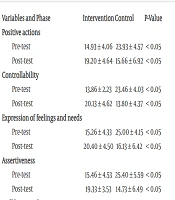
The results presented in Table 2 display two descriptive findings: The mean and standard deviation for the variables and subscales.
Table 2.
Mean ± Standard Deviation of Emotion Regulation and its Dimensions in Experimental and Control Groups in Pre-test and Post-test a
| Variables and Phase | Intervention | Control | P-Value |
|---|---|---|---|
| Positive actions | |||
| Pre-test | 14.93 ± 4.06 | 23.93 ± 4.57 | < 0.05 |
| Post-test | 19.20 ± 4.64 | 15.66 ± 6.92 | < 0.05 |
| Controllability | |||
| Pre-test | 13.86 ± 2.23 | 23.46 ± 4.03 | < 0.05 |
| Post-test | 20.13 ± 4.62 | 13.80 ± 4.37 | < 0.05 |
| Expression of feelings and needs | |||
| Pre-test | 15.26 ± 4.33 | 25.00 ± 4.15 | < 0.05 |
| Post-test | 20.40 ± 4.50 | 16.13 ± 6.42 | < 0.05 |
| Assertiveness | |||
| Pre-test | 15.46 ± 4.53 | 25.40 ± 5.59 | < 0.05 |
| Post-test | 19.33 ± 3.53 | 14.73 ± 6.49 | < 0.05 |
| Well-being seeking | |||
| Pre-test | 11.73 ± 2.60 | 19.46 ± 2.35 | < 0.05 |
| Post-test | 17.73 ± 5.25 | 12.86 ± 4.39 | < 0.05 |
| Emotion regulation | |||
| Pre-test | 51.53 ± 4.35 | 92.00 ± 5.38 | < 0.05 |
| Post-test | 74.00 ± 3.60 | 51.20 ± 4.21 | < 0.05 |
a Values are expressed as mean ± SD.
The results of Table 3 showed that, based on the significance level in the experimental and control groups from the Kolmogorov-Smirnov test, the assumption of normality in the distribution of variable scores within the research population is confirmed.
Table 3.
The Results of the Normality Test of the Distribution of Emotion Regulation Component Scores in two Experimental and Control Groups
| Variables and Phase | Pre-test | Post-test | ||
|---|---|---|---|---|
| K-S | P-Value | K-S | P-Value | |
| Positive actions | 1.02 | 0.24 | 0.56 | 0.90 |
| Controllability | 1.18 | 0.12 | 0.72 | 0.67 |
| Expression of feelings and needs | 0.91 | 0.37 | 0.85 | 0.45 |
| Assertiveness | 0.84 | 0.47 | 0.44 | 0.98 |
| Well-being seeking | 0.49 | 0.96 | 0.99 | 0.27 |
| Emotion regulation | 0.98 | 0.28 | 1.46 | 0.08 |
The results in Table 4 demonstrate the homogeneity of variances. According to the table (P < 0.05) and the non-significance of Levene's test, the use of the analysis of covariance (ANCOVA) is permitted. This indicates that the experimental and control groups were homogeneous in terms of variances before the experimental intervention (in the pre-test phase).
Table 4.
The Results of Homogeneity of Levin's Variances in the Dependent Variables of the Research in the Pre-test Stage
| Homogeneity of Variance Tests | F | DF1 | DF2 | P-Value |
|---|---|---|---|---|
| Positive actions | 0.08 | 1 | 28 | 0.76 |
| Controllability | 1.06 | 1 | 28 | 0.31 |
| Expression of feelings and needs | 0.41 | 1 | 28 | 0.52 |
| assertiveness | 0.35 | 1 | 28 | 0.55 |
| Well-being seeking | 5.03 | 1 | 28 | 0.7 |
The results of Table 5 showed that according to the significance level (P < 0.05), the data supports the hypothesis of the slope of the regression line. Therefore, according to the confirmation of the three preconditions of the multivariate covariance analysis, the analysis can now be performed.
Table 5.
Slope of the Regression Line
| The Regression Line Slope | F | P-Value |
|---|---|---|
| Positive actions | 0.63 | 0.60 |
| Controllability | 3.42 | 0.06 |
| Expression of feelings and needs | 0.34 | 0.79 |
| Assertiveness | 4.39 | 0.76 |
| Well-being seeking | 0.05 | 0.82 |
The results of Table 6 showed that the multivariate significance tests on the effectiveness of mindfulness therapy on emotion regulation components in individuals with bipolar disorder were significant at a level of less than 0.05. Therefore, a difference exists in at least one of the variables, and multivariate covariance analysis is used to determine the extent of this difference.
Table 6.
Summary of Multivariate Covariance Analysis in Emotion Regulation
| Test | Value | F | P-Value |
|---|---|---|---|
| Wilks' Lambda | 0.95 | 16.30 | 0.05 |
The results of Table 7 showed that after controlling for the effect of the pre-test on the dependent variables, there was a significant difference between the adjusted average scores of positive measures (F = 0.34, η² = 0.40, P < 0.05), controllability (F = 0.22, η² = 0.06, P < 0.05), expressing feelings and needs (F = 0.55, P < 0.05, η² = 0.16), daring (F = 0.10, η² = 0.63, P < 0.05), and well-being (F = 0.09, η² = 0.66, P < 0.05) between the pre-test and post-test stages. According to the eta squared coefficients, CBT had the greatest effect on the positive actions variable (40%), meaning that 40% of the difference in the follow-up scores for positive actions is attributable to the effectiveness of mindfulness therapy.
Table 7.
Multivariate Analysis of Covariance (MANCOVA in ANCOVA Context) to Investigate the Effect of CBT on the Variable of Emotion Self-regulation and its Components
| Variables | Sum of Squares | Degrees of Freedom | Mean Square | F | Significance Level | Effect Size |
|---|---|---|---|---|---|---|
| Positive Actions | 19.90 | 1 | 19.90 | 0.34 | 0.05 | 0.40 |
| Controllability | 25.81 | 1 | 25.81 | 0.22 | 0.05 | 0.06 |
| Expressing feelings and needs | 8.62 | 1 | 8.62 | 0.55 | 0.05 | 0.16 |
| Assertiveness | 6.07 | 1 | 6.07 | 0.63 | 0.05 | 0.10 |
| Well-being seeking | 1.96 | 1 | 1.96 | 0.66 | 0.05 | 0.09 |
5. Discussion
The aim of this study was to investigate the effectiveness of mindfulness training on emotional regulation in patients with bipolar disorder. The research results indicated that mindfulness training at the post-test level facilitated and improved emotional regulation and its components in patients suffering from bipolar disorder (Table 7). The findings of the present study are consistent with some results from previous studies (33-40).
Based on a review of the literature, no similar study has yet been published on the effectiveness of mindfulness therapy in the treatment of clinical disorders related to psychological diseases, making this study a novel contribution. The present study can be considered an innovative attempt to utilize mindfulness therapy to reduce clinical symptoms and alleviate the fear of negative evaluation in patients with bipolar disorder. Therefore, the results were analyzed and compared with similar studies.
Previous research has shown that mindfulness training is effective in reducing negative symptoms in patients with bipolar disorder, leading to improvements in their cognitive and behavioral functioning. Consequently, the treatment of bipolar disorder requires a comprehensive approach, and mindfulness training can play an effective role in enhancing cognitive and behavioral functions while reducing the symptoms of the disorder.
The results of Huang et al. (33) indicated that mindfulness is directly associated with emotional regulation and that emotional regulation significantly mediates the relationship between mindfulness and PTSD symptoms. Loeber et al. (34) noted that mindfulness skills, particularly judgment-free acceptance, lead to improved emotional regulation by enhancing self-efficacy in coping with stressors. Similarly, Chiodelli et al. (35) found that mindfulness-based interventions could significantly improve emotional regulation in adults.
In interpreting these findings, it can be stated that emotional regulation enables individuals to manage and modify emotional arousal and experiences at both cognitive and interpersonal levels (36). Any defect or failure in the process of emotional regulation impairs the ability to manage emotions, compromising a person’s adaptive capacity (37). Therefore, it can be suggested that individuals with bipolar disorder who have deficiencies in emotional regulation are likely to experience reduced emotional adaptability (38).
It should also be noted that emotional regulation requires an optimal interaction between cognition and emotion to effectively cope with negative situations. This is because when a person faces any challenge, they interpret it cognitively, which in turn determines their reactions (39). Individuals with high levels of mindfulness possess deeper knowledge and insight into their cognitive processes and personal abilities. Due to the strong relationship between mindfulness and emotions, along with effective strategies for managing tasks, mindfulness enhances an individual's awareness of themselves, their emotions, and their present situation. This increased awareness positively influences both emotional and cognitive responses.
Indeed, it can be inferred that by training in mindfulness skills, emotional regulation abilities can be significantly improved, which in turn has an interactive effect on enhancing the individual’s mindfulness levels (40).
5.1. Conclusions
In explaining the findings of this research and the mechanism of mindfulness-based intervention in improving emotion regulation, it can be stated that mindfulness intervention impacts emotion regulation by creating changes in attention, intention, and attitudes. Mindfulness, with its emphasis on techniques such as observation, description, acting with awareness, and experiencing internal events without judgment, can effectively adjust emotions and reduce negative emotional responses. The role of cognitive change is also highlighted in enhancing emotion regulation. Mindfulness intervention is considered effective in promoting cognitive changes, which lead to more regulated emotions. In other words, mindfulness experiences are believed to influence a person's thought patterns or attitudes. During the stage of cognitive change, individuals learn to observe their thoughts and feelings without judgment, recognizing them as transient mental events rather than representations of reality. This approach helps individuals avoid falling into the trap of rumination patterns.
5.2. Limitations and Suggestions
The limitations of this research include the self-report nature of the research instrument and the absence of a follow-up period. Therefore, it is recommended that future research examine the long-term effects of mindfulness training using a follow-up period. Since this study was conducted at a center for chronic psychological patients in Zahedan city, it is suggested that further research be carried out in other centers, especially governmental hospitals, to cover a wider demographic range. Additionally, implementing mindfulness training in counseling centers is recommended to help reduce the stress and challenges faced by individuals with bipolar disorder and to enhance their self-regulation skills.