1. Background
Multiple sclerosis (MS) is a chronic autoimmune disorder characterized by demyelination of the central nervous system, leading to impaired nerve signal transmission and symptoms such as muscle weakness, fatigue, coordination difficulties, visual impairment, and cognitive decline (1). Affecting approximately 2.8 million individuals globally, MS primarily affects young and middle-aged adults, substantially reducing quality of life and necessitating comprehensive management strategies (2, 3). Although pharmacological treatments, such as disease-modifying therapies, are standard, their limitations, including side effects and incomplete symptom control, highlight the need for complementary non-pharmacological interventions (4). Physical activity, particularly low-impact exercise such as Pilates, has emerged as a promising approach to managing MS symptoms. Pilates, which emphasizes core strength, flexibility, balance, and neuromuscular coordination, may enhance physical function, reduce fatigue, and improve blood circulation, thereby potentially supporting neural repair (5). These potential benefits may result from improved muscle tone, reduced systemic inflammation, and enhanced vascular function, which are critical in MS, in which blood-brain barrier dysfunction exacerbates disease progression (6). Specifically, Pilates might modulate angiogenic pathways, including vascular endothelial growth factor (VEGF) and its receptor, kinase insert domain receptor (KDR), which play pivotal roles in angiogenesis and neuroprotection (7).
VEGF, a key regulator of blood vessel formation, is overexpressed in MS lesions and may contribute to blood-brain barrier permeability and inflammation (7, 8). Although VEGF may promote angiogenesis to support tissue repair, its dysregulation could exacerbate neuroinflammation by facilitating immune-cell infiltration into the central nervous system (9). KDR, the primary receptor for VEGF, mediates endothelial-cell proliferation and vessel stabilization; however, altered KDR expression in MS may amplify pathological angiogenesis (8). Modulating these biomarkers through exercise could offer a novel therapeutic avenue to mitigate inflammation and support neural recovery (10). Recent studies suggest that aerobic and resistance exercise may reduce pro-inflammatory cytokines and VEGF levels in MS, highlighting the potential of exercise as an anti-inflammatory intervention (11, 12). Vitamin D, a fat-soluble secosteroid, is also critical in MS management because of its immunomodulatory and neuroprotective properties (13, 14). Low serum 25-hydroxyvitamin D levels are associated with increased MS risk and disease activity, as vitamin D may regulate immune responses and reduce oxidative stress (14). Its role in endothelial function could further influence VEGF and KDR expression, potentially synergizing with exercise to enhance vascular health. Preliminary evidence indicates that vitamin D supplementation may lower inflammatory biomarkers in neurological disorders, supporting its therapeutic potential in MS (15).
2. Objectives
This pilot study aimed to explore the preliminary combined effects of an 8-week Pilates program and vitamin D supplementation on serum VEGF and KDR levels in men with relapsing-remitting MS. By targeting angiogenic pathways, the study sought to provide initial insights into the potential synergy of these interventions for improving vascular and neurological outcomes. Focusing on VEGF and KDR offers a novel perspective on how lifestyle interventions might modulate MS-related pathways, addressing both the physical and biochemical aspects of the disease (2, 12). This approach aligns with the growing emphasis on integrative strategies for MS management and provides accessible, cost-effective interventions to complement pharmacological treatments.
3. Methods
3.1. Study Design and Setting
Twenty men with relapsing-remitting multiple sclerosis (RRMS) were recruited from the Ahvaz MS Association. Participants were selected from 40 respondents based on the following inclusion criteria: a confirmed RRMS diagnosis according to the McDonald criteria (16), an Expanded Disability Status Scale (EDSS) score of 3 - 5, age 30 - 45 years, no relapses in the past 3 months, and the ability to perform Pilates exercises. Exclusion criteria included a history of cardiovascular, epileptic, metabolic (e.g., diabetes), psychiatric, or orthopedic conditions; use of vitamin D supplements in the past 6 months; concurrent use of disease-modifying therapies known to affect inflammatory biomarkers (e.g., interferon beta); or contraindications to exercise according to the American College of Sports Medicine guidelines. Participants were randomly assigned (1:1) to either the Pilates group (n = 10) or the Pilates + vitamin D group (n = 10) using a simple randomization method (Figure 1).
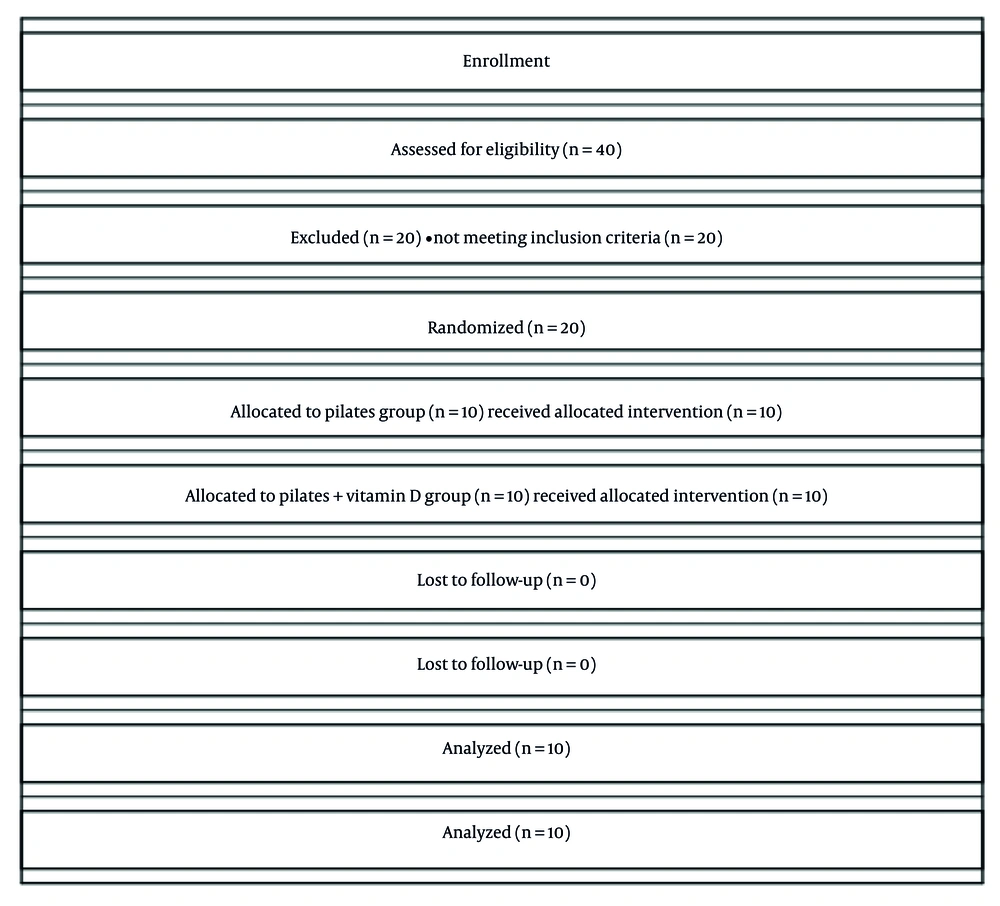
Figure 1.
CONSORT 2010 flow diagram of participant enrollment, randomization, follow-up, and analysis
Blinding was applied to participants and outcome assessors; however, laboratory technicians were not blinded because of resource limitations. An a priori power calculation, based on an expected effect size of 0.8 for changes in VEGF, derived from prior exercise studies in MS (9, 11), indicated that 16 participants per group would provide 80% power at alpha = 0.05. However, due to the pilot nature of the study and resource constraints, the sample size was limited to 10 per group, acknowledging the risk of being underpowered to detect smaller effect sizes. Recruitment was conducted via posters and newsletters distributed through the Ahvaz MS Association, with additional referrals from local neurologists. Of the 40 respondents, 20 met the eligibility criteria after initial screening, including a medical history review and EDSS assessment by a trained neurologist. No dropouts occurred, and 100% adherence was recorded based on session attendance logs. The flow of participants is illustrated in Figure 1.
3.2. Intervention
The 8-week intervention consisted of three weekly Pilates sessions, each lasting 60 - 75 minutes. Each session included a 10-minute warm-up (proper standing posture, Pilates breathing, and stretching), 45 - 60 minutes of core Pilates exercises focusing on advanced stretching, strength, balance, flexibility, and neuromuscular coordination, and a 5-minute cool-down (spinal extension, twist, dorsiflexion, threading the needle, prostration, and lateral breathing) (6, 12).
Exercise intensity was progressed from 50% - 55% heart rate reserve (HRR) in week 1 (one set of 10 repetitions) to 65% - 70% HRR in week 8 (four sets of 12 repetitions), calculated using the Karvonen formula and monitored with a Polar heart rate monitor (12). The Pilates + vitamin D group received a weekly oral dose of 50,000 IU vitamin D3 (cholecalciferol), whereas the Pilates group received a matching placebo (oral paraffin pearl; Zahravi Pharmaceutical Company, Iran). Capsules were identical in appearance, taste, and packaging to ensure blinding. Adherence was monitored via attendance records, with all participants completing at least 90% of scheduled sessions. Intention-to-treat analysis was not required because follow-up was complete (Figure 1).
3.3. Outcome Measures
Venous blood samples (10 mL) were collected after a 12-hour overnight fast, 48 hours before and after the intervention. Serum levels of VEGF and KDR were measured using commercially available ELISA kits (Sunlong Biotech Co., Ltd., China; VEGF: SL1811Hu, sensitivity: 1.8 pg/mL; KDR: SL1627Hu, sensitivity: 0.01 ng/mL). All samples were analyzed in duplicate.
3.4. Statistical Analysis
Data normality was confirmed using the Shapiro-Wilk test (P > 0.05), and homogeneity of variances was verified using Levene's test (P > 0.05). Within-group changes were analyzed using paired t-tests. Between-group differences were assessed using analysis of covariance (ANCOVA), with baseline values, age, and height included as covariates to adjust for observed baseline imbalances. Statistical significance was set at P ≤ 0.05. All analyses were performed using SPSS version 26 (IBM Corp., Armonk, NY, USA). The study was approved by the Ethics Committee of Islamic Azad University, Ahvaz Branch (IR.IAU.AHVAZ.REC.1402.140). Written informed consent was obtained from all participants, and data confidentiality was assured. Data are available from the corresponding author upon reasonable request. Due to limited laboratory resources, baseline and post-intervention 25-hydroxyvitamin D levels were not measured, which is acknowledged as a study limitation.
4. Results
Baseline characteristics of the participants are presented in Table 1. The Pilates group had a mean age of 44.40 ± 2.83 years and a mean height of 174.2 ± 3.99 cm, whereas the Pilates + vitamin D group had a mean age of 37.10 ± 5.64 years and a mean height of 166.1 ± 9.40 cm. No significant between-group differences were observed at baseline (P > 0.05 for all variables, independent t-test).
Table 1.
Baseline and Participant Characteristics a
| Variables | Pilates (n = 10) | Pilates + Vitamin D (n = 10) | P-Value (Between-Group) |
|---|---|---|---|
| Age (y) | 44.40 ± 2.83 | 37.10 ± 5.64 | 0.06 |
| Height (cm) | 174.2 ± 3.99 | 166.1 ± 9.40 | 0.08 |
| Initial weight (kg) | 74.30 ± 10.70 | 76.40 ± 11.46 | 0.52 |
| Final weight (kg) | 73.00 ± 10.47 | 75.10 ± 11.64 | - |
| Initial BMI (kg/m2) | 28.26 ± 3.80 | 27.26 ± 3.51 | 0.52 |
| Final BMI (kg/m2) | 26.88 ± 3.59 | 25.30 ± 3.50 | - |
a Values are expressed as mean ± SD (n = 10 per group). P-values for between-group baseline differences are from independent t-test. No between-group differences were significant (ANCOVA, P > 0.05).
Both groups showed significant reductions in BMI after the intervention (Pilates: from 28.26 ± 3.80 to 26.88 ± 3.59 kg/m2, P = 0.004; Pilates + vitamin D: from 27.26 ± 3.51 to 25.30 ± 3.50 kg/m2, P = 0.012), with no significant between-group difference (P = 0.34, ANCOVA adjusted for baseline). Serum VEGF levels (Figure 2) decreased significantly in both groups after the intervention. In the Pilates group, VEGF decreased from 112.874 ± 24.802 to 99.718 ± 13.263 pg/mL (P = 0.009, paired t-test), whereas in the Pilates + vitamin D group, it decreased from 138.448 ± 14.093 to 111.871 ± 13.022 pg/mL (P = 0.036) (Table 2).
Table 2.
Changes in Serum Parameters After 8 Weeks a
| Variables and Groups | Pre-test | Post-test | Mean Difference | P-Value (t-test) | Between-Group P-Value (ANCOVA) |
|---|---|---|---|---|---|
| VEGF (pg/mL) | 0.031 | ||||
| Pilates | 112.874 ± 24.802 | 99.718 ± 13.263 | 13.156 ± 11.539 | 0.009 | |
| Pilates + vitamin D | 138.448 ± 14.093 | 111.871 ± 13.022 | 26.577 ± 12.071 | 0.036 | |
| KDR (ng/mL) | 0.001 | ||||
| Pilates | 13.231 ± 3.016 | 13.662 ± 4.654 | -0.431 ± 1.638 | 0.003 | |
| Pilates + vitamin D | 9.575 ± 1.418 | 9.486 ± 1.634 | 0.089 ± 0.216 | 0.008 |
a Data are expressed as mean ± SD (n = 10 per group). P < 0.05 indicates statistical significance. Abbreviations: VEGF, vascular endothelial growth factor; KDR, kinase insert domain receptor.
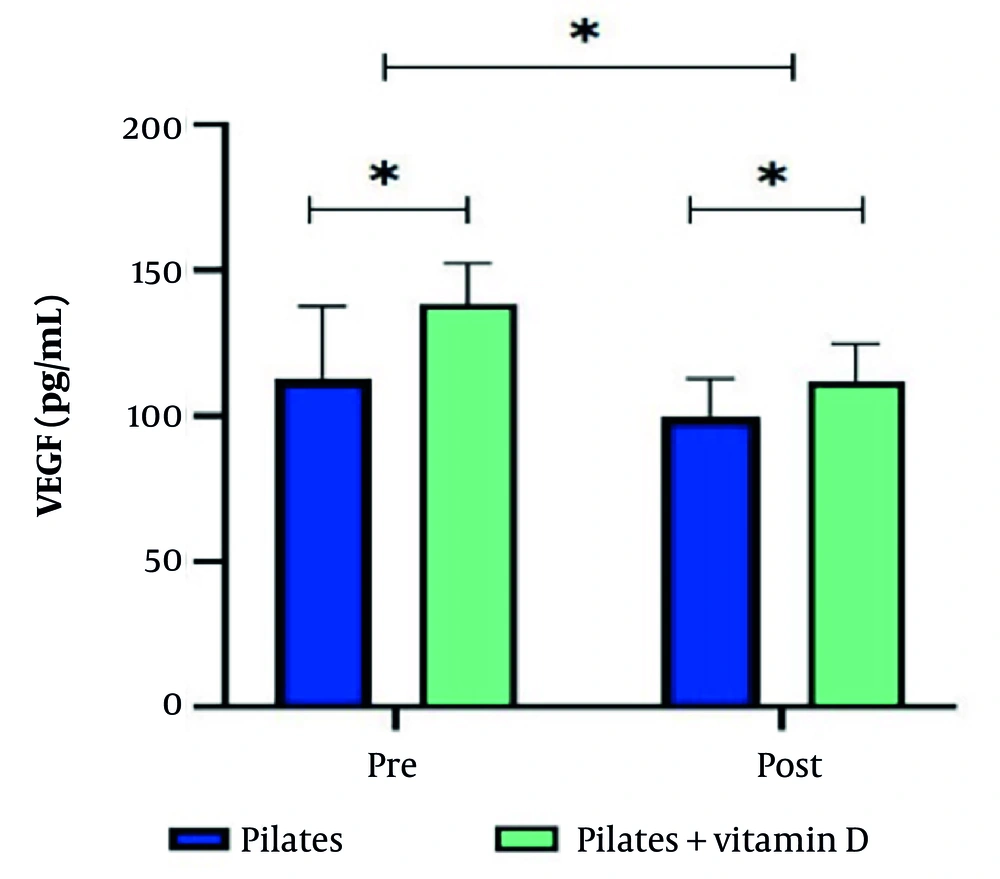
Figure 2.
Changes in Serum VEGF Levels After 8 Weeks. Mean ± standard deviation (n = 10 per group). VEGF levels in the Pilates and Pilates + vitamin D groups before and after the intervention. Y-axis: VEGF (pg/mL); X-axis: pre- and post-intervention. * P < 0.05 indicates significant within-group changes (paired t-test). Asterisk denotes significant between-group difference (ANCOVA, P = 0.031).
The between-group difference was significant, with a greater reduction in the Pilates + vitamin D group (adjusted mean difference: -8.5 pg/mL; 95% CI, -14.7 to -2.3; P = 0.031, ANCOVA) (Table 2). Effect sizes (Cohen d) were 0.72 for Pilates and 0.67 for Pilates + vitamin D, indicating moderate effects (Table 3). For serum KDR levels (Figure 3), the Pilates group showed a slight increase from 13.231 ± 3.016 to 13.662 ± 4.654 ng/mL (P = 0.003, paired t-test), whereas the Pilates + vitamin D group showed a decrease from 9.575 ± 1.418 to 9.486 ± 1.634 ng/mL (P = 0.008). The between-group difference was significant (adjusted mean difference: -0.5 ng/mL; 95% CI, -0.8 to -0.2; P = 0.001, ANCOVA). Effect sizes were 0.90 for Pilates and -0.85 for Pilates + vitamin D, indicating large effects in opposite directions (Table 3). No adverse events were reported during the intervention, and adherence was 100% based on attendance records. Multiple testing was controlled using the Bonferroni correction, with adjusted P values reported where applicable.
Table 3.
Effect Sizes and 95% Confidence Intervals a
| Outcome and Groups | Mean Difference | 95% CI | Cohen d |
|---|---|---|---|
| VEGF (pg/mL) | |||
| Pilates (pg/mL) | -13.156 | -25.3 to -1.0 | -0.67 |
| Pilates + VitD (pg/mL) | -26.577 | -35.0 to -18.2 | -1.95 |
| Pilates vs VitD (between) | -8.5 | -14.7 to -2.3 | -0.45 |
| KDR (ng/mL) | |||
| Pilates (ng/mL) | 0.431 | -2.0 to 2.9 | 0.11 |
| Pilates + VitD (ng/mL) | -0.089 | -1.0 to 0.8 | -0.06 |
| Pilates vs VitD (between) | -0.5 | -0.8 to -0.2 | -0.30 |
a Mean difference is post-intervention minus baseline (within-group) or adjusted between-group differences (ANCOVA, from Table 2). The 95% CIs and Cohen d values are estimated based on pooled SDs and n = 10 per group. Values are from the text (ANCOVA adjusted). Negative d indicates a decrease.
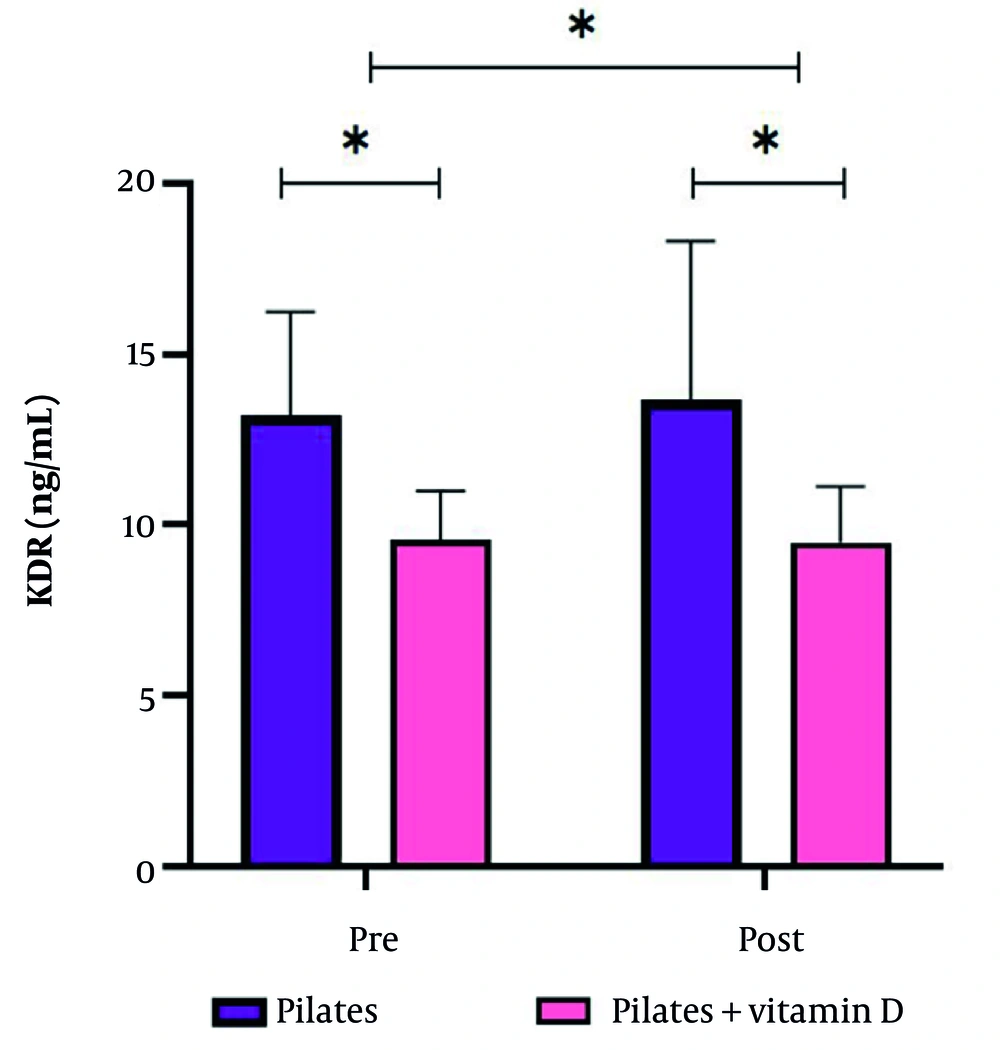
Figure 3.
Changes in Serum KDR Levels After 8 Weeks. Mean ± standard deviation (n = 10 per group). KDR levels in the Pilates and Pilates + vitamin D groups before and after the intervention. Y-axis: KDR (ng/mL); X-axis: pre- and post-intervention. * P < 0.05 indicates significant within-group changes (paired t-test). Asterisk denotes significant between-group difference (ANCOVA, P = 0.001).
5. Discussion
This pilot study examined the potential effects of an 8-week Pilates program, with or without vitamin D supplementation, on serum VEGF and its receptor, KDR, as key markers of angiogenesis and vascular function in MS. Twenty men with relapsing-remitting MS from the Ahvaz MS Association were randomly assigned to a Pilates exercise group (n = 10) or a Pilates + vitamin D group (n = 10). The 8-week intervention comprised three 60 - 75-minute Pilates sessions per week, focusing on core strength, flexibility, and balance. The Pilates + vitamin D group received a weekly oral dose of 50,000 IU vitamin D3. Serum VEGF and KDR levels were measured using ELISA 48 hours before and after the intervention. Data were analyzed using SPSS version 26, with paired t-tests for within-group changes and ANCOVA for between-group differences; significance was set at P ≤ 0.05. Both groups showed significant reductions in VEGF (Pilates: P = 0.009; Pilates + vitamin D: P = 0.036). The Pilates + vitamin D group exhibited a potentially greater reduction in VEGF (P = 0.031). KDR increased slightly in the Pilates group (P = 0.003) but decreased in the Pilates + vitamin D group (P = 0.008), with a significant between-group difference (P = 0.001). Both groups showed significant reductions in BMI (P < 0.05), with no between-group differences (P > 0.05). These results provide initial insights into the potential vascular and anti-inflammatory benefits of these interventions; however, further research is needed to confirm these effects.
The observed reduction in VEGF levels in both groups is consistent with previous studies on exercise in MS, which have linked physical activity to decreased pro-inflammatory cytokines and angiogenic factors (11, 12). Our findings are consistent with Rezaee et al. (9), who reported reduced VEGF in patients with MS after aerobic exercise, suggesting anti-inflammatory effects. However, the differential KDR response contrasts with that reported by Soke et al. (15), in which combined exercise increased VEGF-related factors in Parkinson disease, indicating disease-specific mechanisms. The modest reduction in VEGF with vitamin D echoes Munger et al. (14), although our pilot study suggests potential synergies not observed in standalone supplementation studies (e.g., supplemental vitamin D reduced new lesions by 39% in early MS, as reported by Thouvenot et al. (17)). Additionally, Andreu-Caravaca et al. (6) found that Pilates improved fatigue and balance in MS, supporting our observed BMI reductions. Furthermore, recent animal-model studies underscore the value of combining exercise with antioxidant supplementation in modulating MS pathology, aligning with our approach. For instance, Porsesh et al. (18) demonstrated that aquatic exercise combined with CoQ10 supplementation (150 mg/kg/day for 6 weeks) synergistically reduced oxidative stress markers (increased TAC, CAT, POX, and GR), decreased PTX3 protein expression (P ≤ 0.001) and microglia count, and increased oligodendrocyte count (P ≤ 0.001) in a cuprizone-induced MS rat model, without significant changes in NF200 expression (P > 0.05).
These findings support our proposed anti-inflammatory effects on VEGF/KDR by highlighting how exercise-supplement synergies may mitigate oxidative stress-driven demyelination and neuroinflammation. Similarly, Porsesh et al. (19) showed that the same combination improved spatial memory (increased MWM distance, P < 0.05), elevated Klotho and NeuN protein expression (P ≤ 0.05), enhanced GPX and GSSG levels (P < 0.05), and reduced MDA (P ≤ 0.05), promoting myelin repair and cognitive function in the MS model; this parallels our potential neuroprotective benefits from Pilates and vitamin D. Although pharmacological, Basiratnia et al. (20) found that levothyroxine (100 μg/kg for 10 days) reversed MS-induced cognitive deficits (improved MWM latency/path length/speed, P < 0.001; increased STL in the avoidance test, P < 0.001), reduced oxidative stress (increased TAC, P = 0.0375; decreased MDA, P = 0.001), and lowered inflammation (decreased TNF-alpha/CRP, P ≤ 0.025), suggesting shared pathways, such as antioxidant modulation, that could inform our supplementation strategy for MS management. Moreover, Delpisheh and Safarzade (21) demonstrated that high-intensity interval training modulates adipokine levels (e.g., vaspin) (22) in high-fat-fed rat models, which may parallel our findings regarding inflammation control through VEGF/KDR and support a role for exercise intensity in biomarker regulation.
The greater reduction in VEGF in the Pilates + vitamin D group (adjusted mean difference: -8.5 pg/mL; P = 0.031) may suggest a synergistic effect, potentially mediated by the immunomodulatory properties of vitamin D and its influence on endothelial function (14, 15). This finding is consistent with evidence that vitamin D can modulate inflammatory biomarkers in neurological disorders, supporting its therapeutic potential in MS (13). The contrasting KDR responses, namely a slight increase in the Pilates group (P = 0.003) and a decrease in the Pilates + vitamin D group (P = 0.008), with a significant between-group difference (P = 0.001), indicate differential effects on vascular stabilization.
The increase in KDR with Pilates alone may reflect enhanced endothelial proliferation, a potential mechanism for neural repair in MS (7). Conversely, the decrease with vitamin D supplementation may indicate a regulatory feedback mechanism, possibly reducing pathological angiogenesis (9). These preliminary findings warrant further investigation of the specific pathways involved, such as PI3K/Akt and MAPK, as suggested by prior research (11).
These exploratory findings suggest that Pilates, with or without vitamin D supplementation, may reduce serum VEGF and modulate KDR levels in men with relapsing-remitting MS. The combined intervention showed potentially greater effects on VEGF and distinct KDR regulation, indicating possible benefits for vascular health and MS management. However, these are pilot results from a small sample (n = 10/group), and larger studies with clinical outcomes are warranted to confirm these preliminary findings.
5.1. Limitations
Several limitations should be acknowledged. The small sample size (n = 10 per group) and the absence of a non-intervention control group restrict the generalizability of the findings and limit the ability to attribute changes solely to the interventions, potentially confounding the results with seasonal variations, placebo effects, or laboratory variability.
Baseline imbalances in age (44.4 vs 37.1 years) and height (174.2 vs 166.1 cm), although not statistically significant, may have influenced biomarker levels and exercise responses. The male-only design, although controlling for sex variability, limits applicability to women, who are more commonly affected by MS. In addition, the absence of baseline or post-intervention vitamin D status measurements and incomplete blinding (laboratory technicians were not blinded) further constrain the conclusions, reflecting the pilot nature and resource limitations of this study. Moreover, the lack of serum 25-hydroxyvitamin D measurements limits the ability to confirm whether supplementation corrected vitamin D levels, leaving the vitamin D component unverified.
5.2. Conclusions
In conclusion, this pilot study suggests that an 8-week Pilates program, particularly when combined with vitamin D supplementation, may modulate VEGF and KDR levels in men with relapsing-remitting MS, providing preliminary insights into vascular health management. However, these findings are exploratory, and larger randomized controlled trials with diverse populations, clinical endpoints, and comprehensive biomarker assessments (e.g., 25(OH)D and disease-modifying therapy status) are essential to confirm these effects.