
1. Background
Cancer is one of the most important chronic diseases and is characterized by uncontrolled and abnormal cell growth (1). It represents a major global health concern and is among the most common clinical conditions in Iran. According to the World Health Organization, cancer is projected to account for approximately 13.4% of all deaths in Iran by 2030 (2). Beyond its physical effects, cancer is a significant life stressor and poses substantial threats to the physical and psychological well-being of affected individuals. Reports from the American Cancer Society indicate that nearly 25% of cancer patients experience psychological and mental health problems, including anxiety, depression, and emotional distress (3).
A key factor in psychological adaptation to cancer is distress tolerance, defined as an individual’s capacity to endure and manage negative emotions without engaging in avoidance or maladaptive behaviors (4). Low distress tolerance is associated with perceiving emotional discomfort as unbearable, difficulty shifting attention away from emotional pain, and a tendency to escape or avoid negative emotional experiences. Research has shown that patients with chronic diseases and low distress tolerance often experience higher levels of emotional distress, depression, anxiety, and a reduced quality of life (5). Low distress tolerance may also contribute to maladaptive behaviors, increased psychological distress, and treatment nonadherence, highlighting the importance of identifying factors that can enhance distress tolerance in cancer patients (6).
Two critical psychological constructs that influence adjustment to cancer are social support and pain self-efficacy. Social support, as a protective psychological factor, enables individuals to cope more adaptively with life stressors, including illness-related challenges (7). It is considered a fundamental component of cancer care because it promotes empathetic communication, strengthens emotional bonds, and enhances patients’ coping abilities and emotional stability (8). The literature consistently indicates that social support facilitates adaptive coping mechanisms among patients with chronic illnesses, particularly cancer. For example, Ruiz-Rodriguez et al. (9) demonstrated a significant correlation between perceived social support and enhanced well-being in both cancer patients and their caregivers. Similarly, Johansen et al. (10) reported that patients with higher social support experienced less psychological distress and greater resilience during treatment.
Another crucial factor is pain self-efficacy, defined as an individual’s perceived ability to manage and cope with the physical and emotional aspects of pain (11). Pain self-efficacy influences daily functioning, emotional regulation, and coping strategies (12). Research in oncology settings indicates that interventions aimed at enhancing pain self-efficacy improve treatment outcomes, reduce symptoms, and increase patient participation in self-care activities (13, 14). Strengthening pain self-efficacy has also been associated with improved quality of life and psychological well-being in cancer patients.
Despite substantial evidence on the effects of social support and pain self-efficacy on psychological outcomes, few studies have examined their combined predictive role in distress tolerance, particularly within the Iranian cultural context, where family support and social networks are highly influential. Understanding these relationships can inform the development of culturally sensitive psychological and educational interventions designed to improve resilience and mental health among Iranian cancer patients.
2. Objectives
This study aimed to examine the extent to which social support and pain self-efficacy predict distress tolerance in patients with cancer and to provide empirical evidence to guide interventions that enhance psychological adaptation and resilience in this population.
3. Methods
3.1. Design
This study employed a cross-sectional, correlational-predictive design to examine the relationships between, and the predictive roles of, social support and pain self-efficacy in distress tolerance among patients with cancer.
3.2. Samples
The statistical population comprised all patients with cancer referred to the Radiotherapy Department of Ali Ibn Abi Taleb Hospital in Zahedan, Iran, during 2024 - 2025. Based on an a priori power analysis (power = 0.80, α = 0.05, medium effect size), a minimum sample size of 50 participants was considered sufficient to detect significant predictive relationships. Participants were selected using purposive sampling and were eligible if they met the following criteria: (A) age ≥ 18 years, (B) a confirmed diagnosis of cancer of any type, (C) currently receiving radiotherapy, (D) at least 3 months since diagnosis, and (E) the ability to read and write and provide written informed consent. Exclusion criteria were (A) severe psychiatric disorders, (B) cognitive or physical limitations preventing completion of the questionnaires, and (C) unwillingness to continue participation. This sampling strategy ensured that participants could reliably provide data relevant to social support, pain self-efficacy, and distress tolerance.
3.3. Instruments
3.3.1. Social Support Questionnaire
Perceived social support was assessed using the Medical Outcomes Study Social Support Survey (MOS-SSS), originally developed and validated by Sherbourne and Stewart (15). This scale includes 19 items across five domains: tangible support, informational support, emotional support, affectionate support, and positive social interaction. Responses are rated on a 5-point Likert scale ranging from 1 (never) to 5 (always), with total scores ranging from 19 to 95; higher scores indicate greater perceived social support. The Persian version of the MOS-SSS was used in the current study. Previous validation studies in Iran have demonstrated satisfactory psychometric properties, with Cronbach’s alpha coefficients ranging from 0.78 to 0.91 for the subscales. In the present sample, internal consistency was also strong, with a Cronbach’s alpha of 0.82 for the total scale and 0.75 - 0.89 for the subscales, indicating acceptable reliability.
3.3.2. Distress Tolerance Questionnaire
The Distress Tolerance Scale developed by Simons and Gaher (16) delineates four distinct facets of reactions to emotional adversity: capacity for endurance (Tolerance), extent of engagement with negative affect (Absorption), interpretation of distress (Appraisal), and use of strategies to reduce negative arousal (Regulation). The scale contains 15 items rated on a 5-point agreement scale (1 = strongly agree; 5 = strongly disagree) and requires reverse scoring of item 6. Higher total scores (range: 15 - 75, based on 15 items rated from 1 to 5) indicate greater baseline distress tolerance. The original authors confirmed the scale’s reliability (Cronbach’s alpha for subscales: 0.70 - 0.82; total Cronbach’s alpha: 0.82) and temporal stability (6-month intraclass correlation coefficient = 0.61). In the Persian context, Alavi, as reported by Vahdani et al. (17), demonstrated acceptable internal consistency (α = 0.672) and test-retest reliability (r = 0.79).
3.3.3. Pain Self-Efficacy Questionnaire
Confidence in pain management was assessed using the Pain Self-Efficacy Questionnaire (PSEQ), which is theoretically rooted in Bandura’s social cognitive theory of self-efficacy (18). The scale consists of 10 items assessing an individual’s confidence in performing instrumental activities of daily living while experiencing pain. Response options use a 7-point continuum ranging from 0 (completely unable) to 6 (completely able), yielding a maximum possible score of 60; higher scores reflect higher pain self-efficacy. In the Iranian context, Asghari and Nicholas (19) conducted confirmatory factor analysis of the Persian version and confirmed its validity as a unidimensional construct in chronic pain populations. The instrument demonstrated excellent internal consistency (α = 0.92) and strong test-retest reliability (r = 0.83 over 9 days), both exceeding the established reliability criterion of 0.74.
3.4. Statistical Analysis
Data were analyzed using SPSS version 26. Analyses began with descriptive statistics, including means and standard deviations, and were followed by inferential methods, including Pearson correlation, stepwise regression, and simultaneous regression.
4. Results
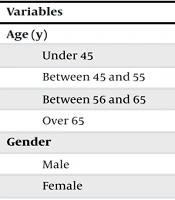
The results in Table 1 showed that the study sample comprised 50 participants (N = 50). The sample included 40% men and 60% women. Regarding age, 16% of participants were aged 18 - 35 years, 44% were aged 36 - 55 years, and 40% were 56 years or older.
Table 1.
Demographic Information
| Feature | Distribution | Percentage (%) |
|---|---|---|
| Gender | ||
| Man | 20 | 40 |
| Woman | 30 | 60 |
| Age (y) | ||
| 18 - 35 | 8 | 16 |
| 36 - 55 | 22 | 44 |
| 56 ≤ | 20 | 40 |
These demographic characteristics are relevant to the study variables. Previous research suggests that gender differences may influence perceived social support, pain self-efficacy, and levels of distress tolerance among patients with cancer. Additionally, age may affect coping mechanisms, pain perception, and psychological adjustment to illness. Because most participants were middle-aged and older adults (84%), the findings primarily reflect the experiences of these age groups. Therefore, age and gender were considered when interpreting the relationships among social support, pain self-efficacy, and distress tolerance.
The results in Table 2 showed that the mean scores for the study variables were as follows: total social support, 92.40 (SD = 10.28); pain self-efficacy, 75.12 (SD = 10.41); and distress tolerance, 87.50 (SD = 8.18). Social support subscale means ranged from 16.12 to 19.94.
Table 2.
Mean and Standard Deviation of Social Support Components, Pain Self-Efficacy, and Distress Tolerance
| Variables and Subscale | Mean ± SD |
|---|---|
| Social Support | |
| Tangible Support | 19.94 ± 2.64 |
| Emotional Support | 16.86 ± 2.51 |
| Informational Support | 16.12 ± 2.78 |
| Affectionate Support | 19.74 ± 3.70 |
| Positive Social Interaction | 19.74 ± 3.59 |
| Total Score | 92.40 ± 10.28 |
| Pain Self-Efficacy (Total Score) | 75.12 ± 10.41 |
| Distress Tolerance (Total Score) | 87.50 ± 8.18 |
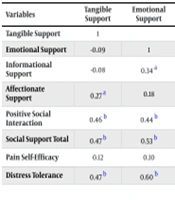
Pearson correlation coefficients among all study variables are presented in Table 3. The matrix reports all pairwise associations among social support components, pain self-efficacy, and distress tolerance. Most social support subscales were positively intercorrelated. Positive social interaction showed strong associations with affectionate support (r = 0.78, P < 0.01) and tangible support (r = 0.46, P < 0.01). Informational support was moderately correlated with emotional support (r = 0.34, P < 0.05). However, the correlations between tangible support and emotional support (r = -0.09, P > 0.05) and between tangible support and informational support (r = -0.08, P > 0.05) were not statistically significant. Pain self-efficacy showed significant positive correlations with affectionate support (r = 0.41, P < 0.01), total social support (r = 0.34, P < 0.05), and distress tolerance (r = 0.28, P < 0.05), whereas its correlations with other social support components were not significant. Distress tolerance was positively and significantly correlated with all social support components, with strong associations observed with total social support (r = 0.95, P < 0.01) and positive social interaction (r = 0.84, P < 0.01).
Table 3.
Pearson Correlation Coefficients Among Social Support Components, Pain Self-Efficacy, and Distress Tolerance
| Variables | Tangible Support | Emotional Support | Informational Support | Affectionate Support | Positive Social Interaction | Social Support Total | Pain Self-Efficacy | Distress Tolerance |
|---|---|---|---|---|---|---|---|---|
| Tangible Support | 1 | |||||||
| Emotional Support | -0.09 | 1 | ||||||
| Informational Support | -0.08 | 0.34 a | 1 | |||||
| Affectionate Support | 0.27 a | 0.18 | 0.16 | 1 | ||||
| Positive Social Interaction | 0.46 b | 0.44 b | 0.28 a | 0.78 b | 1 | |||
| Social Support Total | 0.47 b | 0.53 b | 0.49 b | 0.79 b | 0.93 b | 1 | ||
| Pain Self-Efficacy | 0.12 | 0.10 | 0.13 | 0.41 b | 0.27 | 0.34 a | 1 | |
| Distress Tolerance | 0.47 b | 0.60 b | 0.57 b | 0.64 b | 0.84 b | 0.95 b | 0.28 a | 1 |
a P < 0.05.
b P < 0.01.
The results presented in Table 4 indicate that all subcomponents of social support (positive social interaction, informational support, tangible support, emotional support, and affectionate support) met the criteria for entry into the stepwise regression model and significantly predicted distress tolerance in patients with cancer. In the first step, positive social interaction entered the model and accounted for 70% of the variance in distress tolerance. In the second step, positive social interaction and informational support together explained 82% of the variance. In the third step, the inclusion of tangible support along with positive social interaction and informational support increased the explained variance to 86%. In the fourth step, emotional support was added, resulting in a total explained variance of 92%. Finally, in the fifth step, the addition of affectionate support increased the explained variance to 94%.
Table 4.
Regression Analysis Predicting Distress Tolerance from Social Support Components
| Step | Predictor(s) | r | R2 | Adjusted R2 | β | t | P |
|---|---|---|---|---|---|---|---|
| 1 | Positive Social Interaction | 0.84 | 0.70 | 0.70 | 0.84 | 13.92 | 0.00 |
| 2 | Positive Social Interaction, Informational Support | 0.91 | 0.82 | 0.12 | 0.73 | 10.61 | 0.00 |
| 3 | Positive Social Interaction, Informational Support, Tangible Support | 0.93 | 0.86 | 0.03 | 0.61 | 5.94 | 0.00 |
| 4 | Positive Social Interaction, Informational Support, Tangible Support, Emotional Support | 0.96 | 0.92 | 0.05 | 0.44 | 3.32 | 0.00 |
| 5 | Positive Social Interaction, Informational Support, Tangible Support, Emotional Support, Affectionate Support | 0.97 | 0.94 | 0.02 | 0.15 | 0.27 | 0.00 |
The standardized beta coefficients indicate the relative contribution of each predictor in the model. Specifically, in the first step, a 1-unit change in distress tolerance was associated with a 0.84 change in positive social interaction. In the second step, the contribution of positive social interaction and informational support was 0.73. In the third step, the combination of positive social interaction, informational support, and tangible support yielded a beta coefficient of 0.61. In the fourth step, emotional support showed a beta coefficient of 0.44; however, when all components were included, the beta coefficient decreased to 0.15. These results suggest that each subcomponent of social support contributes incrementally to explaining distress tolerance in patients with cancer.
The regression results shown in Table 5 (F = 4.15, P < 0.05) demonstrate a significant linear relationship between pain self-efficacy and distress tolerance at the 95% confidence level. Pain self-efficacy emerged as an important predictor of distress tolerance. The squared multiple correlation coefficient (R2 = 0.08) indicates that pain self-efficacy accounts for approximately 8% of the variance in distress tolerance, highlighting its role as a direct predictor of distress tolerance in patients with cancer.
Table 5.
Regression Analysis Predicting Distress Tolerance from Pain Self-Efficacy
| Dependent Variable | Predictor | r | R2 | Adjusted R2 | β | F | t | P |
|---|---|---|---|---|---|---|---|---|
| Distress Tolerance | Pain self-efficacy | 0.28 | 0.08 | 0.06 | 0.28 | 4.15 | 2.04 | 0.04 |
5. Discussion
The present study demonstrated that social support and pain self-efficacy significantly predict distress tolerance in patients with cancer. Beyond statistical associations, these findings align with established psychological frameworks of stress, coping, and resilience.
From a theoretical standpoint, the stress-buffering hypothesis explains the relationship between social support and distress tolerance. Social support functions as a protective psychosocial resource that reduces the perceived threat of stressful events and enhances adaptive coping. When individuals perceive that emotional, informational, and tangible resources are available, the cognitive appraisal of stressors becomes less catastrophic and more manageable. This mechanism likely increases distress tolerance by influencing both primary appraisal (perceived threat severity) and secondary appraisal (perceived coping capacity). Thus, social support does not merely accompany distress tolerance; it may actively shape how cancer-related adversity is cognitively processed.
Consistent with previous findings (6, 20-22), our results indicate that higher perceived social support is associated with greater distress tolerance. However, unlike some earlier studies that treated social support as a unitary construct, the present findings highlight the differential contributions of its subcomponents. Positive social interaction showed strong predictive value, suggesting that, beyond instrumental assistance, opportunities to engage in meaningful and emotionally validating social exchanges may be central to sustaining psychological endurance in the face of cancer. This finding partially extends prior research (20, 21) by demonstrating that relational quality, not only support availability, may be critical for fostering distress tolerance.
Moreover, prior studies have documented the protective role of social support against anxiety, depression, and general psychological distress (6). Our findings complement these results by suggesting that social support may operate at a more fundamental regulatory level by enhancing individuals’ tolerance of negative affect rather than merely reducing symptom severity. This distinction is important: distress tolerance reflects the ability to endure emotional discomfort, a capacity that is conceptually linked to resilience processes. Therefore, social support may promote psychological resilience not only by reducing distress but also by strengthening patients’ capacity to withstand it.
The cultural context of Iran provides an additional layer of interpretation. Iranian society maintains strong collectivistic values, family cohesion, and interdependent relational norms. In this context, family-based and relational support may have heightened psychological significance. Emotional reassurance and affectionate bonds may carry more profound implications for identity, dignity, and belonging than in more individualistic societies. Thus, the strong associations observed between social support dimensions and distress tolerance may partly reflect culturally embedded expectations regarding mutual obligation, empathy, and communal coping. These findings underscore the importance of considering sociocultural context when examining psychosocial predictors of adjustment in cancer populations.
Regarding pain self-efficacy, the findings are consistent with previous literature (23-25) demonstrating a positive relationship between self-efficacy beliefs and psychological resilience in chronic illness. Rooted in Bandura’s social cognitive theory, self-efficacy influences emotional regulation, coping behavior, and persistence under adversity. Patients who believe they can manage their pain are more likely to interpret pain episodes as controllable rather than overwhelming. This cognitive framing reduces helplessness and mitigates affective escalation, thereby enhancing distress tolerance.
Prior studies (23, 25) have suggested that pain self-efficacy mediates the relationship between pain intensity and psychological distress. Our findings extend this line of research by positioning pain self-efficacy as a direct predictor of distress tolerance. This suggests that, beyond influencing distress severity, self-efficacy beliefs may fundamentally determine how much distress an individual can endure before experiencing psychological dysregulation. Thus, pain self-efficacy appears to serve as a resilience resource, buffering against emotional destabilization in the context of cancer-related pain.
Importantly, the combined predictive effects of social support and pain self-efficacy point toward a multilevel resilience model. Social support represents an external interpersonal resource, whereas pain self-efficacy reflects an internal cognitive resource. Their simultaneous contribution suggests that distress tolerance in patients with cancer emerges from the interaction between environmental support systems and personal belief structures.
5.1. Conclusions
Overall, the findings of this study underscore the significant roles of social support and pain self-efficacy in predicting distress tolerance among patients with cancer, regardless of gender. The results indicate that robust support from family, friends, and social networks enhances patients’ psychological capacity to cope with distress. Moreover, pain self-efficacy, as a central cognitive resource, enables individuals to regulate negative emotions and adopt adaptive coping strategies in response to illness-related challenges.
These findings align with existing literature and emphasize the critical value of integrating psychosocial components into cancer care. Future research should use longitudinal and intervention-based designs to evaluate causal pathways and the effectiveness of programs aimed at strengthening social support systems and enhancing pain self-efficacy. Additionally, culturally tailored interventions that consider the specific social dynamics of Iranian patients may further improve psychological resilience and quality of life.
By addressing these psychological determinants, healthcare providers can develop more comprehensive and effective psycho-oncological support strategies that better meet the diverse needs of patients with cancer across genders and cultural contexts.
5.2. Limitations and Suggestions
This study has several limitations that warrant consideration. The relatively small sample size (N = 50), drawn from a single radiotherapy department, constrains the generalizability of the findings to the broader oncology population. The cross-sectional nature of the research further limits causal inference regarding the associations among social support, pain self-efficacy, and distress tolerance. Additionally, the exclusive use of self-report instruments may have introduced biases related to memory, social desirability, and subjective response tendencies. Moreover, the lack of control for crucial clinical variables, such as cancer stage, disease severity, treatment regimen, and professional support, may have influenced the observed associations.
Future studies should employ longitudinal or experimental designs and include larger, more heterogeneous samples across multiple clinical settings and cultural contexts to strengthen external validity and clarify causal mechanisms. Incorporating objective clinical indicators and systematically controlling for relevant medical factors would allow a more precise evaluation of psychosocial determinants of distress tolerance. Furthermore, examining potential mediating and moderating constructs, such as resilience, coping strategies, and perceived life expectancy, and developing targeted psychosocial interventions to enhance pain self-efficacy and social support may yield valuable insights and practical implications for improving psychological adjustment and resilience among patients with cancer.