1. Background
Chronic kidney disease (CKD) is a main public health challenge (1), especially in developing countries (2), which its incidence and prevalence are on the rise (3). Although patients undergoing hemodialysis, as a maintenance invasive treatment, can live longer (4), they experience diverse complications that noticeably disturb their quality of life (5). Patients undergoing hemodialysis have an extremely high risk of developing cardiovascular diseases in comparison with general population (6); as a result, cardiovascular diseases with vascular calcifications are the most important cause of morbidity and mortality among these patients (7). Although risk factors, such as hypertension and lipid metabolic disorders (hypercholesterolemia) are more prevalent in the patients with CKD, these factors cannot explain the higher mortality of cardiovascular disease in patients undergoing hemodialysis (8).
In recent years, it has been found that cardiovascular events and mortality are significantly related to hyperuricemia in the general population and in patients with CKD (9, 10). Hyperuricemia, represented by increased level of serum uric acid (SUA), is one of the most prevalent disorders in CKD patients and occurs usually during the early stages of the disease (1). It is accompanied with rapid loss in residual renal function (11).
Moreover, according to the literature, there was a significant association between cardiovascular mortality and systematic inflammation (12). Systemic inflammation is a common disorder in patients with CKD, which results from an increase in the production of oxidative stress-free radicals and a reduction in the capacity of antioxidants (13). It exacerbates with the deterioration of kidney function and hemodialysis inception (14). In recent years, clinical studies have shown that the precipitation of urate crystals in joints of hyperuricemic patients could lead to the release of inflammatory cytokines (15) and a systemic inflammation (16). In other words, inflammation could be involved with elevated serum uric acid; however, this subject has been little investigated in patients undergoing hemodialysis (17).
C-reactive protein (CRP) that is synthesized during the inflammation by liver is a reliable marker for showing the inflammatory state and response (18). Although the role of ferritin is storing intracellular iron (19), it may have other effects. Limited evidence shows that high levels of serum ferritin could aggravate oxidative stress in patients undergoing hemodialysis (20); however, we have not found any study reporting serum levels of inflammation markers in hemodialysis patients with high, normal or low serum levels of ferritin.
2. Objectives
In this study, we analyzed the association between uric acid and CRP (an inflammatory marker) in hemodialysis patients. We also compared CRP (an inflammation marker) level in regular hemodialysis patients with normal or high serum levels of ferritin.
3. Materials and Methods
This study was conducted using a cross-sectional design from October 2012 to January 2013 on ESRD (End stage renal disease) patients who were undergoing maintenance hemodialysis. The data was gathered via a data collection form and measurement of laboratory parameters.
3.1. Patients
One hundred and eighty-two volunteer patients were enrolled from two hemodialysis units in two hospitals in an urban area of Iran (Baqiyatallah and Chamran hospitals in Tehran). The sample criteria included all patients with ESRD aged ≥18 years, having regular recourse for maintenance hemodialysis 2 or 3 sessions per week, and undergoing hemodialysis more than 3 months. Sample size was determined by elements such as α (type I) error level, statistical power error level, and the standard deviation of the measurements for continuous outcomes. The equation used for sample size calculation was:
(d = Absolute error) (21).
3.2. Data Collection
A demographic questionnaire was developed by the researcher for the assessment of age, gender, weight, income, marital status, education and employment status, smoking history, opium use, alcohol consumption, dialysis session and vintage, nephropathy cause, and supplements administration. Required laboratory parameters, including serum levels of uric acid, CRP, ferritin and lipid profiles (cholesterol, triglyceride, HDL, and LDL) were measured. The laboratory data were obtained at least after 12 h of fasting via the venous line at the beginning of hemodialysis session. Lipid profile levels were measured according to standard methods. The determination of serum levels of uric acid was done by the Sigma enzymatic procedure (Sigma Diagnostics) using colorimetric methods. CRP (C-reactive Protein) level was assessed using a BN2 model nepherometer (Germany) according to the instructions by the manufacturer.
3.3. Ethical Consideration
Ethical approval was obtained from the Institutional Ethics Committee (No. 31). Oral and written consents were obtained from all participants in the study after informing each of them about the study purposes, confidentiality of their information, and their freedom to withdraw from the study at any stage.
3.4. Statistical Analyses
All data were shown as Mean ± SD. The χ2-test (chi-square test), t test and analysis of variance (ANOVA) were used in this study. The data was analyzed by SPSS software (version 18). The researcher decided to receive only 5% error in rejecting the full hypothesis at 95% confidence interval. In this study, P value was taken significant at less than 0.05 and the statistical power was considered 80%.
4. Results
The study sample consisted of 182 patients on maintenance hemodialysis. Of them, 112 (61.5%) were men, and 70 (38.5%) were women; with a mean age of 61.9 ± 12.6 y (range 24-88 y). Most of the respondents (56%) were more than 60 years old. Ninety-six (52.7%) participants were retired, 59 (32.4%) described themselves as housewife or husband, 13 (7.1%) were employed, and 14 (7.7%) were unemployed. The mean ages of the retired, unemployed, and employed individuals were 63.4, 61.9 and 49 y, respectively. The mean age of the men (62 y) was similar to mean age of women (61.6 y). The average hemodialysis duration was 37.9 mo (SD ± 42.4; range 2-300 mo). The prevalent causes of nephropathy were hypertension and diabetes (37.4% HTN, 13.7% DM, 29.1% HTN, and DM simultaneously). Educational level in 52.7% of participants was either at primary or secondary level. The greater part of the participants (84.1%) were married, 13.2% and 2.7% of them were widowed and single, respectively. Additional demographic characteristics of patients are listed in Table 1.
The mean of SUA levels was 6 ± 1.3 mg/dL (reference range, 2.6 to 6 mg/dL). Approximately 44% of the participants (men, 26.9% and women, 16.5%) had hyperuricemia (SUA more than 6 mg/dL). The average age of the patients with hyperuricemia was 62.4 y. Hemodialysis duration was significantly longer in patients with nephropathy because of glomerulonephritis (P < 0.000). The means of plasma concentrations of CRP and ferritin were 20.8 (SD ± 33.3) and 625.8 ng/mL (SD ± 579.6). Higher serum levels of CRP and ferritin were seen in 47% and 80% of the patients, respectively. Serum levels of CRP was higher in the patients with history of hospitalization in two last months, but it did not achieve a significant level (P = 0.06). Also ferritin mean was more significant in patients with past history of transplantation (P = 0.01). The mean serum levels of cholesterol, triglyceride, HDL and LDL were 146.4 (SD ± 37.7), 124.2 (SD ± 65.8), 37.8 (SD ± 9.3), 83.1 (SD ± 31.1), respectively.
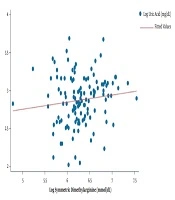
There was no significant difference between the SUA levels of the men (6 ± 1.3 mg/dL) and the women (6 ± 1.2 mg/dL) (P = 0.93). The highest and lowest uric acid mean were seen in individuals with glomerulonephritis (7 ± 1.5 mg/dL, P = 0.03) and diabetes (5.6 ± 1.09 mg/dL, P = 0.04), respectively. There was no significant relationship between age and SUA levels (P = 0.36). Although the highest uric acid mean was seen in employed patients (6.1 ± 1.4 mg/dL), there was no significant relationship between occupation and SUA levels (P = 0.13). In an independent samples t test, a significant positive relationship was reported between dialysis vintage and SUA levels (P = 0.02). A linear correlation analysis showed that there was a significant association between serum levels of triglyceride and cholesterol (P = 0.000), LDL (P = 0.01), and uric acid (P = 0.007). It also indicated that serum levels of uric acid had no significant correlation with serum levels of CRP (P = 0.7), cholesterol, HDL (P = 0.5), LDL (P = 0.6) and ferritin (P = 0.2). Table 2 summarized the relationships between variables. Although there was a significant relationship between SUA levels with plasma triglyceride, it had no meaningful association with plasma CRP and ferritin (Table 3).
Table 1.
Baseline Qualitative Characteristics of the Participants (n = 182)
| Characteristic | Frequency a |
|---|---|
| Age, y | |
| < 40 | 16 (8.8) |
| 40-60 | 64 (35.2) |
| > 60 | 102 (56) |
| Education | |
| Primary | 79 (43.4) |
| Under diploma | 17 (9.3) |
| Diploma | 52 (28.6) |
| University | 34 (18.7) |
| Weight, kg | |
| < 50 | 4 (2.3) |
| 50-70 | 99 (54.4) |
| 70-90 | 70 (38.5) |
| > 90 | 9 (4.8) |
| Nephropathy cause | |
| HTN | 68 (37.4) |
| DM | 25 (13.7) |
| Glomerulonephritis | 5 (2.7) |
| HTN and DM | 53 (29.2) |
| Others | 31 (17) |
| Marital status | |
| Married | 153 (84.1) |
| Single | 5 (2.7) |
| Widow | 24 (13.2) |
a Data are presented as No. (%)
Table 2.
Baseline Quantitative Characteristics of the Participants
| Variables | Age, y | ANOVA | ||
|---|---|---|---|---|
| < 45 | 45-60 | > 60 | ||
| Dialysis vintage, mo | 56 (80.2) | 39.7 (43.3) | 33.9 (32) | 0.14 |
| Body weight, kg | 66.8 (14.9) | 69.8 (11.3) | 69.3 (11.4) | 0.6 |
| Serum parameters | ||||
| Uric acid, mg/dL | 6.4 (0.96) | 6.01 (1.3) | 5.9 (1.3) | 0.3 |
| CRP | 18.8 (33.1) | 17.4 (30.5) | 23.2 (35.1) | 0.5 |
| Total cholesterol, mg/dL | 146.7 (43.6) | 138.6 (34.3) | 151.3 (38.4) | 0.2 |
| LDL cholesterol, mg/dL | 79.8 (30) | 78.2 (29.6) | 86.5 (31.9) | 0.2 |
| HDL cholesterol, mg/dL | 35.3 (9.3) | 37.9 (8.4) | 38.1 (9.9) | 0.5 |
| Triglyceride, mg/L | 149.6 (86.1) | 123.7 (62.2) | 120.7 (64.6) | 0.3 |
| Ferritin, ng/mL | 774.8 (665) | 585 (428.5) | 628 (646) | 0.5 |
Table 3.
Characteristics of Participants With Low, Normal and High Ferritin Levels
| Variable | Low Ferritin (n: 22) | Normal Ferritin (n: 111) | High Ferritin (n: 49) |
|---|---|---|---|
| Age, y | 63.7 ± 14.1 | 61.5 ± 12.7 | 62 ± 11.9 |
| Gender, M/F | 11/11 | 65/46 | 36/13 |
| Weight, kg | 65.5 ± 12.6 | 69.6 ± 10.9 | 70.2 ± 12.7 |
| Dialysis duration, mo | 24.5 ± 24.4 | 36.6 ± 38.3 | 46.7 ± 54.7 |
| Ferritin, ng/mL | 59.1 ± 21.8 | 428.1 ± 180.3 | 1328.1 ± 671.6 |
| CRP | 20.4 ± 33.6 | 20.4 ± 32.5 | 21.9 ± 35.6 |
| Uric acid, mg/dL | 6 ± 1.1 | 6 ± 1.3 | 5.9 ± 1.2 |
| Total cholesterol, mg/dL | 147.5 ± 34.9 | 146 ± 38 | 147 ± 38.9 |
| LDL cholesterol, mg/dL | 82.6 ± 28.4 | 84.7 ± 31.1 | 79.5 ± 32.6 |
| HDL cholesterol, mg/dL | 38.4 ± 6.9 | 37.1 ± 9.1 | 39 ± 10.6 |
| Triglyceride, mg/L | 115.5 ± 53 | 125.7 ± 64.2 | 124.3 ± 74.8 |
5. Discussion
Our data showed that a higher SUA levels, and plasma concentrations of CRP were seen in approximately half of the patients undergoing hemodialysis. The findings also demonstrated the lack of any statistical relationship between SUA levels and inflammatory marker of CRP or serum ferritin. In the present study, the incidence of hyperuricemia was 44%. This result was slightly higher than the findings of Numakura (22). In Numakura study, hyperuricemia prevalence was evaluated in transplanted individuals one year after renal transplantation, whereas in our study its prevalence was reported in patients undergoing hemodialysis. Chronic inflammation due to the release of inflammatory mediators in hemodialysis patients leads to reduced production of essential antioxidants and increased oxidative stress (23), which causes an increase in free radicals (24). In our study, 80.2% of patients had serum CRP level more than 5. In this study, we investigated the relationship between serum concentrations of CRP with plasma ferritin and did not found any association between them. These results conformed to Senol study (13).
Many researchers believed that there was a significant relationship between serum levels of CRP and uric acid as markers of coronary risk so that lowering serum urate could improve systemic inflammation in cardiovascular patients (16). Ogino lowered serum uric acid in patients with chronic heart failure by 50 mg benzbromarone, and improved TNF-a (an inflammation marker) (25). Likewise, after administration of allopurinol 100 mg/day in CKD patients with stable renal function (eGFR < 60), Goicoechea reported that lowering of serum urate, decreased significantly CRP (26) and Muir achieved similar results in the acute ischemic stroke patients (27). Although many studies confirmed that SUA relates to CRP, but in these studies their relationship analyzed together as a prognostic biomarker in acute myocardial infarction and cardiovascular disease; therefore, there was no really significant relationship between them.
Our results also demonstrated that SUA levels are associated with the triglyceride level. This result was analogous with the results of Ziga (28), Cicero (29), and Cerecero (30). According to their findings, the incidence of CKD is higher in men and people older than 45 years. In this study, 56% of patients were male and older than 45 years. In other studies, more than 50% of the hemodialysis patients were jobless (31), but in our study, only 7.7% of the patients were unemployed (if housekeeping is accounted as a jo), and the rest of them were retired or employed. This could indicate that the government and the insurance companies have an appropriate support of hemodialysis patients in Iran.
In accordance with earlier studies of patients undergoing hemodialysis, our results showed that a relatively high proportion of ESRD was caused by hypertension, whereas the incidence of ESRD caused by glomerulonephritis was lower. This finding was inconsistent with the results of Feng in China (32). The reason may be associated with the difference in the ethnicity or China status as a developing country. The limitation of this study was the small sample size. Performing studies with larger sample sizes and long-term use of vitamin B12 are recommended.
Our data showed that a higher SUA levels, and plasma concentrations of CRP were seen in approximately half of the patients undergoing hemodialysis. They also demonstrated the lack of any statistical relationship between SUA levels with inflammatory marker of CRP or serum ferritin. Detailed investigations with larger sample size are recommended.