1. Background
Multiple sclerosis (MS) is the most common chronic disease of the central nervous system. The pathophysiology of MS involves the demyelination and subsequent degeneration of nerve fibers in the central nervous system. Demyelination process produces debris that fills all over the white matter and affect sensory and motor function (1). MS often appears between 20 and 40 years of age, and is two times more common in females than in males (2). Currently, 5.2 million people in the world, and approximately 500 thousand people in the United States are affected by MS (3). In Iran, statistics show that patients with MS were over 50 thousand in 2002. The rising trends in Iranian patients have caused health problems in different areas, which require more attention (4). Chronic natures of the disease, having no definite cure, and its effect on the young generation have devastating effects on the patients' general well-being (5).
The World Health Organization (WHO) in 1948 defined health as "a state of complete physical, mental, and social well-being not merely the absence of disease or infirmity". General health is a quality of life (QOL) that is related to emotional, mental, spiritual, and biologic state of individuals. It adapts individuals with their surrounding and enables them to do necessary physical, psychologic, and social activities (6). Chronic diseases such as MS can affect all aspects of individual health. In the physical side, they cause sensory and cognitive impairment as well as sexual dysfunction and finally, change the patients’ QOL (7). In the psychologic aspect, patients experience problems such as depression, anxiety, and problems in playing their role (8). It also affects their social relationships and increases the patients' dependence on others, leading to lower self-esteem, and feelings of loneliness (9).
MS endangers patients’ independence and ability to participate effectively in family and community, which leads to their lack of competence and self-confidence. Thus, it damages the patients' physical and health integrity and changes all aspects of their health (10). The disease impairs patients’ functional and physical ability and thereby it creates a frustrating situation for the patients, which lead to diminished self-esteem and frustration. During MS, patients' physical condition weakens and they cannot perform their full physical potentials and most of their activities will be limited. This situation makes the patients anxious, angry, and depressed and causes stress and emotional turmoil in them. In this situation, the person is psychologically vulnerable to physical illness and this might end in mental disorder (11). Mahmodi et al. reported that patients with MS experience health and many other socio-psychologic problems (12). Studies by Bahram-Khani et al. revealed that in comparison with healthy people, patients with MS experience more depression, anxiety, social dysfunction, and many other health problems (13). Thus, improving health status including physical, mental, and social health is an important part of patients care and treatment programs (14). In order to achieve the highest level of physical, emotional, and social health and having a positive belief in self-abilities, using an integrated recovery plan could provide an important support. People with MS need to match and coordinate with challenges of their disease. One way to correct the patients' compliance with disease complications is empowering their self-efficacy (15). Self-efficacy was initially introduced as a concept in social learning by Aalto in 1997 (16). Self-efficacy is a person's judgment about his or her ability to perform a particular activity. In this sense, levels of activity affect the individual performance. Self-promotion is very important in the process of behavior change. Frequency of performance and simplification of the tasks by dividing them into smaller achievements, can make the patients self-sufficient in every stage of the work, which leads to full efficacy (15). Nowadays, self-efficacy has an important place in various aspects of life and health. It has a great role in people’s outlook on life, dealing with their problems, their QOL, decision making, and management of stress and depression (17). Furthermore, it has a great influence on improving the general well-being and rehabilitation in chronic conditions (18). In other words, self-efficacy is a predictor of change in health behavior, especially when the goal is to improve the health status of patients with chronic diseases. This can be obtained by empowering the patients to be aware of their interests as well as their potential barriers (19). Haghighat et al. showed that there was a negative correlation between pain perception and self-efficacy for pain control in patients with MS (20). Accordingly, self-efficacy can be regarded as one of the factors influencing health status of patients with MS. Moreover, self-efficacy can be very important in controlling the disease process, avoiding possible complications, reducing the cost of hospitalization and treatment, improving the QOL, and general well-being (15). Janson et al. revealed that self-efficacy improves the health status and QOL in patients with MS (21).
Chronic nature of MS and its long-term problems necessitate the treatment and care services in which nurses play an important role. Given the critical role of nurses in the rehabilitation of patients with MS, they are able to assist in enhancing the ability to perform daily activities and reduce patients’ social, economic, and psychologic problems (22).
2. Objectives
Nowadays, introducing necessary measures to promote the QOL in patients with debilitating problems is strongly felt and medical treatments have little effect on QOL of these patients. Therefore, implementing psychologic techniques can be of great importance. So far, self-efficacy as a way of promoting health support has not been studied in patients with MS in Iran. Therefore, this study was conducted to examine the association between general well-being and self-efficacy in patients with MS.
3. Materials and Methods
This descriptive and correlation study was conducted in Farshchian Teaching and Training Center, Hamadan, Iran. The sample size was calculated using the following formula;
With confidence interval of 99%, power of 90%, r = 0.44, and using convenience sampling, sample size was calculated at 100. After getting Ethic Committee approval from Hamadan University of Medical Sciences, the researcher started the project. Inclusion criteria were no history of malignancy, mental, or chronic diseases, being diagnosed with MS for at least one year, and being literate. Exclusion criterion was being in the active symptomatic phase of the disease.
Patients who were referred to Farshchian Teaching and Training Center and met the eligibility criteria, and tended to participate in the study were recruited. The researcher attended the center throughout the week and introduced herself to the patients. After providing information on the research goals, instructing the participants to complete the questionnaire, and obtaining informed consent from the patients, she assured the patients of the confidentiality of the their information. Then she asked the patients to complete the questionnaire with precision.
Data collection tools included General Health Quesstionneir-28 (GHQ-28) and General Self-Efficacy-Sherer (GSESH) questionnaire. GHQ-28 is the most reliable screening tool for determining psychologic problems and is widely used throughout the world (23). Psychometric studies on various general Health tools shows that in comparison to other versions, GHQ-28 has maximum reliability, sensitivity, and specificity (24). Its reliability has been confirmed in Iran as well. Palahang et al. reported the sensitivity and specificity of GHQ-28 to be 0.88 and 0.74, respectively (25). With Cronbach's alpha coefficient of 0.91, Molavi reported sensitivity and specificity of GHQ-28 to be 0.72 and 0.58, respectively (26).
GHQ-28 contains four scales of somatic symptoms, anxiety and insomnia, social dysfunction, and depression. Each scale consists of seven questions. High scores on this test indicate existence of the disorder and lower scores shows absence of disease and appropriate mental health. For grading the GHQ-28, we used Likert scoring method (item scores, 0, 1, 2, and 3; total range, 0-84). Based on this method of scoring, the obtained scores are reported as follows: zero to 27, good general health; 28 to 55, satisfactory general health; and 56 to 84, poor general health (27).
Regarding reliability and validity of the GSESH, calculated Cronbach’s alpha of 0.86. The Cronbach's alpha of 0.86 and 0.80 was reported by Alaei (28). GSESH contains 23 items with 17 items related to general self-efficacy, and six items related to self-efficacy experiences in different social situations. A 17-item scale was used in this study. GSESH measures peoples’ beliefs about their ability to overcome various situations. The questionnaire is based on a five-level Likert scale from “strongly disagree" through “strongly agree”, presented by scores one through five, respectively. Thus, the highest self-efficacy score on this scale is 85 and the lowest score is 17. Scores indicate the level of self-efficacy as followings: 17 to 34, poor; 34 to 51, average; 51 to 68, good; and 68 to 85, very good self-efficacy. Higher scores indicate stronger and lower scores indicate poorer self-efficacy, respectively (29). Questionnaires had to be completed by patients in 20 minutes. Data were entered in SPSS 16 (SPSS Inc., Chicago, IL, USA) using descriptive statistics, Pearson correlation coefficients, and Chi square test. P value < 0.05 was considered as statistically significant.
4. Results
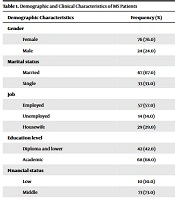
Results showed that mean ± SD age of the study subjects was 34.5 ± 9.1 years. Most of the patients were female (78%). Education level of the majority was secondary school (68%), 74% were married, and 55% were homemakers. Duration of the disease ranged from ten to 30 months in most of the cases (48%) (Table 1). Mean of self-efficacy in the study subjects was 37.5 ± 7.9 and 53% of the patients had moderate efficacy (Table 2). In terms of general well-being, most of the patients (60%) had a good health status.
Table 1.
Distribution of Demographic Variables a
| Demographic characteristics | Values |
|---|---|
| Sex | |
| Male | 78 (78) |
| Female | 22 (22) |
| Age | |
| 16-30 | 40 (40) |
| 31-45 | 50 (50) |
| 46-62 | 10 (10) |
| Education | |
| Secondary School | 68 (68) |
| Associate Degree | 31 (31) |
| Bachelor | 1 (1) |
| Marital Status | |
| Married | 74 (74) |
| Single | 26 (26) |
| Occupation | |
| Unemployed | 11 (11) |
| Home Maker | 55 (55) |
| Employed | 14 (14) |
| Student | 4 (4) |
| University Student | 5 (5) |
| Self-Employed | 11 (11) |
a Data are presented as No. (%).
Table 2.
Distribution of Self-Efficacy by Study Units a
| Self-Efficacy | Value |
|---|---|
| Poor | 41 (41) |
| Average | 53 (53) |
| Good | 6 (6) |
| Very good | 0 (0) |
| Total | 100 (100) |
a Data are presented as No. (%).
Mean of general well-being in the study subjects was 49.6 ± 11.9 (Table 3). Association between self-efficacy and general well-being showed correlation coefficient of 0.549, which indicated a strong association between the two variables (P ≤ 0.001) (Table 4).
Table 3.
Distribution of General well-Being in the Study Units a
| General Well-Being | Value |
|---|---|
| Good | 6 (6) |
| Satisfactory | 60 (60) |
| Not Satisfactory | 34 (34) |
| Total | 100 (100) |
a Data are presented as No. (%).
Table 4.
Association Between Self-Efficacy and General Health a
| General Well-Being/ Self-Efficacy | 17-34 | 34-51 | 51-68 | Chi Square |
|---|---|---|---|---|
| Good | 1 (2.5) | 0 (0) | 0 (0) | 0.001 |
| Satisfactory | 32 (78) | 30 (56.5) | 0 (0) | 0.001 |
| Not Satisfactory | 8 (19.5) | 23 (43.5) | 6 (100) | 0.001 |
| Total | 41 (100) | 53 (100) | 6 (100) | 0.001 |
a Data are presented as No. (%).
5. Discussion
This study was conducted on patients with MS and was aimed at investigating the correlation between self-efficacy and general well-being. Assessment of the patients' general well-being from their own viewpoint showed that mean score was 49.6 for general well-being, 12.01 for physical symptoms-related indicators, 11.6 for anxiety and insomnia, 12.2 for impaired social functioning, and 13.7 for depression-related parameters. These results were consistent with findings of Mahmodi et al. who examined mental health of patients with MS (12). Results from the study by Jones et al. also showed that patients with MS have more mental health problems than healthy people do (30). In England, Thornton et al. compared 39 patients with MS with 40 healthy controls in terms of anxiety and depression. Results showed that both scores were higher in patients with MS in comparison to the controls (31). In a study done on 96 patients with MS in the UK, patients had lower levels of physical health index (32).
Findings of this study showed that social problem were the most prevalent problems (12.2%) in patients with MS. Zabad et al. and Katon et al. (33, 34) cited physical problems as the most common problems in patients with MS, which was not consistent with the results of the present study. It seems that most patients were unwilling to notify others of their disease and physical condition. Overall analysis of the findings shows the necessity of intervention to promote social function, impaired sleep problems, anxiety, and physical condition.
In this study, a significant correlation was observed between self-efficacy and general well-being in people with MS. Thus, with the increase in self-efficacy scores, general scores of well-being declined, indicating a better general health. This finding implies a relationship between self-efficacy and general health, which is consistent with the results of Cecilie and Pardo (35). Janson et al. in a study on evaluation of the effects of self-efficacy on patients with MS showed that people with higher self-efficacy scores had more general well-being and experienced less stress and fatigue (21). McMurray et al. and Tsay reported that increased self-efficacy was related with positive changes in healthcare behaviors and increases general health (36, 37). Other studies in this area have shown that high self-efficacy scores have positive correlation with improving adaptability in patients with MS (38, 39). Haugland et al. reported that self-efficacy directly affects health-related behaviors and QOL (40). In addition, due to the strong efficacy of beliefs about one’s ability, it directly improves the QOL in patients with MS and enhances their general well-being (41). These results suggest that promoting self-efficacy in patients with MS can have an important role in improving their general health. These results can be explored by Bandura's social cognitive theory according to which a sense of self-efficacy is a major factor in stressful situations affecting individuals' thoughts, feelings, and behaviors. It increases their ability to deal successfully with various challenging situations (42).
Given the significant correlation between self-efficacy and general well-being, it is necessary to consider incentives to increase the efficacy of interventions designed to improve general health of people with MS. Furthermore, since self-efficacy has an important role in accepting and maintaining behaviors and is the most important factor in changing behavior (43); therefore, it can be used as an educational program in nursing interventions with the aim of promoting healthy behavior.
Based on the findings, there is a positive correlation between self-efficacy and general health in patients with MS and promotion of self-efficacy can improve the general health of patients. The results of this study could be a basis for design and implementation of nursing interventions and training with the aim of promoting self-efficacy in people with MS.
Given the low cost and safety of these interventions and their effectiveness, they can improve general health of patients with chronic diseases such as MS and increase their QOL. Therefore, considering the results of this study, designing intervention incentives is recommended to increase general health of patients with MS.
5.1. Limitations
Limitations to this study included having no matched control for the age as well as socioeconomic class of patients, evaluation of variables in the short term, and cross-sectional design of study.