1. Background
Osteoporosis, a common bone disease and a major public health concern around the world, is characterized by low bone mass and degenerative changes to skeletal bone tissue microstructures (1, 2). Osteoporosis affects both men and women, but the disease is more common among women (3).
The international osteoporosis foundation estimates that by the year 2025, the annual rate of fractures caused by osteoporosis and related costs in America will increase by about 50% (4). The disease is common in Iran, too. According to the rheumatology research center of the Tehran University of Medical Sciences, six million Iranians have osteoporosis; 50% of men and 70% of women over age 50 are affected by osteoporosis or low bone mass. In addition, evidence shows that a high percentage of fractures occurring in Iran are related to osteoporosis (5).
Osteoporosis leads to a wide range of complications. The most common complication is fractures. Other possible complications include loss of height, kyphosis, negative body image, back pain, chronic pain syndrome, and increased mortality (3). Nevertheless, osteoporosis is a preventable disease, and primary prevention should begin as soon as possible because a rapid increase in bone density occurs at a young age (1, 2, 6).
In this study, primary prevention was encouraged by educating young people to adopt simple but effective preventive behaviors. These preventive behaviors included adequate calcium intake, regular weight-bearing exercise, and getting proper sunlight for vitamin D production in the skin (2, 3). According to existing evidence, calcium consumption (7, 8), physical activity (9, 10), and vitamin D obtained through food or synthesis in the skin after UV exposure (11) all have positive impacts on bone density. For example, studies of Karlsson et al. (9) and Rizzoli et al. (10) confirmed the impact of physical activity on bone mineral density.
Proper knowledge can influence the adoption of osteoporosis prevention behaviors, but due to a lack of adequate education, adolescents have low knowledge and are less concerned about the risk of osteoporosis compared to cancer and cardiovascular diseases (12, 13) Adolescents usually do not believe that they are at risk for the osteoporosis. Thus, widening their knowledge regarding this issue is essential for reducing the risk of osteoporosis in their future lives (14).
Health education is one of the most efficient ways to prevent diseases and encourage health promotion. Using models like the health belief model (HBM) has a significant impact on achieving these goals. The constructs of the health belief model are perceived susceptibility, perceived severity, perceived benefits, perceived barriers, cues to action, and self-efficacy (15). HBM is a theoretical model widely used in studies to predict health promoting behaviors. Findings show a lack of knowledge, low perceived sensitivity, and low perceived severity regarding osteoporosis in the populations studied; the authors emphasized improving public awareness of osteoporosis prevention (16, 17).
However, an important point is that studies in the field of osteoporosis educational intervention focus on postmenopausal women. Recent research shows that 90% of bone growth occurs between 10 and 20 years old, so the best age for the prevention of osteoporosis is early adolescence (18). Due to the cost-effectiveness of education and prevention compared to medical intervention, it is necessary to set up and expand educational programs for adolescents.
2. Objectives
The aim of this study was to determine the effect of an educational program, based on the health belief model, on promoting osteoporosis prevention behaviors in female high school students in Khorramshahr.
3. Methods
The current study was a pre- and post-test, two-group interventional study conducted from February 21 to May 20, 2015. Participants included 172 female students between 11 and 14 years old who were enrolled in the schools of Khorramshahr. They were selected using multistage sampling: four schools were selected from among 20 high schools for girls in Khorramshahr, and then two schools were randomly allocated to the experimental group and two to the control group. Two classes from each school and 43 students per class were selected randomly considering inclusion and exclusion criteria. In this way, 86 subjects were placed in the experimental group and 86 in the control group.
Inclusion criteria of the study included absence of specific diseases (e.g., malabsorption syndrome, osteomalacia, rickets), not taking anticonvulsants, corticosteroids, calcium supplements or vitamin D, and no previous participation in osteoporosis prevention educational programs.
Exclusion criteria included failure to attend one education session or not being compliant with at least two of the following preventive behaviors: (1) physical activity 3 to 4 times a week, each time 30 to 40 minutes, (2) exposure to sunlight 2 to 3 times a week, each time for 15 minutes, (3) consumption of foods rich in calcium, such as 3 to 4 cups daily of dairy foods.
After selection of the study subjects, objectives of the study were explained to each group, and then a pre-test was conducted for both groups using a four-part questionnaire. Pre-test data were analyzed, and on the basis of the results, an educational program was designed for the experimental group. Intervention was applied in four 90-minute sessions that took place weekly using lectures, powerpoint presentations, education manuals, CDs, and posters. The control group received no interventions during this period. Two months after the last session, a post-test was performed on both the control and experimental groups for final evaluation of the program and to determine the resulting behavioral changes. The collected data were analyzed using SPSS 22 software and Mann-Whitney, analysis of covariance, and Wilcoxon statistical tests. After analyzing the data, in order to comply with ethical issues, the manuals, educational CDs, and posters were provided to the control group.
3.1. The Data Collection Tool
The data collection tool was a researcher-made questionnaire containing four parts. The first part was related to demographic data. The second part had 26 questions related to knowledge about osteoporosis; these were designed as 2-point questions (true = 1, false = zero). The third part consisted of 51 questions related to the health belief model constructs and used a 5-point Likert scale (strongly agree = 5, agree = 4, no idea = 3, disagree = 2 strongly disagree = 1), including perceived sensitivity (5 questions), perceived severity (6 questions), perceived benefits (11 questions), perceived barriers (19 questions), self-efficacy (5), and cues to action (5 questions). The fourth part was related to the assessment of the participants’ preventive behaviors and was composed of two segments: (1) information about physical activity and exposure to sunlight obtained through answering four 3-point questions, and (2) a checklist for assessing the amount of consumption of calcium-rich foods and substances that inhibit the absorption of calcium.
Content validity was used to assess questionnaire validity; the questionnaire was given to 10 members of the faculty of nursing and midwifery and was revised according to their comments. Cronbach’s alpha was calculated to determine reliability. The Cronbach’s alpha calculated for whole questionnaire was 0.87; for the knowledge part of the questionnaire, 0.76; perceived susceptibility, 0.72; perceived severity, 0.82; perceived benefits, 0.84; perceived barriers, 0.87; self-efficacy, 0.72; and cues to action, 0.74. The calculated alpha values for the whole questionnaire and each studied part of questionnaire were greater than 0.7 and thus are considered to have an acceptable level of reliability.
3.2. Ethical Considerations
This study was approved by the ethics committee of the Ahvaz University of Medical Sciences (with the code ajums.rec.1393.418). In this study, researchers were committed to ethical issues such as respecting students’ right to participate voluntarily, getting consent from participants, and informing the participants of the study’s purpose.
4. Results
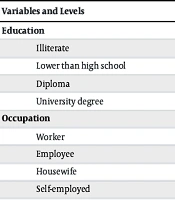
This study included 172 female students with a mean age of 13.25 ± 0.78, of which 86 were in the experimental group and 86 in the control group. Before the intervention, to compare the employment and education status of students’ parents, the chi-square test was used; it showed no statistically significant difference between the experimental and control groups (Table 1).
Table 1.
Frequency Distribution of Demographic Information of Students’ Parents
| Variables | Groups, No. (%) | P Value | ||
|---|---|---|---|---|
| Experimental Group, N = 86 | Control Group, N = 86 | |||
| Educational status of fathers | Diploma and under diploma | 55 (63.95) | 58 (67.44) | 0.215 |
| College education | 31 (36.5) | 28 (32.56) | ||
| Educational status of mothers | Diploma and under diploma | 57 (66.27) | 55 (63.95) | 0.925 |
| College education | 29 (33.72) | 31 (36.05) | ||
| Employment status of fathers | Employed | 50 (58.14) | 48 (55.81) | 0.799 |
| Self-employment | 34 (39.53) | 34 (39.53) | ||
| Unemployed | 2 (2.32) | 4 (4.65) | ||
| Employment status of mothers | Employed | 9 (10.46) | 6 (6.98) | 0.833 |
| Self-employment | 6 (6.98) | 5 (5.81) | ||
| Housewife | 71 (82.56) | 75 (87.21) | ||
Although there were statistically significant differences in the scores for knowledge, the health belief model’s constructs, and students’ preventive behaviors between experimental and control groups before the intervention, the analysis of covariance indicated significant differences between the two groups two months after the intervention (Tables 2 and 3).
Table 2.
Comparison Between the Average Scores of Students’ Knowledge and Constructs of the Health Belief Model
| Variables | Intervention, n = 86 | Control, n = 86 | P Value | |
|---|---|---|---|---|
| Mean ± SD | Mean ± SD | |||
| Knowledge | Pre-Intervention | 13.70 ± 2.90 | 19.20 ± 2.93 | 0.001a |
| Post- Intervention | 25.39 ± 1.47 | 18.16 ± 3.32 | 0.001a | |
| P value | 0.001b | 0.218b | ||
| Perceived Susceptibility | Pre-Intervention | 16.27 ± 3.31 | 18.84 ± 2.15 | 0.001a |
| Post- Intervention | 23.08 ± 1.37 | 18.52 ± 2.31 | 0.001c | |
| P value | 0.001b | 0.234b | ||
| Perceived Severity | Pre-Intervention | 18.67 ± 4.67 | 22.44 ± 3.15 | 0.001a |
| Post- Intervention | 26.49 ± 2.25 | 23.07 ± 2.33 | 0.001c | |
| P value | 0.001b | 0.216b | ||
| Perceived Benefit | Pre-Intervention | 42.23 ± 5.95 | 46.19 ± 5.29 | 0.001a |
| Post-Intervention | 52.16 ± 2.28 | 45.72 ± 3.18 | 0.001c | |
| P value | 0.001b | 0.452b | ||
| Perceived Barrier | Pre-Intervention | 46.09 ± 10.05 | 45.92 ± 12.88 | 0.510a |
| Post- Intervention | 31.89 ± 5.96 | 45.28 ± 7.85 | 0.001a | |
| P value | 0.001b | 0.737b | ||
| Self-efficacy | Pre-Intervention | 16.55 ± 3.55 | 19.83 ± 3.99 | 0.001a |
| Post- Intervention | 22.90 ± 1.65 | 20.80 ± 6.36 | 0.006c | |
| P value | 0.001b | 0.934b | ||
| Guide For Action | Pre-Intervention | 18.95 ± 3.15 | 21.49 ± 3.02 | 0.001a |
| Post- Intervention | 23.26 ± 1.46 | 21.74 ± 1.98 | 0.001c | |
| P value | 0.001b | 0.682b |
aMann-Whitney test.
bWilcoxon test.
canalysis covariance.
Table 3.
Comparison of the Average Scores of Students’ Osteoporosis Prevention Behaviors
| Variables | Intervention, n = 60 | Control, n = 60 | P Value | |
|---|---|---|---|---|
| Mean ± SD | Mean ± SD | |||
| Physical activity | Pre-Intervention | 3.58 ± 1.43 | 3.10 ± 1.19 | 0.032a |
| Post- Intervention | 4.64 ± 0.75 | 3.20 ± 1.81 | 0.001b | |
| P value | 0.001c | 0.632c | ||
| Exposure to sunlight | Pre-Intervention | 6.65 ± 1.35 | 6.08 ± 1.48 | 0.022a |
| Post- Intervention | 7.81 ± 0.79 | 5.81 ± 1.39 | 0.001b | |
| P value | 0.001c | 0.204c | ||
| Consumption of calcium | Pre-Intervention | 6980.64 ± 2979.25 | 6729.30 ± 3583.85 | 0.256a |
| Post- Intervention | 10032.86 ± 4203.99 | 6303.81 ± 3022.01 | 0.001a | |
| P value | 0.001c | 0.095c | ||
| Consumption of substances that inhibit the absorption of calcium | Pre-Intervention | 8.65 ± 7.12 | 9.06 ± 6.41 | 0.396a |
| Post- Intervention | 3.07 ± 2.53 | 9.73 ± 5.09 | 0.001a | |
| P value | 0.001c | 0.305c |
aMann-Whitney test.
banalysis covariance.
cWilcoxon test.
Also, there was a significant intergroup difference in the knowledge and model construct scores before and after the intervention for the experimental group; however, the difference was not significant for the control group (Table 2). The scores for preventive behaviors were evaluated using the Wilcoxon test, according to the amount of physical activity, exposure to sunlight, the amount of calcium-containing food intake, and intake of substances that inhibit calcium absorption. These scores showed significant differences before and after the intervention in the experimental group, but the differences were not significant in the control group (Table 3).
5. Discussion
The study findings revealed that an educational program based on the health belief model is effective in promoting osteoporosis prevention behaviors in female adolescents. The results showed that the knowledge of students in the experimental group increased significantly after the intervention, and this is consistent with the results of studies by Babatunde et al. (15), Hosking et al. (19) and Alseraty et al. (20).
Significant differences in mean scores of perceived sensitivity before and after education in the experimental group were another result of this study. After the intervention, students in the experimental group believed themselves to be more at risk than did the students in the control group. Zhang et al. (21), Doheny et al. (22) and Ghaffari et al. (23) reached similar results. These results indicate the effectiveness of training programs in increasing students’ knowledge, perceived susceptibility, and perceived sensitivity to osteoporosis.
A significant increase in scores of perceived severity in the intervention group compared with those of the control group was another finding of the study. Students in the experimental group had a greater understanding of the severity and seriousness of osteoporosis and its complications. The study results are consistent with the results of similar studies, such as Ebadi Fard Azar et al. (5), Sanaeinasab et al. (12) and Alseraty et al. (20). Due to the effectiveness of the training program in increasing the perceived severity in this study and other studies, it is obvious that it is essential to increase students’ knowledge about the serious consequences of osteoporosis, including physical symptoms, psychological effects, and economic outcomes.
In this study, a significant increase was observed in scores of perceived benefits in the experimental group compared to the control group. The increase in the perceived benefits in the experimental group can be due to the focus on the role of physical activity and intake of calcium-containing food in the prevention of osteoporosis, as well as education based on the health belief model constructs. The results of this study are aligned with the results of Nguyen et al. (24), Zhang et al. (21), Ebadi Fard Azar et al. (5), and Edmonds et al. (16).
This study also showed significant changes in scores of perceived barriers in the experimental group before and after education, as well as significant differences between the experimental and control groups. According to the results, it can be said that education based on the health belief model has led students to overcome perceived barriers to getting enough calcium and physical activity and to adopting preventive behaviors. The results are consistent with the results of other studies, such as Alseraty et al. (20), Niazi et al. (14), and Torshizi (25).
This study found that the self-efficacy of the experimental group after education showed a significant increase compared to pre-education results and compared to the control group. These results are similar to those by Huang et al. (26), Khorsandi et al. (27), and Sanaeinasab et al. (28). The findings of our study showed that education plays an important role in improving people's self-efficacy.
According to the study results, the mean scores of cues to action were significant in the experimental group before and after education as well as between the two groups. The results of the study are consistent with the results by Ebadi Fard Azar et al. (5) and Khani Jeihooni et al. (29).
Regarding preventive behaviors, before the intervention, no significant difference was revealed between the experimental and control groups concerning consumption of calcium-containing foods and substances that inhibit the absorption of calcium. However, after the intervention, there was a significant difference between the experimental group and the control group and a significant difference was observed in the experimental group before and after education. Our results are consistent with the findings of Babatunde et al. (15), Alseraty et al. (20) and Amini et al. (30). According to the results, it can be said that education based on the health belief model could affect the performance of students in increasing the consumption of calcium-containing food and reducing the intake of substances that inhibit the absorption of calcium.
Another finding was a significant increase in physical activity in the experimental group after the intervention as well as in comparison with the control group. The results show the effect of education based on the health belief model on improving the preventive behaviors of students. These results are consistent with those from studies by Sanaeinasab et al. (28), Niazi et al. (14), and Morseth et al. (31). The results show the effectiveness of intervention programs and a need for educational interventions designed to encourage regular physical activity among adolescents.
A significant difference was evident in exposure to sunlight to produce vitamin D comparing the students of the experimental group before and after the intervention, and comparing the experimental group after intervention to the control group. In a study by Yekefallah (32), only 6.7% of girls were exposed to sunlight for vitamin D production. Thus, it can be concluded that education based on the health belief model helps improve students’ performance in this regard.
In general, our findings revealed the effectiveness of a heath belief model–based educational intervention in improving the knowledge of osteoporosis and encouraging preventive behaviors in female adolescents.
5.1. Conclusion
Given the positive effect of this education program based on the health belief model, the importance and role of girls as future mothers, and the low cost of prevention in comparison to medical intervention, it is recommended that these simple but effective activities take place in public health promotion programs in general and adolescent health promotion programs specifically.