


1. Background
Cigarettes are among the most readily available substances worldwide, particularly for college students. Therefore, smoking tendencies and positive attitudes toward cigarette use are major concerns for university health and student affairs officials (1).
Prohibiting college students from smoking is the simplest solution. However, although coercive policies have been implemented and students reprimanded accordingly, these policies have not produced favorable results (2). Therefore, innovative and scientific solutions should be proposed. Analyzing students’ reasons for smoking can provide further insight to support the implementation of appropriate therapeutic interventions (3).
Programs warning students about the dangers of smoking, step-by-step smoking cessation programs, and similar interventions are implemented every year. Although smoking before entering university has always been an issue and has been reported by many students, a significant percentage of students also indicate that their first experience with smoking began during college (4).
Students have cited a variety of reasons for smoking, including an inability to adjust to the college environment and dormitory life, uncertainty about the future, being around people with similar views, academic pressure, lack of interest in their field of study, emotional issues such as relationships with the opposite sex and possible breakups, communication problems, financial problems, being away from family, lack of healthy entertainment, and other similar issues (5).
Although accurate statistics on the prevalence of smoking among students cannot be obtained, the existence of these issues suggests that smoking affects a substantial proportion of students and has consistently been considered one of the most important health issues during the college years (6). It is important to note that, in many cases, smoking serves as an introduction and gateway to substance abuse (7).
Therefore, attitudes toward smoking can be used as an indicator of an individual’s desire to smoke to relieve stress and reduce the psychological pressure caused by the problems mentioned above (8). According to multiple studies, the amount of smoking is positively associated with stress caused by emotional issues and academic difficulties. In other words, as stress and emotional problems increase, people tend to gravitate toward smoking (9).
According to another study, some people use smoking as a temporary means of ignoring family issues (10). One of the main variables affecting why people disregard the adverse effects and risks of smoking for short-term relief and a temporary escape from their problems is insufficient health literacy (11).
Medical students theoretically know the risks and potential harms of smoking and are constantly exposed to related information in the media. Moreover, adequate health literacy in real-world practice helps individuals protect themselves against potential risks from harmful variables, such as disease, substance abuse, or other health-related hazards (12).
If literacy is defined as the operationalization of acquired knowledge and experience in an empirical and tangible way, health literacy can be considered a variable that examines the following: what health is, what factors can threaten health, and what practical measures can help people remain safe from these risks (13). According to some studies, people with adequate health literacy levels are more likely to undergo periodic health checkups and participate in health-related programs, such as regular exercise and a healthy diet (14).
Furthermore, these students are less likely to develop some diseases, and when they become ill, they seek medical advice, act in a timely manner, and are aware of the golden time for treatment (15). Another factor that affects when and how people act based on their knowledge is their level of self-efficacy. Self-efficacy is a person’s belief that they can try and achieve success based on their own capabilities (16).
Without a sense of self-efficacy, many efforts remain unfinished, and the desired outcomes are not achieved. In numerous health-related studies, an acceptable level of self-efficacy has predicted the success of treatment or control programs (17).
In one study, people with higher self-efficacy were more likely to successfully change their lifestyle and adhere to their weight loss program than those with lower self-efficacy (18). Therefore, there is no doubt regarding the effectiveness of timely interventions based on scientific theories and approaches in this field. The health belief model, with its six components, is one such scientific theory (19).
The tendency or aversion to smoking is related to the individual’s, in this study the student’s, concern about the dangers of smoking (perceived susceptibility), the extent of this concern (perceived severity), belief in the benefits of quitting smoking and its effectiveness in disease prevention (perceived benefits), issues that can discourage smoking cessation (perceived barriers), availability of information and resources that help a person quit smoking (cues to action), and beliefs that quitting smoking plays an important role in reducing the dangers of smoking and protecting the individual from its consequences (self-efficacy) (20).
2. Objectives
This study aimed to evaluate the effectiveness of health belief model-based education in improving students’ attitudes toward smoking, health literacy, and self-efficacy.
3. Methods
3.1. Study Design and Setting
This quasi-experimental study was conducted among students at the University of Social Welfare and Rehabilitation Sciences in Tehran who were actively enrolled from May to June 2025. Because quasi-experimental designs have limitations in controlling certain factors, randomization was used to minimize these limitations and support the reproducibility of the study. Students who had smoked at least once in the past were selected using simple random sampling.
3.2. Participants, Sampling, and Intervention
According to Figure 1, based on the initial screening process and the predefined inclusion and exclusion criteria, 178 students were deemed eligible to participate in the study. The sample size was calculated using the formula for comparing the means of two independent groups, with particular emphasis on the primary study outcomes, namely health literacy and self-efficacy. The calculation was based on the study conducted by Panahi et al. (30), entitled "Effect of Health Belief Model-Based Education on Health Literacy and Smoking Prevention Among Students." Based on the reported means and standard deviations for health literacy (M = 72.51, SD = 5.64 in the intervention group and M = 62.21, SD = 5.54 in the control group) and self-efficacy (M = 28.24, SD = 3.24 in the intervention group and M = 26.89, SD = 3.54 in the control group), and a significance level of 0.05 (α = 0.05), the minimum required sample size was estimated to be 27 participants per group. To account for a potential attrition rate of 10%, the final sample size was increased to 30 participants per group, resulting in a total sample of 60 participants. During the screening phase, standardized questionnaires assessing health literacy, self-efficacy, and intention to smoke were administered to all eligible students. Individuals whose health literacy and self-efficacy scores were below the predefined cutoff values and whose intention-to-smoke scores exceeded the cutoff value were identified as at risk and, after meeting the inclusion and exclusion criteria, were enrolled in the study. After written informed consent was obtained, participants were randomly assigned to either the intervention group (n = 30) or the control group (n = 30) using a simple coin-toss randomization procedure, which provided an equal probability (50%) of allocation to either group. Participants were assigned to the intervention group if the outcome was heads and to the control group if the outcome was tails. To minimize selection bias, the randomization process was conducted by an individual independent of the research and intervention teams. The inclusion criteria were completion of at least two academic semesters and having smoked at least once during the previous week. The exclusion criteria included complete smoking cessation for at least two months before the study, use of substances other than cigarettes during the previous two months, participation in other smoking cessation programs or methods, and absence from more than two intervention sessions. After enrollment, baseline assessments (pre-test) were conducted. Subsequently, the intervention group participated in eight 90-minute educational sessions based on the health belief model and designed according to the World Health Organization protocol (Table 1). During the intervention period, the control group received no specific educational program. A post-test assessment was conducted one week after completion of the intervention.
Table 1.Health Belief Model Intervention Protocol
| Weeks | Session Durations | Provided Contents |
|---|---|---|
| First | 1.5 hours | Conducting a pre-test and learning about the dangers of nicotine |
| Second | 1.5 hours | Preparing a list of risks and dangers of smoking and the necessity of quitting smoking |
| Third | 1.5 hours | Investigating the extent and severity of students' concerns about the listed dangers |
| Fourth | 1.5 hours | Exploring disease prevention and the possible benefits of quitting smoking |
| Fifth | 1.5 hours | Examining the triggers of temptation, obstacles to smoking cessation, and disrupting factors in starting a smoking cessation program |
| Sixth | 1.5 hours | Exploring resources that can help reduce smoking, such as treatment centers, counseling centers, and self-help books |
| Seventh | 1.5 hours | Creating a timetable for reducing smoking over a six-month period |
| Eighth | 1.5 hours | Conducting post-tests, evaluating the success of the program, and conducting student interviews and surveys |
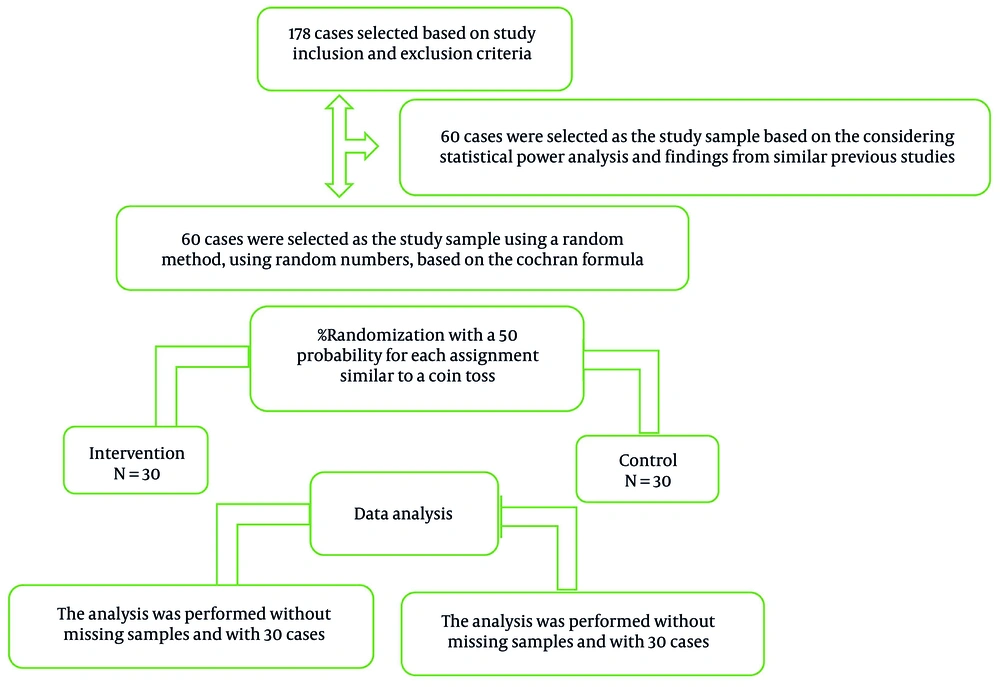
Figure 1.
Random allocation sampling process
3.3. Measures
One of the tools used in this study was the attitudes toward smoking questionnaire, which was developed and validated by Riahi et al. in 2009 (21). This questionnaire measures three variables: contact with smokers, a smoke-free and healthy environment, and participants' views on smoking-related laws. It consists of 32 closed-ended items scored on a five-point Likert scale, with scores ranging from 1 (strongly disagree) to 5 (strongly agree).
Questions 4, 5, 12, 13, 14, 15, 16, and 17 are scored in reverse order. A score between 32 and 54 indicates a negative attitude toward smoking, a score between 55 and 108 indicates a moderate attitude toward smoking, and a score above 109 indicates a positive attitude toward smoking. This questionnaire assesses three dimensions: cognitive, emotional, and behavioral. The reliability coefficient for the total questionnaire was 0.871. The reliability coefficients for the cognitive dimension (9 items), emotional dimension (11 items), and behavioral dimension (12 items) were 0.739, 0.825, and 0.876, respectively. The content validity ratio (CVR) was 0.62, and the content validity index (CVI) was 0.84.
To ascertain questionnaire validity, face validity was assessed to ensure the representativeness of the item content and the overall structure of the questionnaire through direct consultation with experts and specialists in the field, in addition to the use of scales developed in previous studies (21).
To measure self-efficacy, the 17-item Sherer and Maddox questionnaire, standardized by Barati, was used (22). The reliability of the questionnaire based on Cronbach's alpha was 0.79. Regarding questionnaire validity, there is a moderate negative correlation between the scores of the self-efficacy scale and the internal-external control scale developed by Sherer and Maddox. The CVR was 0.78, and the CVI was 0.79.
This scale comprises three components: the inclination to initiate behavior, the tendency to continue persisting and exerting effort, and the ability to maintain persistence in the face of failure. Scoring was based on a Likert scale from completely disagree (1) to completely agree (5). Questions 1, 3, 8, 9, 13, and 15 are scored in reverse order. Scores between 17 and 34 indicate weak self-efficacy, scores between 34 and 51 indicate moderate self-efficacy, and scores above 51 indicate very high self-efficacy (23).
To measure health literacy, the 33-item scale developed by Tavoussi et al. in 2014 was used (24). It measures individuals' abilities across various dimensions of health literacy, including reading skills (4 questions), access (6 questions), comprehension (7 questions), evaluation (4 questions), and decision-making and application of health information (12 questions) (25).
This questionnaire uses a 5-point Likert scale. For questions related to reading skills, a score of 5 is assigned to "completely easy," 4 to "easy," 3 to "neither easy nor difficult," 2 to "difficult," and 1 to "completely difficult." For the other four dimensions of health literacy, a score of 5 is assigned to "always," 4 to "most of the time," 3 to "sometimes," 2 to "rarely," and 1 to "not at all" (26).
Scoring was performed as follows: first, the raw score for each individual across the domains was obtained as the algebraic sum of the item scores. Subsequently, to convert this score to a range of zero to 100, the formula of the difference between the raw score and the minimum possible raw score divided by the difference between the maximum possible score and the minimum possible score was used. Finally, to calculate the total score, the scores of all dimensions, based on the established range of zero to 100, were summed and divided by the total number of dimensions.
Scores ranging from 0 to 50 are classified as insufficient health literacy, scores up to 66 reflect a not very sufficient level of health literacy, scores between 66 and 84 indicate sufficient health literacy, and scores from 84 to 100 are categorized as excellent health literacy. Moreover, this questionnaire has good validity and acceptable reliability. The CVR was 0.75, and the CVI was 0.81 (27).
3.4. Statistical Analysis
Data were analyzed using SPSS Chicago version 21. The chi-square test was used to compare demographic characteristics between groups. In the descriptive section, means and standard deviations were reported. In the inferential section, one-way MANCOVA was used.
3.5. Ethical Considerations
The researcher followed ethical guidelines, including ensuring that participants were not harmed, allowing participants to leave the study at any time, not disclosing identity information, maintaining confidentiality, and obtaining informed consent from participants. Furthermore, this study was registered under the ethical code IR.SJAU.REC.1404.005.
4. Results
All participants remained in the study until all information was collected; therefore, there were no missing data, and the analysis was performed using data from all participants. The results demonstrated that the chi-square test was not significant for any demographic variable, indicating no significant differences in demographic variables between the intervention and control groups (Table 2).
Table 2.Baseline Measures of Demographic Variables in the Intervention and Control Groups
| Variables | Education | Age | Gender | Marital Status | Ethnicity | Field of Study | Duration of Smoking |
|---|---|---|---|---|---|---|---|
| Chi-square | 2.38 | 4.42 | 0 | 0.19 | 3.07 | 0 | 3.21 |
| P value | 0.71 | 0.22 | 0.13 | 0.6 | 0.22 | 0.24 | 0.83 |
The results also showed that the mean attitude toward smoking score in the control group did not improve from before to after the intervention. In the control group, it changed from 47.72 in the pre-test to 45.91 in the post-test, whereas in the intervention group, it decreased from 46.03 in the pre-test to 22.53 in the post-test.
Furthermore, the mean health literacy score in the control group was 52.15 in the pre-test stage and remained almost constant in the post-test stage, at approximately 51.92. In the intervention group, it increased from 50.73 in the pre-test to 63.16 in the post-test.
Finally, the mean self-efficacy score in the control group changed from 31.38 in the pre-test to 29.15 in the post-test, whereas in the intervention group, it increased from 29.73 in the pre-test to 55.53 in the post-test. The analysis of covariance showed that none of the within-group effects for attitudes toward smoking, health literacy, and self-efficacy was significant. However, the between-group effects were significant for attitudes toward smoking (P = 0.016), health literacy (P = 0.029), and self-efficacy (P = 0.018). These findings indicate that, after implementation of the health belief model, there were significant differences between the control and intervention groups, and that this model was effective in reducing attitudes toward smoking and increasing health literacy and self-efficacy among students (Table 3).
Table 3.Descriptive Indicators of Research Variables and Paired Sample t-Test for Analyzing Mean Differences in the Intervention and Control Groups a
| Variables and Times | Control Group | Intervention Group | Between-group P Value |
|---|---|---|---|
| Attitude toward smoking | |||
| Pre-test | 47.72 ± 6.76 | 46.03 ± 6.93 | 0.031 |
| Post-test | 45.91 ± 7.20 | 22.53 ± 5.84 | 0.016 |
| Within-group P value | 0.47 | 0.66 | - |
| Health literacy | |||
| Pre-test | 52.15 ± 9.41 | 50.73 ± 7.12 | 0.045 |
| Post-test | 51.92 ± 8.08 | 63.16 ± 8.31 | 0.029 |
| Within-group P value | 0.55 | 0.89 | - |
| Self-efficacy | |||
| Pre-test | 31.38 ± 3.79 | 29.73 ± 2.15 | 0.033 |
| Post-test | 29.15 ± 4.86 | 55.53 ± 3.92 | 0.018 |
| Within-group P value | 0.37 | 0.61 | - |
a Values are expressed as mean ± SD. Descriptive indicators of research variables and paired sample t-test for analyzing mean differences in the intervention and control groups based on the MANCOVA analysis test.
5. Discussion
The results of the present study indicate that health belief model education is effective in reducing positive attitudes toward smoking. This finding is consistent with the study by Mohammadi et al. (28), which found that the health belief model raises real alarms about the dangers to which students are exposed, leading them to take serious and planned actions to reduce cigarette consumption. However, these results contrast with those of some studies reporting that at least some individuals, after realizing the extent of the dangers, experience increased anxiety, which leads them to smoke more in a vicious cycle to reduce their anxiety levels (29).
Based on this finding, health belief model education most likely highlighted the dangers of smoking. Although the participants were already aware of these risks, during the training sessions, students who paid more critical attention to each risk were more likely to correctly assess the seriousness of the dangers than those who examined the risks less critically and more generally. In other words, information about the risks is already present in students' minds, but unless it is categorized, conceptualized, and made meaningful, it will not be transformed into practical information that motivates them to reduce smoking.
Consistent with another finding of this study regarding improved health literacy, Panahi et al. reported that the health belief model facilitates the learning process for students by categorizing and staging health care information. Therefore, step-by-step education organizes knowledge in the minds of the audience and leads to the formation of applied health literacy (30). It can be inferred that the health belief model increased students' awareness of the negative health effects of smoking and encouraged them to seek professional help. By introducing, recommending, and providing reliable sources for further guidance, such as scientific books, experts (physicians, psychiatrists, and smoking cessation specialists), health and treatment centers, and student counseling centers, this model encourages individuals to use this knowledge and apply their skills to reduce cigarette consumption. Thus, these individuals increased their health literacy in this area by searching for, analyzing, and evaluating true and false information. Although the content presented in the sessions of this study can be considered only a cue, it encouraged the students to seek and use other sources of information to strengthen their health literacy regarding smoking.
Finally, the results demonstrate the effect of the health belief model on students' self-efficacy and show that the health belief model effectively increases their sense of self-efficacy. This finding is consistent with the study by Chen S, which concluded that the health belief model gives some individuals the opportunity to try new things and make mistakes for the first time in a judgment-free environment. These individuals can also gather useful information while correcting their mistakes and developing a skill achieved through their own efforts, which may result in a sense of self-efficacy (31). This finding is also consistent with the study by Mohammadian et al., who showed that use of the health engagement model increases self-efficacy in cardiac patients (32). Additionally, this finding is consistent with the study by Masoudi et al., who demonstrated that the health belief model predicts levels of healthy behaviors (33). In interpreting this finding, it can be noted that self-efficacy is related to the amount of information individuals have. When people have the knowledge necessary to perform a specific action, ambiguity and anxiety are reduced, and performance improves accordingly. When performance is accompanied by positive outcomes, the internal sense of self-efficacy is activated. Essentially, the belief that if a person tries hard enough, they will succeed becomes solidified. Therefore, the health belief model helps students update their information about smoking, reduce their anxiety and uncertainty, strengthen the foundation for future healthy behaviors, and eventually quit smoking.
5.1. Conclusions
The health belief model may reduce positive attitudes toward smoking among some students and, to some extent, modify the positive beliefs and values associated with smoking among these students. It may also improve health literacy, thereby increasing health awareness regarding the harms of smoking and appropriate health behaviors, and increase self-efficacy in believing in and relying on one's own ability to take action to reduce smoking among these students. Therefore, health belief model education is recommended as an option in smoking cessation programs for students with conditions similar to those of the sample in this study. It appears that it may be effective for 20% of students.
5.2. Limitations and Suggestions
Although it was impossible to control every confounding factor because of the quasi-experimental nature of the study, efforts were made to reduce their effects by randomly assigning participants to two groups: intervention and control. However, the study would be more generalizable if it were designed to account for potential confounding factors that were overlooked in the present study. Therefore, these results have limitations because quasi-experimental designs limit causal inference compared with randomized trials. This study did not include follow-up; therefore, the durability of the results was not examined. Students' exposure to previous anti-smoking policies and readiness for change were not measured; therefore, the results should be interpreted with caution.
This study was conducted among college students. Because their main daily activity is studying and acquiring knowledge, they may have found it easier to follow the training and acquire the information presented. Therefore, it may be suspected that the obtained results were not due solely to the effectiveness of health belief model education. Similar studies with different study populations should be conducted to obtain more valid results. Therefore, because of the small sample size, quasi-experimental design, and other reasons mentioned above, the results should be generalized to other groups with caution.

