
1. Background
Thalassemia is a genetic disease (1). Children with thalassemia need long-term treatment such as blood transfusion and iron chelation. The families of these children seek information and support from the community (2). The prevalence of thalassemia is high in developing countries, especially in Asian and Mediterranean areas (3, 4). Iran has 25,000 patients with thalassemia that experience blood transfusion regularly (5). Results of a study showed that patients with thalassemia suffer from insufficient psychological health (6). Nowadays, the use of different therapeutic regimens for patients with thalassemia has increased their lifespan; therefore, these patients need to take many actions such as continual skilled training and counseling.
The healthcare team manage patient’s problems, which are available at wards and as a result, they pay no attention to the patient’s family and they feel that owing to routine care, there is no need to pay attention to the patient’s family. In addition, owing to the fact that it is not clear who is responsible for supporting members of a family, this issue has worsened the situation; thus the family has been ignored (7). The chronic condition impacts on everyday life (8). Thalassemia is a major health problem not only for children and families but also for public health organization (9). The health care team has important role for educating the patients because good intervention helps them to manage their disease (10); Therefore, a multidisciplinary team is needed for the management of patients with thalassemia (11).
One of the basic cares is providing holistic care (12). Nurses as one of the bodies of the healthcare team have an important role to provide support to parents (13). Good health system and nurses and other personnel are essential for providing proper care (14). The health care team has a unique role in supporting parents having children with thalassemia, but the health system difficulties, such as drug shortage, have doubled the parents’ problems. According to previous studies (9, 15), the health care team has a key role in providing proper intervention, but there is no qualitative study about parents having children with thalassemia. One study revealed that although many studies have been carried out concerning quality of life of patients with thalassemia, it is necessary to do qualitative studies in families having children with thalassemia in order to determine their needs (16).
2. Objectives
Then this study aimed to explore the difficulties of the health system for supporting parents having children with thalassemia.
3. Methods
A qualitative method was used in this research, which was done in Shahrekord in 2017. The method applied to this study is a conventional content analysis (17). Ten participants, including 5 mothers, 1 grandmother, 2 fathers, and 2 nurses participated in this study. The method for selecting participants was based on purpose. In this study, selecting the participants was continued until data saturation was obtained and this is when the interview did not add any new data to the previous ones. The inclusion criteria for participants were parents having a child with thalassemia, nurses worked at least 1-year-work experience as a nurse in the thalassemia unit, and voluntary participation in this study. The exclusion criteria were parents having specific diseases such as depression -chronic diseases in which they were under treatment- and that disease causes specific needs and the parents clearly stated this issue. In addition, the parents and nurses who were not willing to continue to participate in the research.
3.1. Data Collection
In this study, the main method for data collection was deep, semi-structured, face to face, and individual interviews. At first, the researcher did some initial interviews to become familiar with unpredicted and probable problems. Some of the following questions will be made in the interview: Please talk about the time when your child was inflicted with thalassemia? What were your problems after the diagnosis? The interview continued by asking explorative questions such as “Is there any other issue required to be mentioned?” The average time for the interview was 30 mins.
3.2. Data Analysis
Content analysis was used to classify the interview’s data. These steps were taken (18): First, the interview forms were read several times to achieve an overall sense of the whole. Second, the text was divided into compacted meaning units. Third, the compacted meaning units were abstracted with codes. Fourth, the codes were classified into subcategories and categories, based on comparisons of their similarities and differences. Fifth, categories were formed as expressions of the latent content of the text. The criteria of credibility, dependability, confirmability, and transferability were used for assessing the data accuracy (18).
For determining data credibility, there was a constant involvement with the subject and data. Texts of the interviews and findings were shared with some of the participants. For the purpose of determining data dependability, we used the opinions of a blind observer as a researcher who was familiar with clinical nursing and methodology of qualitative research but was not a member of the research group, and there was no agreement on results. In order to determine the confirmability of the data, all activities were registered and a report of the research process was prepared. To determine transferability, the results were shared with 2 nurses and parents with the same situation out of the study and the results were confirmed.
4. Results
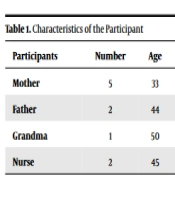
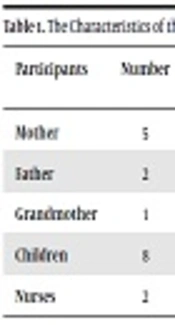
The characteristics of the participant are shown in Table 1. Analyzing the data indicated two categories, including a group needing to change the marriage laws of couples with thalassemia and a group involving with the drug crisis (Table 2).
Table 1.
The Characteristics of the Participants
| Participants | Number | Age, Mean ± SD | Work Experience, Mean ± SD |
|---|---|---|---|
| Mother | 5 | 33 ± 6.4 | - |
| Father | 2 | 44 ± 2 | - |
| Grandmother | 1 | 50 | - |
| Children | 8 | 6 ± 3 | - |
| Nurses | 2 | 45 ± 3 | 20 ± 5 |
Table 2.
Main Category, Categories and Subcategories
| Main Categories | Categories | Subcategories |
|---|---|---|
| Change of the health system structure | Need to change the marriage laws of couples with thalassemia | Marriage prevention of couples with thalassemia |
| Prevention of childbirth | ||
| Drug crisis | Lack of drugs | |
| Inability to provide drugs | ||
| Drug complications |
4.1. Need to Change the Marriage Laws of Couples with Thalassemia
Data analyses showed the necessity of changing the marriage laws of couples with thalassemia, which was divided into two subcategories of marriage prevention of couples with thalassemia and the prevention of childbirth. Most parents demanded a change in the law to prevent the marriage of couples. When they encountered multiple problems, they considered the existence of specific laws to be the only preventive solution. In this regard, a mother said: “...Just advise you not to let the thalassemia get married and have children. Science has now progressed. We married 28 years ago and did not test. We were not happy with the marriage of my daughter, and we did not like to marry a man with thalassemia...” [g1]. Another mother stated that: “...Now patients with thalassemia are getting married very much, they make a mistake. We also wanted not to have children. Just do not let them marry each other...” [m2].
4.2. Drug Crisis
The category of drug crisis was characterized by three subcategories, including the lack of drugs, inability to provide drugs, and drug complications. Most parents expressed the lack of expensive drugs for their children, especially for parents who were suffering from thalassemia. It was a major problem, particularly the lack of foreign Desferal. One of the major problems was that parents had adverse effects on the market. In this regard, a mother said “...The drug problem is that patients with thalassemia have a problem with the medicine because it is really hard to overcome the Desferal problem. We already had foreign Desferal, it was very good, but now it is expensive and we are three patients, thus we have three problems. We need a lot of money...” [m3].
Most parents expressed a major problem of their children with drug complications. They stated that Desferal in the market had adverse effects. In this regard, a father said: “...Iranian Desferal causes a lot of pain. If I inject one night, I cannot work for a few days. The injection site is swollen. The pain is severe and our basic need is Desferal.” Another mother stated: “...My daughter, when she injects Desferal has trouble for a few days, especially Iranian Desferal. We are currently under heavy sanctions and there is no foreign medicine and the problem of thalassemia is multiplied...” [m5]. The nurses said that: “...Most of our patients say that they are facing a problem with Desferal in your market. Desferal has problems in Iran and your foreign Desferal is not on the market. Injection site swelling is a common difficulty...” [n2].
5. Discussion
Analyzing the data revealed two categories. The first category needing to change the marriage laws of couples with thalassemia containing two subcategories of marriage prevention of couples with thalassemia and promote the use of contraceptive methods, and the second category involving with the drug crisis containing three subcategories as follows: the lack of drugs, inability to provide drugs, and drug complications. There was no study in this regard, but other studies showed that these parents need support and proper intervention regarding marriage prevention of couples with thalassemia and promote the use of contraceptive methods. One study stated that thalassemia produced physical, mental, economic, and social problems for parents; therefore, reducing these difficulties needs appropriate interventions (19). Thalassemia care programs should be supplied over a long time for obtaining considerable results (20). Also, another study showed that policymakers determine a strategy such as screening for prevention programs (21). Findings of another study indicated that parents’ knowledge about thalassemia and preventive measures is not enough; therefore, proper intervention in the form of programs for general health training with a focus on target society are required (22). It is obvious that the marriage of couples with thalassemia leads to the birth of a child with thalassemia. Another study stated that the screening test is the best way for preventing thalassemia, but canceling the marriage is less effective, particularly in Muslim countries (23). Researchers stated that preventive program and services were not enough for the management of patients with thalassemia (24).
The current study showed that the category of the drug crisis consisted of three subcategories, including the lack of drugs, inability to provide drugs, and drug complications. However, one study showed that parents of children with thalassemia require information about the disease and they need support and counseling (25). Researchers mentioned that awareness of parents about thalassemia was inadequate (26). It is required to provide family-based services such as giving medical information to parents, family psychological support, and financial support in order to decrease parents’ stress (27). This is a qualitative study; thus the results should be cautiously generalized to all communities. However, the results of this study presented that the health system should provide comprehensive planning to support the parents having children with thalassemia. The limitations of this study are as follows: the duration of the disease, or indeed the age of the child, was not considered. The number of samples was low.
5.1. Conclusions
Parents have many problems with the lack of drugs, inability to provide drugs, and drug complications. Health authorities must take the necessary measures to provide the appropriate treatment and drug for these patients. Also, there is a need for adequate laws and programs for couples to play a role in preventing childbirth with thalassemia.