
1. Background
Long life is one of the achievements of the twenty-first century (1), and researchers and doctors can help improve the quality of life of the elderly with a global understanding of chronic diseases (2); by increasing life expectancy and elderly age, more people will experience chronic diseases. The European cardiovascular disease report shows that chronic illness causes 80% of all deaths (1). Chronic disease is a long-term disease that causes physical changes in the body and by limiting the function of the patient’s body, prolongs the course of treatment and makes it difficult to recover (1). If chronic disease is not controlled, it may lead to sleep disturbances, malnutrition, physical impairment, decreased function, cognitive impairment, decreased self-esteem, and increased stress with depression and anxiety (2). Controlling chronic diseases reduces social and economic costs, also, global evidence suggests that one of the highest costs in the community is to control chronic diseases. By controlling smoking, healthy diet, physical activity, and control of alcohol consumption, one can be safe against many chronic diseases (3). Chronic diseases are becoming more and more important day by day, and nowadays not only in developed countries, yet also in many developing countries, chronic diseases account for a huge part of health problems (4).
According World Health Report 2002, mortality, morbidity, and disability caused by major chronic diseases are almost 60% of all deaths and 43% of the global burden of disease. By 2020, their contributions is expected to rise to 73% of all deaths and 60% of the global burden of disease, respectively. Most of these deaths (79%) occur in developing countries. Four major chronic diseases, including cardiovascular diseases (CVD), cancer, chronic obstructive pulmonary disease (COPD), and type 2 diabetes, are related to preventable biological risk factors, such as high blood pressure, high blood cholesterol and overweight, unhealthy diet, physical inactivity, and smoking. To decrease the rate of major chronic diseases, these risk factors should be managed through integrate primary, secondary, and tertiary prevention approaches (5).
What the modern knowledge should pay attention to is not just prolonging life, yet it should be noted that the extra years of human life ultimately lead to calmness, and physical and mental health; and if such a situation is not met, scientific advances will be fruitless and dangerous for providing a long life (6). Hence, researchers and doctors will help improve quality of life through a comprehensive understanding of chronic diseases (2). People also get their health and medical information from a variety of sources, including doctors, nurses, family, colleagues, TVs, radios, newspapers, magazines, and the Internet (7). Nowadays, social networks are also considered to be important sources of medical information by many researchers. Furthermore, social networks have a positive impact on those, who are involved in health care careers (8).
Today, social networks are the easiest way to share articles, among millions of people around the world for free. Social networks provide a new space for communication between researchers and are the main tools for promoting knowledge (9). Application of these networks among scientific communities has increased, and some of these networks, such as ResearchGate and Mendeley, are widely used as tools for disseminating research results and sharing knowledge in various medical areas (9-11). Using the features of each of these social networks, the real-time impact of scientific works can be viewed, unlike citation impact that requires a lot of time to be calculated (12).
These papers are known as core works and are of high quality in the scientific field. Since 2010, a new level of article metrics has been introduced for the purpose of evaluating articles, known as altmetrics or article level metrics, which evaluates the impact of an article not only within the scope of articles published in scientific journals and conferences, yet also in a wide range of sources, regardless of the format of the publication. altmetrics do not merely consider citations, yet they include other impact factors, such as downloads, viewing articles, and mentioning in social media and news media. Contrary to the citation metrics, which are quite slow and time-consuming, altmetrics can evaluate scientific generations in a short period of time. Moreover, many scientific generations that are published outside the journals on the web can be evaluated via altmetrics (13). Social networks are one of the areas where the information on altmetrics can be extracted.
ResearchGate (RG) is a social network for researchers; ResearchGate social network is created for communication among researchers and facilitates sharing and access to scientific outputs, knowledge, and expertise. Over 80 million articles, nine million researchers, and one million answers to research questions and what is needed to advance research can be found in ResearchGate. Another feature of this network is RG score, which is dedicated to network members. This score makes the interaction between researchers evaluable and observable, which is an important issue in the research process (14). Calculation of RG score is based on four factors: (1) number of shared works, (2) investigator’s activity in asking questions, (3) answers to questions, and (4) followers (15).
Mendeley social network was published in 2007 and has provided a comprehensive tool for researchers through a combination of academic social networking and resource management tools (16). Mendeley is also a free citation management software that has many capabilities for managing, storing, citing, and sharing research works. Storage of scientific works in Mendeley is entitled as “Read” (17). The advantage that distinguishes Mendeley from other similar products is the ability to share research with other academic users. Mendeley provides the potential for both groups of students to save time and minimize rework, and thus, increase productivity and outcome of their works (18).
Various studies have been conducted on investigating the presence of researchers and their scientific generations in social networks (19-21), as well as sharing information and full text of articles in social networks (22-26) in Iran and all around the world; however, the importance of availability of highly cited articles on chronic diseases in social networks and their relationship with the amount of citations to scientific works has not been studied. The highly cited papers well-defined by Clarivate Analytics’ essential science indicators (ESI) have been widely used to measure the scientific performance of universities, scientists, research institutions, and countries. Clarivate Analytics Company sorts highly cited papers in 22 fields every ten years based on the highest impact. Finally, one percent of the top papers in each of the research areas are selected and presented as highly cited articles.
2. Objectives
The present research aimed at identifying the role of social networks, such as ResearchGate and Mendeley, in promoting the results of scientific research and their impacts on citation and scientific behaviors of researchers in the future. Therefore, investigation of the presence of articles in scientific social networks can be a starting point for introducing more and more of the capabilities of these networks and the impact that they will have on the visibility of the works and, consequently, on the increase of their citation. Given the new emergence of social networking topic in the scientific community, findings of this study can be helpful for researchers in this field and can complement the results of previous researches on the role and potential of scientific social network as a tool of information and communication media.
3. Methods
This was a descriptive-cross sectional study conducted using altmetrics and citation analysis. Table 1 indicates the social networking sites and the indicators assessed (Table 1). The Web of Science (WoS) database was used to extract highly cited papers and citations of each paper. This database is one of the largest databases with highly valid internationally-published articles, including thousands of sources of journals, patents, biology literatures from web resources, and other scientific resources, as well as search citations and display of highly cited articles. All the highly cited papers on chronic diseases in different languages published during the past ten years were searched via strategy published by the Peykari on the 14th of October 2018 (4).
The research population consists of 12457 papers in the field of chronic disease from 2008 to October 2018, and since the sample is highly cited papers, only 171 papers were extracted as highly cited papers. The information on each paper includes the title of the paper, year of the publication, the number of pages, type of publication, access to the paper, and the number of citations received in the form of an Excel file to be analyzed in the final stage.
Then, a map of the history of scientific production in this field and its growth and development were analyzed using VOSviewer, HistCiteTM, and descriptive statistics software of MS Excel. Data collection was analyzed by SPSS version 19, and the nonparametric Spearman and chi-square tests were used. In all testing, P value at the level of P < 0.05 was considered significant.
Table 1.
The Social Networks and the Indicators
| Web Present | The Indicator Used |
|---|---|
| WoS | URL citations, citation, H-index, type of access, year of published |
| Mendeley | URL citations, citations, readers |
| ResearchGate | URL citation, RG score, publications, reads, citations, profile views |
4. Results
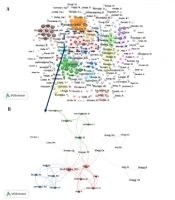
The study indicates that there are 171 highly cited papers on chronic diseases by 2018 at WoS. Overall, 1440 authors contributed to the publication of these articles. Figure 1 is a visualization of their collaboration status. One hundred percent of the articles were published in English. The United States, United Kingdom, and Canada were ranked 62.6%, 20.5%, and 13.5%, respectively, in the highly cited papers. J Reedy with five papers, and Hansson GK and Libby P each with 1732 citations were the most prolific writer and most prestigious scholars in the field, respectively. These papers were published in 111 journals, with Lancet journal with 11 articles having the largest share of publication in this field. Harvard University with 20 papers is one of the most prominent pioneers in this field with the more frequent publication on chronic diseases in 2015. The published papers include 102 original research papers (59.46%), 60 review papers (35.08%), and nine (5.26%) papers on other types. By mapping chronic disease was shown; the trends in chronic disease research published in the web of science revealed that the first article was published 10 years prior to 2018 (Figure 1).
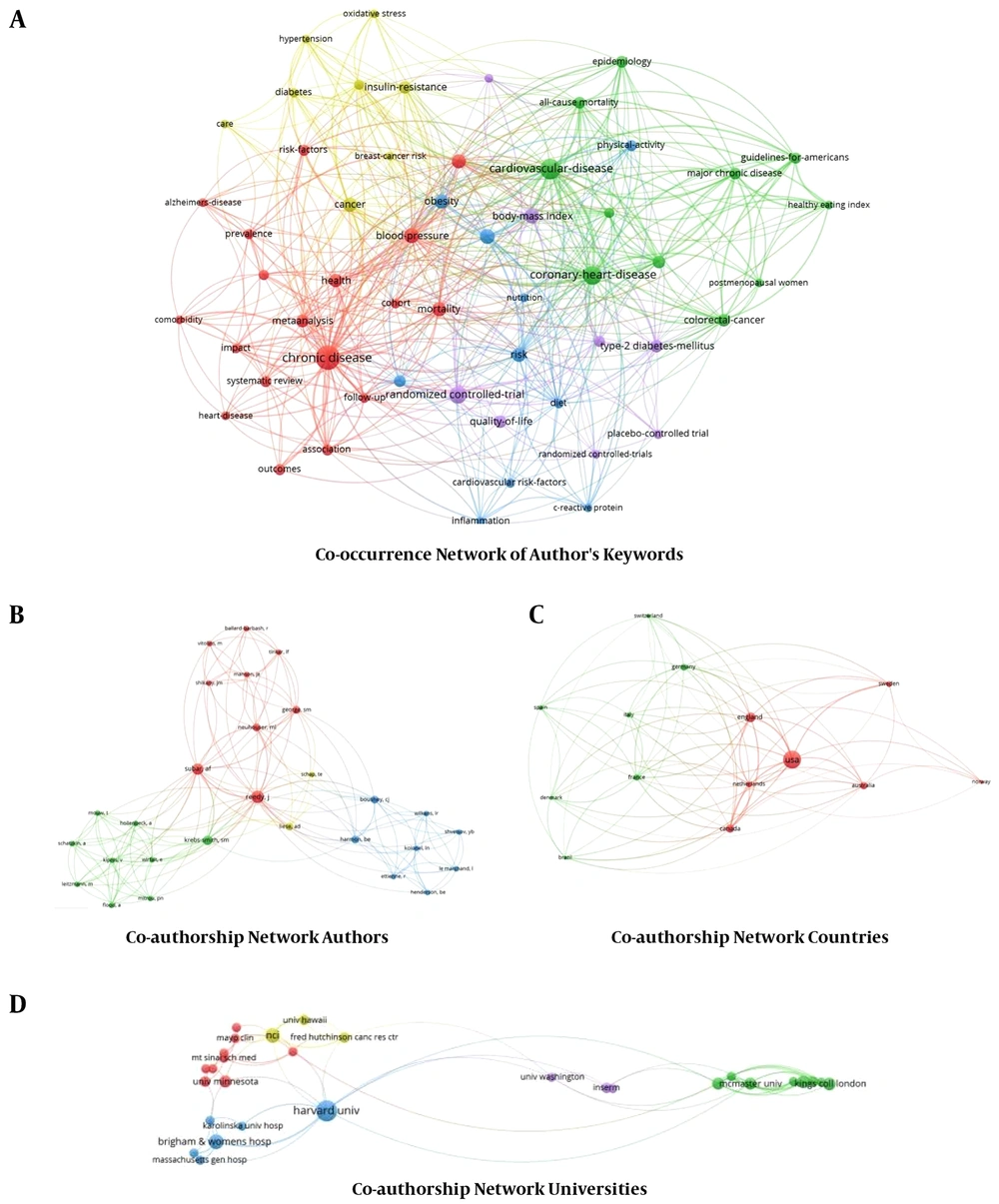
Figure 1.
Visualization of bibliographic in 171 highly cited papers on chronic diseases by 2018 at WoS (colors are attributed to nodes by VOSviewer to highlight clusters)
During the last 10 years, keywords were extracted from the publications, and clustered analysis tended to focus on people with cardiovascular disease, type-2 diabetes mellitus, blood pressure, and hypertension. Overall 165 highly cited papers (96.5%) were uploaded in ResearchGate and according to the findings of this study, six subjects (3.5%) were not found in ResearchGate. Read metric of papers in ResearchGate ranged from 0 to 4215, and the total number of papers was 54503 times with an average score of 318.73 ± 565.6. Generally, papers had 942 followers, and each paper had 5.51 ± 7.07 followers on average. Papers were published with 41 recommendations and each paper had 0.24 ± 0.61 recommendations on average. Overall, 158 (92.4%) papers were uploaded in Mendeley. Papers were read 31765 times and their “Read” ranged from 0 to 1400, which was lower than ResearchGate. In other words, each paper was read 185.76 ± 228.83 times on average (Table 2).
Table 2.
The Presence of Highly-Cited Chronic Diseases in Social Networks
| Profile | Frequency, No. (%) |
|---|---|
| Mendeley (URL citation) | 158 (96.5) |
| ResearchGate (URL citation) | 165 (92.4) |
The coverage rate of papers on the social network of ResearchGate was about 96.5%, which is better than Mendeley with 92.4%. Overall, 96% of papers were indexed in Research Gate and 94% of the indexed articles in Mendeley were read at least once (non-zero occurrence). Each paper indexed in ResearchGate has been read on average by 318.73 people. In comparison with that, every paper in Mendeley was read by 185.76 people (Table 3).
Table 3.
Mean and Standard Deviation of Indicators in Each Social Networking Site
| Citation Database and Social Networks, Indicators | Mean ± SD |
|---|---|
| WoS | |
| Citation | 213.74 ± 239.719 |
| Pages of paper | 16 ± 10.83 |
| ResearchGate | |
| Citation | 231.17 ± 267.7 |
| Followers | 5.51 ± 7.07 |
| Reads | 318.73 ± 565.6 |
| Recommendations | 0.24 ± 0.61 |
| Views | 0.272 ± 0.904 |
| Mendeley | |
| Citations | 210.78 ± 267-96 |
| Readers | 185.76 ± 228.83 |
Statistical analysis showed that there is a correlation of 0.207 between the amount of citation in the Web of Science and “Read” rate of the papers in ResearchGate (P < 0.05). No correlation was found between the amount of citation in the Web of Science and the rate of recommendations and followers of papers in ResearchGate (P < 0.05). There was a correlation of 0.343 between the number of citations in the Web of Science and “Read” rate of the papers in Mendeley (0.343) (P < 0.05). In both networks, the difference in mean citations between the two groups was measured by the t-test and no significant difference was observed (P < 0.01).
5. Discussion
These results provide some insights into the research articles in chronic diseases and similarly others studies (7, 8). The findings indicated that 171 papers in the field of chronic diseases are indexed in the Web of Science. There was an irregular growth in this field in the Web of Science and the highest number of publications was during 2015. However, the results of other studies also indicate an upward growth in the scientific generations of medical researchers in the recent years (1, 27).
The United States, Britain, and Canada have the largest share of papers in this area, respectively. On the other hand, Iran was ranked 28th in this field. The findings showed that “Lancet” has the highest number of papers in this field with 11 papers. Most of the works reviewed in the field of “chronic diseases” were original research papers. The results of review of the scientific generations of Iran University of Medical Sciences indicated that 63.2% of the papers were research papers. Meeting abstract and letter were ranked second and third, respectively (28). Overall, 74.6% of scientific generations of Shahrekord University of Medical Sciences were research papers (29). On the other hand, 72.4% of the scientific generations of researchers at Scopus citation base were research papers (20). In this way, it can be inferred that most scientific generations in the field of medical sciences are mostly oriented towards original studies.
According to the findings of this study, there were 165 highly cited papers in ResearchGate (96.5%). On the other hand, there were 158 highly cited papers (92.4%) in Mendeley. ResearchGate is one of the most popular academic social networks and has been the most used among scholars to carry out academic activities as a bridge between social media and scientific publications with the aim of making scientific researchers more visible on the web and to increase access to scientific publications. The results of this study are consistent with the reported results of Asnafi et al. and Ramezani-Pakpour-Langeroudi et al. regarding the presence of academic researchers in ResearchGate social network (24, 30). The findings of the above-mentioned study indicated that ResearchGate has the greatest use among scholars to carry out academic activities, while Haustein et al. indicated that the number of users is low in ResearchGate, so that only 21% of users used ResearchGate to share their scientific results and interact with other researchers (31).
Mendeley with 158 highly cited papers (92.4%) had the second rank, which is consistent with the reported results of Mas-Belda et al. (32). Their study also found that Mendeley was not widely known among cited scholars of European Institutions as a social network. These findings are consistent with the reported results of Thelwall and Wilson, Maflahi and Thelwall, and Li et al. In their studies, they compared the number of readers of papers in scientific journals (25, 33, 34). The results of the present study are consistent with the studies of Erfanmanesh, Ebrahimi et al., and Zahedi on the number of research papers in Mendeley in Iran. The results of their studies indicated that the number of times a paper was read by Mendeley could have the potential to measure the impact of scientific papers (17, 35, 36).
In the present study, there was a significant relationship between the citation rate of the Web of Science and the social network metrics of ResearchGate (number of citations and number of Reads). In other words, there was a positive relationship between the number of Reads and number of citations of this social network with the number of citations in Web of Science (P < 0.05), which is consistent with the reported results of Asnafi and Pakdaman, and Ramezani Pakpour et al. Moreover, there was a significant statistical relationship between the number of citations in Web of Science and metrics of Mendeley social network (number of citations and number of Reads). In other words, there was a positive relationship between the number of Reads and number of citations of this network with the number of citations in Web of Science (P < 0.05), which is consistent with the reported results of Thelwall and Wilson, Maflahi and Thelwall, Li et al., Erfanmanesh et al., and Ebrahimi et al. (25, 33, 35, 36).
5.1. Conclusions
Altmetric indicators can be used as complementary to other scientometric indicators for examining the impact of scientific productions, the performance of researchers and their visibility, and also can be predictive of citations that may receive articles in the future. Presence in scientific networks represents a culture of information sharing among researchers, which leads to collaboration in the production of knowledge. Researchers in the field of “chronic diseases”, sharing research findings in social networks, can contribute in increasing the citation rate to the papers, and to increase the scientific communication with other researchers. Therefore, it can be concluded that the more frequent the reading of articles on these two social networks, the more frequent citations of articles on the Web of Science were higher.
5.2. Limitations
Using Web of Science alone was a limitation and it is possible that some publications were missed. Nevertheless, key chronic disease journals do feature in the findings along with those from other disciplines available in the public domain. Also, the interpretation of highly cited papers, from cluster analysis of frequently occurring keywords and authorship in countries and universities, are limited because the interpretation of each cluster is not standardized and therefore prone to subjectivity.