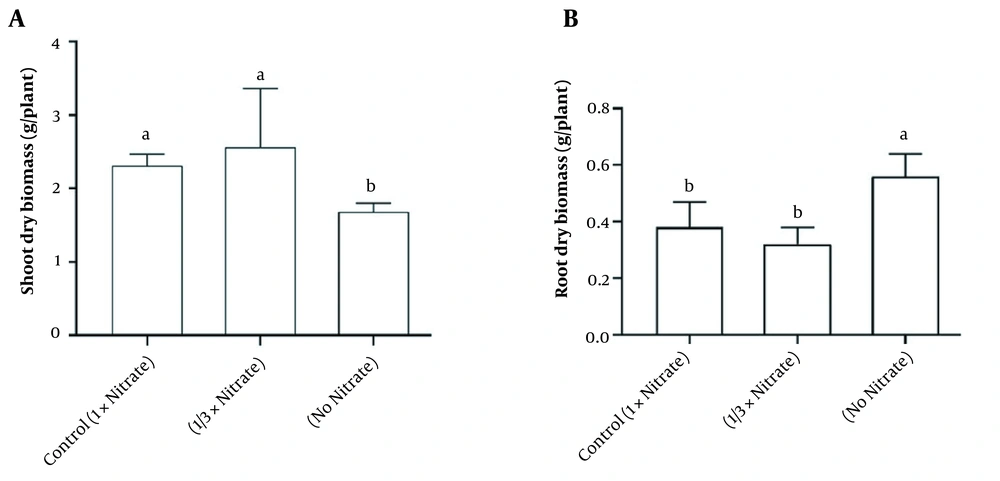
The applied nitrogen had different effects on the morphology of the plants, and N deficiency caused a decrease in shoot biomass and an increase in its roots. This is consistent with a previous study demonstrating that long-term NO
3 starvation decreased shoot biomass but increased root growth (
7). Moreover, during N deficiency in
Hypericum perforatum, a decrease in shoot biomass but an increase in root growth was observed (
7). It has been suggested that in N deficiency, the enlarged root system intensifies of nitrogen absorption from the environment (
19), where nitrogen mobilization from internal sources (such as phenylalanine deamination by PAL enzyme) can play an important role (
7).
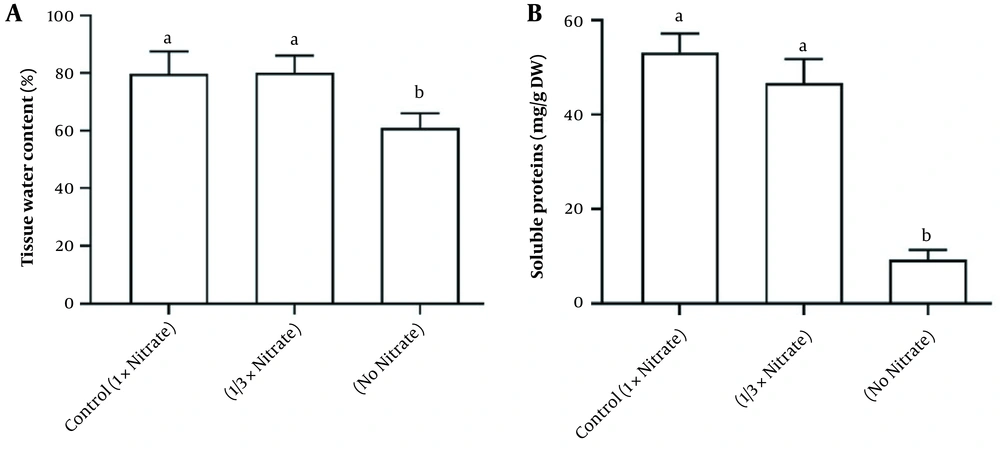
According to the results, tissue water content and soluble proteins decreased in nitrogen deficiency. This is in agreement with previous research on chamomile plants demonstrating that proteins were suppressed more by nitrate deficiency (
20). However, organic nitrogen metabolites such as proteins are always depleted or tend to be depleted in N-deficient plants (
21). A sharp decrease in protein content in nitrate deficiency indicates its effect on protein biosynthesis. Nitrate is essential for plant species’ optimal growth and basic physiology.
Nitrogen deficiency, which affects the oxidative balance, can be considered an abiotic stress factor. For example, increased H
2O
2 production has been reported in nitrogen deficiency in
Arabidopsis roots (
22) and chamomile shoots and roots (
7). In
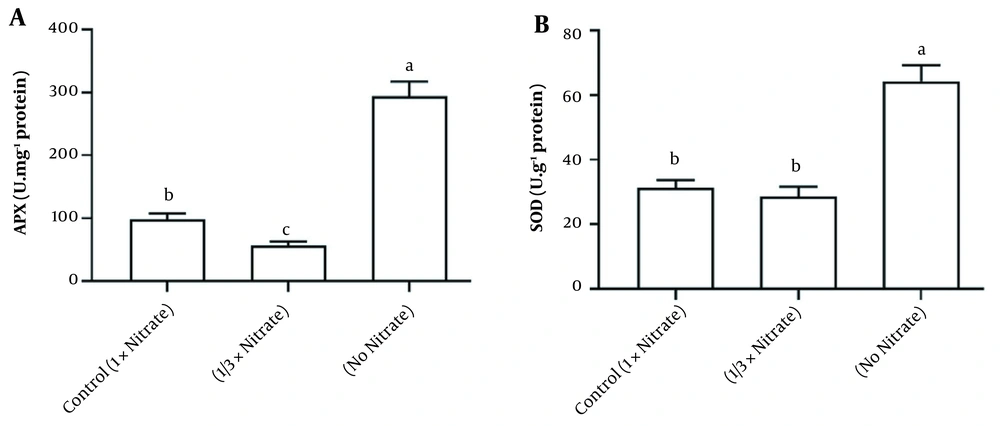
Hypericum spp., significant variation in the activities of APX, CAT, and SOD has been observed, and these enzymes have been demonstrated to play an essential role in ROS scavengers for normal plant growth (
23). Therefore, according to our results, these effects on growth parameters were predictable. In this study, N deficiency significantly affected the corresponding antioxidant enzymes (APX and SOD). In agreement with our research, increased activity of SOD and APX was observed in rice and cucumber plants under N deficiency (
24). Cui et al. also observed H
2O
2 accumulation in
Hypericum (
25).
In the last decades, phenolic metabolites with many positive health effects have received much attention, and they are demonstrated to be a broad and structurally variable group of secondary metabolites (
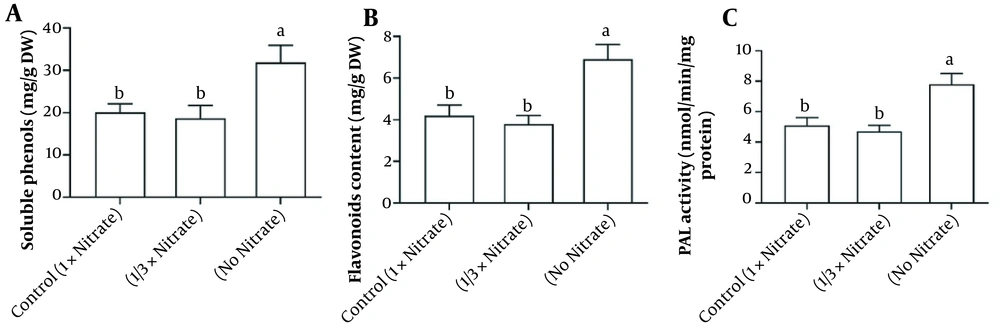
26). PAL enzyme is a key step in the biosynthesis pathway of phenols, which is regulated during N deficiency (
27). Under N deficiency, an increase in its activity was observed in shoots, which was corroborated by growth changes. The observed increase in the PAL activity in N-deficient plants is consistent with previous studies (
19,
21). However, a high level of soluble phenols was observed in no-nitrate treatments, which is another indication of stimulation of phenolic metabolites in response to N deficiency. In agreement with our results, total soluble phenols in spinach shoots (
28) and
H. perforatum plant cultures increased with nitrogen depletion (
29). Due to their high antioxidant activity, flavonoids are phenols’ most intensively studied compounds (
30). Unfortunately, their accumulation in shoots is less studied because they are mostly present in flowers. Flavonoids had the highest accumulation under nitrate deficiency. In other species, these metabolites also respond to nitrogen deficiency by increasing their accumulation (
31). Due to the abundance of phenolic metabolites, they can also provide antioxidant protection due to their high antioxidant properties (
32).
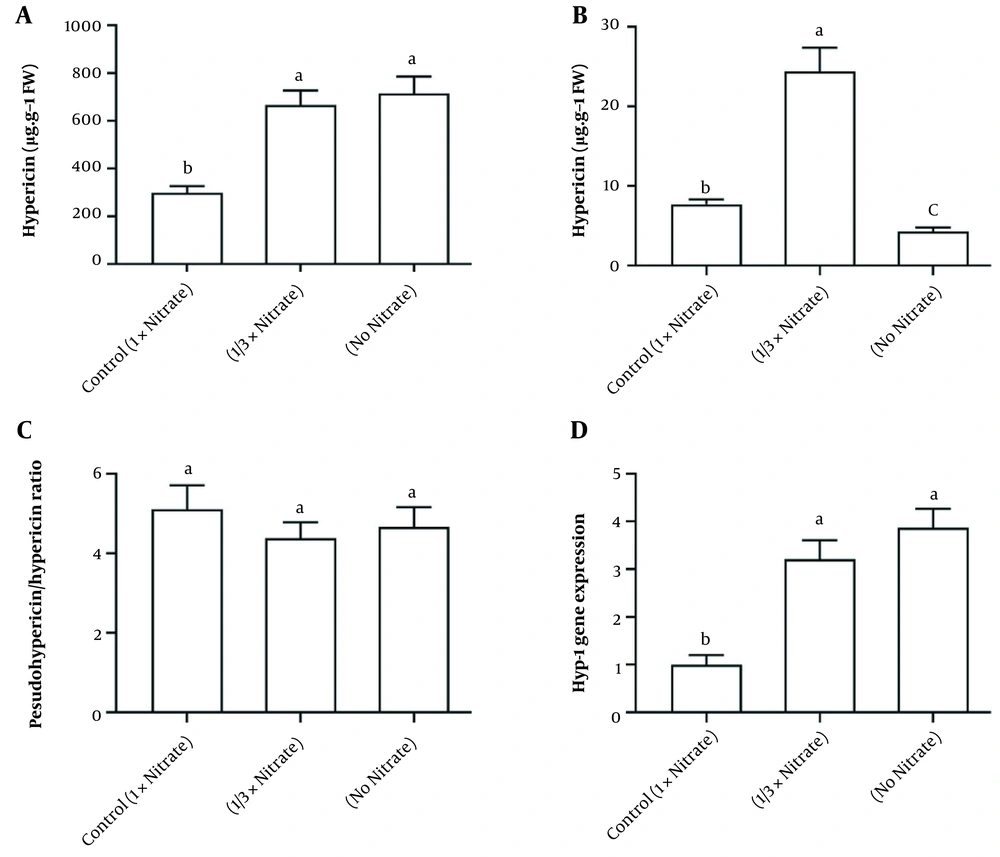
Pseudohypericin, hypericin, and hyperforin are among hypericins, which are important therapeutic secondary metabolites produced by
H. androsaemum plants. Our research demonstrated that nitrogen supply to
H. androsaemum plants could have a profound effect on the content of these metabolites in shoots. The present research is in agreement with previous studies in which hypericin content was higher than hyperforin in laboratory-cultured shoots (
33), while sand-cultured
H. perforatum shoots contained more hyperforin than hypericin (
9). Also, in our study, the amount of pseudohypericin was more abundant than hypericin, which was consistent with the results of Briskin et al. (
6). Our results demonstrated that the decrease in nitrate availability caused a significant increase in the content of hypericin types. On the contrary, nitrate deficiency stimulated hypericin and pseudohypericin accumulation, but hyperforin content decreased. These findings are consistent with previous studies where reduced nitrogen availability increased total hypericin content (
6,
29). Our study demonstrated that nitrate deficiency had the greatest effect on pseudohypericin, hypericin (increase), and hyperforin (decrease). Hitherto, there has yet to be a report on the effect of nitrogen on hyperforin content that can be discussed in detail.
Analysis of the putative gene in hypericin biosynthesis
hyp-1 has demonstrated a relative association with pseudohypericin and hypericin rather than with hyperforin content, mainly observed in treating nitrate deficiency. It was previously reported that the function of this gene is not limited to hypericin biosynthesis (
29), which can be seen in the present study. Although the details of the biosynthetic pathway for the production of hypericin and pseudohypericin are not fully understood, it has been demonstrated that this reaction is primarily controlled by mass action, and the levels of early intermediates in the metabolic pathway may be modulated in response to nitrogen supply. It has also been suggested that hypericin and pseudohypericin are products of anthracoid metabolism originating from the polyketide pathway (
34). Currently, studies are being conducted on the biosynthesis pathway of these metabolites with an emphasis on a better understanding of how effective genes and environmental factors such as nitrogen supply regulate this pathway.
It can be concluded that in H. androsaemum plant, N deficiency acts as abiotic stress, which increases antioxidant enzymes, phenolic compounds, and metabolites of hypericin and pseudohypericin and the expression of hyp-1 gene related to these metabolites’ biosynthetic pathways. Therefore, the present study supports the role of hypericin and pseudohypericin metabolites in plant defense systems. Based on these data, in this medicinal plant, higher amounts of secondary metabolites are formed in N deficiency, which are beneficial for health in addition to the plant’s defense mechanisms. Currently, more studies are needed on regulating the biosynthesis of hypericin and pseudohypericin by environmental factors such as nitrogen supply.