


1. Background
2. Objectives
3. Methods
3.1. Collection of Umbilical Cord
3.2. Isolation of Wharton’s Jelly from Umbilical Cord
3.3. Flow-Cytometric Analysis
3.4. Secretome Preparation
3.5. SK-BR3 Cell Line Culture
3.6. MTT Assay
3.7. Colony-Forming Unit (CFU) Assay
3.8. Apoptosis Assays by Annexin V/PI
3.9. Antioxidative Enzyme Detection
3.10. Catalase Detection
3.11. Superoxide Dismutase Detection
3.12. Glutathione Contents
3.13. RNA Extraction and Real‑time PCR
| Name | Forward | Reverse | Product Size |
|---|---|---|---|
| E-cadherin | GCTGGACCGAGAGAGTTTCC | CAAAATCCAAGCCCGTGGTG | 155 |
| β-catenin | GAGGCTTCTGGTGAAATCGC | TGCAGTTGCTAAACTTCACATT | 121 |
| N-cadherin | ACGGAGGAAGGTCTGAGGA | CCAACTCCATCAAATCAGCTTG | 179 |
| Vimentin | GGCGAGGAGAGCAGGATTTC | TGGGTATCAACCAGAGGGAGT | 95 |
| GAPDH | GGTCGGAGTCAACGGATTTGG | TGATGACAAGCTTCCCGTTCT | 194 |
Abbreviation: GAPDH, glyceraldehyde-3-phosphate dehydrogenase.
3.14. Statistical Analysis
4. Results
4.1. Effective Inhibition of Cell Proliferation and Alteration of the Cellular Morphology of SK-BR3 Cells by hWJMSCs-Se
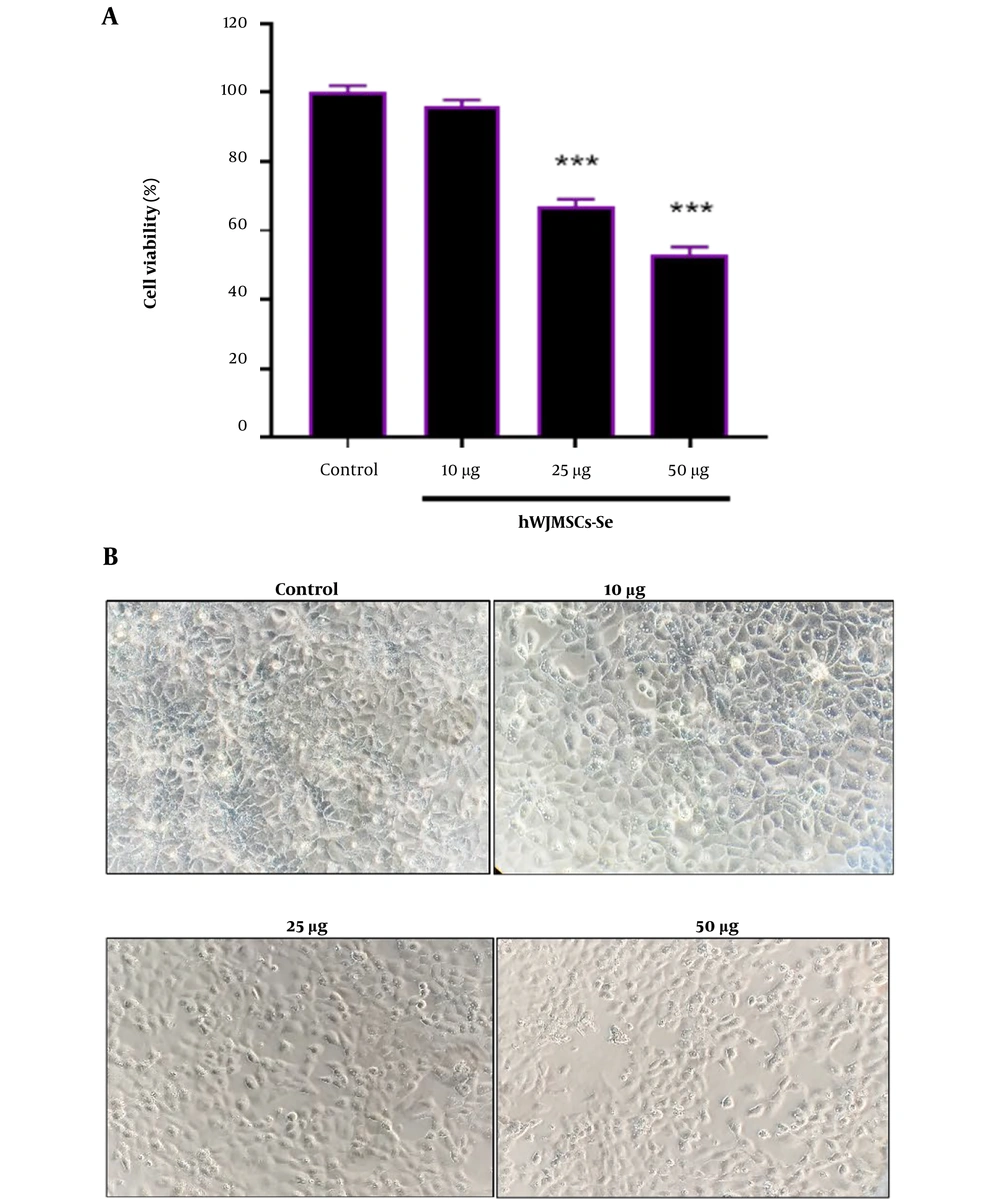
Effects of human Wharton’s jelly mesenchymal stem cell secretomes (hWJMSCs-Se) on viability and morphology of the SK-BR3 cells; SK-BR3 cells treated with 25 or 50 μg/mL hWJMSCs-Se for 48 h. *** P < 0.001; * Symbol indicates the comparison of hWJMSCs-Se groups and non-treated controls. Results are presented as means ± standard deviation (SD) and are representative of three independent experiments.
4.2. Repression of Colony Forming Tendency in SK-BR3 Cells by hWJMSCs-Se
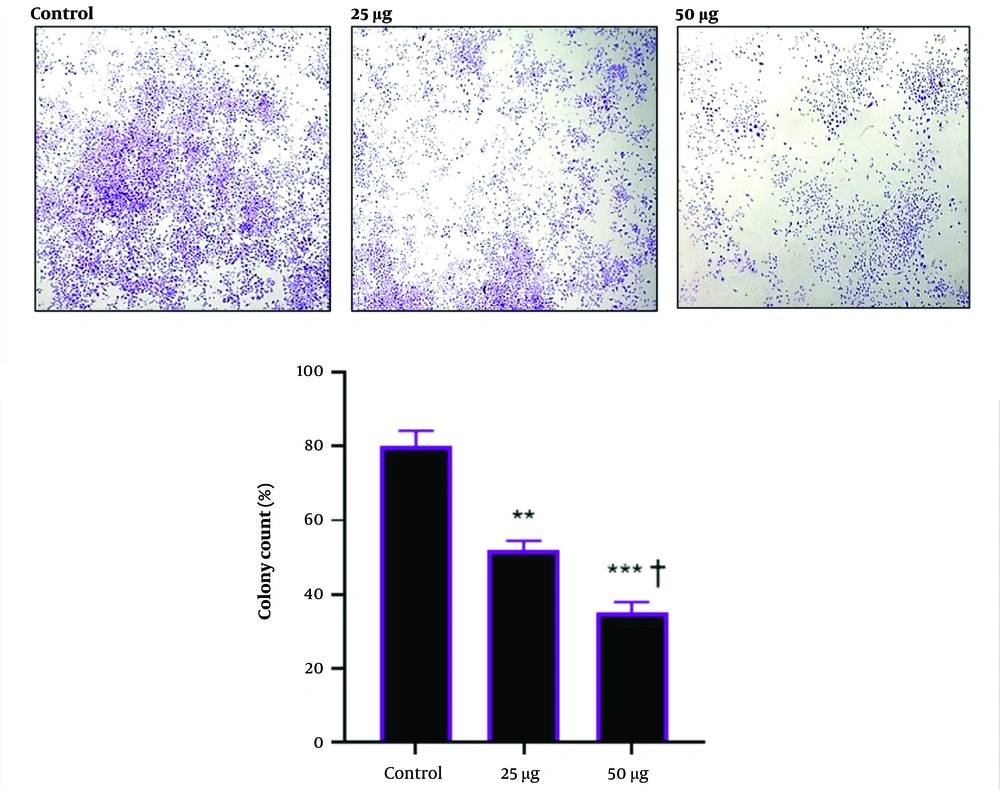
Colony formation and number of SK-BR3 cells in different groups; SK-BR3 cells treated with 25 or 50 μg/mL human Wharton’s jelly mesenchymal stem cell secretomes (hWJMSCs-Se) for 48 h. ** P < 0.01; *** P < 0.001; * Symbol indicates the comparison of hWJMSCs-Se groups and non-treated controls; † Symbol indicates the comparison between 25 and 50 μg/mL hWJMSCs-Se groups. Results are presented as means ± standard deviation (SD) and are representative of three independent experiments.
4.3. Measurement of Apoptosis of SK-BR3 Cells as a Result of Treatment with hWJSMCs-Se
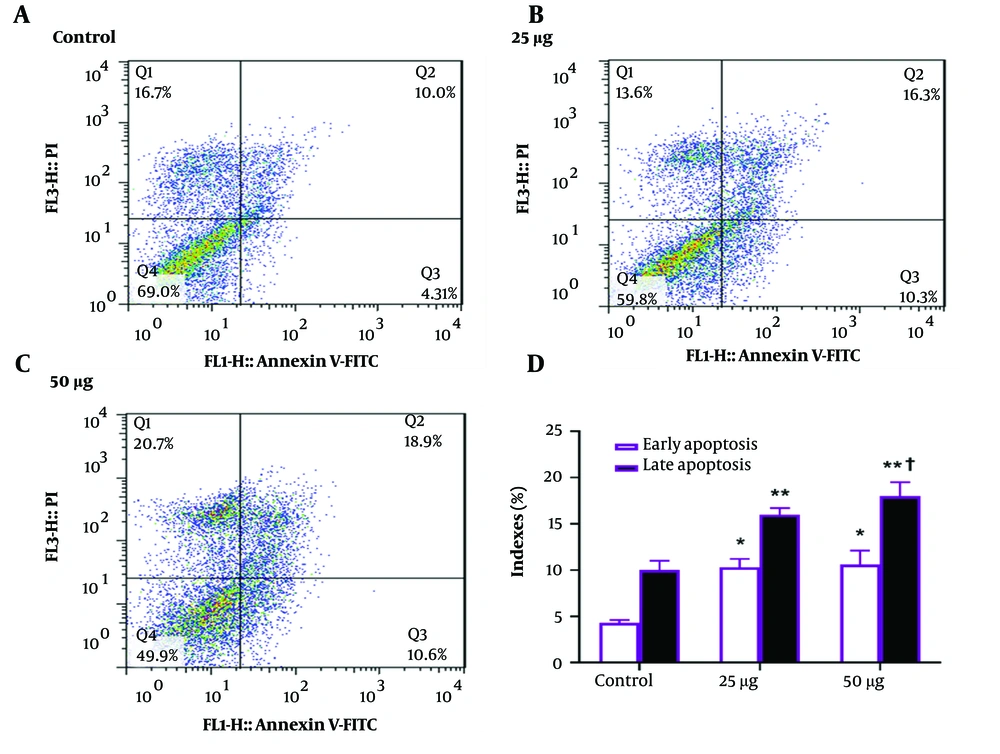
Human Wharton’s jelly mesenchymal stem cell secretomes (hWJMSCs-Se)-induced apoptosis of SK-BR3 cells treated with 25 or 50 μg/mL hWJMSCs-Se for 48 h; Representative dot plots of annexin V-FITC (X-Axis) versus PI (Y-Axis) fluorescence for control and experimental groups. * P < 0.05; ** P < 0.01; † P < 0.05; * Symbol indicates the comparison of hWJMSCs-Se groups versus non-treated controls. † Symbol indicates the comparison between 25 and 50 μg/mL hWJMSCs-Se groups. Results are presented as means ± standard deviation (SD) and are representative of three independent experiments.
4.4. Activity of Antioxidant Enzymes Increased by Treatment with hWJSMCs-Se

Superoxide dismutase (SOD), catalase (CAT), and glutathione analysis of SK-BR3 cell line exposed to 25 and 50 µg/mL of human Wharton’s jelly mesenchymal stem cell secretomes (hWJMSCs-Se) concentrate for 48 h. The activity of SOD and CAT was significantly increased in fold changes of 25 µg/mL (P < 0.05) and 50 µg/mL (P < 0.01) compared to controls. Glutathione content was significantly increased in fold changes of 50 µg/mL (P < 0.01) compared to controls. Results are presented as means ± standard deviation (SD) and are representative of three independent experiments
4.5. Real-time PCR
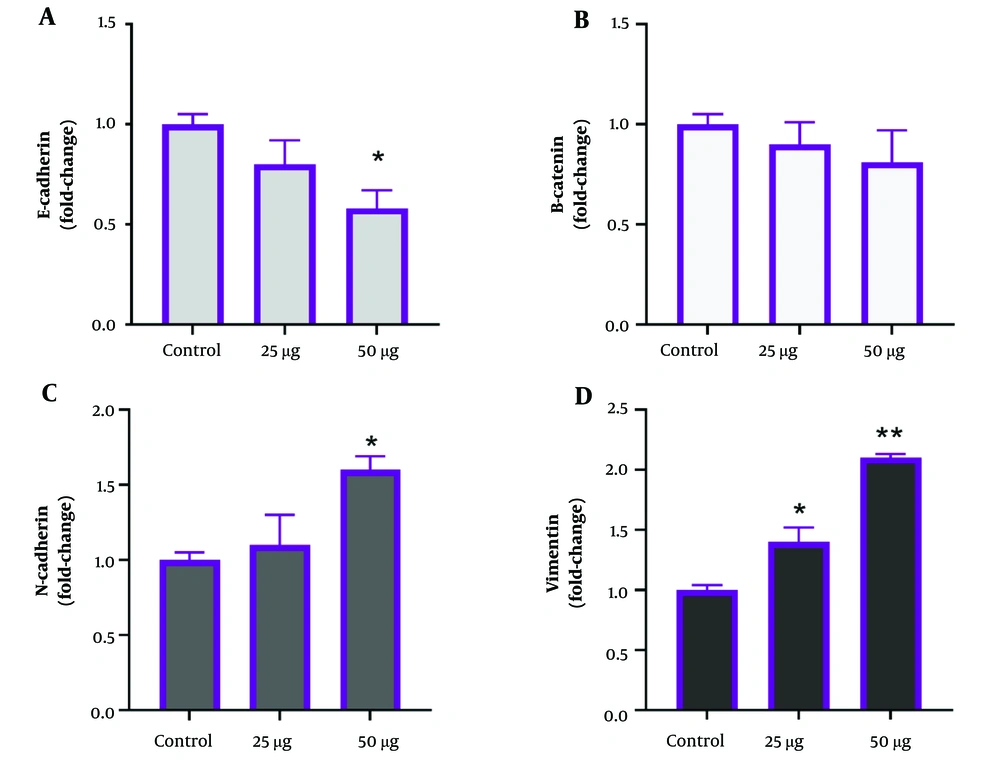
E-cadherin was significantly decreased in fold changes of 50 µg/mL (P < 0.02) compared to controls. N-cadherin was significantly increased in fold changes of 50 µg/mL (P < 0.05) compared to controls. N-cadherin and vimentin were significantly increased in fold changes of 25 µg/mL (P < 0.05) and 50 µg/mL (P < 0.01) compared to controls. Results are presented as means ± standard deviation (SD) and are representative of three independent experiments.


