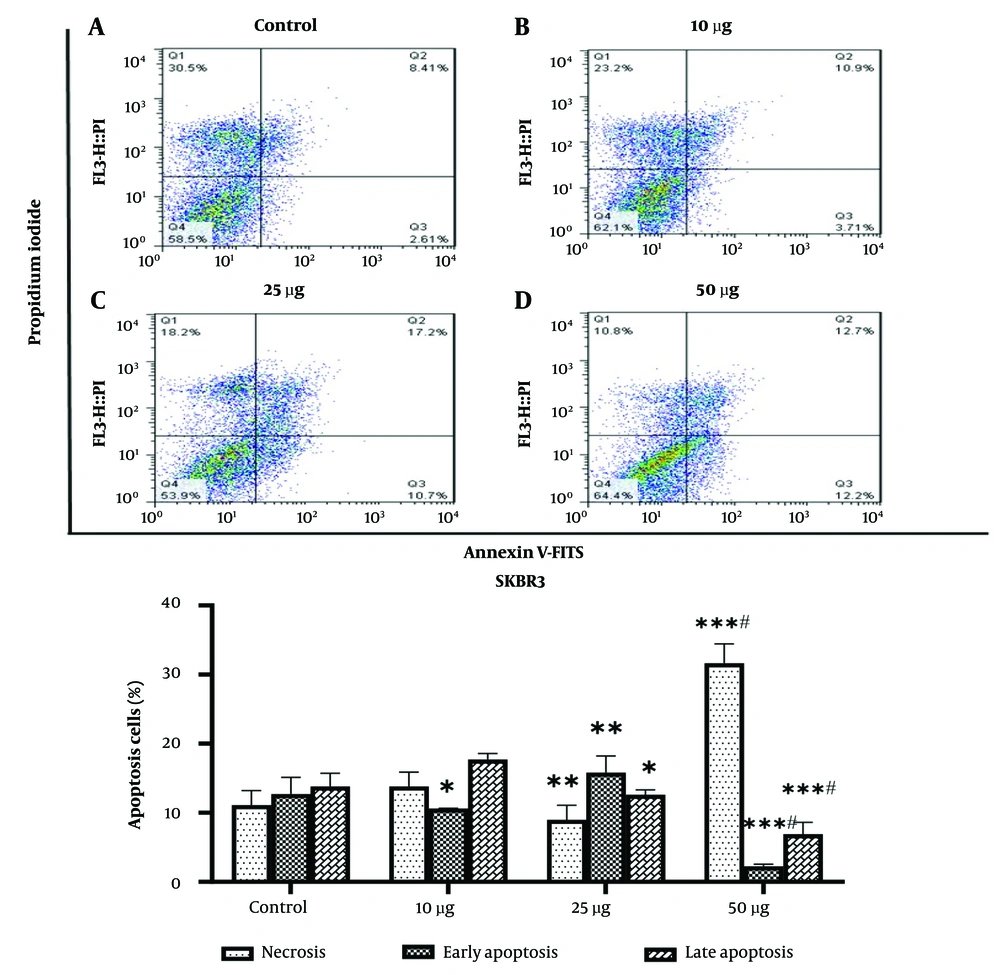
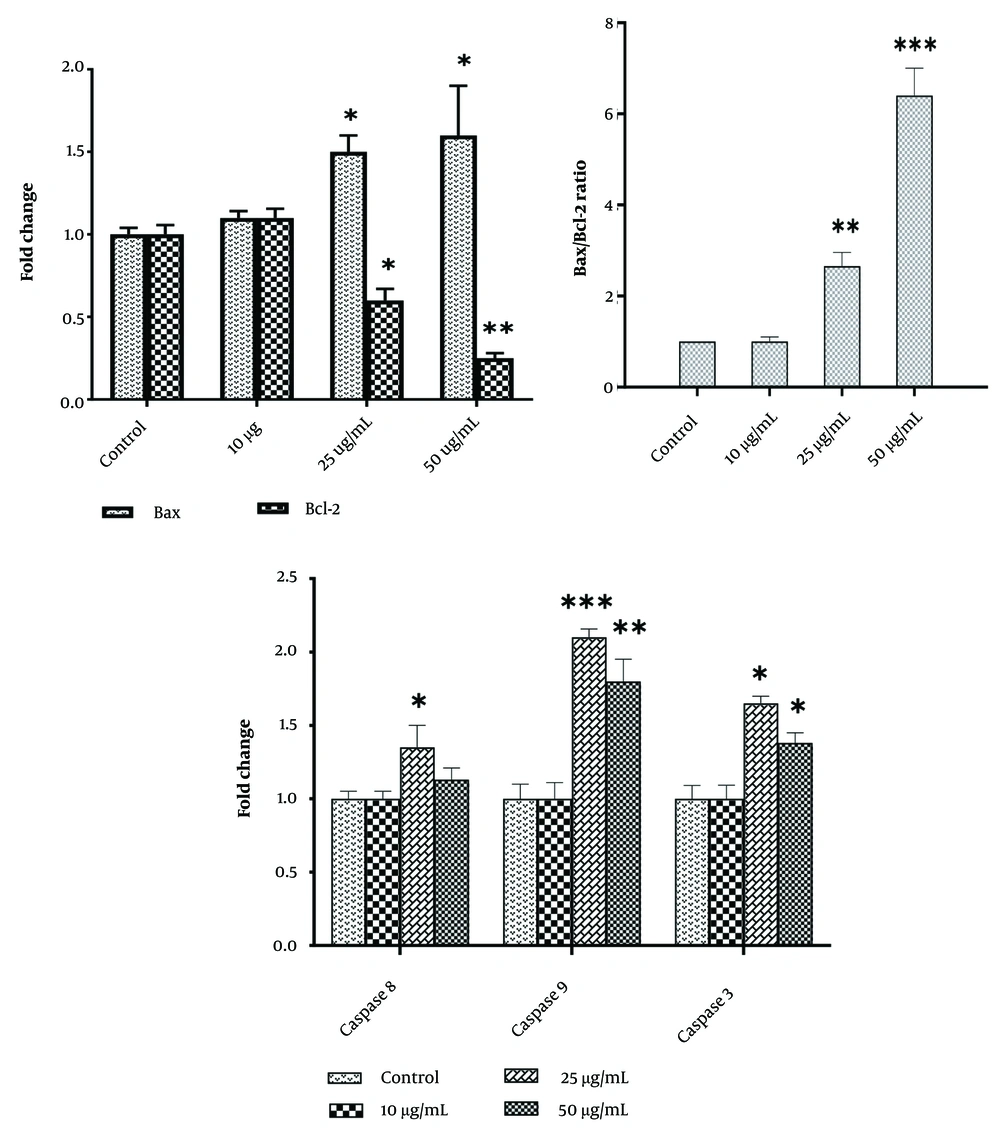
The current investigation demonstrated that the viability percentage of the HER2-positive BC cell line was significantly reduced in the 25 μg/mL group after 48 hours and in the 50 μg/mL group at both 24 and 48 hours. Additionally, colony formation and the number of SKBR3 cells were markedly diminished in the 50 μg/mL group. WJ-MSC secretome induced early apoptosis more effectively in the 25 μg/mL group than in the 50 μg/mL group. This was demonstrated by the enhanced expression of apoptotic genes, including Caspase-3 and Caspase-9, along with a parallel reduction in the anti-apoptotic gene Bcl-2. Moreover, a lower Bax/Bcl-2 ratio was observed in the 25 μg/mL group compared to the 50 μg/mL group.
The results showed that WJ-MSC secretome in both the 25 μg/mL and 50 μg/mL groups reduced the viability and proliferation of the SKBR3 cell line in a concentration- and time-dependent manner. The time- and dose-dependent inhibitory activity of WJ-MSC secretome on viability was evident across multiple cancer cell lines, including those from breast cancer such as MDA-MB-231, T47D, and MCF7 (
12,
13); ovarian carcinoma TOV-112D (
14); osteosarcoma MG-63 (
15); benign neoplastic keloid cells (
16); bladder cancer; lymphoma cells; gastric cancer cells; leukemia cells; human endometrial stromal cells; and colon cancer cells HT-29 (
11). Animal studies further supported the inhibitory effects of WJ-MSC secretome on the development of osteosarcoma, lung cancer, BC, and pancreatic cancer (
17). Contrasting results were observed in glioblastoma cell lines U251 and SNB-19, where WJ-MSC secretome promoted high cell survival, proliferation, and migration (
18). However, other studies have shown that WJ-MSC secretome inhibits the growth and proliferation of the U87MG glioma cell line, emphasizing the impact of cell type and culture techniques on the outcomes (
19).
The WJ-MSC secretome at 25 μg/mL showed a higher early-to-late apoptosis ratio compared to 50 μg/mL (
Figure 3). Early apoptosis (annexin V+/PI−) reflects the initial stages of apoptosis with intact membrane integrity, while late apoptosis (annexin V+/PI+) indicates membrane loss and cell death progression. This suggests that 25 μg/mL induces apoptosis more gradually, allowing cells time for apoptotic signaling before reaching terminal stages (
20). At 50 μg/mL, the lower early-to-late apoptosis ratio suggests an accelerated apoptotic process due to a stronger apoptotic signal. This aligns with previous studies demonstrating the anti-tumor effects of WJ-MSC secretome on ovarian, lung, and leukemic cancer cells (
14,
21).
Human Wharton's jelly-derived mesenchymal stem cells offer benefits such as low immunogenicity, multipotency, and non-carcinogenicity. Their anticancer effects involve both direct contact and secreted factors, with conditioned media shown to inhibit tumor growth. Modified MSCs produce immunostimulants (IL2, IL7, IL12, CX3CL1) and apoptosis-inducing molecules such as TRAIL, IL-8, and NK4. Cytokines in the WJ-MSC secretome, such as TRAIL, suppress cell growth via the Bax and Caspase-3 pathways, while TNFα induces necrotic or apoptotic cell death depending on the context (
22,
23).
In our study, the WJ-MSC secretome at 25 μg/mL, compared to the 50 μg/mL group, significantly influenced the expression of Bax and its subsequent downregulation of the anti-apoptotic gene Bcl-2, thereby promoting the intrinsic apoptotic pathway. The Bax/Bcl-2 ratio is crucial in determining cell survival or apoptosis, with a lower Bax/Bcl-2 ratio promoting apoptosis and a higher ratio contributing to cell survival and cancer progression (
24). Notably, the secretome induces apoptosis in colon cancer cells through the activation of the intrinsic pathway (
11).
Figure 4 underscores the impact of WJ-MSC secretome on the levels of Caspase-9 and Caspase-3 gene expression in the SKBR3 cell line. These findings are consistent with previous research demonstrating the ability of WJ-MSC secretome to induce apoptosis in MDA-MB 231 and MCF7 cell lines (
25). Furthermore, WJ-MSC secretome treatment significantly increased the mRNA expression of Caspases-9 and -3 in a dose-dependent manner, supporting its apoptotic effects.
The observed anticancer effect of WJ-MSC secretome is attributed to an apoptotic mechanism. These studies suggest that WJ-MSCs induce apoptosis through multiple mechanisms and signaling pathways. This includes the reduction of apoptosis in nucleus pulposus cells in intervertebral disc degeneration by inhibiting Wnt/β-catenin signaling (
26), inhibition of gastric cancer cell growth and viability by inducing apoptosis and modifying NF-κB and MAPK signaling pathways (
27), and protection against sepsis-induced organ injury by reducing systemic inflammation, partially through activation of the cholinergic anti-inflammatory pathway (
28). Additionally, previous studies have demonstrated that MSCs derived from the human umbilical cord can trigger apoptosis in glioma and xenografted cells by activating Caspase-3 and Caspase-9 (
29). These findings are further supported by the enhancement of apoptotic gene expression, including Caspase-3 and Caspase-9, and the subsequent downregulation of the anti-apoptotic gene Bcl-2. The differential Bax/Bcl-2 ratio observed between the two concentrations reinforces the notion that the apoptotic response is dose-dependent, with higher concentrations promoting a faster apoptotic pathway (
30).
The implications of these findings are critical for therapeutic strategies, as they suggest that varying concentrations of WJ-MSC secretome can modulate the kinetics of apoptosis in cancer cells. A controlled apoptotic response, as seen in the 25 μg/mL group, may be beneficial in a clinical setting where gradual induction of cell death is preferable to minimize adverse effects on surrounding tissues. On the other hand, a higher concentration leading to rapid apoptosis might be advantageous for swiftly reducing tumor burden in aggressive cancers.
Overall, the ability to fine-tune the apoptotic response through precise dosing of WJ-MSC secretome offers a promising avenue for targeted breast cancer therapy. Future studies should focus on understanding the molecular mechanisms governing this differential apoptotic induction and evaluating the in vivo efficacy and safety of WJ-MSC secretome at various concentrations.
5.1. Conclusions
This study examined the effects of WJ-MSC secretome on HER2-positive breast cancer cells. Our findings indicated that WJ-MSC secretome significantly reduced the viability and growth of SKBR3 cells in relation to both dosage and duration. Additionally, WJ-MSC secretome promoted early apoptosis in a dose- and time-dependent manner, as evidenced by alterations in the expression of apoptotic genes, including Caspase-3 and Caspase-9, as well as changes in the ratio of pro-apoptotic Bax to anti-apoptotic Bcl-2. These results suggest that the timing and dosage of WJ-MSC secretome administration can substantially influence the apoptotic process in cancer cells. Furthermore, our findings highlight the potential of WJ-MSC secretome as a novel and effective therapeutic strategy for targeted breast cancer treatment. Future studies should aim to further elucidate the molecular mechanisms underlying this phenomenon and explore the efficacy and safety of WJ-MSC secretome at various doses and time points.