


1. Background
2. Objectives
3. Methods
3.1. Plant Harvesting and Extract Preparation
3.2. Gas Chromatography-mass Spectrometry (GC-MS) Analysis
3.3. MTT Test
3.4. Cellular Fluorescence Staining with Acridine Orange (AO) and Ethidium Bromide (EB)
3.5. Analysis of Cellular Apoptosis by Flow Cytometry
3.6. Quantitative Analysis of Data
4. Results
4.1. GC-MS Analysis of Essential oil Obtained from H. longiflorus
| Name of the Compound | Retention Time (min) | Percentage in Essential Oil | Type |
|---|---|---|---|
| α-Thujene | 5.481 | 0.69 | C10H16 (MH) |
| α-Pinene a | 5.611 | 5.17 | C10H16(MH) |
| Sabinene (β-Thujene) | 6.299 | 2.58 | C10H16(MH) |
| L-β-Pinene | 6.352 | 1.47 | C10H16 (MH) |
| Ethylcyclohexane | 6.51 | 2.59 | C8H16 |
| o-Cymene | 7.175 | 0.31 | C10H14 (MH) |
| Carvene(D-Limonene) a | 7.24 | 0.70 | C10H16(MH) |
| 1,8-cineol (eucalyptol) a | 7.281 | 2.70 | C10H18O (OM) |
| Linaloola | 8.393 | 3.13 | C10H18O (OM) |
| Geijerene | 8.957 | 1.60 | C12H18 (SH) |
| L-terpinen-4-ol a | 9.657 | 0.91 | C10H18O (OM) |
| Cyclopentane, 1-hexyl-3-methyl- | 9.763 | 0.99 | C12H24 |
| α –Copaene | 12.481 | 2.42 | C15H24 (SH) |
| β-Bourbonene | 12.622 | 1.84 | C15H24 (SH) |
| Caryophyllene a | 13.092 | 3.80 | C15H24 (SH) |
| β-Copaene | 13.204 | 0.62 | C15H24(SH) |
| Isogermacrene D | 13.398 | 0.42 | C15H24(SH) |
| 1,1,4,8-tetramethyl-cis, cis,4,7,10-cycloundecatriene | 13.528 | 0.34 | C15H24(SH) |
| cis-Muurola-4(14),5-diene | 13.634 | 0.33 | C15H24 (SH) |
| Germacrene D | 13.881 | 5.14 | C15H24 (SH) |
| Bicyclogermacrene | 14.063 | 0.94 | C15H24 (SH) |
| β-bisabolene | 14.133 | 0.69 | C15H24 (SH) |
| γ-Cadinene | 14.269 | 2.57 | C15H24 (SH) |
| 1-Isopropyl-4,7-dimethyl-1,2,3,5,6,8a-hexahydronaphthalene | 14.357 | 2.19 | C15H24(SH) |
| Elemol | 14.751 | 13.43 | C15H26O (OS) |
| Benzoic acid cis-3-hexenyl ester | 14.91 | 0.57 | C13H16O2 |
| Hexadecane (Cetane) | 15.145 | 2.53 | C16H34 |
| Caryophylla-3,8(13)-dien-5α-ol | 15.275 | 0.35 | C15H24O (OS) |
| γ-cadinene | 15.563 | 0.88 | C15H24 (SH) |
| Aromadendrene | 15.651 | 0.91 | C15H24 (SH) |
| Bicyclo[4.4.0]dec-1-ene, 2-Isopropyl-5-methyl-9-methylene | 15.845 | 20.69 | C15H24 (SH) |
| 1H-Indene, 1-ethylideneoctahydro-7a-methyl-, cis- | 16.027 | 5.46 | C9H8 |
| Muurola-4,10(14)-dien-1 β -ol | 16.398 | 1.16 | C15H24O (OS) |
| Biadamantanyliden | 19.951 | 0.30 | C20H28 |
| 3a,9b-Dimethyl-1,2,3a,4,5,9b- hexahydrocyclopenta[a]naphthalen-3-one | 21.809 | 0.43 | C15H18O |
| Namber of Compound | Compound | % | |
| 6 | Monoterpene hydrocarbons (MH) | 10.92 | |
| 16 | Sesquiterpene hydrocarbons (SH) | 45.38 | |
| 3 | Oxygenated monoterpenes (OM) | 6.74 | |
| 3 | Oxygenated sesquiterpenes (OS) | 14.94 | |
| 7 | Others | 12.87 | |
| 35 | Total | 90.85 | |
a The compounds whose cytotoxic effects against cancer cells have been reported.
4.2. Cytotoxicity Evaluation of Essential oil from H. longiflorus on Cancer Cells
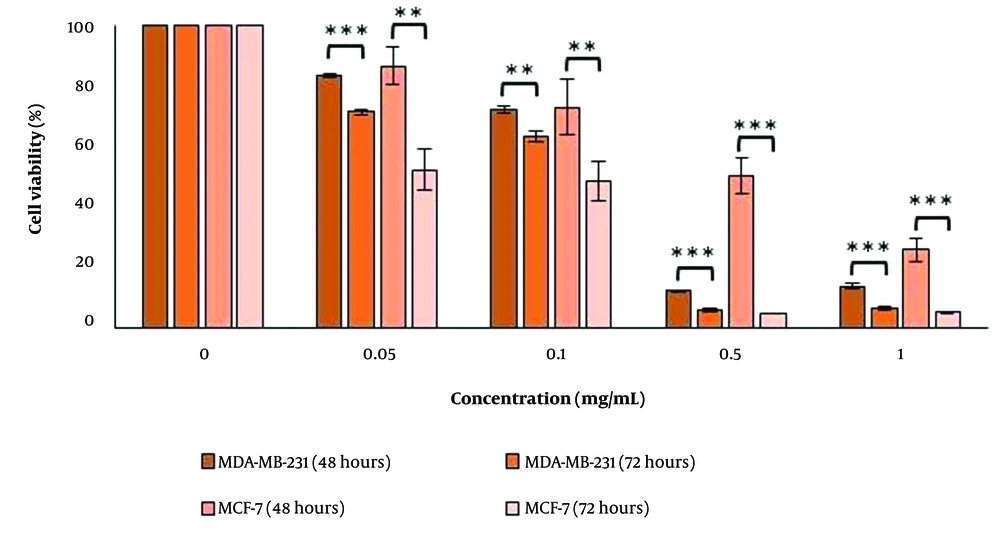
The survival percentage of MDA-MB-231 and MCF-7 cells under varying concentrations of H. longiflorus essential oil in two periods of 48 and 72 hours. The data is based on the mean of three distinct tests. P-value less than 0.05 was considered significant (*P-value < 0.05, **P-value < 0.01, ***P-value < 0.001). Th cells treated with 0.4% Tween were considered negative control.
a IC50 of the essential oil on the MDA-MB-231 cells was compared with their IC50 on the MCF-7 cells in the same period.
b P-value < 0.001 is considered significant.
c P-value < 0.01 is considered significant.
4.3. Evaluation of the Induced Cell Death in MDA-MB-231 and MCF-7 Cell Lines by Essential oil Using Acridine Orange and Ethidium Bromide Double Staining
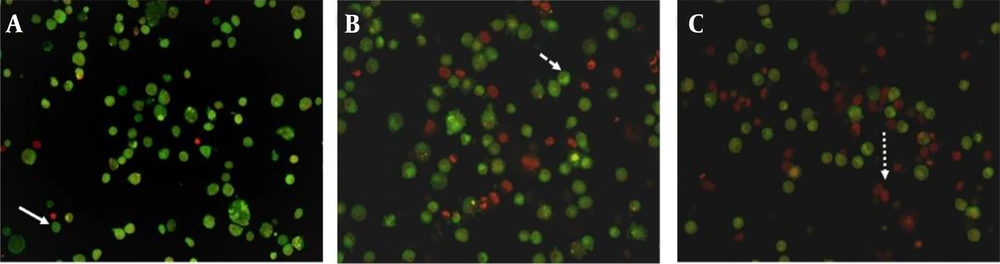
Fluorescent microscope image (magnification ×400) of MDA-MB-231 cells treated with A, 0.4% tween; B, carboplatin (positive control) at IC50 concentration and; C, essential oil obtained from H. longiflorus Benth., at IC50 concentration after staining with acridine orange and, ethidium bromide. The smooth arrow indicates live cells, the dashed arrow indicates primary apoptotic cells, and the dotted arrow indicates secondary apoptotic cells.
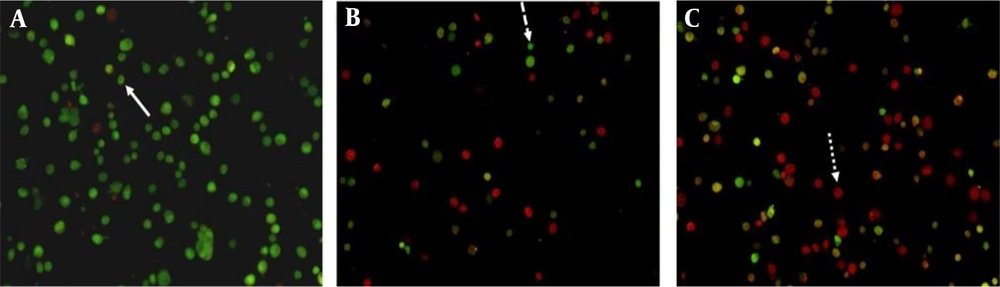
Fluorescent microscope image (magnification ×400) of MDA-MB-231 cells treated with A, 0.4% tween; B, carboplatin (positive control) at IC50 concentration and; C, essential oil obtained from H. longiflorus, at IC50 concentration after staining with acridine orange and, ethidium bromide. The smooth arrow indicates live cells, the dashed arrow indicates primary apoptotic cells, and the dotted arrow indicates secondary apoptotic cells.
4.4. Quantitatively Investigate the Type of Death of Cells Treated with the Essential Oil
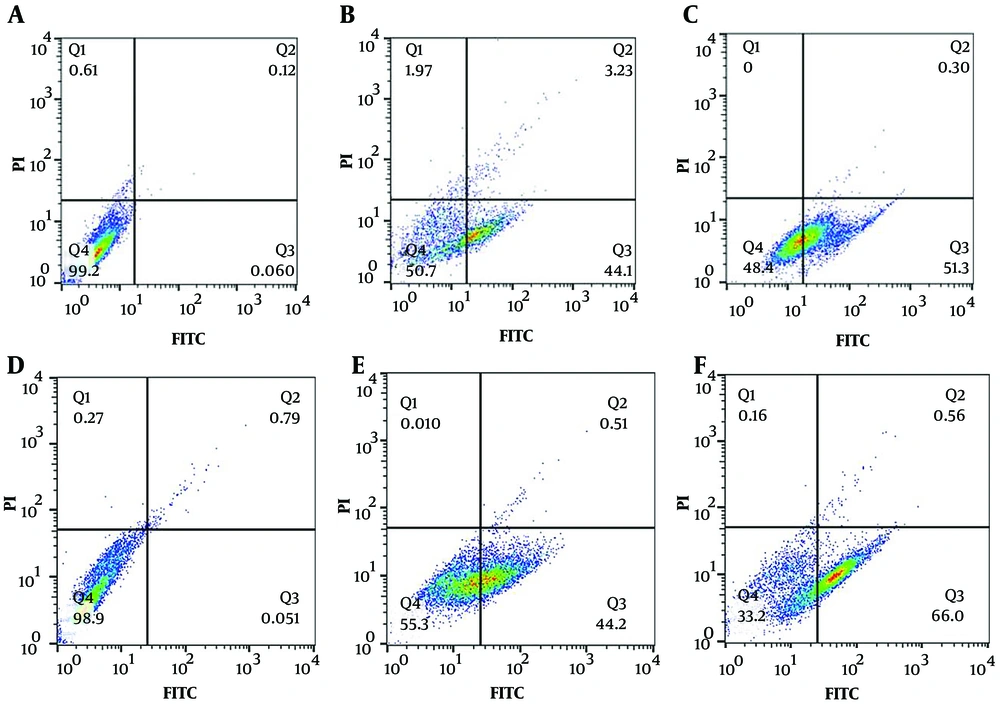
Flow cytometry analysis of MDA-MB-231 (A, B and C) and MCF-7 (D, E and F) cells treated with 0.4% Tween (negative control) (A and D), carboplatin (positive control) (Band E) and the essential oil (C and F) using two fluorescent dyes, Annexin V-FITC and PI. Q4 (Percentage of live cells ((Annexin V-FITC- and, PI-)), Q3 (Percentage of cells that are in the early stages of apoptosis ((Annexin V-FITC+ and PI-)), Q2 (total percentage of dead cells with apoptosis) delay and, necrosis (Annexin V-FITC+ and, PI+)) and, Q1 (Percentage of necrotic cells (Annexin V-FITC- and, PI+)), FL1-H (related to Annexin V-FITC) and, FL3-H (related to PI).


