


1. Background
Viral hepatitis is a major global public health concern. Among the various types of viral hepatitis, hepatitis A is a common infectious disease of children, especially in developing countries.
In Khuzestan Province (southwest of Iran), as a result of contamination of rivers' water by human sewage, water-borne diseases such as hepatitis A are more common than in other parts of the country. The results of two studies of hepatitis A prevalence in Ahvaz showed that hepatitis A was the most common type of hepatitis in children referring to children’s hospital and more than 80% of asymptomatic school students between ten and 15 years of age were seropositive for hepatitis A. It means that they had exposure to hepatitis A in early childhood (1, 2). Hepatitis A virus (HAV) is a member of Picornavirus family and the target organ of virus is the liver. HAV is transmitted through fecal-oral route (3).
In developing countries, HAV mainly involves children and by increasing the age, the majority of population is seropositive for HAV. The common signs and symptoms of the disease include anorexia, nausea, vomiting, abdominal pain, yellowish discoloration of skin and sclera, and hepatomegaly. Increased liver enzymes (Alanine aminotransferase [ALT], Aspartate aminotransferase [AST], and Alkaline phosphatase [ALP]) are common laboratory findings in children infected with HAV (4). The diagnosis of hepatitis A is confirmed by detection of anti-HAV IgM in sera of the patients.
Although hepatitis A is a self-limited disease and most cases do not need any specific therapy, in some patients, the disease presents as cholestatic jaundice or recurrent hepatitis or might progress to fulminant hepatitis (5). Hepatic failure occurs in less than 1% of patients with hepatitis A; however, because of high frequency of this disease, HAV is the main etiologic agent of fulminant hepatitis and hepatic failure in some populations (6).
2. Objectives
Regarding high prevalence of HAV in Khuzestan Province, we decided to study the clinical manifestations, laboratory findings, and epidemiologic characteristics of children with hepatitis A infection in Aboozar Children’s Hospital, Ahvaz, Iran.
3. Patients and Methods
In a retrospective study, medical records of all children with hepatitis A who had been admitted to Aboozar Children’s Hospital from March 2005 to March 2010 were reviewed. The inclusion criteria were the presence of clinical manifestations compatible with hepatitis A and positive serum anti HAV (IgM). Information concerning age and sex distribution, season, clinical manifestations, laboratory findings, and course of the disease were obtained. Data were analyzed using SPSS 21 (IBM Inc, USA). Since, the study was reviewing of medical records; there was not any ethical consideration.
4. Results
A total of 105 patients were enrolled in the study consisting of 53 males (50.5%) and 52 females (49.5%). The age of the patients ranged from four months to 13 years (mean, 7.02 years). Five cases (4.8%) were younger than two years and 14 patients (13.3%) older than ten years. Figure 1 shows the age distribution of patients with hepatitis A.
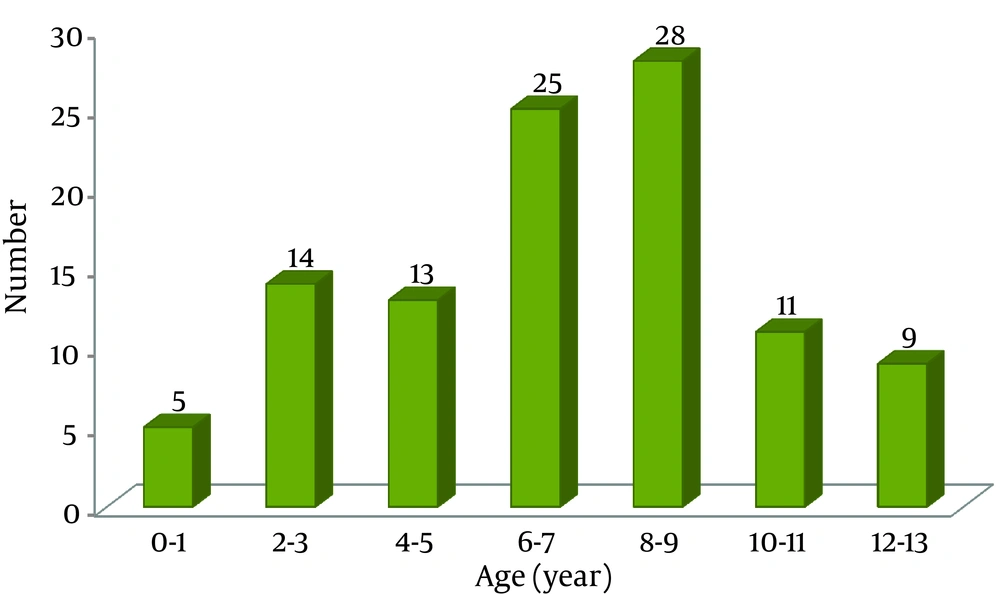
Figure 1.
Age Distribution of Children With Hepatitis A
Forty one patients (39.1%) were admitted in summer, 34 (32.4%) in spring, 19 (18.1%) in autumn, and 11 (10.4%) in winter. Eight patients had a history of contact with hepatitis A in their family. One patient had a documented history of hepatitis A one year ago. The most common clinical manifestations were Jaundice in 84 patients (80%) and abdominal pain in 80 (76.2%). The first presentation of one patient was fever and convulsion and another patient was referred as a case of diarrhea. Table 1 shows signs and symptoms of children with hepatitis A.
Table 1. Clinical Manifestation of the Studied Children With Hepatitis A
| Signs and Symptoms | Quantity a |
|---|---|
| Jaundice | 84 (80) |
| Abdominal Pain | 80 (70.6) |
| Vomiting | 79 (75.2) |
| Fever | 66 (62.8) |
| Anorexia | 61 (58.1) |
| Dark-Colored Urine | 54 (51.4) |
| Hepatomegaly | 39 (37.1) |
| Pruritus | 1 (0.9) |
| Diarrhea | 1 (0.9) |
a The total number of participants was 105. The values are presented as No. (%).
The mean levels of ALT and AST were 22.38 and 19.40 μkat/L, respectively. Bile was detected in urinalysis of 77 patients (73%). Hemoglobinuria is reported in 11, proteinuria in three, and glycosuria in two cases. Table 2 shows laboratory finding in children with hepatitis A.
Table 2. Laboratory Finding of Children With Hepatitis A a
| Laboratory Findings | Mean Value |
|---|---|
| ALT, μkat/L | 22.38 |
| AST, μkat/L | 19.40 |
| ALP, μkat/L | 15.07 |
| PT, sec | 15.1 |
| Hemoglobin, g/dL | 11.06 |
| Total bilirubin, μmol/L | 179.60 |
a Abbreviations: ALT, alanine aminotransferase; AST, aspartate aminotransferase; ALP, alkaline phosphatase; and PT, prothrombin time.
Abdominal sonography was performed in 13 cases and ascites was reported in six, splenomegaly in two, and gallbladder wall thickening in three cases. All patients received supportive therapy and in patients with dehydration and electrolyte imbalance, rehydration and correction of electrolytes was done. Mean hospital stay duration was 4.7 days. Recurrent hepatitis occurred in one patient. There was not any case of death or fulminant hepatitis.
5. Discussion
Hepatitis A is a common disease in the southwest of Iran. Similar to other studies, the disease had affected both gender equally in our study (7-9); however, the disease was more common in males than females in some studies (10-13).
The majority of patients belonged to age group of five to ten years, which are the ages that children enter the community and expose to communicable diseases such as hepatitis A in kindergartens and schools. By increasing the age, the numbers of infected persons decreased and as it is shown in previous study, more than 80% of children in this region were seropositive for hepatitis A (2).
The disease was more common in spring and summer than other seasons. Because of hot weather in spring and summer in Khuzestan Province, the contact with unsanitary water and exposure to the disease is more common in these seasons than in other seasons. The most common sign of disease was jaundice (80%). In studies from Pakistan and Korea, 80% and 84.5% of patients presented with jaundice, respectively (10, 14). In one study from the Czech Republic, 48.3% of all patients with hepatitis A had jaundice (15).
The common signs and symptoms of the disease include jaundice, abdominal pain, vomiting, fever, anorexia, dark urine, and hepatomegaly. The levels of aminotransferases, bilirubin, and prothrombin time were increased. In 34 cases (32.4%), the levels of liver enzymes returned to normal value after two weeks; however, the normalization of liver enzymes took longer time in other studies (10, 14). Similar to other studies, the mean duration of hospital stay was about four days (7, 10, 16). In conclusion, hepatitis A is a common disease in children younger than ten years of age in the southwest of Iran. This disease has a favorable outcome and complications such as fulminant hepatitis and death are rarely seen in children.


