1. Background
A tooth eruptive is a process that buds move from the initial development place in the alveolar bone to the final performance place in the oral cavity (1).
In some literature, teething is defined as a natural physiological process that all children experience and generally commences from six months to about three years (2). Baby’s first tooth usually grows between four and ten months and all his twenty teeth grow by the age of thirty months. Therefore, between six to thirty months, a tooth is erupted on average per month, a period in which mild and common diseases and rapid evolutionary changes occur (3). A broad range of symptoms may occur concomitantly with teething. However, no scientific evidence is available to suggest any symptoms or signs specific to teething (4). The association between primary tooth eruption and minor symptoms such as irritability, increased salivation, runny nose, loss of appetite, diarrhea, rash and sleep disturbance was reported (5). It looks that dental follicles with enriched sources of eicosanoids, cytokines and growth factors play a key role in the process of teething (6). The level of inflammatory cytokines such as, B1, interleukin (IL), -IL-8 and tumor necrosis factor (TNF)-α increase gingival crevice fluid that cause eruption of deciduous teeth and this may explain some of the symptoms associated with the eruption protests (7). The relationship between general health of infants and primary teeth eruption are discussed more than 5000 years and demonstrated that a variety of symptoms such as fever, diarrhea, convulsions, vomiting, neuralgia, loss of weight, toxemia, tonsillitis, paralyze and meningitis are associated with teeth eruption (8) and the perception of teething problems was found to be significantly associated with parents’ educational level. Generally, health givers with higher education and related awareness about teething, professionals and parents with high income had a better level of knowledge about teething (9, 10). In the period from 16 to 19 century AD, a significant number of infant death attributed to the teeth eruption (8); therefore, age and gender have independent effects on the growth and teeth eruption, which occur in lower weight in girls than boys of the same age (11). Typically, teeth eruptions do not cause significant discomfort for infants and young children. It is a normal physiological and risk free phenomenon (12). “Teething leads to raising some serious symptoms such as diarrhea, vomiting, eczema, bronchial secretions, and seizures and the screaming fits and strabismus” were demonstrated and reported by some pediatricians (13). Macknin reported an association between increased biting, drooling, gum rubbing, sucking, irritability, waking up, rubbing the ear, acne, loss of appetite for solid foods and body temperature with tooth eruption (14). Yet there are wrong beliefs among mothers and health workers about teething in infants (15-17). These false beliefs may prevent proper dealing with some common evolutionary status during infancy. On the other hand, they may lead to serious delays in the diagnosis of disease (3, 18).
2. Objectives
According to the above-mentioned matters, the current study aimed to investigate the attitudes and common opinions about teething by child health professional groups.
3. Methods
This analytical and cross sectional study aimed to determine child health professionals’ attitudes toward the symptoms of tooth eruption. Samples included general practitioners (GPs), dentists, pediatricians and child nurses. Data about signs and symptoms were collected using a researcher- made questionnaire that contained demographic factors and 22 questions attributed to the signs of teething with agree and disagree answers. There were 213 respondents 14 pediatric specialists, 74 general practitioners, 45 dentists and 80 nurses that filled out the questionnaires. After completing the questionnaires, the collected information and data were transferred into the statistical software SPSS ver. 16 and analyzed using ANOVA and Chi-square test. Significant level was considered as 0.05 in the 95% confidence interval.
4. Results
Out of the 213 participants, 37.6%, 34.7%, 21.1% and 6.6% were nurses, general practitioners, pediatric dentists and pediatricians, respectively. The number of female nurses was much higher than those of other staffs (Table 1). Nurses were the youngest group and the pediatricians were the eldest (Table 2).
Table 1.
Gender Distribution of Participants
| Groups | Male, No. (%) | Female, No. (%) | Total, No. (%) |
|---|---|---|---|
| Nurses | 10 (12.5) | 70 (87.5) | 80 (37.6%) |
| General practitioners | 32 (43.24) | 42 (56.76) | 74 (34.7) |
| Pediatric Dentist | 32 (71.11) | 13 (28.89) | 45 (21.1) |
| Pediatrician | 9 (64.29) | 5 (35.71) | 14 (6.6) |
| Total | 83 (38.97) | 130 (61.03) | 213 |
Table 2.
Mean Age of Participantsa
| Group | N | Mean ± SD (yr) |
|---|---|---|
| Nurses | 80 | 33.20 ± 5.74 |
| General practitioners | 74 | 34.86 ± 6.15 |
| Dentist | 45 | 34.00 ± 5.32 |
| Pediatrician | 14 | 43.71 ± 5.78 |
| Total | 213 | 34.64 ± 6.29 |
aP value is considered as 0.001.
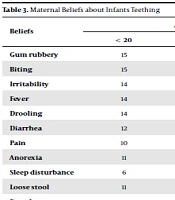
It is widely believed that most of the symptoms analyzed in the study were somehow related to the eruption of children’s teeth with the lowest level of agreement by pediatricians and various agreement levels by nurses, general practitioners and pediatric dentists. Table 3 shows the percentages of distribution agreement about teething symptoms amongst groups of medical staffs. Gum rubbing (57%), biting (36%), irritability (36%), fever (57%), drooling (50%), diarrhea (78%), pain (86%), anorexia (71%), earache (93%) and crying (93%) were the signs and symptoms which pediatricians mostly disagreed with compared with other medical staffs in the study. There was a significant difference between the belief of staffs about many of the signs and symptoms under study such as gum rubbing (P < 0.001), biting (P = 0.008), irritability (P = 0.033) and vomiting (P = 0.004). In accordance with the results of the table, for all the symptoms mentioned above there were observed statistical differences between the medical staffs' beliefs. Dentists highly agreed with gum rubbing (98%) compared with other groups; nurses were in the second place (93%); the significant value for this sign of teething was P < 0.001. Biting was another sign related to teething. For this specific sign, dentists had the highest level of agreement (96%), followed by nurses (91%). General practitioners agreed with irritability as a sign of teething (92%) compared with other staffs. Pediatricians disagreed (100%) with the signs of ear infection, headache, red cheek and coryza. Earache, ear infection, cough and red cheek were symptoms that all staffs had the same attitudes about; therefore, no differences were observed between their attitudes (P > 0.05) in such a way that the majority of staffs in each type disagreed with the fact that earache, ear infection, cough and red cheek are symptoms for teething.
Table 3.
Distribution of Beliefs on Teething Symptoms Amongst Physicians and Nurses
| Symptoms | Beliefs | Nurses (%) | General Practitioners (%) | Dentist (%) | Pediatrician (%) | Pearson Chi-Square Value | P Value |
|---|---|---|---|---|---|---|---|
| Gum rubbing | Agree | 74 (93) | 68 (92) | 44 (98) | 6 (43) | 38.93 | < 0.001 |
| Disagree | 6 (7.5) | 6 (8.11) | 1 (2.22) | 8 (57.14) | |||
| Biting | Agree | 73 (91) | 62 (84) | 43 (96) | 9 (64) | 11.75 | 0.008 |
| Disagree | 7 (8.75) | 12 (16.22) | 2 (4.44) | 5 (35.71) | |||
| Irritability | Agree | 71 (89) | 68 (92) | 40 (89) | 9 (64) | 8.76 | 0.033 |
| Disagree | 9 (11.25) | 6 (8.11) | 5 (11.11) | 5 (35.71) | |||
| Fever | Agree | 68 (85) | 62 (84) | 35 (78) | 6 (43) | 14.26 | 0.003 |
| Disagree | 12 (15) | 12 (16.22) | 10 (22.22) | 8 (57.14) | |||
| Drooling | Agree | 68 (85) | 60 (81) | 40 (89) | 7 (50) | 11.77 | 0.008 |
| Disagree | 12 (15) | 14 (18.92) | 5 (11.11) | 7 (50.00) | |||
| Diarrhea | Agree | 57 (71) | 16 (22) | 20 (44) | 3 (21) | 41.75 | < 0.001 |
| Disagree | 23 (28.75) | 58 (78.38) | 25 (55.56) | 11 (78.57) | |||
| Pain | Agree | 46 (58) | 34 (46) | 35 (78) | 2 (14) | 34.12 | < 0.001 |
| Disagree | 34 (42.5) | 40 (54.05) | 10 (22.22) | 12 (85.71) | |||
| Anorexia | Agree | 46 (58) | 18 (24) | 25 (56) | 4 (29) | 21.36 | < 0.001 |
| Disagree | 34 (42.5) | 56 (75.68) | 20 (44.44) | 10 (71.43) | |||
| Sleep disorder | Agree | 49 (61) | 24 (32) | 25 (56) | 7 (50) | 13.7 | 0.003 |
| Disagree | 31 (38.75) | 50 (67.57) | 20 (44.44) | 7 (50) | |||
| Loose stool | Agree | 44 (55) | 12 (16) | 15 (33) | 6 (43) | 25.48 | < 0.001 |
| Disagree | 36 (45) | 62 (83.78) | 30 (66.67) | 8 (57.14) | |||
| Earache | Agree | 20 (25) | 12 (16) | 5 (11) | 1 (7) | 5.41 | 0.144 |
| Disagree | 60 (75) | 62 (83.78) | 40 (88.89) | 13 (92.86) | |||
| Vomiting | Agree | 12 (15) | 2 (3) | 11 (24) | 1 (7) | 13.44 | 0.004 |
| Disagree | 68 (85) | 72 (97.30) | 34 (75.56) | 13 (92.86) | |||
| Crying | Agree | 46 (58) | 8 (11) | 19 (42) | 1 (7) | 42.78 | < 0.001 |
| Disagree | 34 (42.5) | 66 (89.19) | 26 (57.78) | 13 (92.86) | |||
| Urine malodor | Agree | 0 (0) | 0 (0) | 5 (11) | 0 (0) | 19.115 | < 0.001 |
| Disagree | 80 (100) | 74 (100.00) | 40 (88.89) | 14 (100.00) | |||
| Green stool | Agree | 17 (21) | 2 (3) | 0 (0) | 0 (0) | 24.269 | < 0.001 |
| Disagree | 63 (78.75) | 72 (97.30) | 45 (100.00) | 14 (100.00) | |||
| Ear infection | Agree | 2 (3) | 0 (0) | 0 (0) | 0 (0) | 3.357 | 0.34 |
| Disagree | 78 (97.5) | 74 (100.00) | 45 (100.00) | 14 (100.00) | |||
| Headache | Agree | 12 (15) | 0 (0) | 5 (11) | 0 (0) | 13.6 | 0.004 |
| Disagree | 68 (85) | 74 (100.00) | 40 (88.89) | 14 (100.00) | |||
| Cough | Agree | 4 (5) | 2 (3) | 0 (0) | 1 (7) | 3.003 | 0.391 |
| Disagree | 76 (95) | 72 (97.30) | 45 (100.00) | 13 (92.86) | |||
| Red cheek | Agree | 4 (5) | 2 (3) | 5 (11) | 0 (0) | 4.932 | 0.177 |
| Disagree | 76 (95) | 72 (97.30) | 40 (88.89) | 14 (100.00) | |||
| Diaper rash | Agree | 0 (0) | 0 (0) | 0 (0) | 2 (14) | 28.698 | < 0.001 |
| Disagree | 80 (100) | 74 (100.00) | 45 (100.00) | 12 (85.71) | |||
| Coryza | Agree | 10 (13) | 0 (0) | 0 (0) | 0 (0) | 17.444 | 0.001 |
| Disagree | 70 (87.5) | 74 (100.00) | 45 (100.00) | 14 (100.00) | |||
| Seizure | Agree | 0 (0) | 0 (0) | 0 (0) | 0 (0) | - | - |
| Disagree | 80 (100) | 74 (100.00) | 45 (100.00) | 14 (100.00) | |||
| Constipation | Agree | 0 (0) | 0 (0) | 5 (11) | 0 (0) | 19.115 | < 0.001 |
| Disagree | 80 (100) | 74 (100.00) | 40 (88.89) | 14 (100.00) |
5. Discussion
The present study investigated physicians and nurses’ attitudes and beliefs towards teething in infants and found differences between the pediatrician beliefs and those of other staffs.
Tooth eruption time varied in age 4-10 months. The first tooth eruption occurs in 1% before the 4th month when 1% of infants do not have any teeth until the 12th months (19). In the present study, the mean time length of teething was 7.16 ± 1.60 months. The minimum and maximum age was 4-14 months. Physicians and nurses believed that teething is associated with some signs and symptoms.
In a study conducted by Wake and Hesketh on pediatric nurses, pharmacists, GPs, dentists and specialists demonstrated at least some infants or young children with signs and symptoms of teething and believed that the prevalence of symptoms of teething were quite different (20). In a study by Sarrell EM, 76% of parents and 83% of nurses believed that tooth eruption is associated with infant mortality and parents’ views were different from those of doctors and nurses (5). Feldens, after studying 500 children reported that teething is correlated with irritability, fever, diarrhea and itching (21), which was similar to the outcomes. Barlow et al., said that more than half of parents and pediatric dentists believed that teething was associated with diarrhea (22). The current study results, compared to those of Barlow’s, showed that more than half of nurses agreed but less pediatric dentists had agreement. Baykan reported that almost all parents expressed that children had at least one of the symptoms introduced in the questionnaire. The most common reported symptoms were irritability, restlessness, fever and biting; similar to the current study findings (23). In another study, the majority of nurses believed that loss of appetite, crying, increased salivation, and increased excitability were essential components in the process of tooth eruption. The latter study said that about 82% of nurses agreed with fever and 61% with diarrhea, where the current study demonstrated that more than 70% of the nurses agreed with the two symptoms (13). Sarrell concluded that the most common symptoms associated with tooth eruption included irritability, fever, diarrhea and loose stools, ear infections, vomiting, wheezing and asthma exacerbations; similar to the results of the current study (3). Wake observed a relationship between temperature, mood disorders, pathological appearance, sleep disorders, drooling, diarrhea, smelly urine, red cheeks, rash or facial flushing with infant teething (6). Peretz observed that the most common symptoms associated with teething were drooling teeth (15%), diarrhea (13%) and drooling- diarrhea (8%), respectively. Fever and diarrhea were observed in 8% of the cases. The protests are often observed during the initial eruption of permanent incisors (24). Coreil observed that 35% of dentists agreed that teething is associated with diarrhea and it is less severe than other common explanations such as changes in eating habits, increased salivation and stress (25). A cohort study found that increasing the number of prospective biting, drooling, irritability, ear rubbing, facial rash, decreased appetite for solid foods and mild temperature increase were associated with the eruption of teeth (9). Wake also reported that most child health professionals (70% - 85%) believed that teething causes fever, pain, irritability, sleep disturbances, biting and putting objects to mouth, drooling and red cheeks (13). But in another investigation on 21 infants in Melbourne, Australia, no signs and symptoms were strongly correlated with teething, which was not consistent with the results of many other studies including the current one (19).
Macknin showed that signs and symptoms such as sleep disturbance, Shelley stools, increased stool frequency, decreased appetite for liquids, cough, rash on other parts of the body except the face, vomiting and fever over 38.8°C were statistically connected with the tooth eruption (14). In another study very small number of healthcare providers believed that teething causes eczema and rash (18). Wake and Hesketh conducted a study on pediatric nurses, pharmacists, GPs, dentists and children specialists and in each group it was thought that at least some infants or young children had symptoms of teething, although beliefs toward the prevalence of teething symptoms were quite different in the groups (19).
Almost many pediatric health professionals believed that teething causes a wide range of symptoms and has many signs, most of which are minor and related to discomfort rather than physical illness. The current study did not approve an estimated strong correlation between teething and symptoms in children; although it cannot rule out the possibility of weak associations. The current study findings were consistent and in contrast with those of many other studies on professional beliefs toward teething symptoms and sings. These may create optimal management of common patterns of illness during teething and these beliefs and attitudes may sometimes stop physicians and nurses from effectively managing some of the common developmental issues of infancy and might lead to late diagnosis of important illness.
Practice implications
Although some health professionals such as nurses and physicians believe that some symptoms in infants are probably attributed to teething, further studies on this seemingly trivial issue are required. It is equally important to inform parents that some symptoms should not be attributed to teething, as they may have a more serious underlying cause, and provide parents with information about normal developmental phases of early childhood.