
1. Background
Colorectal cancer (CRC), known as bowel cancer and colon cancer, is the progress of cancer from the colon or rectum (1). The incidence of CRC is increasing globally, and the greatest increase is in low- to middle-income countries (2). However, old age and factors associated with lifestyle are responsible in most patients with CRC, but genetic disorders could also be mentioned as another reason for CRC (3). Diet, obesity, and lack of physical activity were mentioned as risk factors. In regards to gender, it affects both male and females equally (4). In fact, CRC was mentioned as a disease of developed countries (accounts for over 63%) with a western culture (5). With a gradual improvement in 5-year survival rate, national statistics have reported reductions in the incidence and death rates (6). The highest CRC incidence rates were reported for North America, Europe, and Australia. There are reports regarding an increase in incidence for Japan, Thailand, and Iran. In regards to Saudia Arabia, the double rate was reported since 1994 (7-9). There is an attribution of half of the incidence associated with mortality due to CRC globally. Survival is extremely reliant upon the stage of disease at finding, and characteristically sorts from a 5-year survival rate at the localized stage; 70% for local and 10% for individuals identified for metastatic cancer. Around 20% of those with development in CRC have a background with a positive family history (10-13).
2. Objectives
Due to Western influences of lifestyle in many countries including Iran, colorectal cancer is on the rise, therefore, this study designed to provide period prevalence (PP) and incidence rates (Irs) data of CRC in Isfahan province, Iran.
3. Methods
In conjunction to the Isfahan Kidney Transplantation Research Centre (IKTRC) data associated with the cancers of colorectal (extracted from the project with the origin source of 295115) were obtained from the Isfahan Deputy of Health associated to the years from 2011 - 2015. De-identified coded file included age, gender, final code for cancer diagnosis and date of reported cancer were recorded in Excel. Mean ± standard deviation (SD) calculated for age, as a continuous variable. Information associated with the population at risk was obtained from Isfahan Program and Budget Management Organization. The proportion of the total cases over the period of the studied years/to the population at risk × 100,000 was expressed as PP. The incidence rate was calculated by dividing new cases of cancer during a given time period/to the population at risk during the same time period × 100,000 (14-19).
4. Results
Table 1 shows demographic and epidemiology characteristic of patients with CRC. In all, 2623 individuals with CRC were identified. For the total population, the PP was calculated as 52.6 in which corresponded to a value of 22.6 for females and 30.1 for males. Figure 1 shows the PP for CRC, according to the anatomical sites as well as; colon, rectum, rectosigmoid junction and anus, analcanal, anurectum that were as follow; 35.5, 12.9, 3.3, and 0.98 respectively.
Table 1.
Period Prevalence, Estimated Deaths and Living Colorectal Cancer Cases by Sex, in Isfahan Province/Iran
| Sites of Cancers | Total Cases | Period Prevalence | Estimated Living Cases | Estimated Deaths | ||||
|---|---|---|---|---|---|---|---|---|
| Both Genders | Females | Males | Both Genders | Females | Males | |||
| Colon | 1767 | 35.5 | 1326 | 606 | 740 | 441 | 178 | 263 |
| Rectum | 644 | 12.9 | 586 | 230 | 356 | 58 | 23 | 35 |
| Rectosigmoid junction | 163 | 3.3 | 156 | 68 | 93 | 7 | 2 | 5 |
| Anus , anal canal, anorectum | 49 | 0.98 | 44 | 16 | 28 | 5 | 2 | 3 |
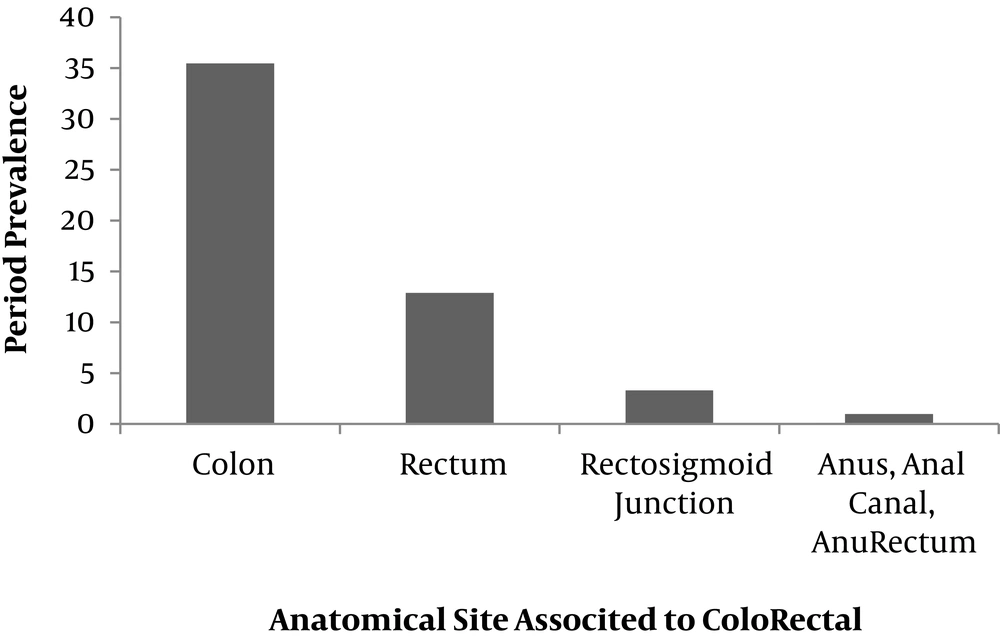
Figure 1.
Period prevalence of CRC according to different anatomical parts in Isfahan province, Iran
Figure 2 shows the distribution of age according to gender. With a minimum of three and a maximum of 98, the mean age ± SD was 62.0 ± 14.4 years old. The minimum reported age in females with CRC was 19 and in males three years old. Age-related to CRC at the ages from 20 to 50 and 50 to 98 years were as follow; 225 versus 895 (females) and 249 versus 1247 (males).
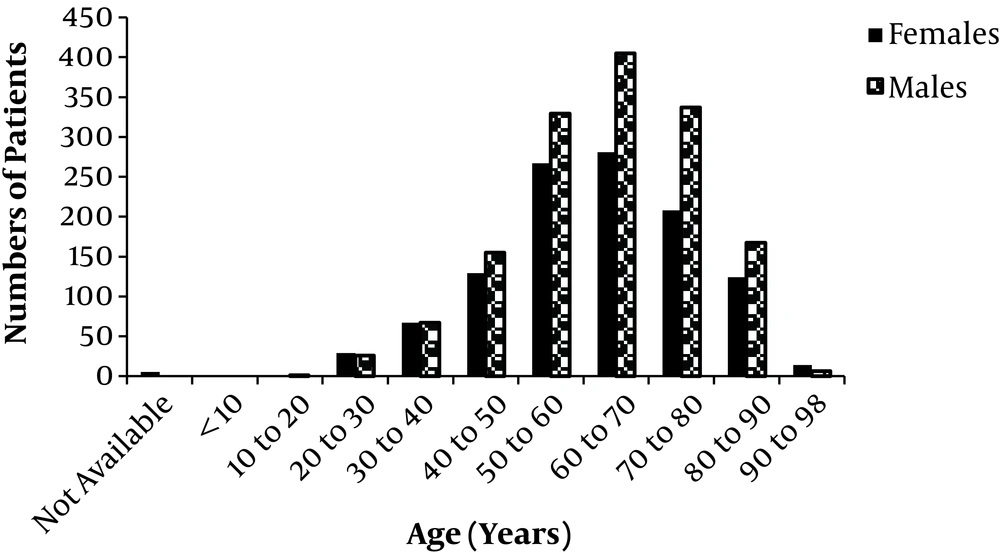
Figure 2.
Age distribution in according to gender in patients with CRC
Figure 3 shows the Irs for the related years of study. The calculated Irs for each year were as follow; 10.3 (2011 - 2012), 13.9 (2012 - 2013), 13.1 (2013 - 2014), and 15.1 (2014 - 2015) correspondingly.
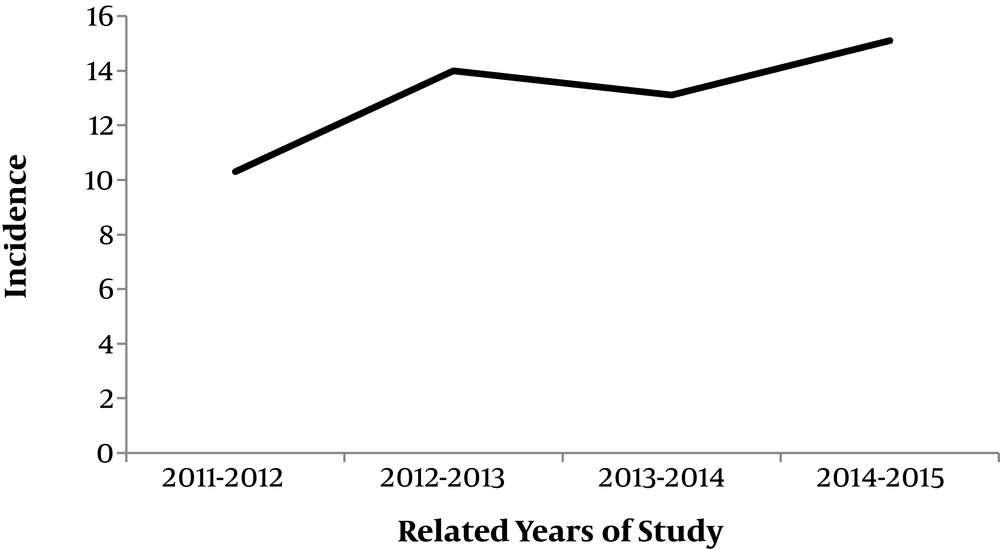
Figure 3.
Incidence of CRC in related years of study in Isfahan province
Death informed data was associated with 511 records out of the total population (n = 2623) that was reported.
5. Discussion
CRC is the main cause of morbidity and mortality in which was reported as the third deadliest cancer throughout the world (1). Due to Western influences of lifestyle in many countries, including Iran, the study of CRC is an important issue for health authorities (14-19). The mean age of patients in this study was 62.0 year with a tendency associated with 82% of occurrence in older age of life (50 to 98 years). This is in agreement with previous publications that mentioned advanced age as main risk factors in addition to family history and lifestyle (20). In addition, another publication confirmed that incidence of CRC increases with age, in which the highest incidence is observed, is after 75 years and above (13).
In this study, the total PP with a value of 52.6 per 100,000 persons was 6.8% higher in males than females (22.6 versus 30.1), respectively. The previous study confirmed over 55% of male cases. Other studies indicated that the incidence is higher in men. In another study, the sex ratio of males to females was 1.4 (4).
Regarding incidence of CRC, it is different in the world about 20 times, and most cases are reported in Western industrial countries. There was a significant (P < 0.01) increase of 47% in the incidence of CRC from the year 2011 to 2015. According to previously published articles, incidence rates vary ten-fold in both sexes worldwide. The highest estimated rates are found in Oceania with age-standardized rates of 44.8 and 32.2 per 100,000 in men and women and the lowest in Western Africa with age-standardized rates of 4.5 and 3.8 per 100,000 (20).
In agreement with previous publications that reported an increase in both sexes between 2003 and 2008 (in women from 3.92 to 7.78 and in men from 5.56 to 12.7 per 100,000), in this study there was an increase in the incidence of CRC (21). The reason that may explain the increase in incidence could be associated with physical activity and smoking. In addition, in Iran, there are evidence that smoking has increased.
The previous study reported the lowest rate of CRC for Africa (3.6 per hundred thousand) and South Asia, including India and China, (3.6 per hundred thousand) (22, 23).
The results of this study showed that the tendency of CRC in Isfahan province/Iran is increasing. This could be due to alterations in lifestyle, smoking habit, physical activity, and western style, of diet based on fast food. According to the heavy burden of CRC on the health system, the plan for change in strategy based of disease reduction, prevention, and early diagnosis is recommended for health authorities in the Isfahan province/Iran (1-26).
Finally, the PP associated with CRC was with a value of 52.6 per 100,000 persons with a significant increase in the incidence from 2011 to 2015. These outcomes highlighted for a greater effort that should be made for prevention and early diagnosis of CRC in Iran.