
1. Background
Half of the global population are women, and they live at the menopause stage for about one-third of their lifetime (1). According to WHO, the total number of postmenopausal women will reach 1.2 billion by 2030, and the ratio of these women in developed and developing countries will equal 24% and 76%, respectively (2). Like many other developing countries, Iran is changing considerably in terms of demographic and epidemiological variables. In 2013, the Iranian Ministry of Health reported the number of women aging 45 - 60 years to be around 2215000 in this country. It is estimated that by 2021, roughly 5 million menopausal women will exist in Iran (3). Accordingly, the rise of life expectancy and the escalating rate of the elderly turned sexual health into a critical issue for menopausal women (4, 5).
Menopause refers to the breakdown of menstrual cycles, which entails the drop in ovulation at the end of the fertility period. This phenomenon gives rise to a host of different effects and may result in physical, emotional, and social complications (6). Some women associate menopause with the onset of worries, emergence of signs of old age, and the termination of attractiveness (7). In fact, one of the most pervasive complaints after menopause is the decline of libido, sexual attractiveness, and sexual activity (8). Female sexual dysfunction may transpire at any age; nevertheless, it is more prevalent in middle age or during menopause (9, 10). Approximately 40% of menopausal women undergo sexual dysfunction (9). The findings of the study conducted by Safarinejad showed that 31.5% of Iranian women aging 20 - 60 years old experience sexual dysfunction. More specifically, the incidence of sexual dysfunction was 39% in women over 50 (11). Meanwhile, women encounter sexual dysfunction 2.3 times more in the post-menopause stage than in the pre-menopause stage (12).
Sexual health does not always mean the absence of sexual dysfunction. Indeed, sexual satisfaction often translates into one’s agreeable feeling/attitude towards sexual activity or behavior (Oriel). Needless to say, sexual activity plays a major role in women’ quality of life, and it is indispensable to women’s health in general (13, 14). Concerning the link between sexual activity and relationship quality in long-term relationships, studies suggest that couples who are sexually active and satisfied with their life are happy with their overall life quality as well (15, 16). Satisfaction with one’s sexual life often leads to family consistency and marriage durability. Some authors have reported that approximately 70% of Iranian women are from Tehran and who seek divorce have complaints about sexual dissatisfaction (17). Furthermore, one of the main problems of menopausal women is the undesirable effect of sexual dysfunction on marital satisfaction. In this regard, a qualitative study observed that some menopausal women are under the impression that the fall in their sexual activity accounts for their marital conflicts and dissatisfaction (18).
Undoubtedly, physiological and pathological factors are involved in such transformations (Ports), yet socioeconomic and cultural factors also play a decisive role in the development or removal of these problems (19). In fact, menopause is a complicated biologic event, which operates within specific sociocultural and psychological circumstances that could influence one’s impression of this common phenomenon (20). Women grapple with menopause in various social conditions; consequently, their attitudes towards it intimate distinct meanings (21). Hence, it is vital to consider demographic, socioeconomic, and cultural variables, which affect sexual satisfaction and sexual activity of menopausal women. However, as discussing sexual issues is taboo in the Iranian society, there is a paucity of research concerning sexual satisfaction as well as factors shaping a satisfactory sexual life for Iranian women.
2. Objectives
Thus, this study intends to disclose some demographic, socioeconomic, and cultural determinants of sexual satisfaction among postmenopausal women in Shiraz, Iran.
3. Methods
This is a cross-sectional study carried out on 400 married women in their postmenopausal period in Shiraz, Iran, in 2018. Regarding the inclusion criteria, it should be mentioned that only married postmenopausal females who were living in Shiraz with their husband, and at least one year had passed from their last menstruation were considered qualified. Based on the formula provided by Krejcie and Morgan (1970), a sample size of 384 was determined for this study. To avoid sample attrition as stressed by Bryman and Bell (2003), 440 questionnaires were distributed among the participants. However, only 400 questionnaires were analyzed since 40 others were incomplete. In order to determine the unit of analysis, multi-level cluster sampling was used. Data were collected by questionnaire, which consisted of four sections: questions related to socioeconomic and demographic background, questions related to attitude about menopausal period, questions related to lifestyle, and questions related to sexual satisfaction and sexual activity. The reliability of the subscales was determined by Cronbach’s alpha. Alpha coefficient ranges in value from 0 to 1. The higher the score, the more reliable the generated scale is. The questionnaire used in this study includes two Likert scales. The first scale with 10 items measured the attitude towards menopausal period, and its Cronbach’s alpha was 0.7. The other scale had five items and assessed sexual satisfaction as well as sexual activity, and its Cronbach’s alpha was 0.79. The content validity of this questionnaire was confirmed by a panel of academic experts. Thus, the instrument was revised such that incomprehensible terms were rephrased and vague questions were omitted. Finally, data analysis was conducted by SPSS V. 20. Multiple linear regression was employed for statistical analysis, and P value of < 0.05 was considered statistically significant.
4. Results
Table 1 describes respondents based on their sociocultural and demographic characteristics. The first demographic information concerns the age of participants. The highest percentage of these individuals belonged to the age groups of 50 - 54 (58.5%) and 45 - 49 (35.5%). In terms of spousal age difference, it can be observed that 31.5% of respondents had 7 - 10 years of age difference. With respect to the education level of study samples, the findings showed that 50.0% of these people had 10 - 12 years of education. In addition, the results demonstrated that 42.8% of husbands had 10 - 12 years of education. Employment status is an index of social and economic position. The findings revealed that 80% of participants were housewives, and only 20% of them had a job outdoors.
Table 1.
Distribution of Respondents According to Demographic and Sociocultural Background
| Variable, Category | No. (%) | Mean (SD) |
|---|---|---|
| Age | 55 (3.4) | |
| 40 - 44 | 24 (6.0) | |
| 45 - 49 | 142 (35.5) | |
| 50 - 54 | 234 (58.5) | |
| 54+ | 24 (6.0) | |
| Spousal age difference, y | 6.7 (4.6) | |
| < 3 | 94 (23.5) | |
| 3 - 6 | 112 (28.0) | |
| 7 - 10 | 126 (31.5) | |
| 10+ | 68 (17.0) | |
| Respondent’s education level (years of study) | 11 (3.3) | |
| Illiterate | 3 (0.8) | |
| 1 - 5 | 24 (6.0) | |
| 6 - 9 | 59 (14.8) | |
| 10 - 12 | 220 (55.0) | |
| 12+ | 94 (23.5) | |
| Husband’s education (years of study) | 12 (4.4) | |
| Illiterate | 9 (2.3) | |
| 1 - 5 | 26 (6.5) | |
| 6 - 9 | 50 (12.5) | |
| 10 - 12 | 171 (42.8) | |
| 12+ | 144 (36.0) | |
| Occupation | - | |
| Housewife | 320 (80.0) | |
| Employed | 80 (20.0) |
Sexual activity and sexual satisfaction of respondents were measured through a number of indices. Figure 1 shows that 45% of menopausal women had a sexual relationship once or twice a month. In addition, the sexual relationship of 35% of these women was less than once a month. However, 23% of women said that they had a sexual relationship once or twice a week. Figure 2 indicates that although 72% of respondents believed that their sexual desire had declined after menopause, 27% of them felt no such change before and after menopause. In terms of offering a sexual relationship, according to Figure 3, 95% of women said that their husbands offered sex in most cases.
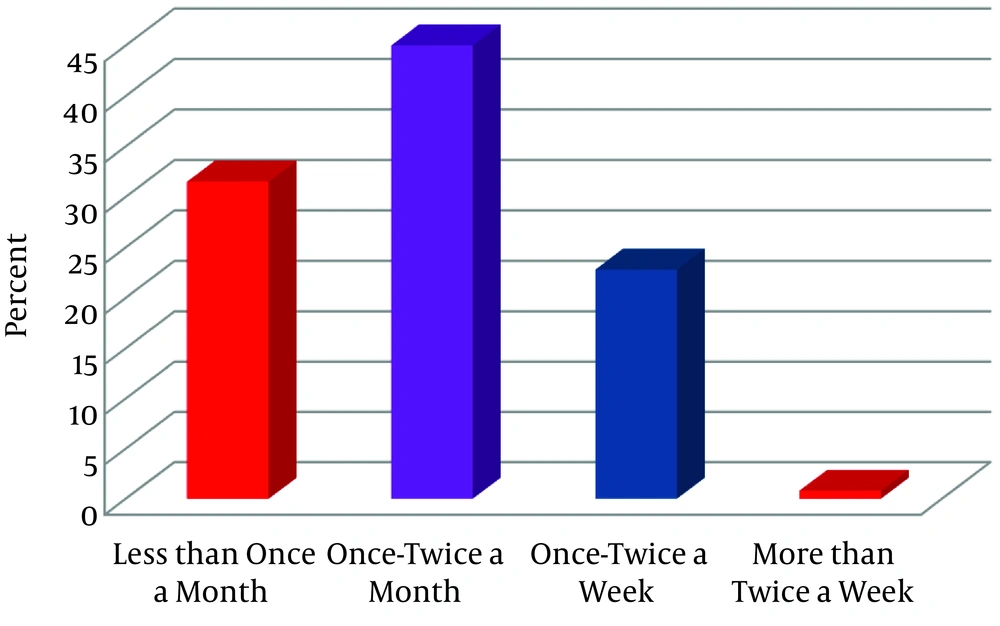
Figure 1.
Distribution of respondents according to the number of sexual relationship
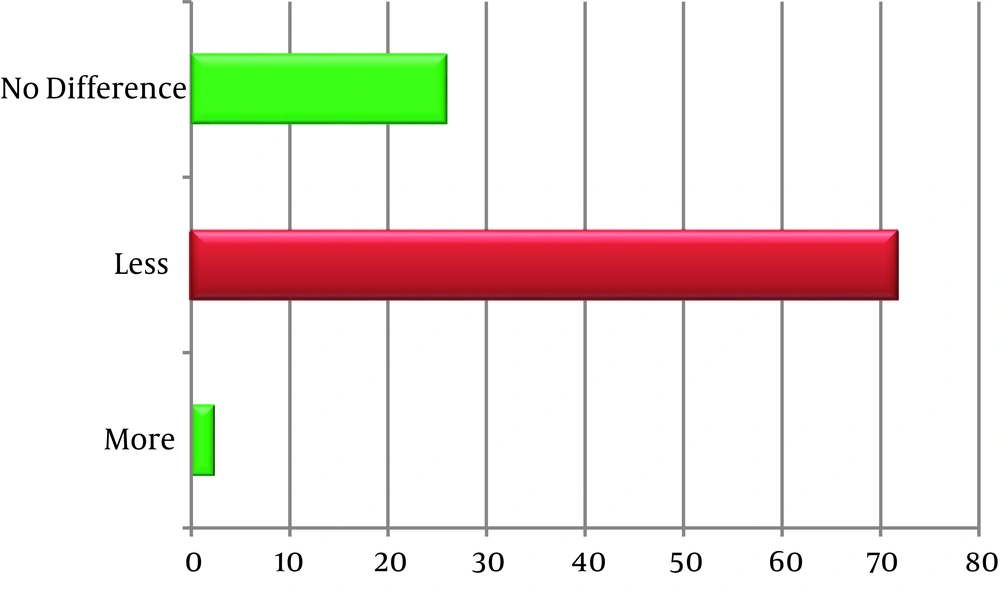
Figure 2.
Difference in respondents’ sexual motivation after menopause versus before menopause
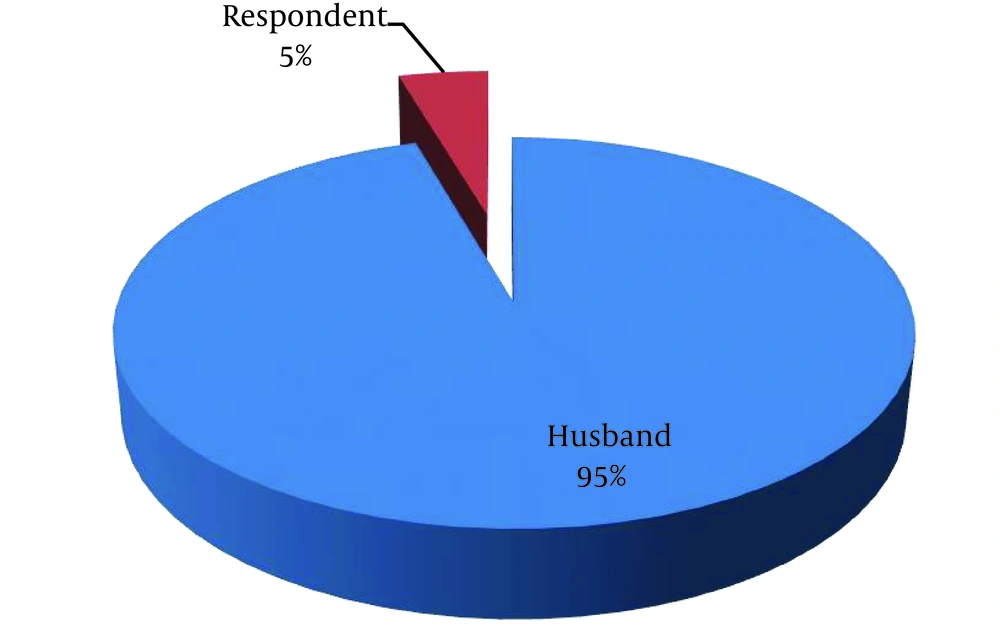
Figure 3.
Distribution of respondents according to sex offer
Pearson correlation analysis was performed to find the coefficient correlation between the variables. In fact, Pearson correlation helps the researcher find the relationship between independent variables as well as the relationship between independent variables and dependent variable. As shown in Table 2, sexual satisfaction has a significantly positive relationship with lifestyle (r = -0.169, P < 0.05), attitude towards menopause (r = -0.298, P < 0.05), and number of monthly sex (r = -0.340, P < 0.05). In the next step, multiple regression analysis was employed to examine the relationship between sexual satisfaction and various potential predictors. Before discussing the results of this test (Table 2), it should be mentioned that dummy variables were used with regard to categorical factors. Damodar (22) defines a dummy variable which takes the value of 0 or 1 to represent the lack or existence of some categorical effect that might influence the outcome. Specifically, for the ethnicity variable, the value of 1 was given to Fars while 0 was obtained for Non-Fars participants. In terms of occupation, 1 was given to housewives while 0 was obtained for employed participants. It can be seen in Table 3 that 23.50% of sexual changes can be explained with reference to three predictors of lifestyle (B = 0.378, t = 2.09, P < 0.05), number of monthly sex (B = 0.599, t = 6.81, P < 0.01), and positive attitude towards menopause, all of which are significantly associated with sexual satisfaction of respondents (B = 0.242, t = 5.99, P < 0.01).
Table 2.
Correlation Between Sexual Satisfaction and Socioeconomic and Cultural Factors
| Variable | Age | Respondent’s Education | Husband’s Education | Number of Children | Lifestyle | Ethnicity (Fars) | Respondent’s Job | Spousal Age Difference | Number of Sex | Attitude Towards Menopause | Sexual Satisfaction |
|---|---|---|---|---|---|---|---|---|---|---|---|
| Age | 1 | ||||||||||
| Respondent’s education | -0.043 | 1 | |||||||||
| Husband’s education | -0.011 | 0.666** | 1 | ||||||||
| Number of children | 0.056 | -0.358** | -0.293** | 1 | |||||||
| Lifestyle | 0.106* | 0.181** | 0.125* | -0.109* | 1 | ||||||
| Ethnicity (Fars) | 0.076 | 0.121* | 0.000 | -0.061 | 0.021 | 1 | |||||
| Respondent’s job (housewife) | -0.050 | -0.274** | -0.169** | 0.177** | -0.155** | -0.065 | 1 | ||||
| Spousal age difference | -0.012 | -0.245** | -0.175** | 0.278** | -0.088 | -0.052 | 0.079 | 1 | |||
| The number of sex | -0.079 | 0.112* | 0.109* | 0.080 | 0.112* | 0.010 | -0.015 | -0.152** | 1 | ||
| Positive attitude towards menopause | 0.022 | 0.142** | 0.131** | -0.138** | 0.211** | 0.064 | 0.025 | -0.037 | 0.148** | 1 | |
| Sexual satisfaction | -0.061 | 0.033 | 0.073 | -0.003 | 0.169** | 0.017 | 0.047 | -0.097 | 0.298** | 0.340** | 1 |
Table 3.
Prediction of Sexual Satisfactiona
| Model | Unstandardized Coefficients | Standardized Coefficients | t | P Value | |
|---|---|---|---|---|---|
| B | Beta | ||||
| Constant | 6.57 | 3.10 | 2.11 | 0.035 | |
| Number of sex (monthly) | 0.457 | 0.599 | 0.230 | 6.81 | 0.000 |
| Age | -0.010 | 0.054 | -0.011 | -0.185 | 0.854 |
| Age of husband | -0.042 | 0.034 | -0.075 | -1.221 | 0.223 |
| Respondent’s education | -0.064 | 0.064 | -0.066 | -1.001 | 0.318 |
| Husband education | 0.035 | 0.046 | 0.048 | 0.771 | 0.441 |
| Number of children | 0.050 | 0.115 | 0.024 | 0.436 | 0.663 |
| Lifestyle | 0.315 | 0.378 | 0.101 | 2.09 | 0.037 |
| Spousal age difference | -0.043 | 0.035 | -0.061 | -1.23 | 0.217 |
| Ethnicity (Fars) | 0.134 | 0.682 | 0.009 | 0.197 | 0.844 |
| Positive attitude towards menopause | 0.251 | 0.242 | 0.287 | 5.99 | 0.000 |
| Respondent’s job (housewife) | 0.362 | 0.373 | 0.047 | 0.971 | 0.332 |
aR2 = 0.235.
5. Discussion
The findings of this study indicated that a considerable percentage of respondents (35%) had a sexual relationship less than once a month. Furthermore, 45% of participants had a sexual relationship once or twice a month. Another important result was that 72% of women revealed that their sexual desire had diminished after menopause. Similarly, Merghati-Khoei et al., found that sexual desire decreased or died out in 94.5% of 200 postmenopausal Iranian women who participated in their study (23). Another cross-sectional study by Omidvar et al., in Iran, proposed that 70% of women in Amol, northern Iran, underwent a decrease in sexual activities after menopause (24). Islam et al., reviewed 34 related articles, comprising 24743 Asian women, and concluded that reduced sexual desire is widespread among the postmenopausal population (25). However, the findings of the research by Utian and Schiff on 833 women in the United States displayed that only 31% of these women experienced decreased interest in sex, painful intercourse, and vaginal dryness (26). Watson et al., carried out a qualitative study on 14 women aged 64 to 77 years and observed that, unlike what is commonly believed, no study subject thought that aging had brought about a negative effect on their sexuality. In fact, many of their subjects associated postmenopausal stage with awakened libido; additionally, while sex might not have maintained its high priority as before menopause, it still occupied a significant dimension of their romantic life. Such incompatibility in the findings of various studies could suggest that sexual satisfaction is affected by a complex set of factors (27). Furthermore, although the results of the present study depicted that the number of monthly sex is a major predictor of female sexual satisfaction, 95% of respondents said that it was their husband who offered sex in most cases. This tendency could be explained by means of cultural factors. The conventional patriarchal perception is that it is vulgar for women to explicitly talk about their libido and sexual behaviors or problems. This amounts to stating that the majority of women are not at ease discussing sex generally as they are afraid of being judged negatively (28).
Several studies have demonstrated that culture plays a fundamental role in shaping individuals’ beliefs, attitudes, and values associated with sexuality, different experiences of menopausal symptoms, and their ability to enjoy sex. Accordingly, culture has a decisive impact on sexual satisfaction or dissatisfaction (29, 30). In other words, symptoms associated with menopause period (e.g., vaginal dryness, irritability, sleeplessness, and headaches) occur less frequently in communities where menopause is regarded as a positive rather than negative incident (31, 32). The findings of the current study confirmed that the attitude towards post-menopause period is one of the main predictors of sexual satisfaction. Similarly, the research by Marvan et al., on Mexican women, exhibited that positive attitudes towards premenopausal and postmenopausal periods are associated with better sexual function (33). The results of a meta-analysis by Bahari et al., on 3453 participants suggested that 25% and 58% of Iranian women had respectively positive and neutral attitudes towards menopause, indicating the poor sexual knowledge among this population (34).
The results of the present study also pointed out that lifestyle is another factor which has a significant relationship with one’s attitude towards menopause, sexual activity, and sexual satisfaction. Thus, women with a healthier lifestyle (including healthy eating and regular physical activity) have greater sexual activity and sexual satisfaction. Finley also believed that conducting a healthy lifestyle may assist women treat their low libido problem (35). Moreover, the findings of the present study showed that there is no correlation between sexual satisfaction and the education level of couples. However, the results revealed that couples’ education has a meaningful and positive relationship with the main predictors of sexual satisfaction of women, i.e. lifestyle and positive attitude towards menopause. Similarly, Alizadeh et al., reported that physical and mental symptoms in post-menopause period have a negative relationship with educational status (5).
In sum, the findings of this study illustrated that sexual satisfaction, as a dependent variable, is affected by a complex set of variables. One the other hand, sexual satisfaction and sexual activity are crucial dimensions of women’s life that influence not only their health status and life quality but also the stability of their marital life. As a result, conducting new studies on factors affecting postmenopausal women’s sexual activity and sexual satisfaction is of utmost importance. In addition, the results established that it is imperative to undertake further research via mixed methods, which integrate qualitative and quantitative data in order to acquire more in-depth knowledge about sexual issues. Another point which needs to be mentioned is that husbands play a vital role in women’s sexual satisfaction; hence, it is promising to perform studies that take both partners into account. Furthermore, as elaborated earlier, lifestyle and attitude towards menopause have meaningful relationships with female sexual activity and sexual satisfaction. Therefore, health policy-makers should be aware of women’s educational requirements concerning sexual issues, particularly in post-menopause period. They should also pay more attention to factors affecting women’s lifestyle in order to improve it. Last but not least, sexual culture in Iran needs to be modified in some aspects. Couples have to raise their awareness about the correct ways of meeting both their own sexual needs and those of their spouse through enhancing their communication skills and other effective strategies.
5.1. Conclusions
Based on the results of the present study, it is strongly recommended that health policy-makers and researchers be more attentive to sexual issues. This is particularly consequential among postmenopausal women since the sexual wellbeing of these individuals is one of the main factors shaping their general health. Moreover, the results verified that sexual activity and sexual satisfaction are affected not only by physiological factors but also by demographic and sociocultural variables.