1. Introduction
Hepatic cirrhosis is a global health problem, causing significant morbidity and mortality every year. Bacterial infections are frequent complications in patients with decompensated cirrhosis, and are the most frequent triggers of spontaneous bacterial peritonitis, urinary tract infections, pneumonia, and cellulitis (1). Bacterial infection, a risk that is magnified in these patients, increases the rate of short-term mortality, being the most frequent cause of death (2). Recently, multidrug-resistant (MDR) bacterial infections are in an alarming increase in patients with decompensated cirrhosis (3). Multidrug-resistant bacteria are associated with poor prognosis and high mortality, especially if administrated with inadequate antibiotics. Empirical antibiotic strategies using piperacillin/tazobactam, carbapenems or ceftazidime/cefepime + glycopeptides (linezolid) are suggested as the primary approach against MDR bacterial infections (4, 5).
Here, we report a 76-year-old female with a history of decompensated cirrhosis who developed hospital-acquired pneumonia. Her respiratory symptoms improved after moxifloxacin treatment. To date, there have been no data regarding the clinical use of moxifloxacin in child-Pugh C patients. Thereby, this case should raise concerns to investigate its antibacterial efficacy and hepatotoxicity in patients with decompensated cirrhosis.
2. Case Presentation
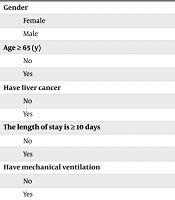
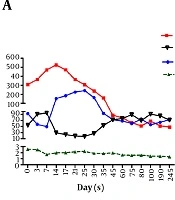
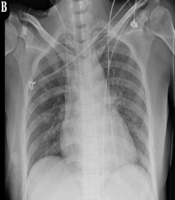
On July 31, 2019, a 76-year-old woman was admitted to our institution with the diagnosis of decompensated cirrhosis (Table 1). She received comprehensive therapy, including supportive care, symptomatic treatment, and empirical anti-infective therapy with intravenous cefmetazole 1 g every 12 h (Table 2). The patient signed an informed consent form, and ethical considerations were in agreement with the institutional and/or national research committee guidelines. In the afternoon of hospital day 14 (August 13, 2019), the patient showed fever “off and on” up to 39.0°C, chills, and cough with white sputum. Chest CT on hospital day 15 showed evidence of pneumonia with streaky opacities and edema in both lungs (Figure 1), and wet rales were noted in both lungs at auscultation. Serial laboratory examinations showed elevated infection indices, including WBC 9.96 × 10⁹/L, neutrophil 79.2%, C-reactive protein (CRP) 40.82 mg/L, procalcitonin 1.04 ng/mL, and IL-6 149.4 pg/mL. Viral IgM was negative for adenovirus, respiratory syncytial virus, influenza virus, and parainfluenza virus. After consultation with doctors from the Departments of Respiratory Medicine, Gastroenterology, Pharmacy, and Infection, bacterial pneumonia was diagnosed.
Table 1.
Laboratory Indices Associated with Infection During Hospitalization
| Date | WBC, × 109/L | Neutrophil, % | CRP, mg/L | PCT, ng/mL | IL-6, pg/mL |
|---|---|---|---|---|---|
| 20190801 | 8.02 | 49.8 | |||
| 20190805 | 10.04 | 50.5 | |||
| 20190807 | 14.64 | 83.4 | |||
| 20190812 | 6.35 | 56.5 | 29.43 | ||
| 20190814 | 9.96 | 72.2 | 40.82 | 1.04 | 149.4 |
| 20190816 | 12.43 | 79.7 | 93.87 | 2.47 | 341.9 |
| 20190819 | 12.18 | 86 | 137.54 | 2.96 | 878.8 |
| 20190821 | 13.48 | 87.9 | 127.33 | 2.96 | 2026 |
| 20190824 | 7.96 | 88 | 135.7 | 4.25 | 805.5 |
| 20190825 | 5.07 | 85.7 | 135 | ||
| Normal value | 3.50 - 9.50 | 40.00 - 75.00 | 0 - 10 | 0 - 0.05 | 0 - 7 |
Table 2.
Antibiotic Use During Hospitalization
| Drug Name | Dose, g | Frequency | Start Date | Stop Date |
|---|---|---|---|---|
| Cefmetazole | 1 | bid | July 31 | August 14 |
| Imipenem/cilastatin | 1 | q8h | August 14 | August 26 |
| Linezolid | 0.6 | q12h | August 16 | August 20 |
| Moxisaxin, 250 mL | 0.4 | qd | August 20 | August 23 |
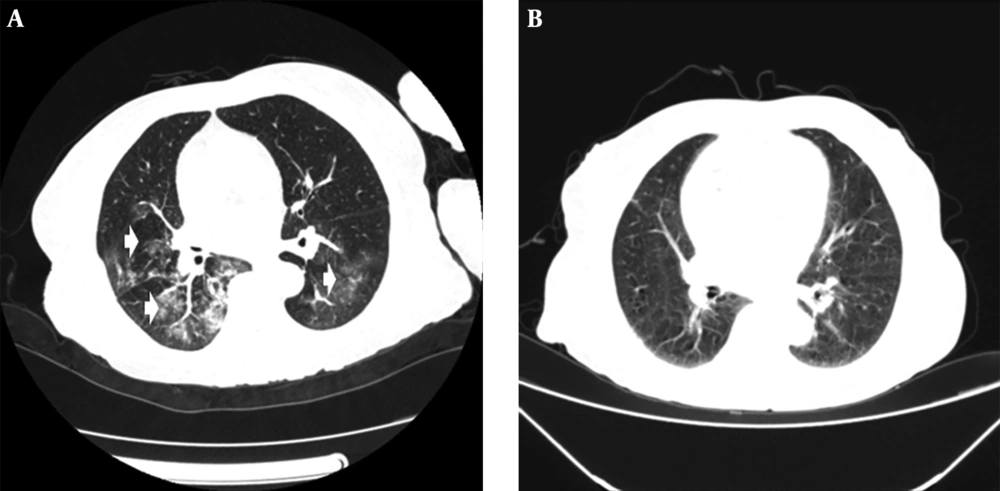
Figure 1.
Chest CT. A, On August 5. The CT scan revealed no active lung lesion; B, on August 16. The CT scan revealed pneumonia with streaky opacities and edema in the lower lobe of both lungs.
Subsequently, treatment with imipenem/cilastatin (1 g administered intravenously every eight hours) was initiated on day 14, and linezolid (0.6 g administered intravenously every 12 hours) was initiated on day 16. On hospital day 20 (after a four-day course of imipenem/cilastatin and linezolid treatment), the patient showed aggravated chest tightness and shortness of breath, with the highest body temperature of 38.5°C, showing elevated laboratory test results such as WBC 12.18 × 10⁹/L, CRP 137.54 mg/L, and procalcitonin 2.96 ng/mL. Alternatively, the patient received an intravenous therapy consisting of 0.4 g of moxifloxacin every 24 hours and 1 g of imipenem/cilastatin every eight hours. After three days, the patient’s infectious condition significantly improved. Her cough and expectoration clearly decreased, body temperature dropped to 37.8°C, and WBC was normalized to 7.96×10⁹/L. However, the patient began to demonstrate prodromal symptoms of hepatic encephalopathy such as agitation and somnolence. This might be attributed to adverse events of moxifloxacin. Thereby, moxifloxacin was discontinued, and the patient only received imipenem/cilastatin therapy. Two days later, body temperature again returned to 38.7 °C, indicating a failure to control the infection.
3. Discussion
This case report describes the clinical use of moxisaxin for a patient with decompensated cirrhosis who developed hospital-acquired pneumonia. The patient treatment started with MDR covering strategies, but the initial therapy failed. Following moxisaxin treatment, she experienced rapid and significant improvement in clinical symptoms. At this time, she showed mild hepatic encephalopathy, and moxisaxin was discontinued. Subsequently, her infectious indices rapidly elevated. Thus, moxisaxin in this patient showed good antibacterial efficacy, and her hepatic encephalopathy might have caused by moxisaxin administration.
Two types of empirical antibiotic strategies are considered in patients with decompensated cirrhosis (1, 4). The first approach is the classical strategy using first to third-generation cephalosporins, quinolones, or amoxicillin-clavulanic acid. The second approach is the MDR covering strategy, including piperacillin/tazobactam, carbapenems, or ceftazidime/cefepime + glycopeptides (linezolid). As a whole, MDR covering strategies exhibit better efficacy than classical schemes because of the emergence of MDR bacteria (6).
Moxifloxacin is a fourth-generation fluoroquinolone with great antibacterial efficacy (7). Apart from Gram-negative bacteria and Gram-positive bacteria, moxisaxin also confers resistance to atypical pathogens (Mycoplasma pneumoniae, Chlamydia pneumoniae, Legionella pneumophila, etc.). Given the negative bacterial culture, the patient may be infected with atypical pathogens. Therefore, reasonably, moxisaxin showed better antibacterial efficacy than imipenem/cilastatin + linezolid. Moxifloxacin is recommended in clinical practice guidelines as an empirical antibiotic treatment for bacterial infections in patients with cirrhosis (4). However, moxifloxacin has the potential of neurotoxicity, mental disorders induction, and hepatotoxicity. Furthermore, there is a lack of clinical safety data on moxifloxacin in the treatment of decompensated cirrhosis, especially in child-Pugh C patients. As a result, moxifloxacin administration may lead to hepatic encephalopathy in these patients.
3.1. Conclusions
There is preliminary evidence that moxisaxin administration contributes to effective antibacterial therapy in patients with decompensated cirrhosis who develop hospital-acquired pneumonia. However, because of a lack of drug safety data in patients with child-Pugh C classification of hepatic cirrhosis, moxifloxacin should be used with caution. Thus, more data are needed to evaluate antibacterial efficacy and hepatotoxicity before moxifloxacin is used as empirical antibiotic therapy for these patients.