
1. Background
Cutaneous leishmaniasis is the most common type of leishmaniasis globally, often caused by three parasitic species, Leishmania tropica, L. major, and L. infantum. The disease is endemic in 88 countries, and its prevalence is higher in tropical and subtropical regions, so that it is among the six most common diseases in these regions (1-5). Zoonotic cutaneous leishmaniasis accounts for most leishmaniasis cases in Iran [14]. Leishmaniasis is endemic in many parts of the Islamic Republic of Iran. This disease is common in most parts of Iran from north to south and east to west. Recently, new outbreaks have been reported in the east of the country, including the villages of Neishabour [15]. Although cutaneous leishmaniasis is a malignant and non-fatal disease, it is a health problem in Iran due to skin lesions and their effects on the body, especially in children. Cutaneous leishmaniasis occurs in dry and wet forms and has a wide range of clinical symptoms. Humans and dogs in urban areas and rodents in rural areas are the main reservoirs of this disease (6, 7).
Sandflies transmit Leishmania parasites to the hosts through infected bites, causing leishmaniasis (8). The primary vector of dry cutaneous leishmaniasis is Phlebotomus sergenti, and that of wet cutaneous leishmaniasis is P. papatasi (5, 7). Mosquito bites lead to the transmission of the Leishmania parasite to the skin, which eventually causes wounds due to the multiplication and growth of the parasite in macrophages. Wounds last for six to 18 months and heal in the end by leaving a scar (8). Annually, about 700,000 to 1,300,000 new cases and 20,000 to 30,000 deaths occur in the world due to cutaneous leishmaniasis, 95% of which is in the Mediterranean, Middle East, and Central Asia, and about two-thirds in six countries: Afghanistan, Iran, Brazil, Iraq, Syria, and Algeria (2, 6). Cutaneous leishmaniasis is one of Iran's most common vector-borne diseases and is the second most common vector-borne disease after malaria. About 20,000 new disease cases are reported annually in Iran, but estimates show that the actual number is about 80,000 to 100,000 (8-11). The disease incidence in Iran is estimated to be about 28 per 1000 people, with the highest rate in the eastern regions of the Caspian Sea, southern, southeastern, and central regions of the country (7, 12-14).
Various factors affect leishmaniasis incidence, including climate change, environmental conditions, occupation, gender, and vegetation (1, 15). Climate change, reduced rainfall, dam construction, drying of rivers, deforestation, declining vegetation, agricultural expansion, migration to cities, and suburbanization have led to the transmission of the leishmaniasis parasite and the spread of the disease in these areas. Working in open spaces and animal husbandry is the other factor affecting the exposure to the disease vector and incidence (16-21). In general, this disease lasts for six to 18 months. Although the disease treatment is done locally and systemically, the person is faced with the consequences and drug side effects such as arrhythmia, increased liver enzymes, anemia, thrombocytopenia, and leukopenia. However, treatment is ineffective in resistant cases (6, 9, 22). Therefore, adequate measures are essential to prevent the disease, which requires the identification of at-risk groups and the epidemiology of the disease in these areas.
Fars province is one of the endemic areas of cutaneous leishmaniasis in Iran. In recent years, the incidence of this disease has ranked first or second (2). Various factors such as urbanization, migration, climate change, and drought have affected the incidence of this disease in the province. Studies in Fars province have shown that Shiraz, Marvdasht, Lar, Khonj, and Arsanjan counties have high risks and are the endemic foci of cutaneous leishmaniasis in Fars province (23). Jahrom city is located in the south of Fars province and is considered a hypo-endemic area of the disease in this province. The disease incidence in this city is reported between 41- 135.6% of a per 100000 people, but due to its proximity to endemic areas, including Lar, Shiraz, and Zarrin Dasht counties, there is a risk of increasing the incidence of the disease and becoming an endemic area (24). As a result, it is necessary to study and be aware of the epidemiology of the disease in this city.
2. Objectives
The present study was conducted to investigate the epidemiology of cutaneous leishmaniasis in Jahrom city between 2015 and 2019 to determine the epidemiological status and groups at risk of the disease, take effective health measures, and prevent or reduce its prevalence.
3. Methods
3.1. Study Area
This descriptive-analytical study was performed to evaluate the epidemiology of cutaneous leishmaniasis in Jahrom city between 2015 and 2019. Jahrom city in the south of Fars province has a population of 186,269 people, a warm climate, and latitude and longitude of 28°3' N and 53°3' W, located 1050 meters above the sea level.
3.2. Data Collection
To collect information, we referred to the Communicable Diseases Unit of Jahrom City Health Center and examined all Jahrom city residents diagnosed with cutaneous leishmaniasis based on smear tests and clinical manifestations between 2015 and 2019. The required data, including the patient's age, gender, residence place, travel history, date of diagnosis, date of symptom onset, and the lesion location, were evaluated.
3.3. Data Analysis
The chi-square test in SPSS V.22 was used for comparing the proportion of cutaneous leishmaniasis between different gender groups, age groups, residency statuses (rural and urban), and seasons.
4. Results
A total of 584 patients with cutaneous leishmaniasis registered in Jahrom Health Center between 2015 and 2019 were included in the study. According to the findings, the highest proportion occurred in 2015 and the lowest in 2016. The majority of the patients aged 0 - 40 years, and the highest proportion was seen in the category of 0 - 10 years (28.8%). Cutaneous leishmaniasis was more common in autumn (38.7%) and winter (36.5%) and among city residents (65.7%) (Table 1). The chi-square test showed a significant difference between age groups (P = 0.03), autumn and winter seasons (P = 0.002), and urban and rural inhabitants (P = 0.002) (Table 1).
Table 1.
Demographic Characteristics of Cutaneous Leishmaniasis in Patients in Jahrom City Between 2015 and 2019
| Variables | Frequency | Percent | P Value |
|---|---|---|---|
| Year | 0.03 | ||
| 2015 | 180 | 30.8 | |
| 2016 | 88 | 15.1 | |
| 2017 | 117 | 20.0 | |
| 2018 | 108 | 18.5 | |
| 2019 | 91 | 15.6 | |
| Age | 0.03 | ||
| < 10 years | 168 | 28.8 | |
| 11 - 20 years | 96 | 16.4 | |
| 21 - 30 years | 107 | 18.3 | |
| 31 - 40 years | 79 | 13.5 | |
| 41 - 50 years | 50 | 8.6 | |
| 51 - 60 years | 45 | 7.7 | |
| > 60 years | 39 | 6.7 | |
| Season | 0.001 | ||
| Spring | 63 | 10.8 | |
| Summer | 82 | 14.0 | |
| Autumn | 226 | 38.7 | |
| Winter | 213 | 36.5 | |
| Residence | 0.002 | ||
| Rural | 200 | 34.3 | |
| Urban | 383 | 65.7 |
In this study, 59.4% of the patients were males, and 40.6% were females. There was a significant difference in the proportion of cutaneous leishmaniasis between genders (P = 0.01). There was a statistical difference between the years studied, and in all years, the disease proportion was higher in males than in females. Among patients with travel history, 38% were females, and 61.2% were males. There was a statistically significant difference between them (Table 2).
Table 2.
Frequency of Cutaneous Leishmaniasis Based on Gender in Jahrom City Between 2015 and 2019
| Year and Gender | Frequency | Percent | P Value |
|---|---|---|---|
| 2015 | 0.03 | ||
| Female | 75 | 41.7 | |
| Male | 105 | 58.3 | |
| 2016 | 0.001 | ||
| Female | 31 | 35.2 | |
| Male | 57 | 64.8 | |
| 2017 | 0.03 | ||
| Female | 50 | 42.7 | |
| Male | 67 | 57.3 | |
| 2018 | 0.001 | ||
| Female | 39 | 36.1 | |
| Male | 69 | 63.9 | |
| 2019 | 0.05 | ||
| Female | 42 | 46.2 | |
| Male | 49 | 53.8 | |
| Total | 0.01 | ||
| Female | 237 | 40.6 | |
| Male | 347 | 59.4 |
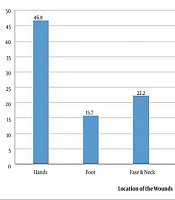
The most common sites of cutaneous leishmaniasis lesions were the hands (28.3%) and the face (24.5). In males, most lesions occurred on the hands (48.8%) and feet (24.3), but in females, most lesions were on the hands (48.7) and face (24.8). The chi-square test showed a significant difference between the sites of lesions in total patients (P = 0.001), males (P = 0.001), and females (P = 0.001) (Table 3).
Table 3.
Frequency of Lesions Caused by Cutaneous Leishmaniasis
| Site of Lesion | Frequency | Percent | P Value |
|---|---|---|---|
| Total | 0.001 | ||
| Hand | 285 | 48.8 | |
| Face | 143 | 24.5 | |
| Feet | 112 | 19.2 | |
| Body | 29 | 5.0 | |
| Hand, face, and trunk | 15 | 2.5 | |
| Male | 0.001 | ||
| Hand | 169 | 48.8 | |
| Face | 57 | 16.5 | |
| Feet | 84 | 24.3 | |
| Body | 22 | 6.4 | |
| Hand, face, and trunk | 14 | 4.0 | |
| Female | 0.001 | ||
| Hand | 116 | 48.7 | |
| Face | 55 | 23.1 | |
| Feet | 59 | 24.8 | |
| Body | 7 | 2.9 | |
| Hand, face, and trunk | 2 | 0.5 |
5. Discussion
Cutaneous leishmaniasis is spreading nearly all over Fars province and is a serious and increasing public health problem in Jahrom. According to the findings, the highest proportion of disease occurred in 2015 and the lowest in 2016 and then 2019. This study aimed to analyze the epidemiological data of cutaneous leishmaniasis in Jahrom city of Fars province during 2015 - 2019. In this study, a total of 584 patients with cutaneous leishmaniasis were referred to urban and rural health centers in Jahrom to be treated. This disease has a different prevalence in different years and seems to be a public health problem in this city. According to the present study, the average prevalence of cutaneous leishmaniasis in Jahrom city was 55 per 100,000, which according to the existing studies, is about twice the average prevalence of the disease in Iran (27.5 per 100,000) (2). A 10-year study of the disease incidence by Rahmanian et al. from 2006 to 2014 showed that the highest number of cases belonged to 2006 (1,200 cases) and the lowest to 2010 (90 cases), but then it increased in 2013 (24). This indicates that the disease in this city does not have a constant trend. Most cases of cutaneous leishmaniasis occurred in the age group of fewer than 10 years.
In the study conducted in Marvdasht city, most cases belonged to the age group of 15 - 30 (25). The highest incidence was in the age group of 10 to 30 years in Isfahan and 15 - 24 years in Andimeshk (9, 15). Also, the highest incidence of the disease occurred in the age group under 10 years in Khorasan Razavi, 10 to 30 years in Khatam city, and 15 - 24 years in Hamedan (9, 20, 26). In the study of Norouzinezhad et al. in Iran, the disease prevalence was higher in the age group under 15 years (2). In the study of Rahmanian et al., who studied the 10-year trend of cutaneous leishmaniasis in Jahrom city, the disease incidence was higher in the age group over 30 years (24). People become relatively immune in endemic areas of cutaneous leishmaniasis due to past infections. As a result, younger age groups are less susceptible to the disease due to their immunity.
In this study, the proportion of cases was higher in men than in women. In the study of Nilforouzadeh et al. in Isfahan, the disease proportion was higher in men (61.8%) than in women (38.2%) (12). In the Almasi Hashiani et al. study in Marvdasht, 60.2% of the patients were males, and 39.8% were females (25). The other male prevalence rates are 64.1% in Ilam (2012), 56% in Andimeshk (2013), 52% in Khorasan Razavi (2013), 61% in Khatam (Yazd), and 93.8% in Hamedan. These differences were statistically significant (9, 22, 28-30). In the study of Jorjani et al. in Golestan, the disease proportion was higher in men (56.7%) (27). Among the most common causes of the disease in men, we can mention their outdoor employment, less clothing, and body exposure to the disease vector, while the disease in women can be due to the high spread of the disease vector. In the present study, most disease cases belonged to urban residence. In Hamedan and Isfahan, the proportion of the disease was higher in urban areas than in rural areas (12, 26). In Norouzinezhad et al.'s study in Iran, the disease prevalence was higher in urban areas (2). In the study of Jorjani et al. in Golestan, the disease prevalence was higher in rural areas (81.5%) than in urban areas (27). Among the reasons for the increased disease in urban areas are the migration of people from rural to urban areas, drought, and creating a suitable environment for the growth of the disease reservoir and vector in the city.
It is worth mentioning that most cases of the disease were observed in autumn and winter in the present study. In a study conducted in Marvdasht (2011), most cases of the disease occurred in autumn (53.7%) (25). In the study of Jorjani et al. in Golestan, disease prevalence was higher in autumn (27). Also, in studies conducted in Isfahan, Andimeshk, and Khatam city, most disease cases occurred in autumn in October, November, and December, which was statistically significant (12, 20, 28). Because there is usually a commune period of several months between the bite of the disease vector and the onset of symptoms, and most of the time, the vector is active in the spring, most symptoms appear in the fall. According to the findings of our study, most cutaneous leishmaniasis lesions were on the hands and the least on the trunk. In the study of Mohammadi et al. in Marvdasht (2018), most lesions were on the hand (76.18%) (29). In Isfahan, most lesions were on the hand and the least on the trunk (12). In Ilam, most lesions were on the hands (52%) and the least on the trunk (3.6%), which was statistically significant (30). In Andimeshk, the most common site of lesion was on the hands and then on the legs (28). In Lamerd, the most and the least organs involved with lesions were the hands and trunk, respectively (27). In Hamedan, the most involved organs were the hands and feet (71.6%) (26). Because the leishmaniasis vector cannot bite through clothes, it usually affects uncovered limbs, especially the hands, legs, and face.
The limitations of the present study are the migration of the patients to other cities, infection of people due to travel to other parts of the country, unknown location of patients at the time of mosquito bites, and failure of some patients to refer to the Jahrom City Health Center for treatment.
5.1. Conclusions
According to the findings, cutaneous leishmaniasis infection was higher in younger age groups, men, urban dwellers, and autumn in Jahrom city. The most common lesions were on the hands, feet, and face. Therefore, it is necessary to pay attention to the risk groups and perform disease control interventions such as indoor and outdoor residual spraying in the appropriate season to control the disease.