1. Introduction
Legionella species are facultative intracellular Gram-negative bacilli that present in natural water sources, man-made water systems, and pot humid soil. These bacteria could infect and multiply in both phagocytic protozoa and within mammalian professional phagocytes and epithelial cells (1). Up to now, 53 species and 70 serogroups of Legionellaceae have been described (2), which Legionella pneumophila serogroup O1 has been known as the most prevalent of Legionnaires’ disease (LD) among the 15 recognized L. pneumophila serogroups (3). The reports have shown that 1% - 5% of community acquired pneumonia (CAP) as well as up to 30% of nosocomial acquired pneumonia caused by Legionella species (4, 5).
Legionnaires’ disease may occur in the community or in hospitals. The mortality rate can approach 50% in immunocompromised patients (6). Pontiac fever is a mild, self-limiting flu-like illness caused by Legionella species but unlike LD, Pontiac fever does not involve the lower respiratory tract (7). There are many risk factors, which have been associated with LD and some of them are age, chronic lung disease, diabetes, malignancy, immunosuppression, immunocompromised diseases and smoking (8). Since the pneumonia caused by Legionella does not show the unique presentation, so for confirmation of the LD the laboratory tests are necessary. Although Legionellae culture remains the gold standard among the diagnostic methods for LD, the sensitivity of the culture method for Legionella species has been estimated to be approximately 60%, which depends on the type of clinical samples (9). Legionella are fastidious, slow growing bacteria (colonies appear after 3 to 4 days) and require to be cultured in selective and nonselective media (10).
Polymerase chain reaction (PCR) is a high sensitive and faster method than culture, which has been used for detection of the Legionellae bacteria in specimens from the lower respiratory tract (11). However, the rapid diagnosis of LD by detection of the soluble L. pneumophila serogroup 1 antigen in urine samples is effective in early treatment decisions. The urinary antigen (UAG) test has proven to be the much sensitive and easy diagnostic method. Legionella antigen in urine is detectable one day after onset of the disease, and persists for days to weeks (9). Peptidoglycan-associated lipoprotein (PAL) of L. pneumophila is a conserved antigen among Legionella species and is considered as a powerful diagnostic antigen in urine (12).
2. Objectives
The aim of this study was to detect the LD agents in clinical specimens of patients with respiratory symptoms referred to Ahvaz teaching hospitals by culture, urinary antigen and PCR of the 16SrRNA gene.
3. Methods
In this study, a total of 200 specimens (100 urine and 100 respiratory samples, including 94 sputum samples and 6 pleural fluid specimens) were collected from patients hospitalized in Ahvaz teaching hospitals (65 specimens from Imam Khomeini Hospital and 25 specimens from Razi hospital) between May 2015 and January 2016.
This study was approved by the ethics committee of Ahvaz Jundishapur University of Medical Sciences, Ahvaz, Iran (code: IRAJUMS. RES. 1394. 263). Informed consent was obtained from all patients before the study began. Clinical examinations of the patients by an infectious disease specialist showed that the patients were affected to acute respiratory symptoms (20 cases), pneumonia (71 cases), and bronchiectasis (9 cases).
3.1. Culture
Each respiratory specimen was aliquoted in two parts, one part inoculation to the culture media and another part was stored at -70°C until PCR accomplishment. The sputum specimens were decontaminated by heat treatment (56°C for 30 minutes), pleural fluid samples were concentrated by centrifugation (13, 14).
The prepared specimens were inoculated to a nonselective media as the buffered charcoal yeast extract (BCYE) agar and a selective media as modified Wodowsky and Yee (MWY) with the supplementary materials (Mast Group Ltd., Merseyside., UK). The plates were incubated at 37°C and about 90% humidity in 3% - 5% CO2, for up to 2 weeks. All cultures were inspected daily. The Legionella suspected colonies were examined by Gram staining, catalase and oxidase tests and then the Gram-negative bacilli were inoculated to the MWY agar, blood agar (Merck, KGaA, Darmstadt, Germany), and eosin methylene blue (EMB) Agar (Merck, KGaA, Darmstadt, Germany). Colonies that grew on the MWY agar but not on the blood agar and EMB agar were identified as Legionella spp. (13).
3.2. Extraction of DNA from Respiratory Samples
DNA extraction was performed with the high pure PCR template preparation kit (Roche, Mannheim, Germany) according to the manufacturer’s instructions. The concentration of the extracted DNA was measured by a photobiometer (Eppendorf, Germany) in 260/280 nm UV long waves.
3.3. DNA Amplification
The PCR master mix was prepared in each 50 μL reaction containing 5 μL in 10X PCR buffer, 1 μL of dNTP mix (10 mM), 3 μL MgCl2 (50 mM), 2μL of each primer (10 μM) TAG, A/S Denmark (Table 1), 0.5 μL of Taq DNA polymerase (5 U/μL), 5 μL of DNA template and 31.5 μL of distilled water.
Table 1.
Primers of the 16S rRNA Gene of Legionella pneumophila
| Gene | Primer Sequences | Product Size, bp | References |
|---|---|---|---|
| 16S rRNA | JFP-5ˊ -AGGGTTGATAGGTTAAGAGC-3ˊ | 386-bp | (13) |
| JRP-5ˊ-CCAACAGCTAGTTGACATCG-3ˊ |
DNA amplification was performed in a thermocycler (Eppendorf, Germany) under conditions of initial denaturation at 94°C for 3 minutes, followed by 35 cycles of denaturation at 94°C for 30 seconds, annealing at 55°C for 30 seconds, extension at 72°C for 30 seconds and a final step of extension at 72°C for 5 minutes.
3.4. Electrophoresis
The PCR product was electrophoresed on 1.5% agarose gel (SinaClon BioScience Co, Iran) in 1X buffer Tris/ borate/ EDTA buffer (SinaClon BioScience Co, Iran) at 120V for 60 minutes. The DNA was stained with the DNA safe stain (SinaClon BioScience Co, Iran) and photography of DNA amplified was performed in a gel documentation system (Viber company, French). In this study, L. pneumophila serogroup 1 (ATCC 33152) and distilled water were used as positive and negative controls, respectively.
3.5. Detection of Urinary Antigen
The urine specimens were analyzed for the detection of urinary antigens of L. pneumophila serogroup 1 using a commercially kit (Legionella V-Test, Coris BioConcept, Gembloux Belgium) according to the manufacturer’s instructions. When the urine specimen migrates across the collector pad, the conjugate is rehydrated and migrates alone with the sample. Positive specimens react with the anti- L. pneumophila conjugate to form a red line at the test line region of the strip (Upper line). The results were read within 15 minutes.
4. Results
In this study, a total of 200 specimens (including 100 urine and 100 respiratory samples) collected from patients with acute respiratory symptoms (59 males and 41 females) were examined. The mean age of the patients was 54 years (range 15 to 93 years).
The results of this study showed that 5% of the urine specimens and 3% of the respiratory specimens were positive for L. pneumophila using the Coris Legionella V-test kit and PCR of 16S rRNA gene, respectively. However, Legionella spp. strains were isolated from 1% of the respiratory samples by culture. Based on these results, LD was detected in 5 patients (3 males and 2 females) by the urinary antigen test, while the culture and PCR results of respiratory samples were positive for 1% and 3% of these patients, respectively (Figure 1).
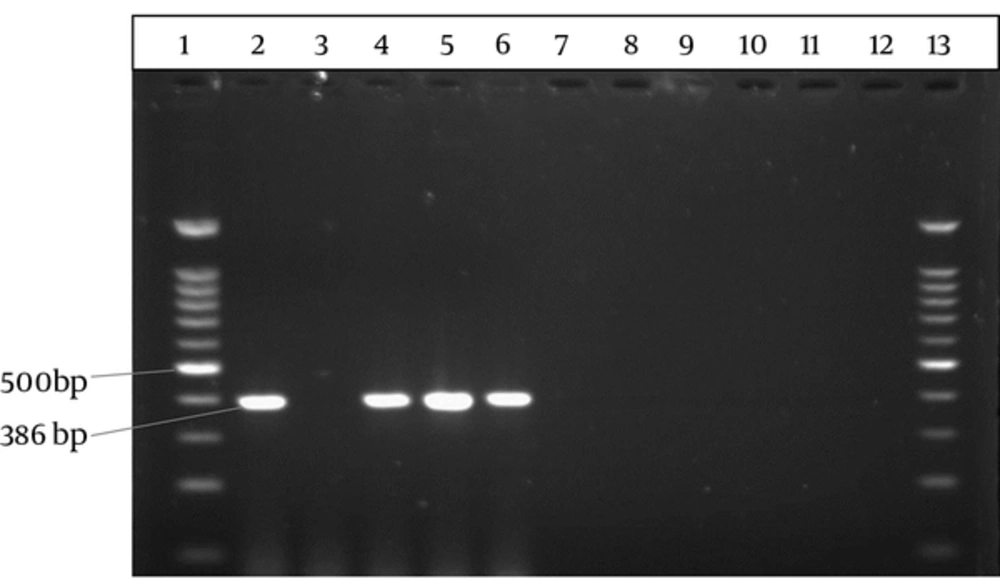
Figure 1.
Lanes 1 and 13, 100 bp DNA size marker (SinaClon BioScience Co, Iran); lane 2, positive control: L. pneumophila ATCC 33152; Lane 3, negative control: distilled water; lanes 4 - 6, Positive samples, and lanes 7 - 12, negative samples.
The results of this study showed that of 75 patients hospitalized in Imam Khomeini hospital, Ahvaz, 4 patients had LD and the presence of L. pneumophila in the urine of these patients was validated by the urinary antigen test. However, the identification of Legionella were confirmed by PCR in only 2 of these patients, while their culture results were negative. Also, from a total of 25 patients hospitalized in Razi Hospital, Ahvaz, 1 patient had LD and the presence of Legionella in the sputum and urine sample of the patient was confirmed by the culture, PCR and urinary antigen test (Table 2).
Table 2.
Frequency of Patients with the Legionnaire’s Disease Based on Isolation and/or Identification of Legionella pneumophila by Culture, PCR and UAG Methods
| Hospital | Patients | Culture | PCR | UAG |
|---|---|---|---|---|
| Imam Khomeini | 75 | 0 | 2 (2.7%) | 4 (5.3%) |
| Razi | 25 | 1 (4%) | 1 (4%) | 1 (4%) |
| Total | 100 | 1 (1%) | 3 (3%) | 5 (5%) |
Abbreviations: PCR, polymerase chain reaction; UAG, urinary antigen.
5. Discussion
Legionella species are ubiquitous in water sources and transmitted via water through the inhalation of contaminated aerosol of water (15). Legionnaires’ disease is a severe pneumonia but these infections are seldom recognized. Also, LD occurs both sporadically and in epidemic forms, and if treated improperly can lead to increased morbidity and mortality (12).
Isolation of Legionella species from clinical specimens by culture has been known as the gold standard test for many years (13). Legionella species are nutritionally fastidious and not easily growing on the culture media. They require the growth factors such as cysteine and Fe++ ion, which should be added to the media (7). Culture diagnosis requires proper processing of samples, selective medium, and technical skill (5).
Polymerase chain reaction is a very useful method for the detection of Legionella spp. (16). However, differentiation between living and dead Legionella cells is not possible by the PCR techniques (17). The detection of soluble Legionella antigen in patient's urine was discovered after outbreak of the severe acute pneumonia in Philadelphia convention in 1976 (18), which has been found significant in recent years (9). Urine antigen testing is very useful for patients who cannot produce sputums. The sensitivity and speciality of introduced techniques for detection of the urinary antigen of L. pneumophila serogroup1 have reported variable between 70% - 100% (for sensitivity), and 100% (for speciality) (12).
Chen et al. (2015) showed that the sensitivity of the used tests for detection of L. pneumophila in clinical specimens was highest for UAG, PCR and culture tests, respectively (19). Our results showed that rapid detection of L. pneumophila, serogroup1 as the agent of LD is possible by the Coris Legionella V-test kit with the highest sensitivity. However, detection of the 16SrRNA gene of L. pneumophila by PCR demonstrated the good sensitivity (60%), which was more than the culture and isolation of Legionella (25%) from clinical specimens. Lower sensitivity of the culture in detection of the LD agent in clinical specimens might be related to the antibiotic therapy of the patients (20).
Bencini et al. (2007) reported Legionellosis can be diagnosed by PCR of the sputum specimens. This report showed that the 16SrRNA gene PCR is preferred for the detection of LD caused by L. pnemophila (21). Comparison between PCR and culture in diagnosis of the L. pneumophila in bronchoalveolar lavage fluid specimens was reported by Hajia et al. (2004). This study showed one positive for the culture and four for the specific Legionella PCR (20).
The specificity of three different methods for detection of the L. pneumophila in our study was 100%. Statistical analysis (SPSS version 21, and the Chi-square test) showed a significant difference (P < 0.05) between UAG, PCR and culture results of total clinical specimens, which obtained from Imam Khomeini and Razi hospitals. There was no significant difference (P > 0.05) between LD and variables such as age and gender in our study. Of the 5 patients with positive urine samples, 3 patients were positive for L. pneumophila in sputum samples by PCR, and 1 patient was positive by culture.
5.1. Conclusions
The detection of the soluble antigen of the L. pneumophila serogroup 1 in urine by an enzyme immunoassay (EIA) kit has proven as a rapid detection and more sensitive than PCR and culture for detection of L. pneumophila in respiratory specimens.