1. Background
Chronic obstructive pulmonary disease (COPD) is a progressive inflammatory airway disorder marked (1, 2) by irreversible airflow limitation, often exacerbated by repeated infections (1, 3). With the global burden of COPD rising, it has become increasingly clear that patients are at heightened risk of opportunistic infections due to chronic lung remodeling, frequent antibiotic exposure, corticosteroid use, and compromised mucosal immunity (4, 5). Among these infections, invasive pulmonary aspergillosis (IPA) has emerged as a life-threatening fungal complication, particularly in hospitalized or immunocompromised COPD patients, with reported mortality rates as high as 70 - 95% in untreated or misdiagnosed cases (6, 7). The IPA is primarily caused by Aspergillus fumigatus, a ubiquitous environmental mold capable of producing airborne conidia that, upon inhalation, can colonize and invade pulmonary tissues (8).
In susceptible hosts, including COPD patients, damaged epithelial barriers and impaired alveolar macrophage function facilitate fungal hyphal growth and angioinvasion. Aspergillus fumigatus is responsible for most IPA cases, although other species such as A. flavus, A. terreus, and A. niger are increasingly recognized, particularly in cases involving antifungal resistance (9, 10). The emergence of azole-resistant Aspergillus strains is a growing concern, underscoring the need for timely diagnosis, species-level identification, and appropriate antifungal susceptibility testing (AST).
Voriconazole, a triazole antifungal agent, remains the first-line treatment for IPA (11, 12). It inhibits fungal cytochrome P450-dependent 14α-sterol demethylase, disrupting ergosterol synthesis and fungal membrane integrity (13). The Individualized Drug Administration Guidelines for Voriconazole in China recommend monitoring steady-state blood trough concentrations, maintaining them at 0.5 - 5.0 mg·L-1, and adjusting dosage based on adverse events and clinical response (14). However, voriconazole’s pharmacokinetics exhibit significant interindividual variability due to nonlinear metabolism, hepatic cytochrome P450 polymorphisms, and drug-drug interactions.
As such, therapeutic drug monitoring (TDM) is strongly recommended to maintain trough plasma concentrations within a therapeutic window (typically 1.0 - 5.0 µg/mL) to balance efficacy with hepatotoxicity and neurotoxicity risks (14). Despite this, the clinical correlation between voriconazole trough levels and toxicity profiles in COPD-related IPA remains underexplored. Beyond antifungal therapy, restoring host immune competence is increasingly recognized as essential for improving IPA outcomes. The COPD patients often exhibit altered T-cell subsets, impaired macrophage activation, and persistent pro-inflammatory cytokine profiles, all of which contribute to fungal persistence and host tissue damage (15, 16). Thymosin alpha 1 (Tα1) is an endogenous thymic peptide with immunomodulatory properties shown to enhance T-cell maturation, antigen presentation, and macrophage function (17, 18). It has demonstrated clinical benefit in viral and fungal infections, particularly in immunocompromised individuals, but its role in the management of IPA in COPD remains inadequately studied. Previous studies have suggested that adjunctive immunotherapy may enhance antifungal efficacy and reduce inflammation in IPA (19, 20). However, there is limited microbiologically-focused research addressing how Tα1 modulates the host immune response, inflammatory cytokines, and antifungal outcomes when combined with voriconazole in COPD patients. Therefore, the present study aimed to: Evaluate the clinical efficacy of sequential Tα1 plus voriconazole therapy versus voriconazole monotherapy in COPD patients with IPA; Assess changes in peripheral blood immune cell subsets including CD3+, CD4+, CD8+, CD4/CD8 ratio and key pro-inflammatory cytokines including interleukin-6 (IL-6), interleukin-8 (IL-8), and tumor necrosis factor-α (TNF-α); Analyze the association between voriconazole blood trough concentrations and adverse drug reactions (ADRs), thereby identifying a safe and effective therapeutic window.
2. Objectives
By integrating clinical, pharmacokinetic, and immunological assessments, this study seeks to fill an important knowledge gap at the intersection of antifungal therapy and host immune modulation in COPD-associated invasive aspergillosis.
3. Methods
3.1. General Data
This was a case-control study that enrolled 100 hospitalized patients with COPD complicated by IPA, admitted to Minzu Hospital of Guangxi Zhuang Autonomous Region between February 2023 and February 2024. The COPD was diagnosed according to the Global Initiative for Chronic Obstructive Lung Disease (GOLD) 2023 guidelines (21), while IPA was classified based on the 2024 Chinese Expert Consensus criteria and the European Organization for the Research and Treatment of Cancer/Mycoses Study Group Education and Research Consortium (EORTC/MSGERC) definitions (22), with modifications appropriate for non-neutropenic patients.
3.2. Diagnostic Criteria
(1) Host factors included: A history of invasive pulmonary fungal infection; continuous use of glucocorticoids, including inhaled glucocorticoids, for more than 3 weeks; trauma, major surgery, prolonged stay in the intensive care unit (ICU), long-term use of mechanical ventilation, intravenous catheter placement, total parenteral nutrition, and long-term use of broad-spectrum antibiotics — any one of these conditions. (2) The clinical features were persistent fever, and antibiotic treatment for 96 hours was ineffective. In the early stage of chest imaging infection, there are nodular shadows with increased density beneath the pleura, as well as halo signs around the lesion. In the later stage, there are cavity shadows, crescent signs, or new infiltrative shadows appearing on the basis of the original lung lesion. (3) Microbiological examination revealed the presence of fungal hyphae in aspirated material from the trachea or in qualified sputum specimens through direct microscopic examination, and the same type of Aspergillus was isolated in consecutive ≥ 2 cultures; direct microscopic examination of bronchoalveolar lavage fluid (BALF) revealed the presence of fungal hyphae, and the same type of Aspergillus was cultured; the serum galactomannan test was positive for 2 consecutive times within 1 week.
Inclusion criteria: (1) Adults aged 40 - 80 years; (2) confirmed diagnosis of COPD and probable/proven IPA; (3) positive fungal culture or microscopy for Aspergillus; (4) complete clinical and laboratory data; and (5) informed consent obtained.
Exclusion criteria: (1) Known immunodeficiency (e.g., human immunodeficiency virus (HIV), leukemia); (2) recent systemic antifungal or immunomodulatory therapy (within 30 days); (3) active lung cancer or other malignancy; (4) allergy to Tα1 or voriconazole; (5) ethical approval was granted by the hospital's institutional ethics board.
3.3. Treatment Regimen
All patients received standard supportive care, including oxygen therapy, bronchodilators, sputum clearance, and electrolyte balance.
1. Control group (CG): Intravenous voriconazole (Hainan Poly Pharm Co., Ltd., China) 200 mg every 12 h for 3 days, followed by oral voriconazole (Pfizer Inc., USA) 200 mg twice daily for 6 weeks.
2. Observation group (OG): The same voriconazole regimen plus Tα1 (Hainan Shuangcheng Pharmaceuticals Co., Ltd., China) 1.6 mg/day by subcutaneous injection for 6 weeks.
The grouping criteria for voriconazole blood trough concentration were as follows: Blood trough concentration > 4.0 μg × mL-1 was included in the high trough concentration group, blood trough concentration between 1.0 - 4.0 μg × mL-1 was included in the medium trough concentration group, and blood trough concentration < 1.0 μg × mL-1 was included in the low trough concentration group (23).
3.4. Microbiological Methods
3.4.1. Sample Collection and Processing
Sputum (n = 74) and BALF (n = 26) samples were collected using sterile techniques before antifungal therapy. Samples were cultured on Sabouraud dextrose agar (SDA; Sigma, USA) and incubated at 35°C for up to 7 days.
3.4.2. Species Identification
Colonies displaying characteristic morphology were further identified using:
- Matrix-assisted laser desorption/ionization time-of-flight (MALDI-TOF) mass spectrometry (Bruker Biotyper, USA).
- Internal transcribed spacer (ITS) region sequencing (primers ITS1 and ITS4) for isolates with low-confidence MALDI scores (< 2.0) or atypical morphology. Sequencing results were aligned using National Center for Biotechnology Information (NCBI) Basic Local Alignment Search Tool (BLAST) and compared with GenBank reference sequences.
3.4.3. Antifungal Susceptibility Testing
Minimum inhibitory concentrations (MICs) for four antifungal agents (voriconazole, itraconazole, posaconazole, amphotericin B) were determined using broth microdilution according to Clinical and Laboratory Standards Institute (CLSI) M38-A3 guidelines (24).
- Inoculum size: 0.4 - 5 × 10⁴ colony-forming unit (CFU)/mL
- Incubation: 48 h at 35°C
- The MIC: lowest concentration yielding 100% inhibition
Interpretive breakpoints were applied per CLSI standards. Quality control strains used A. fumigatus American Type Culture Collection (ATCC) MYA-3626, Candida parapsilosis ATCC 22019.
3.4.4. Fungal Burden Quantification
Quantitative cultures were performed on serial sputum and BALF samples collected at baseline and after 6 weeks of therapy. The CFU/mL were calculated from dilution plating on SDA. Clearance was defined as culture-negative status after treatment.
3.5. Immunological and Cytokine Assays
3.5.1. Immune Cell Profiling
Peripheral blood (4 mL fasting sample) was collected before and after treatment. Lymphocyte subsets were analyzed by flow cytometry (Beckman Coulter CytoFLEX, USA) using fluorescently labeled monoclonal antibodies: CD3+ (total T-cells), CD4+ (helper T-cells), CD8+ (cytotoxic T-cells), and CD4/CD8 ratio calculated automatically.
3.5.2. Cytokine Analysis
Serum was separated by centrifugation and stored at -80°C until testing. Levels of IL-6, IL-8, and TNF-α were measured using enzyme-linked immunosorbent assay (ELISA) kits (R&D Systems, USA). Assays were performed in duplicate in accordance with the manufacturer’s protocol. Optical density was measured at 450 nm using a microplate reader.
3.6. Voriconazole Trough Level Monitoring
Plasma voriconazole concentrations were measured at steady state (after 5 days of dosing). Blood samples were collected immediately before the morning dose, and plasma levels were analyzed using liquid chromatography tandem mass spectrometry (LC-MS/MS) (25).
Patients were grouped by trough concentrations:
- Low: < 1.0 µg/mL
- Medium: 1.0 - 4.0 µg/mL
- High: > 4.0 µg/mL
3.7. Outcome Measures
1. Primary outcomes: Clinical response, fungal clearance, and immune modulation.
2. Secondary outcomes: Adverse events and inflammatory cytokine levels.
Clinical response definitions:
- Cure: Symptom resolution plus radiologic/microbiologic clearance
- Significant improvement: > 50% symptom and imaging improvement
- Effective: Partial improvement without worsening
- Ineffective: No change or worsening
3.8. Statistical Analysis
Data were analyzed using SPSS version 27.0 (IBM Corporation, USA) and GraphPad Prism 9.0 (GraphPad Software, USA).
- Continuous variables: Expressed as mean ± standard deviation, analyzed using t-test or ANOVA.
- Categorical variables: Expressed as counts/percentages, analyzed using chi-square or Fisher’s exact test.
- Kaplan-Meier survival analysis with log-rank test was used to compare adverse-event-free survival.
A P-value < 0.05 was considered statistically significant.
4. Results
4.1. Baseline Characteristics
A total of 100 COPD patients with confirmed IPA were enrolled and randomly assigned to the OG (voriconazole plus Tα1, n = 50) or the CG (voriconazole alone, n = 50). No statistically significant differences were found between groups regarding sex, age, COPD duration, COPD stage, or Body Mass Index (BMI), confirming baseline comparability (P > 0.05; Table 1).
Table 1.
Baseline Characteristics of Study Participants in Observation Group and Control Group a
| General Data | CG (N = 50) | OG (N = 50) | χ2/t | P-Value |
|---|---|---|---|---|
| Gender | 0.19 | 0.663 | ||
| Male | 36 (72.0) | 34 (68.0) | ||
| Female | 14 (28.0) | 16 (32.0) | ||
| Age (y) | 61.00 ± 6.75 | 60.70 ± 6.50 | 0.631 | 0.529 |
| COPD course (y) | 7.00 ± 1.25 | 7.10 ± 1.30 | 0.385 | 0.701 |
| COPD grading | 0.407 | 0.523 | ||
| III | 32 (64.0) | 35 (70.0) | ||
| IV | 18 (36.0) | 15 (30.0) | ||
| BMI (kg/m2) | 20.0 ± 2.01 | 19.80 ± 1.92 | 0.615 | 0.54 |
Abbreviations: CG, control group; OG, observation group; COPD, chronic obstructive pulmonary disease; BMI, Body Mass Index.
a Values are expressed as No. (%) or mean ± SD.
4.2. Adverse Drug Reactions and Voriconazole Trough Concentrations
The ADRs occurred in 17 patients, including: Ten cases of hepatotoxicity (elevated transaminases) and 7 cases of neurotoxicity (hallucinations, delirium, and insomnia). The incidence of ADRs was correlated with voriconazole plasma trough levels:
- Low trough (< 1.0 µg/mL): 3/32 patients (9.4%)
- Medium trough (1.0 - 4.0 µg/mL): 8/49 patients (16.3%)
- High trough (> 4.0 µg/mL): 6/19 patients (31.6%)
The high trough group exhibited a significantly higher ADR rate than the low trough group (P < 0.05), though the difference with the medium group was not statistically significant (P > 0.05), as shown in Table 2. All ADRs resolved with dose adjustment or supportive care; no treatment discontinuations occurred.
Table 2.
Incidence of Adverse Drug Reactions by Voriconazole Trough Level a
| Groups | No. | Skin Allergies | Hepatic Injury | Neurotoxicity | Visual Impairment | Total ADR Rate |
|---|---|---|---|---|---|---|
| Low trough group | 32 | 0 | 1 | 2 | 0 | 3 (9.38) |
| Medium trough group | 49 | 0 | 5 | 3 | 0 | 8 (16.33) |
| High trough group | 19 | 0 | 4 | 2 | 0 | 6 (31.58) |
| χ2 | - | - | - | - | - | 0.797/4.044/1.948 |
| P-Value | - | - | - | - | - | 0.372/0.044/0.163 |
Abbreviation: ADR, adverse drug reaction.
a Values are expressed as No. (%).
4.3. Clinical Efficacy
After 6 weeks of treatment, the OG demonstrated a higher clinical response rate than the CG:
- The OG: Fourteen cured, 30 significantly improved, 4 improved, 2 ineffective → 96.0% effective rate.
- The CG: Nine cured, 24 significantly improved, 7 improved, 10 ineffective → 80.0% effective rate.
This difference was statistically significant (P = 0.014; Table 3), indicating enhanced clinical efficacy with adjunctive Tα1.
Table 3.
Comparison of Clinical Efficacy Between Treatment Groups a
| Groups | No. | Skin Allergies | Hepatic Injury | Neurotoxicity | Visual Impairment | Total ADR Rate |
|---|---|---|---|---|---|---|
| Low trough group | 32 | 0 | 1 | 2 | 0 | 3 (9.38) |
| Medium trough group | 49 | 0 | 5 | 3 | 0 | 8 (16.33) |
| High trough group | 19 | 0 | 4 | 2 | 0 | 6 (31.58) |
| χ2 | - | - | - | - | - | 0.797/4.044/1.948 |
| P-Value | - | - | - | - | - | 0.372/0.044/0.163 |
Abbreviation: ADR, adverse drug reaction.
a Values are expressed as No. (%).
4.4. Immunological and Inflammatory Markers
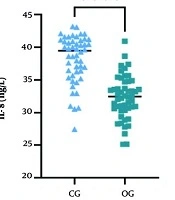
Using flow cytometry, post-treatment immune profiling revealed significant changes: CD3+, CD4+, and CD4/CD8 ratio increased significantly in the OG compared to the CG (P < 0.05). CD8+ levels decreased in the OG (P < 0.05; Figure 1). In parallel, ELISA results indicated that systemic inflammation was reduced more effectively in OG patients: Serum IL-6, IL-8, and TNF-α levels were significantly lower in the OG than in the CG (P < 0.0001; Figure 2). These findings suggest that Tα1 enhanced T-cell immune function and mitigated inflammatory response in COPD patients with IPA.
![Immune function of chronic obstructive pulmonary disease (COPD) patients complicated by invasive pulmonary aspergillosis [IPA, versus control group (CG), **** P < 0.0001]](https://brieflands.com/journals/jjm/articles/161724/figures/jjm-18-11-161724-i001-preview.webp "Immune function of chronic obstructive pulmonary disease (COPD) patients complicated by invasive pulmonary aspergillosis [IPA, versus control group (CG), **** P < 0.0001]")
Figure 1.
Immune function of chronic obstructive pulmonary disease (COPD) patients complicated by invasive pulmonary aspergillosis [IPA, versus control group (CG), **** P < 0.0001]
![Inflammation of chronic obstructive pulmonary disease (COPD) patients complicated by invasive pulmonary aspergillosis [IPA, versus control group (CG), **** P < 0.0001]](https://brieflands.com/journals/jjm/articles/161724/figures/jjm-18-11-161724-i002-preview.webp "Inflammation of chronic obstructive pulmonary disease (COPD) patients complicated by invasive pulmonary aspergillosis [IPA, versus control group (CG), **** P < 0.0001]")
Figure 2.
Inflammation of chronic obstructive pulmonary disease (COPD) patients complicated by invasive pulmonary aspergillosis [IPA, versus control group (CG), **** P < 0.0001]
4.5. Microbiological Findings
A total of 100 Aspergillus isolates were recovered (sputum: N = 74; BALF: N = 26). Species identification was conducted using MALDI-TOF mass spectrometry, with ITS sequencing for confirmation (Table 4). The AST was performed using the CLSI M38-A3 broth microdilution method. The MIC ranges and resistance rates are summarized below:
- Voriconazole: The MIC 0.25 - 2.0 µg/mL; geometric mean MIC: 0.75 µg/mL. Three percent of A. fumigatus isolates were resistant (MIC ≥ 2.0 µg/mL).
- Itraconazole: The MIC 0.5 - 4.0 µg/mL; 5% resistance
- Posaconazole: The MIC 0.125 - 1.0 µg/mL; 0% resistance
- Amphotericin B: The MIC 0.5 - 2.0 µg/mL; 1 isolate with reduced susceptibility (A. terreus).
Table 4.
Aspergillus Species Distribution and Antifungal Susceptibility a
| Species | No. of Isolates | Voriconazole MIC Range (µg/mL) | Resistance | Itraconazole Resistance | Posaconazole Resistance | Amphotericin B Resistance |
|---|---|---|---|---|---|---|
| Aspergillus fumigatus | 84 (84) | 0.25 - 2.0 | 3 | 4 | 0 | 0 |
| Aspergillus flavus | 9 (9) | 0.5 - 1.0 | 0 | 11 | 0 | 0 |
| Aspergillus terreus | 5 (5) | 0.5 - 1.0 | 0 | 0 | 0 | 20 |
| Aspergillus niger | 2 (2) | 0.5 - 1.0 | 0 | 0 | 0 | 0 |
| Total | 100 (100) | - | 3 | 5 | 0 | 1 |
Abbreviation: MIC, minimum inhibitory concentration.
a Values are expressed as No. (%) or percentage.
Baseline fungal burden was comparable across groups (mean sputum CFU/mL: 3.2 × 10⁴). After 6 weeks:
- The OG: Median CFU reduction: 92%; culture-negative status (sputum/BALF): 90% (45/50)
- The CG: Median CFU reduction: 78%; culture-negative status: 76% (38/50, P = 0.047)
Voriconazole trough concentrations > 1.0 µg/mL were associated with higher fungal clearance (86% vs. 69%, P = 0.031). No added benefit was observed with levels > 4.0 µg/mL. Patients with azole-resistant Aspergillus (n = 3) all belonged to the CG and exhibited partial responses, necessitating prolonged therapy.
4.6. Safety and Tolerability
Kaplan-Meier analysis revealed no significant difference in cumulative survival free of adverse reactions between groups (χ2 = 0.908, P = 0.341; Figure 3), confirming that the addition of Tα1 did not increase safety risks.
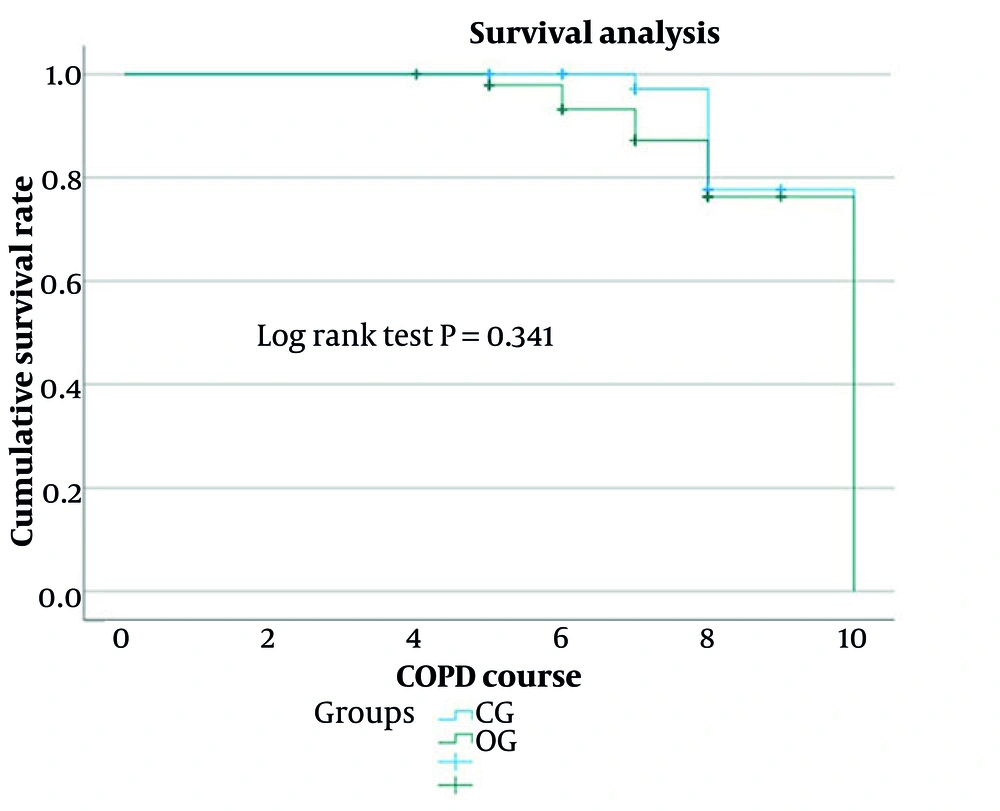
Figure 3.
Cumulative survival rate without adverse reactions in both groups
5. Discussion
The IPA remains an underrecognized but critical complication in patients with COPD, where structural lung damage and immune dysregulation create an opportunistic niche for Aspergillus species. Our study demonstrates that sequential therapy combining Tα1 with voriconazole significantly improves clinical response, immune recovery, and fungal clearance without increasing adverse events. The Tα1, an immune-enhancing drug, is widely applied in the clinical treatment of infectious diseases because of its robust immune-boosting properties and its inhibitory effect on inflammatory responses (26, 27). Importantly, this benefit was supported by microbiological data, including antifungal susceptibility profiles and reductions in fungal burden, thereby reinforcing the therapeutic value of immune augmentation in COPD-associated IPA.
We identified A. fumigatus as the predominant species (84%) among isolates, consistent with previous findings in both immunocompromised and non-neutropenic populations. Less frequent species such as A. flavus, A. terreus, and A. niger were also detected, reflecting the ecological diversity of Aspergillus in airway infections. While molecular typing was not performed, the species-level identification itself is clinically relevant, especially given the intrinsic resistance of A. terreus to amphotericin B and the emerging resistance trends in A. fumigatus. Our AST revealed low rates of azole resistance — 3% for voriconazole among A. fumigatus isolates — which aligns with recent Chinese and global surveillance studies (28, 29). However, these resistant isolates correlated with poorer clinical response and were exclusively found in patients who did not receive Tα1. This highlights the importance of routine susceptibility testing, particularly in high-risk or non-responding COPD patients, as well as the potential for adjunctive therapy to overcome host-related limitations when pharmacological eradication is compromised.
Fungal burden reduction was significantly greater in the Tα1 group, with a 92% median decrease in CFU compared to 78% in the monotherapy group. More notably, 90% of patients in the adjunctive therapy group achieved culture negativity, compared to 76% in the CG. These findings suggest that Tα1 not only enhances host immunity but may facilitate more rapid and complete fungal clearance when combined with antifungal therapy.
While voriconazole remains the cornerstone of IPA treatment, its success is partly contingent on achieving therapeutic drug levels. With increased blood trough concentration, the incidence rate of ADRs increased remarkably. The median time for patients to develop hepatotoxicity after medication was 10 days; when trough concentration exceeded 3.5 μg × mL-1, the risk of liver function damage increased (30). Voriconazole trough levels between 1.0 - 4.0 µg/mL were associated with optimal efficacy and minimal toxicity in our cohort, reaffirming current TDM guidelines. Patients with trough levels < 1.0 µg/mL had lower fungal clearance and clinical response, whereas those with levels > 4.0 µg/mL exhibited higher rates of hepatotoxicity and neurotoxicity without additional microbiological benefit (31).
This research divided COPD patients complicated by IPA into low, medium, and high trough concentration groups, and analyzed whether there were differences in the incidence of ADRs among the three groups. There were a total of 7 cases of hallucinations, dreaminess, and delirium; there was no statistical significance in the probability of central neurotoxicity between the medium trough concentration group (3 cases) and the low trough concentration group (2 cases), whereas both were lower than the high trough concentration group. This trend was similar to the increased risk of liver function damage observed in patients. It is evident that a blood trough concentration of voriconazole greater than 4.0 μg × mL-1 elevates the risk of ADRs. Thus, after initial blood trough concentration detection is completed in clinical practice, it is recommended to reduce the maintenance dose of patients in the high trough concentration group based on the results. These findings underscore the need for individualized dosing guided by pharmacokinetics.
Interestingly, patients in the Tα1 group with subtherapeutic voriconazole levels still exhibited favorable fungal clearance, suggesting that enhanced immune function may partially compensate for suboptimal drug exposure. Immunologically, Tα1 restored CD3+, CD4+, and CD4/CD8 ratios while reducing CD8+ cytotoxic T-cell excess, which is often associated with persistent inflammation in COPD (17, 32). This immune modulation likely contributed to the suppression of pro-inflammatory cytokines (IL-6, IL-8, TNF-α), further limiting fungal persistence and lung tissue injury (33, 34). These observations are in line with previous reports of Tα1 improving immune function in viral, bacterial, and fungal infections (26, 27).
Despite these strengths, our study has limitations. First, although species-level identification was achieved, molecular typing and resistance gene analysis were not performed, which could have provided deeper insights into epidemiological patterns and resistance mechanisms. Second, quantitative fungal burden was assessed by culture-based methods only, without molecular quantification [e.g., polymerase chain reaction (PCR)], which may underestimate fungal load or overlook mixed-species colonization. Third, while our sample size is respectable, the single-center design may limit generalizability, and further multicenter trials are warranted.
5.1. Conclusions
In conclusion, this study provides evidence that adjunctive Tα1 enhances the efficacy of voriconazole therapy in COPD-associated IPA, improving both microbiological and clinical outcomes. Our findings support the integration of immune-based strategies into antifungal management, especially in non-neutropenic hosts with impaired local defense. Regular species identification, AST, and TDM remain essential components of optimized IPA care. Future studies should explore the molecular mechanisms of Tα1’s immune effects and validate these findings in broader patient populations.