
1. Introduction
Clostridioides difficile is an anaerobic, sporulating Gram-positive bacillus that causes C. difficile infection (CDI), with symptoms ranging from mild antibiotic-associated diarrhea to more severe forms, such as pseudomembranous colitis or toxic megacolon. The main risk factors for the development of CDI include the use of broad-spectrum antibiotics (fluoroquinolones, clindamycin, third-generation cephalosporins, and penicillin), being over 65 years old, and prolonged hospitalization (1). The presence and production of toxin A (an enterotoxin), toxin B (a cytotoxin), and, in approximately 20% of strains, binary toxin, are correlated with the severity of CDI symptoms.
The hypervirulent C. difficile RT027 strain is known to cause more severe infections, have a higher mortality rate, overproduce toxins, and exhibit increased sporulation (1, 2). According to a report by the Chief Sanitary Inspectorate of Poland, as many as 40.45% of hospital outbreaks were caused by C. difficile (2, 3). The annual epidemiological report published by the ECDC for 2018 - 2020 highlights the dominance of RT 014 and RT 002 across Europe and the United Kingdom (4). In Poland, ribotype RT027, ranked 11th in the aforementioned report, continues to clearly predominate over other ribotypes (1, 2, 4). However, our recent investigations led to the identification of a novel ribotype, RT 955, reported as resistant to metronidazole and not previously described in Poland (5).
2. Case Presentation
A 68-year-old woman was hospitalized on December 27, 2023, in a 33-bed internal medicine ward of a district hospital in Silesia, Southern Poland, with symptoms of diarrhea, defined as at least three loose or watery stools per day (Bristol Stool Scale type 7), and abdominal pain (6). On admission, elevated inflammatory markers were noted: C-reactive protein (CRP) = 102.6 mg/dL (N: 0 - 5 mg/dL) and white blood cell (WBC) count = 16.4 × 10³/µL (N: 8 - 10 × 103/µL), with a normal creatinine level. The patient presented with multiple comorbidities: Type 2 diabetes mellitus, hypertension, and cardiac issues, and she had undergone prior surgical intervention at the same institution. The interview revealed that the patient’s prior hospitalization concluded on December 18, 2023. Given the patient’s recent exposure to antibiotics (amoxicillin combined with clavulanic acid), testing for antibiotic-associated CDI was warranted.
The stool sample was analyzed for glutamate dehydrogenase (GDH) and C. difficile toxins A and B using the TechLab C. diff Quick Check Complete (TechLab, Blacksburg, USA), according to the multistep algorithm implemented in Poland. After obtaining positive test results, the stool sample underwent culture on CDIF-chromID and CLO selective media (bioMerieux, Marcy l'Etoile, France). Identification of the cultured colonies was carried out using the VITEK 2 Compact System (bioMerieux, Marcy l'Etoile, France) (1, 2). When CDI was confirmed by laboratory results, oral metronidazole therapy (500 mg three times per day for 7 days) was commenced. By the third day of treatment, the number of bowel movements had decreased. Upon completion of the metronidazole therapy, with improvement in the patient’s overall condition, abdominal pain had resolved and diarrhea had subsided, allowing for discharge home.
However, on January 29, 2024, the patient was readmitted due to a recurrence of diarrhea (seven bowel movements per day), accompanied by abdominal pain, malaise, and weakness. Body temperature was 37.9°C, CRP = 149 mg/dL (N: 0 - 5 mg/dL), and WBC = 33.3 × 10³/µL (N: 8 - 10 × 103/µL). The stool sample was tested for CDI, as described above, after receiving positive results. An oral vancomycin treatment (250 mg four times daily for 10 days) was started. Additionally, the patient received rehydration treatment. On February 9, 2024, the patient was sent home after her condition stabilized and her diarrhea resolved.
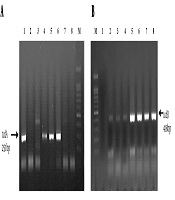
Two C. difficile strains were cultured from stool samples of this patient. To determine if it was a recurrence or reinfection, a decision was made to compare isolated strains by toxicity profile, antibiotic susceptibility, and ribotyping, especially since there was a noted CDI outbreak in this hospital in December 2023, caused by C. difficile RT027. Genes encoding GDH (gluD), toxins A (tcdA),B (tcdB), and bacterial 16S rDNA in C. difficile isolates were detected using multiplex PCR (mPCR). Detection of the binary toxin genes (ctdA/ctdB) was performed according to the method described by Stubbs et al. (7). The presence of the ermB gene, responsible for the MLSB resistance mechanism in C. difficile, as well as ribotyping, were determined as previously described (1, 2).
The reference C. difficile strain ATCC 700057 was used as a negative control in both the mPCR assays and antimicrobial susceptibility testing. The E-test (bioMerieux, Marcy l'Etoile, France) was used to assess the isolates’ susceptibility to ten different antibiotics. Plates were incubated at 37°C for 48 hours in an anaerobic chamber (Whitley A35 Workstation, UK). The European Committee on antimicrobial susceptibility testing (EUCAST) guidelines were followed for interpreting the antibiotic susceptibility results for C. difficile, C. perfringens (v.14.0; 2024), and Gram-positive anaerobes (v.11.0; 2021) (8). Erythromycin resistance was defined as a minimum inhibitory concentration (MIC) > 256 mg/L.
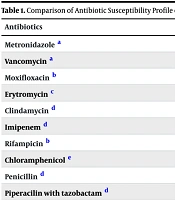
Both studied strains of C. difficile (isolated in December 2023 and January 2024) possessed an A+/B+/CDT+ toxin phenotype. Ribotyping demonstrated that the first strain from December 27, 2023, belonged to RT027, and the second from January 29, 2024, also to RT027, suggesting that this is a recurrence of a previous infection with the C. difficile outbreak strain. Antibiotic susceptibility testing demonstrated an identical susceptibility profile (Table 1): Clostridium difficile isolates were sensitive to metronidazole (MIC = 1 mg/L) and vancomycin (MIC = 0.25 mg/L). High-level resistance to erythromycin (MIC > 256 mg/L), clindamycin (MIC > 256 mg/L) (confirmed by the ermB gene), and moxifloxacin (MIC > 32 mg/L) was found in both. Both isolates were also resistant to imipenem (MIC = 12 and 32 mg/L, respectively), piperacillin with tazobactam (MIC = 4 mg/L), rifampicin (MIC > 32 mg/L), penicillin G (MIC = 0.75 and 1 mg/L, respectively), and chloramphenicol (MIC = 16 and 24 mg/L, respectively).
Table 1.
Comparison of Antibiotic Susceptibility Profile of Two Clostridioides difficile RT027 Isolates
| Antibiotics | RT0271 MIC (mg/L) | RT0272 MIC (mg/L) | Range (mg/L) | EUCAST (mg/L) |
|---|---|---|---|---|
| Metronidazole a | 1 | 1 | 0.016 - 256 | > 2 |
| Vancomycin a | 0.25 | 0.25 | 0.016 - 256 | > 2 |
| Moxifloxacin b | > 32 | > 32 | 0.002 - 32 | 4 |
| Erytromycin c | > 256 | > 256 | 0.016 - 256 | N/A |
| Clindamycin d | > 256 | > 256 | 0.016 - 256 | > 0.25 |
| Imipenem d | 12 | > 32 | 0.002 - 32 | > 0.5 |
| Rifampicin b | > 32 | > 32 | 0.002 - 32 | 0.004 |
| Chloramphenicol e | 24 | 32 | 0.016 - 256 | > 8 |
| Penicillin d | 0.75 | 1 | 0.016 - 256 | > 0.5 |
| Piperacilin with tazobactam d | 4 | 4 | 0.016 - 256 | > 0.5 |
Abbreviation: N/A, not available.
a Resistance for C. difficile according EUCAST (v.14, 2024).
b ECOFF for C. difficile was used because lack of them according EUCAST (v.11).
c Assumed R > 256 mg/L.
d MICs for C. perfingens according to EUCAST (v.14, 2024).
e MICs for Gram-positive anaerobes were used because lack of them according EUCAST (v.11).
However, genome sequencing was not performed to confirm the clonality of the isolates. Therefore, although both strains had identical ribotype and antimicrobial susceptibility profiles, definitive differentiation between recurrence and reinfection is limited. According to current definitions, recurrence is defined as the return of symptoms within eight weeks after resolution of a previous episode and may result either from relapse with the same strain or reinfection with a different strain. In this case, recurrence occurred within four weeks and involved the same ribotype RT027, which supports but does not definitively prove relapse (9). It is possible that the patient, during the first hospitalization with CDI, was infected with spores of C. difficile RT027 - the outbreak strain, still present in the hospital environment. Some spores survived treatment with metronidazole (during the presence of metronidazole in the intestine, spores usually do not germinate). Symptoms, however, started at home when metronidazole treatment was finished and appropriate conditions for germination of spores were available. It is not a surprise and a well-known fact that the microbiome of the large intestine after antibiotic treatment may be restored in about 3 weeks, and during this time, reinfection/recurrence is likely possible.
3. Discussion
The two cases of CDIs described here in the same patient over a one-month period raise many questions, particularly regarding the prevention of such reinfections/recurrences when hospitalization is required despite an ongoing CDI outbreak. This is a challenging issue, as patients with diarrhea are often cohorted in the same room. It seems logical to isolate each of these patients in a single room, rather than cohorting them, to prevent further spread of the infection. It is also important to consider the various characteristics of C. difficile isolates before deciding to cohort patients in the same room. Clostridioides difficile spores are resistant to many factors and, once released into the hospital environment, become the primary source of C. difficile transmission among patients during hospitalization (2, 10).
An important yet frequently underestimated aspect of C. difficile infection control is the proper disinfection of patient rooms and strict adherence to hand hygiene by medical personnel. Clostridioides difficile produces highly resistant spores that are not susceptible to standard alcohol-based disinfectants. Moreover, literature data indicate that alcohol may even enhance the sporulation process, contributing to the pathogen’s persistence in the hospital environment and facilitating its spread. Therefore, it is essential to use biocidal agents with proven efficacy against the spore forms of C. difficile, such as chlorine-based disinfectants (e.g., sodium hypochlorite). Routine surface decontamination, appropriate hand hygiene, and strict compliance with cleaning protocols after CDI patients are discharged play a pivotal role in limiting the nosocomial transmission of this resilient pathogen (10).
Clostridioides difficile can cause many complications, some unexpected. Ischemic colitis may be suspected as a potential consequence in patients with CDI; such a case report in a patient with overweight was recently published by scientists from Romania (11). Another case of CDI was described in a 74-year-old male after Helicobacter pylori eradication therapy, who was hospitalized in the emergency room with refractory severe watery diarrhea and advanced leukocytosis (> 70,000/µL). Despite intravenous metronidazole, oral vancomycin therapy, and emergency open sigmoidectomy, the patient died. The C. difficile isolate recovered was RT 002, positive for toxins A and B but negative for binary toxin (12).
Different cases of CDI as complications after antibiotic therapy with different antibiotics may be found in the literature (13). Recently, we demonstrated increasing antibiotic resistance among C. difficile RT027 strains, especially resistance to erythromycin, clindamycin (MLSB type), moxifloxacin, imipenem, and rifampicin (14). Therefore, appropriate antibiotic stewardship in hospitals is a very important issue for the prevention of CDI spreading between patients (1, 2). Prevention of outbreaks is the primary target of any hospital infection control team.
Here we presented a case of CDI and recurrence caused by C. difficile RT027 strains over one month in a 68-year-old female patient hospitalized in the internal medicine ward of a district hospital in the Silesian region, Southern Poland. A recent real-world effectiveness study suggests that the use of fidaxomicin may lead to better outcomes compared to oral vancomycin for the initial treatment of hospitalized patients with CDI (15). It is possible that treating our patient with fidaxomicin could have prevented a recurrence. However, due to its high cost and limited availability, fidaxomicin is not used as a first-line treatment in Poland. This case highlights the need to take into account the characteristics of C. difficile isolates (toxicity, ribotype, and antibiotic susceptibility profile) during treatment and cohortation of patients in the same room, and to consider them for differentiation of CDI reinfection and recurrence.