
1. Background
The widespread and often inappropriate use of antibiotics has led to the global emergence of antimicrobial resistance, now recognized as a major public health threat by the World Health Organization (1-5). Infections caused by multidrug-resistant organisms result in significant morbidity, mortality, and economic burden (6-8). Among hospital-acquired infections, Acinetobacter baumannii has emerged as a particularly concerning pathogen, especially in intensive care unit (ICU) settings, due to its ability to persist in the hospital environment and acquire multiple resistance mechanisms (9, 10).
Acinetobacter baumannii is responsible for a wide range of infections including ventilator-associated pneumonia (VAP), bloodstream infections, urinary tract infections, meningitis, and wound infections (11, 12). The increasing prevalence of carbapenem-resistant A. baumannii (CRAB) is of particular concern, as carbapenems are often considered one of the last-line antibiotics (13-15). Resistance mechanisms in CRAB include production of β-lactamases (serine and metallo-β-lactamases), efflux pump overexpression, and reduced membrane permeability (9, 10, 16-18). These resistance factors significantly limit treatment options and are associated with poor clinical outcomes.
Recent regional data highlight the extent of the problem. In Southeast Asia, approximately 65% of Acinetobacter isolates from ICU-acquired infections were found to be carbapenem-resistant (19). In Iran, a systematic review showed that over half of clinical isolates were resistant to imipenem (20). In the absence of newer agents like cefiderocol — currently unavailable in Iran — treatment often relies on older agents such as colistin, frequently used in combination with meropenem or ampicillin-sulbactam (21-23). While in vitro studies suggest that certain combinations (e.g., colistin plus meropenem) may have synergistic effects, clinical evidence remains scarce and inconclusive. Furthermore, the potential for synergy in triple-drug treatments and the development of resistance during combination therapy are areas of ongoing research. However, there is limited high-quality clinical data to inform practice (24-26).
2. Objectives
To date, few randomized controlled trials (RCTs) have compared combination regimens in patients with CRAB infections. The relative efficacy of triple therapy (colistin+meropenem+ampicillin-sulbactam) compared to dual therapy (colistin+ampicillin-sulbactam) remains unclear. Addressing this gap is essential for optimizing treatment in critically ill patients with limited options. The present study aims to compare the treatment response and clinical outcomes of dual versus triple antibiotic regimens in ICU patients with carbapenem-resistant Acinetobacter infection.
3. Methods
3.1. Study Design and Setting
This was a single-center, randomized controlled trial conducted at Bohlool Hospital, Gonabad, Iran. Patient enrollment began in June 2024 and was completed in April 2025.
3.2. Eligibility Criteria
Patients were eligible if they were ≥ 18 years old, admitted to the ICU, and had a confirmed or suspected diagnosis of VAP, hospital-acquired pneumonia (HAP), urosepsis, or bloodstream infection. Diagnosis of pneumonia was based on CDC/NHSN criteria (27), requiring clinical signs (e.g., new infiltrate on imaging, fever, leukocytosis/leukopenia, respiratory symptoms) plus microbiological confirmation by isolation of Acinetobacter from sputum, tracheal aspirate, or bronchoalveolar lavage (BAL). Ventilator-associated pneumonia was diagnosed in mechanically ventilated patients within 48 hours prior to infection onset. Urosepsis was defined as a positive urine culture (≥ 10⁵ CFU/mL) with pyuria and systemic inflammatory response syndrome (SIRS), in the absence of other infection sources. The isolation of CRAB from any infection site was also required. In the case of polymicrobial infections, susceptibility of the isolate to fluoroquinolones or any β-lactam antibiotics, prior colistin therapy > 96 hours, pregnancy, known allergy to colistin, meropenem, or ampicillin-sulbactam, and a history of carbapenem-induced seizures, the patient was not included in the study. Patients who died within 48 hours of antibiotic initiation were excluded from the final analysis.
3.3. Randomization and Blinding
Eligible patients were randomized using block randomization (blocks of four, 1:1 allocation) generated via Random Allocation Software. The sequence was managed by an independent researcher not involved in patient care. Participants were assigned to either the dual or triple therapy group using coded identifiers. Outcome assessors were blinded to group allocation.
3.4. Interventions
Patients in the dual therapy group received colistin and ampicillin-sulbactam. The triple therapy group received colistin, meropenem, and ampicillin-sulbactam. Dosages were as follows: Colistin: Nine million IU loading dose, followed by 4.5 million IU every 12 hours (infused over 1 hour), adjusted for Glomerular Filtration Rate (GFR) (28); meropenem: Two g every 8 hours (3-hour infusion), adjusted for GFR (29); ampicillin-sulbactam: Three g every 6 hours, adjusted for GFR (30). Concomitant antimicrobial therapy for non-Acinetobacter pathogens (e.g., gram-positive, fungal, or anaerobic) was permitted as clinically indicated. The dual therapy regimen (colistin+ampicillin-sulbactam) was selected based on common practice and the intrinsic activity of sulbactam against A. baumannii. Meropenem was added to form the triple therapy regimen based on in vitro evidence of potential synergy between colistin and carbapenems, even against carbapenem-resistant strains. The rationale was that high-dose, prolonged infusion meropenem might exert a meaningful pharmacodynamic effect and help mitigate the emergence of resistance, despite in vitro resistance testing.
3.5. Outcomes
The primary outcome was clinical success at day 14. “Clinical success” was defined as: Patient alive at day 14, systolic BP > 90 mmHg without vasopressors, ≥ 30% improvement in SOFA score (if initial SOFA ≥ 3) or no worsening (if SOFA < 3), and sterile blood culture (for bacteremic patients). Secondary outcomes included: All-cause mortality at 14 and 28 days, final outcome, and total hospital stay (survivors only).
3.6. Microbiological Analysis
Acinetobacter isolates and carbapenem susceptibility were confirmed at the hospital laboratory using disk diffusion on Mueller-Hinton agar. A 0.5 McFarland suspension was cultured, and resistance was defined as inhibition zones ≤ 19 mm for carbapenems (imipenem or meropenem), per Clinical and Laboratory Standards Institute (CLSI) guidelines.
3.7. Sample Size Calculation
The sample size was calculated based on the primary outcome of clinical success at day 14. Based on prior studies (31, 32), the clinical success rate for colistin-based monotherapy was approximately 40%. We hypothesized that the triple therapy regimen (colistin+meropenem+ampicillin-sulbactam) would achieve a substantially higher success rate of 80%. Using G*Power software (version 3.1), an alpha error of 0.05, and a power of 80%, a sample size of 23 patients per group was calculated to detect this effect size. Accounting for an anticipated dropout or non-evaluability rate of less than 10%, no further inflation of the sample size was deemed necessary. Thus, a total of 46 patients (23 per group) were planned for enrollment. We anticipated a clinical success rate of 40% in the dual therapy group and 80% in the triple therapy group. To detect this difference with 80% power and α = 0.05, a sample size of 23 patients per group was calculated.
3.8. Data Collection and Statistical Analysis
Clinical and laboratory data were collected prospectively using standardized forms. Statistical analysis was performed using SPSS version 25. Categorical variables were compared using chi-square or Fisher’s exact test. The Shapiro-Wilk test was used to assess the normality of distribution for continuous variables. Based on the results, continuous variables were analyzed using independent samples t-test or Mann-Whitney U test. Descriptive statistics were reported as mean ± standard deviation (SD) or median (interquartile range, IQR), as appropriate.
4. Results
4.1. Patient Enrollment and Allocation
A total of 65 ICU patients with Acinetobacter infections were assessed for eligibility. Sixteen were excluded due to isolate susceptibility to at least one antibiotic, and two were under 18 years of age (Figure 1). The remaining 47 patients were enrolled and randomized to the dual therapy (n = 23) and triple therapy groups (n = 24). One patient in the triple therapy group died within 48 hours of antibiotic initiation and was excluded. Finally, 46 patients were included in the analysis.
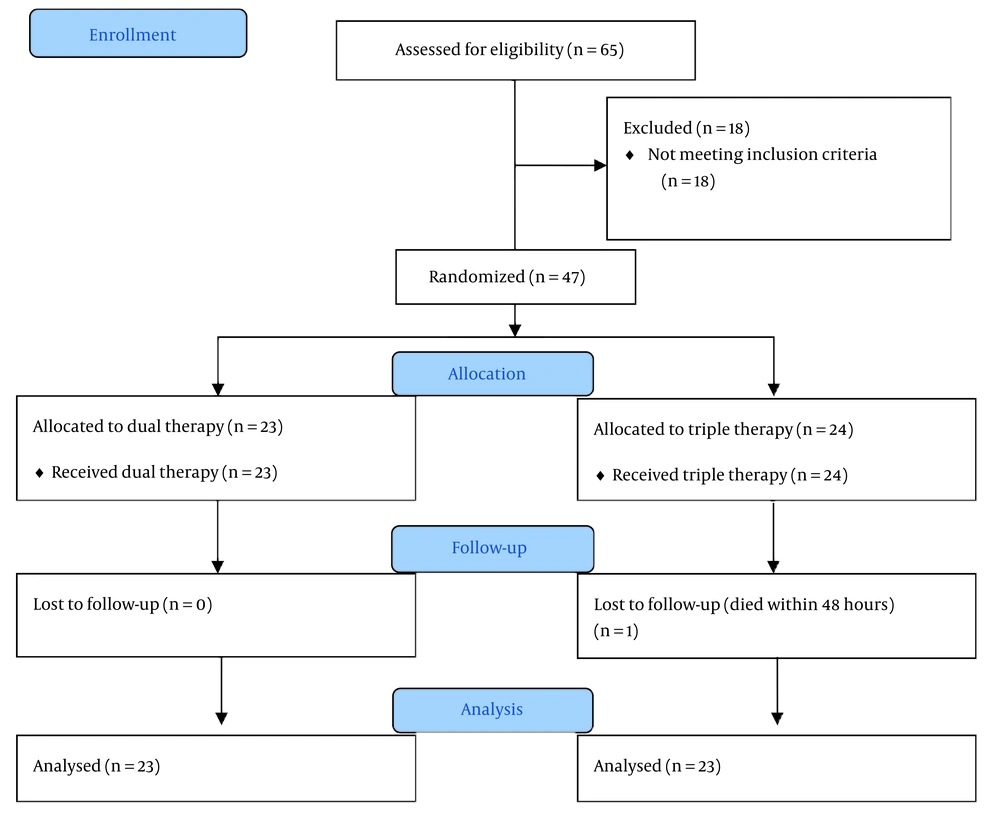
Figure 1.
Flow diagram of study
4.2. Baseline Characteristics
Of the included patients, 52.2% were male, with a mean age of 70.89 ± 18.84 years. The most common comorbidity was hypertension (37%), followed by ischemic heart disease (21.7%). There were no statistically significant differences between groups in terms of age, sex, or baseline comorbidities (P > 0.05) (Table 1).
Table 1.
Baseline Characteristics of the Participants (N = 23) a
| Characteristics | Dual Therapy | Triple Therapy | P-Value |
|---|---|---|---|
| Demographics | |||
| Gender (male) | 13 (56.5) | 11 (47.8) | 0.555 |
| Age (y) | 71.82 ± 22.99 | 69.95 ± 13.99 | 0.741 |
| Comorbidities | |||
| Ischemic heart disease | 3 (13) | 7 (30.4) | 0.153 |
| Chronic obstructive pulmonary disease | 2 (8.7) | 3 (13) | > 0.999 |
| Hypertention | 7 (30.4) | 10 (43.5) | 0.359 |
| Diabetes mellitus | 2 (8.7) | 3 (13) | > 0.999 |
| Malignancy | 3 (13) | 1 (4.3) | 0.609 |
| Dementia | 1 (4.3) | 1 (4.3) | > 0.999 |
| Peptic ulcer | 2 (8.7) | 0 (0) | 0.489 |
| Dyslipidemia | 0 (0) | 2 (8.7) | 0.489 |
| End stage renal disease | 0 (0) | 2 (8.7) | 0.489 |
| Femur fracture | 1 (4.3) | 0 (0) | > 0.999 |
| Transverse myelitis | 1 (4.3) | 0 (0) | > 0.999 |
| Other | 6 (39.1) b | 6 (39.1) c | > 0.05 for all |
| Source of Acinetobacter isolation | |||
| Sputum | 17 (73.9) | 20 (87) | 0.217 |
| Urine | 3 (13) | 0 (0) | |
| Wound | 2 (8.7) | 3 (13) | |
| Cerebrospinal fluid | 1 (4.3) | 0 (0) | |
| Admission to infection onset (d) | 16.22 ± 13.54 | 16.87 ± 8.48 | 0.846 |
| Status at infection onset | |||
| Decreased level of consciousness | 15 (62.2) | 18 (78.3) | 0.326 |
| Mechanical ventilation | 13 (56.5) | 19 (82.6) | 0.055 |
| Serum creatinine (mg/dL) | 1.54 (0.9, 1.91) | 1.59 (0.84, 2.57) | 0.475 |
| Serum albumin (g/dL) | 2.71 ± 0.33 | 2.62 ± 0.34 | 0.409 |
| White blood cells (× 10⁹/L) | 12.0 (8.3, 16.5) | 9.7 (7.9, 13.6) | 0.368 |
a Values are expressed as No. (%), mean ± SD, or median (IQR).
b Including dementia (n = 1), peptic ulcer (n = 2), femur fracture (n = 1), transverse myelitis (n = 1), malignancy (n = 3).
c Including dementia (n = 1), dyslipidemia (n = 2), end stage renal disease (n = 2), malignancy (n = 1).
4.3. Primary Outcome 14-Day Clinical Success
At day 14 after treatment initiation, 13 patients (28.3%) had died. As shown in Table 2, the 14-day mortality rate was higher in the dual therapy group (39.1%) compared to the triple therapy group (17.4%); however, this difference was not statistically significant (P = 0.102). It is noteworthy that clinical success at day 14 corresponded precisely with survival status; all patients who achieved clinical success were alive, while those who did not had died.
Table 2.
Study Outcomes (N = 23) a
| Outcome | Dual Therapy | Triple Therapy | P-Value |
|---|---|---|---|
| Clinical failure at day 14 | 9 (39.1) | 4 (17.4) | 0.102 |
| 14-day mortality | 9 (39.1) | 4 (17.4) | 0.102 |
| 28-day mortality | 15 (65.2) | 8 (34.8) | 0.039 |
| Final outcome (discharged) | 8 (34.8) | 6 (26.1) | 0.522 |
| Treatment initiation to discharge among patients discharged alive from hospital (d) | 14 (8, 31) | 35 (20, 49) | 0.155 |
a Values are expressed as No. (%) or median (IQR).
4.4. Secondary Outcomes
14-day mortality: The 14-day mortality rate was 39.1% (9/23) in the dual therapy group and 17.4% (4/23) in the triple therapy group (P = 0.102). 28-day mortality: By day 28, mortality was significantly higher in the dual therapy group (65.2%, 15/23) than in the triple therapy group (34.8%, 8/23) (P = 0.039).
Final outcome: By the end of the study, the overall in-hospital mortality rate was 69.6% (32/46), with no significant difference between the dual (65.2%, 15/23) and triple (73.9%, 17/23) therapy groups (P = 0.522). The rate of discharge was 34.8% (8/23) in the dual therapy group and 26.1% (6/23) in the triple therapy group.
Length of stay: Among patients who were discharged alive, the median time from treatment initiation to discharge was 14 days (IQR 8 - 31) in the dual therapy group and 35 days (IQR 20 - 49) in the triple therapy group, a difference that was not statistically significant (P = 0.155) (Table 2).
4.5. Adverse Events and Safety
The safety of the treatment regimens was assessed. The incidence of nephrotoxicity, defined as a rise in serum creatinine by ≥ 0.3 mg/dL or 1.5 times baseline, was 21.7% (5/23) in the dual therapy group and 30.4% (7/23) in the triple therapy group (P = 0.509). No cases of neurotoxicity were reported. No therapy discontinuations due to adverse drug reactions were recorded.
5. Discussion
This randomized clinical trial was conducted to compare the effectiveness of two antibiotic combination regimens in the treatment of patients with carbapenem-resistant Acinetobacter infections admitted to the ICU. Baseline characteristics including age, sex, and comorbidities were comparable between the groups. Moreover, the initial infection source was largely similar across groups, with the respiratory tract being the most common. One patient died within 48 hours of initiating antibiotic therapy, and this individual belonged to the triple therapy group. Given the short timeframe, it is unlikely that this death was attributable to the antibiotic regimen. Consequently, this patient was excluded from the final outcome analysis.
The primary outcome assessed was clinical failure or mortality by day 14. Although 14-day mortality was numerically lower in the triple therapy group (17%) compared to the dual therapy group (39%), this difference was not statistically significant. However, by day 28, a significant difference emerged; mortality was lower in the triple therapy group. Despite this, overall in-hospital mortality was high in both groups — 65.2% in the dual therapy group and 73.9% in the triple therapy group — with no statistically significant difference. Despite demonstrating a lower 28-day mortality rate, the addition of meropenem did not translate into a statistically significant improvement in overall survival compared to the dual regimen. The lack of significant difference in final mortality may reflect the high baseline mortality risk inherent to ICU patients with multidrug-resistant gram-negative infections (33-35). Factors such as underlying organ failure, late diagnosis, delays in effective therapy, or non-infectious contributors to death (36, 37) may have diluted the impact of antibiotic regimen.
To our knowledge, no previous clinical trial has directly compared the same regimens used in our study. In a 2022 observational study, Falcone et al. compared colistin-based regimens with cefiderocol-based regimens in patients with severe carbapenem-resistant Acinetobacter infections. They reported a 30-day mortality rate of 55.8% in the colistin group versus 34% in the cefiderocol group (21). While cefiderocol was not available in our setting and not used in this study, all patients in our trial received colistin, and the overall 30-day mortality was 50%, consistent with Falcone’s findings for colistin-based therapy. A 2019 randomized controlled trial by Dickstein et al. involving 266 patients found that, among those with isolates resistant to both colistin and carbapenems, mortality was higher in the group receiving colistin–meropenem compared to colistin alone (38). In contrast, a 2021 systematic review and meta-analysis by Scudeller et al. examined in vitro studies on the synergistic effects of combination therapy against carbapenem-resistant gram-negative bacilli. The review suggested a high level of synergy between meropenem and colistin (39). This discrepancy highlights the limitation of extrapolating in vitro findings to clinical practice, reinforcing the importance of clinical trials in guiding treatment decisions.
In our study, concurrent use of ampicillin-sulbactam in both groups could have influenced treatment response, so our findings may reflect a three-drug effect rather than meropenem’s contribution alone. It is important to note that ampicillin-sulbactam has intrinsic activity against Acinetobacter via the sulbactam component (40). According to a 2021 network meta-analysis, combination regimens containing high-dose sulbactam alongside other antibacterial agents — such as colistin — appear to be a promising therapeutic option for treating multidrug-resistant and extensively drug-resistant A. baumannii infections (41). Our study adds important real-world evidence to a growing but inconclusive body of data regarding optimal combination therapy for these infections. However, further high-quality clinical trials are needed to confirm their efficacy and safety.
This trial is among the first randomized studies comparing these specific regimens in carbapenem-resistant Acinetobacter infections. However, the study has several limitations including small sample size, single-center design, lack of genotypic or minimum inhibitory concentration (MIC)-based resistance profiling, and unmeasured variables such as sequential organ failure assessment (SOFA) score trends. Additionally, colistin resistance testing was not routinely performed, and newer agents like cefiderocol were not available in our setting. Definitive conclusions about the usefulness of combination therapy require larger, multicenter trials with microbiologic stratification. Future research should also investigate resistance-guided combination strategies to optimize outcomes in this high-risk population.
5.1. Conclusions
In this randomized clinical trial, the addition of meropenem to a dual regimen of colistin and ampicillin–sulbactam was associated with improved 28-day survival in ICU patients with carbapenem-resistant A. baumannii infections. Although this benefit did not extend to overall in-hospital mortality, our findings suggest that triple therapy may offer a modest clinical advantage in critically ill patients. Given the high mortality associated with these infections and the limited treatment options, larger multicenter studies are warranted to validate these results and optimize combination therapy strategies in resource-limited settings.