
1. Background
Therapy of community-acquired respiratory tract infections is complicated by the increasing resistance to available antibiotics worldwide. Streptococcus pneumoniae and Haemophilus influenzae are two of the most frequent bacterial causes implicated in community-acquired respiratory tract infections. There has been a global increase in resistance to widely used antimicrobial agents in these microorganisms (1, 2). An increase in resistance to penicillin has been observed in S. pneumoniae since 1967, when the first isolate with intermediate-level resistance to penicillin was described. In addition to penicillin resistance, multiple resistance to other antibiotics can occur by other mechanisms such as target site modification and efflux pumps (3). Development of resistance in S. pneumoniae complicates treatment strategies by limiting treatment options and increases the risk of treatment failure.
Penicillin resistance rates in S. pneumoniae are high in some regions of the world, while they tend to be lower in some countries (4). In Turkey, resistance to several antimicrobials is monitored by the Central Asian and Eastern European Surveillance of Antimicrobial Resistance (CAESAR) Project and shows high levels of penicillin resistance in invasive isolates (5). However, recent data regarding respiratory isolates of S. pneumoniae and H. influenzae are scarce. Monitoring resistance rates, vaccination, and antimicrobial stewardship are essential in controlling the spread of resistant strains and ensuring the continued effectiveness of available treatments. An increase in antibiotic resistance in H. influenzae is also a significant problem in the treatment of these infections (6). Ampicillin is the first-choice treatment for H. influenzae infections.
The most common resistance mechanism to ampicillin in H. influenzae isolates is the production of beta-lactamase enzymes. This enzyme produces resistance against narrow-spectrum beta-lactam antibiotics and first-generation cephalosporins. Another mechanism contributing to resistance to beta-lactams is the alteration of penicillin-binding proteins (PBPs), preventing the antibiotic from binding to its target. This form of resistance is observed in beta-lactamase-negative, ampicillin-resistant (BLNAR) strains of H. influenzae (7). While the widespread use of H. influenzae type b (Hib) conjugate vaccines has led to a substantial reduction in invasive H. influenzae type b infections globally, increasing resistance in non-typeable H. influenzae strains (NTHi), particularly BLNAR, is emerging as a significant concern (7, 8). Recently, multidrug-resistant (MDR) isolates of H. influenzae have been reported (1, 9). In Turkey, where routine childhood Hib vaccination was introduced in 2006, the impact on resistance patterns remains understudied, making this type of surveillance critical.
Despite the availability of national and regional antimicrobial resistance surveillance programs, recent long-term data focusing specifically on respiratory isolates of S. pneumoniae and H. influenzae in Turkey remain limited. Most published studies are either short-term, focused on invasive isolates, or lack longitudinal trend analysis. Given the central role of these pathogens in community-acquired respiratory tract infections and the increasing impact of antimicrobial resistance on empirical treatment decisions, updated and extended surveillance data are required. This study addresses this knowledge gap by providing a 13-year resistance trend analysis from a tertiary care center using the standardized SENTRY surveillance methodology. Therefore, the objective of this study was to evaluate long-term antimicrobial resistance trends in S. pneumoniae and H. influenzae isolated from community-acquired respiratory tract infections in Turkey over a 13-year period using the standardized SENTRY surveillance methodology.
2. Objectives
This study aimed to determine and compare antimicrobial resistance rates in S. pneumoniae (n = 335) and H. influenzae (n = 185) isolates obtained from community-acquired respiratory tract infections at a tertiary care hospital in Turkey between 2010 and 2023. This study represents the first long-term surveillance (13 years) of both S. pneumoniae and H. influenzae resistance trends in Turkey using the SENTRY methodology. It provides a comprehensive dataset from a single tertiary care center, enabling longitudinal analysis.
3. Methods
3.1. Bacterial Isolates
Streptococcus pneumoniae (n = 335) and H. influenzae (n = 185) were recovered from patients with community-acquired respiratory tract infections between 2010 and 2023 at Hacettepe University Hospital. Respiratory tract specimens included sputum, bronchoalveolar lavage, and tracheal aspirate. Isolates were collected consecutively and only one isolate per patient was included. Isolates were from children (defined as patients < 18 years of age) (47.2% in S. pneumoniae and 65.7% in H. influenzae). Only the first isolate per patient and per infection episode was included to avoid duplication. Respiratory isolates were collected consecutively from patients diagnosed with community-acquired respiratory tract infections between 2010 and 2023 and were selected in accordance with the SENTRY Antimicrobial Surveillance Program protocol. Only clinically significant respiratory isolates considered the probable etiological agents of infection based on local clinical and microbiological criteria were included in the study.
Respiratory specimens consisted of sputum, bronchoalveolar lavage (BAL), and tracheal aspirate samples. Duplicate isolates from the same patient, non-respiratory specimens, and isolates not deemed clinically significant were excluded. This standardized isolate selection approach was applied to ensure data quality, reproducibility, and consistency with the objectives of the SENTRY surveillance program. Streptococcus pneumoniae and H. influenzae isolates were kept at -80°C using Microbank™ beads (Pro-Lab Diagnostics, UK) until the day of the study. At the beginning of the study, after thawing at room temperature, the isolates were vortexed and subcultured on 5% sheep blood agar for S. pneumoniae and on chocolate agar for H. influenzae. Each isolate was subcultured twice before susceptibility testing.
3.2. Identification and Antibiotic Susceptibility Testing
Isolates were identified using standard microbiology methods and matrix-assisted laser desorption ionization-time of flight mass spectrometry (MALDI-TOF MS; Bruker Daltonics, Bremen, Germany). For both microorganisms, microdilution methodology was used for antibiotic susceptibility tests following European Committee on Antimicrobial Susceptibility Testing (EUCAST) (2025) guidelines (10). For both microorganisms, microdilution methodology was used for antibiotic susceptibility tests in minimum inhibitory concentration (MIC) panels by ThermoFisher Scientific (Cleveland, Ohio, USA) in cation-adjusted Mueller-Hinton broth (CAMHB) supplemented with 2.5 - 5% lysed horse blood with a final bacterial inoculum of 5 × 10⁵ CFU/mL.
In S. pneumoniae isolates, in vitro activity of penicillin, ceftriaxone, ceftaroline, meropenem, erythromycin, clindamycin, moxifloxacin, tetracycline, trimethoprim-sulfamethoxazole (SXT), linezolid, and vancomycin were determined. Streptococcus pneumoniae ATCC 49619 was used as the quality control isolate. In H. influenzae isolates, in vitro activity of ampicillin, cefepime, ceftriaxone, ceftaroline, meropenem, levofloxacin, tetracycline, and SXT were determined. Haemophilus influenzae ATCC 49247 was used as the quality control isolate. Isolates were identified as susceptible (S), susceptible; increased exposure (I), and resistant (R) as suggested in the European Committee on Antimicrobial Susceptibility Testing breakpoint table in 2025 (10). European Committee on Antimicrobial Susceptibility Testing 2025 breakpoints, which were the latest available guidelines at the time of data analysis, were used for interpretation.
4. Results
A total of 335 S. pneumoniae and 185 H. influenzae isolates collected between 2010 and 2023 were included in the analysis. Overall, S. pneumoniae isolates demonstrated high rates of penicillin and macrolide non-susceptibility with fluctuations across consecutive two-year periods, while resistance to ceftriaxone, ceftaroline, fluoroquinolones, linezolid, and vancomycin remained low. In H. influenzae, ampicillin resistance was primarily associated with β-lactamase production and BLNAR phenotypes, whereas resistance to third-generation cephalosporins and fluoroquinolones remained uncommon throughout the study period.
In vitro activities of the antimicrobial agents against S. pneumoniae isolates are given in Table 1. Penicillin resistance was the highest in 2010 - 2011 isolates (53.1%), which then decreased to approximately 40% with a recent surge to 52.3% in 2022 - 2023. Erythromycin, clindamycin, tetracycline, and SXT resistance rates mostly remained stable. Penicillin-resistant S. pneumoniae isolates demonstrated high rates of co-resistance to erythromycin (89.4%), tetracycline (78.0%), clindamycin (73.9%), and trimethoprim-sulfamethoxazole (56.3%), as illustrated in Figure 1, whereas all isolates remained fully susceptible to linezolid and vancomycin.
Table 1.
In vitro Resistance Rates of Streptococcus pneumoniae to Antimicrobial Agents (2010 - 2023) a
| Variables | 2010 - 2011 (N = 49) | 2012 - 2013 (N = 35) | 2014 - 2015 (N = 47) | 2016 - 2017 (N = 62) | 2018 - 2019 (N = 66) | 2020 - 2021 (N = 32) | 2022 - 2023 (N = 44) | |||||||
|---|---|---|---|---|---|---|---|---|---|---|---|---|---|---|
| I | R | I | R | I | R | I | R | I | R | I | R | I | R | |
| Penicillin | 12.2 | 53.1 | 17.1 | 40.0 | 27.7 | 38.3 | 19.4 | 38.7 | 28.8 | 40.9 | 40.6 | 31.2 | 31.8 | 52.3 |
| Ceftriaxone | 53.1 | 2.0 | 48.6 | 0.0 | 36.2 | 2.1 | 37.1 | 3.2 | 37.9 | 1.5 | 40.6 | 0.0 | 50.0 | 2.3 |
| Ceftaroline b | 0.0 | 0.0 | 0.0 | 1.6 | 1.5 | 0.0 | 6.8 | |||||||
| Meropenem b | 0.0 | 0.0 | 0.0 | 0.0 | 0.0 | 0.0 | 0.0 | |||||||
| Erythromycin b | 51.0 | 57.1 | 53.2 | 48.4 | 42.4 | 43.8 | 65.9 | |||||||
| Clindamycin b | 40.8 | 57.1 | 40.4 | 38.7 | 27.3 | 31.2 | 52.3 | |||||||
| Moxifloxacin b | 0.0 | 8.6 | 0.0 | 4.8 | 1.5 | 0.0 | 0.0 | |||||||
| Tetracycline b | 49.0 | 58.8 | 44.7 | 50.0 | 37.9 | 40.6 | 40.9 | |||||||
| SXT | 0.0 | 44.9 | 5.7 | 34.3 | 4.3 | 38.3 | 4.8 | 40.3 | 4.5 | 36.4 | 3.1 | 18.8 | 4.5 | 43.2 |
| Linezolid b | 0.0 | 0.0 | 0.0 | 0.0 | 0.0 | 0.0 | 0.0 | |||||||
| Vancomycin b | 0.0 | 0.0 | 0.0 | 0.0 | 0.0 | 0.0 | 0.0 | |||||||
Abbreviation: SXT, trimethoprim-sulfamethoxazole.
a Values are expressed as percent.
b There is no category I according to European committee on antimicrobial susceptibility testing criteria.
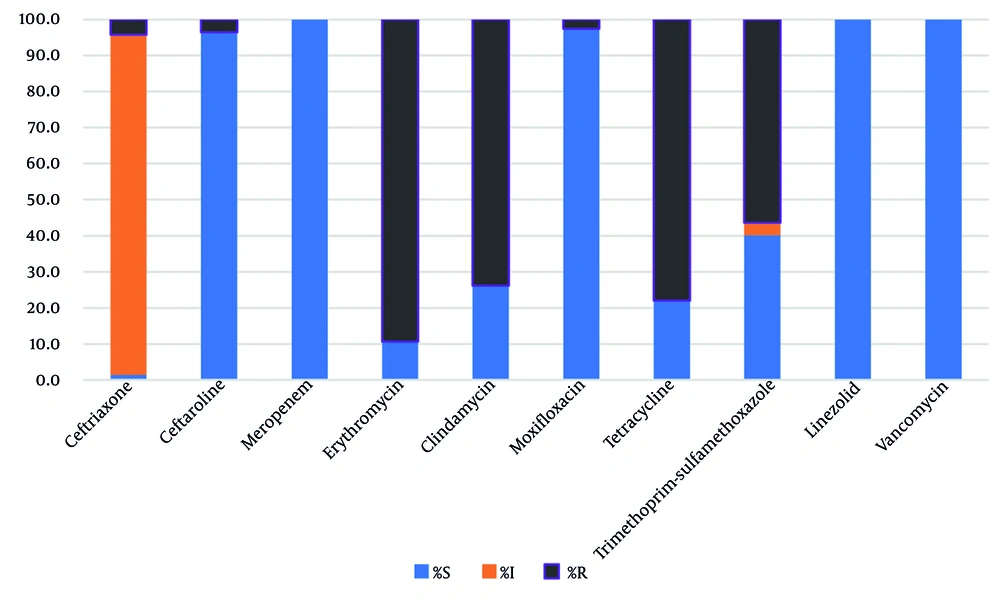
Figure 1.
Antibiotic susceptibility results of penicillin-resistant isolates. According to European Committee on Antimicrobial Susceptibility Testing 2025 criteria, there is no intermediate (I) category for ceftaroline, erythromycin, clindamycin, meropenem, moxifloxacin, tetracycline, linezolid, and vancomycin
Figure 1 highlights the high frequency of co-resistance among penicillin-resistant S. pneumoniae isolates, particularly to macrolides, lincosamides, tetracyclines, and trimethoprim-sulfamethoxazole. In contrast, linezolid and vancomycin retained full activity against all penicillin-resistant isolates. The absence of an intermediate (I) category for several antimicrobial agents reflects European Committee on Antimicrobial Susceptibility Testing interpretative criteria.
Overall rates of resistance to antimicrobial agents in S. pneumoniae (2010 - 2023) are shown in Table 2. Multidrug resistance patterns observed in S. pneumoniae isolates are shown in Table 3. In vitro resistance rates in H. influenzae isolates are given in Table 4. Beta-lactamase production was found in 7.0% (n = 13) of the H. influenzae strains. The rate of beta-lactamase negative ampicillin resistant isolates (BLNAR) was 6.5% (n = 12). Resistance to ceftriaxone, meropenem, or tetracycline was not detected among the BLNAR isolates. The resistance rates to cefepime, ceftaroline, levofloxacin, and SXT were determined as 30.0%, 8.3%, 9.1%, and 58.3%, respectively.
Table 2.
Overall in vitro Activity of Antimicrobial Agents Against Streptococcus pneumoniae Isolates (2010 - 2023)
| Antimicrobial Agent | N | MIC50a | MIC90a | MIC Range | I (%) | R (%) |
|---|---|---|---|---|---|---|
| Penicillin | 335 | 0.5 | 4 | ≤ 0.06 - > 4 | 24.8 | 42.4 |
| Ceftaroline b | 335 | 0.06 | 0.25 | ≤ 0.015 - > 1 | 1.5 | |
| Ceftriaxone | 335 | 0.25 | 2 | ≤ 0.06 - > 2 | 42.7 | 1.8 |
| Meropenem b | 309 | ≤ 0.12 | 1 | ≤ 0.12 - > 1 | 0.0 | |
| Erythromycin b | 335 | 2 | >2 | ≤ 0.12 - > 2 | 51.0 | |
| Clindamycin b | 335 | ≤ 0.25 | > 1 | ≤ 0.25 - > 1 | 40.0 | |
| Linezolid b | 335 | 1 | 1 | ≤ 0.12 - 2 | 0.0 | |
| Moxifloxacin b | 277 | ≤ 0.12 | 0.25 | ≤ 0.12 - > 4 | 2.5 | |
| Tetracycline b | 334 | ≤ 0.5 | > 4 | ≤ 0.5 - > 4 | 45.5 | |
| SXT | 335 | 1 | > 4 | ≤ 0.5 - > 4 | 3.9 | 37.6 |
| Vancomycin b | 335 | 0.25 | 0.5 | ≤ 0.06 - 0.5 | 0.0 |
Abbreviation: SXT, trimethoprim-sulfamethoxazole.
a Values are expressed as mg/L.
b There is no category I according to European Committee on Antimicrobial Susceptibility Testing criteria.
Table 3.
Multidrug Resistance Patterns in Streptococcus pneumoniae
| Resistance Phenotype | N |
|---|---|
| Resistance to 2 antimicrobials | |
| Penicillin, macrolide | 127 |
| Penicillin, tetracycline | 110 |
| Penicillin, SXT | 80 |
| Penicillin, moxifloxacin | 3 |
| Resistance to 3 antimicrobials | |
| Penicillin, macrolide, tetracycline | 106 |
| Penicillin, macrolide, SXT | 73 |
| Penicillin, tetracycline, SXT | 54 |
| Penicillin, macrolide, moxifloxacin | 3 |
| Penicillin, moxifloxacin, tetracycline | 2 |
| Penicillin, moxifloxacin, SXT | 2 |
| Resistance to 4 antimicrobials | |
| Penicillin, macrolide, tetracycline, SXT | 53 |
| Penicillin, macrolide, moxifloxacin, SXT | 2 |
| Penicillin, macrolide, moxifloxacin, tetracycline | 2 |
| Resistance to 5 antimicrobials | |
| Penicillin, macrolide, moxifloxacin, tetracycline, SXT | 1 |
Abbreviation: SXT, trimethoprim-sulfamethoxazole.
Table 4.
Overall in vitro Activity of Antimicrobial Agents Against Haemophilus Influenzae Isolates (2010 - 2023) a
| Antimicrobial Agent | N | MIC50 | MIC90 | MIC Range | I (%) | R (%) |
|---|---|---|---|---|---|---|
| Ampicillin b | 184 | ≤1 | 2 | ≤1 - >8 | 13.0 | |
| Cefepime b | 185 | ≤0.5 | ≤0.5 | ≤0.5 | 3.4 | |
| Ceftriaxone b | 185 | ≤0.06 | ≤0.06 | ≤0.06 | 0.0 | |
| Ceftaroline b | 185 | ≤0.015 | 0.03 | ≤0.015 - 0.12 | 3.2 | |
| Meropenem b | 185 | ≤0.06 | 0.12 | ≤0.06 - 0.5 | 0.0 | |
| Levofloxacin b | 185 | ≤0.5 | ≤0.5 | ≤0.5 - >2 | 5.8 | |
| Tetracycline b | 184 | 0.5 | 0.5 | ≤0.25 - 1 | 0.0 | |
| SXT | 185 | ≤0.5 | >4 | ≤0.5 - >4 | 0.5 | 30.3 |
Abbreviation: SXT, trimethoprim-sulfamethoxazole.
a Values are expressed as mg/L.
b There is no category I according to European Committee on Antimicrobial Susceptibility Testing criteria.
5. Discussion
Respiratory infections caused by S. pneumoniae and H. influenzae are important causes of mortality and morbidity. Treatment of these infections is usually empirical. Awareness of local antimicrobial resistance patterns is crucial for optimizing the effectiveness of empirical therapy. In this study, penicillin resistance is 24.5% in S. pneumoniae, and 47.7% of the isolates have MIC values in the I category, which implicates that they can be treated with higher doses of penicillin (11, 12). Our results show that resistance to penicillin in our hospital is high in respiratory tract isolates, but it has not increased steadily over the years. Penicillin resistance profiles in S. pneumoniae may show geographic variations and were reported as 28.4% in Romania, 48.3% in Serbia, 0% in Bulgaria, 2.5% in Czech Republic, and 6.8% in Russia according to the results of Survey of Antibiotic Resistance (SOAR) 2014 - 2016 in respiratory tract isolates (13-15) In several global studies between 2017 - 2020, resistance to penicillin in S. pneumoniae was reported as 3.1% in Europe, 1.0% in North America, 5.4% in Africa and the Middle East, 7.1% in the Asia-Pacific region, and 10.8% in Latin America (16). Differences in penicillin resistance rates in our country may result from regional differences in antibiotic prescription trends in the community.
Beta-lactam resistance in S. pneumoniae is due to the structural changes in penicillin binding proteins (PBP1A, 2X, and 2B). Ceftriaxone, cefotaxime, and carbapenems are less affected by these changes (17). Resistance to these agents is lower than penicillin resistance in our study. Resistance to meropenem, linezolid, and vancomycin was not observed. In the treatment of S. pneumoniae infections, moxifloxacin is a favorable option in empirical treatment due to the low resistance rates. In our study, overall resistance to moxifloxacin was 2.5%. Fluoroquinolone resistance in S. pneumoniae is mainly associated with mutations in gyrA and parC genes, leading to decreased drug affinity for DNA gyrase and topoisomerase IV (3). The variation in resistance rates across different geographical regions may be attributed to differences in antibiotic prescribing practices. While resistance remains relatively low, emerging data from various regions underscore the need for continuous monitoring and responsible fluoroquinolone usage.
The rate of resistance to macrolides is increasing dramatically in S. pneumoniae isolates all over the world (13-15, 18, 19). In the present study, overall resistance rates for the macrolides are > 45%. Resistance to erythromycin has shown a steady increase over the years in our hospital. The rate, which was 51.0% in 2011, increased to 65.9% by 2023. Macrolide resistance in S. pneumoniae may be due to changes in the ribosomal target (erm), active efflux (mef), or point mutations. High-level resistance to macrolides in isolates from our region can be explained by the high prevalence of the erm(B) gene in Turkey (20, 21). As genotyping methods were not employed for macrolide-resistant isolates in our study, we cannot speculate further on the mechanism of macrolide resistance. While erythromycin is generally recommended as the first-line empirical treatment for pneumonia when S. pneumoniae is suspected — provided its resistance rates are lower than those of penicillin — our findings indicate that this recommendation is not applicable in our setting (11, 22).
Resistance to SXT in S. pneumoniae is high in our isolates, similar to many European countries (23, 24). In penicillin-resistant isolates, resistance to macrolides, tetracycline, and SXT is also high (Figure 1). Several patterns of multi-resistance were observed in these isolates (Table 3). Of the 142 penicillin-resistant S. pneumoniae isolates, 127 were also resistant to erythromycin and 110 isolates were also resistant to tetracycline. One isolate was resistant to penicillin, erythromycin, tetracycline, moxifloxacin, and SXT. These results demonstrate that multidrug resistance is emerging even in community-acquired S. pneumoniae infections. The high frequency of resistance to conventional antibiotics (penicillin, erythromycin, tetracycline) highlights the need for careful selection of empirical therapy. The presence of extensively drug-resistant (XDR) phenotypes, albeit rare, suggests that even in community-acquired infections, treatment options may be very limited.
Although the use of pneumococcal vaccines significantly reduces the spread of resistant strains in S. pneumoniae, it should not be overlooked that methods such as reducing unnecessary antibiotic use, expanding vaccine use, monitoring changing resistance patterns with surveillance studies, and implementing alternative treatment protocols may help slow down the development of resistance or suppress resistant strains. Continuous surveillance, dissemination of regional resistance data, and rational antibiotic use are critical to slow this threat.
Resistance to ampicillin and other beta-lactam antibiotics is frequently due to beta-lactamase production in H. influenzae. Resistance to ampicillin is lower in our country compared to other countries (2, 25, 26). In recent years, reports on beta-lactamase negative ampicillin resistant (BLNAR) strains are increasing (27, 28). In our isolates, 6.5% of the isolates were BLNAR. These isolates were more rare in our country than in other countries (6, 26, 29, 30).
The widespread use of the H. influenzae type b (Hib) vaccine suppresses encapsulated strains while leading to an increased prevalence of non-typable H. influenzae (NTHi). Since BLNAR strains generally belong to the NTHi group, vaccination rates may influence these dynamics (8). The presence of BLNAR strains is clinically relevant, as these isolates may not respond to ampicillin or amoxicillin-clavulanate, complicating empirical therapy decisions. Considering that resistance rates may change in the future, it is essential to continue regular surveillance studies to better understand the impact of vaccination policies on antibiotic resistance profiles.
Fluoroquinolones have been reported to show good activity against H. influenzae (26, 31). Resistance levels (5.8%) in our study are consistent with the rates reported worldwide. However, it is reported that a slight increase in fluoroquinolone resistance has been observed in some regions in Europe, which might have been triggered by the widespread use of these antibiotics (8, 32)
The highest rate of resistance has been observed for SXT in H. influenzae isolates (30.3%) and is similar to previous studies from Turkey (33, 34). The rates of resistance to SXT were 6% in the USA, 30.8% in Latin America, and 17.8% in Europe between the years 1997 - 1999 according to SENTRY surveillance results (1, 25). According to the SENTRY Antimicrobial Surveillance Program conducted between 1997 and 1999, the rates of resistance to SXT were reported as 6% in the USA, 30.8% in Latin America, and 17.8% in Europe (1, 25). In another study, the resistance rate to SXT was 21.4% (35). This situation highlights the development of resistance due to the widespread use of SXT. Resistance rates to third-generation cephalosporins, such as cefepime, ceftriaxone, and ceftaroline, ranged from 0% to 3.4%. These rates are consistent with the low levels of resistance in both Europe and the United States. Resistance to meropenem and tetracycline was not observed in this study, similar to other countries (25). This suggests that these drugs remain effective treatment options for H. influenzae infections.
The findings of this study suggest that antibiotic resistance profiles of H. influenzae may show regional differences and are closely related to local antibiotic use policies. While resistance to beta-lactams and carbapenems in particular remains low, resistance rates were found to be higher for commonly used drugs such as SXT. This finding once again emphasizes the importance of rational antibiotic use that could be achieved with an active national antimicrobial stewardship program. Future studies indicate the need for more extensive monitoring programs to develop effective treatment strategies for H. influenzae infections.
5.1. Limitations
This study has several limitations that should be acknowledged. First, it was conducted at a single tertiary care hospital, which may limit the generalizability of the findings to other regions of Turkey or to different healthcare settings. Second, the retrospective design based on routinely collected clinical isolates may have introduced inherent selection bias. Third, molecular characterization, including serotyping of S. pneumoniae and genotypic analysis of resistance mechanisms in both pathogens, was not performed, which restricts deeper insights into the underlying molecular epidemiology of antimicrobial resistance. Finally, as the isolates originated from a tertiary care center, resistance rates may reflect a population with higher antimicrobial exposure and may not fully represent community-level resistance patterns.
5.2. Conclusions
This 13-year surveillance study provides valuable insight into resistance dynamics in a tertiary care hospital setting in Turkey. The importance of local resistance data in empirical treatment selection is emphasized. Although resistance rates in S. pneumoniae and H. influenzae have remained relatively stable over the years, rational use of broad-spectrum antibiotics and continuous surveillance of resistance development are essential. These findings support the continued use of ceftriaxone and respiratory fluoroquinolones for empirical therapy in our setting.