
1. Background
Infertility, defined by the World Health Organization (WHO) as the inability to achieve pregnancy after 12 months of regular, unprotected intercourse, is a major global public health concern with significant psychological, social, and economic implications (1). More than 22 million women worldwide — many within reproductive age — are affected annually (2). The burden is particularly high in low- and middle-income countries, where strong cultural expectations surrounding childbearing may lead to stigma, isolation, and economic hardship (3). Although infertility has multifactorial and sometimes idiopathic causes, infectious agents of the urogenital tract are increasingly recognized as important contributors (4). Among these, Mycoplasma hominis and M. genitalium are notable opportunistic pathogens capable of both asymptomatic colonization and persistent infections affecting reproductive health. In women, they may cause ascending infections leading to pelvic inflammatory disease, tubal obstruction, and infertility (5). In men, these organisms have been associated with epididymitis, prostatitis, reduced sperm motility, and sperm DNA fragmentation (6).
Mycoplasmas lack a cell wall, rendering them intrinsically resistant to β-lactam antibiotics. Treatment therefore depends on macrolides, tetracyclines, and fluoroquinolones (7). However, rising global antimicrobial resistance — particularly macrolide resistance in M. genitalium and emerging fluoroquinolone resistance — poses challenges for effective treatment and may contribute to persistent infection-related infertility (8, 9). Molecular diagnostic methods, especially polymerase chain reaction (PCR), offer rapid and sensitive detection compared with traditional culture techniques (10, 11). Despite their clinical importance, epidemiological information from southern Iran remains limited, and existing studies have not fully characterized the burden of these infections in both men and women or examined antimicrobial resistance patterns.
2. Objectives
This study aims to address key knowledge gaps by simultaneously evaluating the prevalence of M. hominis and M. genitalium among fertile and infertile men and women in Bandar Abbas, Hormozgan province, using molecular diagnostic methods. In addition, the study investigates antimicrobial resistance to erythromycin and azithromycin (macrolides) and moxifloxacin (a fluoroquinolone) using minimum inhibitory concentration (MIC) determination by the 96-well microbroth dilution method. By integrating molecular detection with standardized antimicrobial susceptibility testing and including both sexes with fertile comparison groups, this research represents the first comprehensive regional investigation of these organisms and their antimicrobial resistance profiles in southern Iran.
3. Methods
3.1. Study Design and Participants
This cross-sectional descriptive study was conducted in the first half of 2024 at the Ome Leila Infertility Center, Bandar Abbas, Hormozgan province, Iran. A total of 200 participants were enrolled, including 100 infertile individuals and 100 fertile individuals as controls. Fertility status was confirmed by a gynecologist for female participants and by an andrologist for male participants. The mean age of participants in both groups was 31.4 years, ranging from 20 to 40 years.
3.2. Inclusion and Exclusion Criteria
The inclusion criteria for all participants were no antibiotic use in the previous month and abstinence from sexual activity for 4 - 5 days prior to semen sample collection. Participants who did not meet these criteria were excluded from the study (7).
3.3. Data Collection
Demographic and clinical information — including age, place of residence, type of infertility (primary or secondary), and smoking and alcohol consumption — was collected using a structured questionnaire. The final sample size of 200 participants was chosen based on the expected prevalence of genital Mycoplasma infections reported in prior studies. Using these prevalence estimates and a 95% confidence level, the required sample size was reviewed and confirmed in consultation with a statistician. This number was also feasible given the study duration and the applied inclusion/exclusion criteria.
3.4. Sample Collection and Laboratory Procedures
Endocervical swabs were obtained using sterile Dacron swabs and immediately placed into 5 mL of pleuropneumonia-like organism (PPLO) broth under aseptic conditions for transport and subsequent processing. To prevent interference with microbial growth, only Dacron or polyester swabs with aluminum or plastic shafts were used. Semen specimens were collected by masturbation after 4 - 5 days of sexual abstinence and delivered to the laboratory within 30 minutes in sterile, screw-capped containers (4). Semen quality was assessed according to WHO guidelines, including volume, pH, motility, concentration, and morphology. All handling, transport, and disposal procedures followed institutional biosafety standards and ethical regulations.
3.5. Enrichment and Selective Isolation of Mycoplasma Species
For the enrichment of M. hominis and M. genitalium, PPLO broth was prepared with 10% arginine, 10% glucose, and 5% horse serum. Penicillin G (1000 IU/mL) and polymyxin B (500 IU/mL) were included to suppress non-target microbial growth, and the pH was adjusted to 7.0. Media were stored at 4°C until use (12). Upon arrival, 1 mL of each semen and endocervical sample was inoculated individually into the enrichment medium. Cultures were incubated at 37°C with 5 - 10% CO₂ for 24 hours, then filtered through 0.45 µm PVDF syringe filters into fresh PPLO broth containing 20% horse serum and 0.02% phenol red. The incubation continued for 3–5 days, during which bacterial growth was monitored daily. Color changes were used as indicators: yellow for M. genitalium (glucose fermentation) and purple for M. hominis (arginine hydrolysis). Biochemical assays were also performed to confirm species identity (7). It should be noted that this enrichment process was intended to improve the sensitivity of subsequent molecular detection rather than for quantitative or semi-quantitative culture. All enriched cultures were then subjected to PCR analysis for genus- and species-specific identification of M. hominis and M. genitalium, ensuring reliable DNA amplification and accurate detection.
3.6. DNA Extraction
Genomic DNA was isolated from all 200 clinical samples using the High Pure PCR Template Preparation Kit (Beh Gene, Iran; Cat. No. BP101R010/050/100) following the manufacturer’s instructions (3). DNA concentration and purity were assessed using a NanoDrop 2000 spectrophotometer (Thermo Scientific, USA). Extracted DNA samples were stored at -20°C until further PCR analysis.
3.7. Polymerase Chain Reaction-Based Detection and Multiplex Differentiation of Mycoplasma Species
Conventional PCR targeting a conserved region of the 16S rRNA gene was performed on all DNA samples to detect the Mycoplasma genus. This approach enhances sensitivity and minimizes false-negative results, particularly in specimens with low bacterial load that may not produce visible growth during enrichment. Subsequently, multiplex PCR was carried out to simultaneously identify M. hominis and M. genitalium using species-specific primers (Table 1). Primer sequences were validated for specificity using NCBI BLAST. Conventional PCR reactions (20 µL) included 10 µL of 2X Master Mix (SinaClon, Iran), 1 µL of each primer (10 pmol/µL), 5 µL of DNA template (50 ng), and 3 µL of nuclease-free water. Thermal cycling conditions are presented in Table 2.
Table 1.
Nucleotide Sequences, Used Primers, and Their Lengths
| Gene/Target | Primer Sequence | Length (Base Pair) |
|---|---|---|
| Mycoplasma genus (13) | 272 | |
| 16s rRNA | ||
| F | 5’ TGGGGAGCAAACAGGATTAGATACC3’ | |
| R | 5’ TGCACCATCTGTCACTCTGTTAACCT3’ | |
| M. hominis (14) | 604 | |
| 16s rRNA | ||
| F | 5’ACCCATTGGAAACAATGGCTAATGCCGGATACG3’ | |
| R | 5’ATAGACCCAGTAAGCTGCCTTCGCCT3’ | |
| M. genitalium (15) | 927 | |
| 16s rRNA | ||
| F | 5’GCAGTGAAGAACGAGGGG3’ | |
| R | 5’GTCCTCGCTTCGGTCCTCTCG3’ |
Table 2.
Thermal Cycling Conditions and Time Parameters for Polymerase Chain Reaction Amplification
| Stage | Initial Denaturation | Denaturation a | Annealing a | Extension a | Final Extension |
|---|---|---|---|---|---|
| Temperature (°C) | 94 | 94 | 59.3 | 72 | 72 |
| Time | 2 min | 15 s | 15 s | 15 s | 5 min |
a Cycle = 35.
Multiplex PCR reactions (20 µL) consisted of 10 µL of 2X Master Mix (CinnaGene, Iran), 1 µL of each primer, 2 µL DNA template (50 ng), and 4 µL nuclease-free water. Thermal cycling parameters are shown in Table 3. Reference strains M. hominis PG21 (ATCC 23114) (16) and M. genitalium G37 (ATCC 33530) (17) were included as positive controls, while nuclease-free water served as the negative control. Polymerase chain reaction products were separated on 1.5% agarose gels, stained with CyberSafe DNA stain, and visualized under UV light. A DNA ladder (100 - 3000 bp; GeneRuler, Fermentas) was used as a size reference. Expected amplicon sizes were 272 bp for the Mycoplasma genus, 604 bp for M. hominis, and 927 bp for M. genitalium. Samples lacking these bands were recorded as negative.
3.8. Antimicrobial Susceptibility Testing
The MICs of erythromycin and azithromycin (macrolides) and moxifloxacin (fluoroquinolone) were determined using the standard 96-well broth microdilution method. PPLO broth supplemented with horse serum and either L-arginine (for M. hominis) or D-glucose (for M. genitalium), and containing phenol red as a pH indicator, was used as the growth medium. Briefly, 25 µL of PPLO broth was dispensed into wells 1 - 9, 10, and 12 of each microtiter plate row. Next, 25 µL of antibiotic stock solution (512 mg/L) was added to wells 1 and 11. Serial twofold dilutions were performed across wells 1 - 9, resulting in final antibiotic concentrations ranging from 0.25 to 64 mg/L in a total volume of 200 µL per well.
Subsequently, 175 µL of standardized inoculum (10⁴ CFU/mL) from each Mycoplasma-positive isolate was added to wells 1 - 9 and 12. Well 10 served as the medium control, well 11 as the antibiotic control, and well 12 as the growth control. Each assay was performed in duplicate to ensure reproducibility and to minimize pipetting- or contamination-related errors. Plates were incubated at 37°C and visually examined daily for 18 - 72 hours. Growth was indicated by a color change due to the metabolic degradation of glucose (yellow for M. genitalium) or arginine (purple for M. hominis) in the presence of phenol red. The MIC was defined as the lowest antibiotic concentration showing no color change at the time when the growth control (well 12) exhibited its first detectable color shift. Quality control was performed using M. hominis PG21 (ATCC 23114) and M. genitalium G37 (ATCC 33530). Interpretation of susceptibility and resistance followed CLSI breakpoints (mg/L): erythromycin (S ≤ 1, R ≥ 4), azithromycin (S ≤ 0.125, R ≥ 4), and moxifloxacin (S ≤ 0.25, R ≥ 0.5) (18).
3.9. Statistical Analysis
All statistical analyses were performed using SPSS software (version 29). Demographic and clinical variables were summarized using frequencies and percentages (%). Parametric tests were applied to variables with a normal distribution, while non-parametric tests were employed for variables that did not meet normality assumptions or for categorical data. A two-tailed P-value of < 0.05 was considered statistically significant.
4. Results
A total of 200 clinical samples, including 100 infertile and 100 fertile participants, were analyzed. All samples underwent PCR-based detection to identify the Mycoplasma genus and to differentiate M. hominis and M. genitalium. Positive isolates were further assessed for antimicrobial susceptibility to erythromycin, azithromycin, and moxifloxacin using the standard MIC method. The following sections present the prevalence, species distribution, and relevant statistical analyses.
4.1. Polymerase Chain Reaction-Based Detection and Multiplex Differentiation
Conventional PCR targeting the 16S rRNA gene was performed on all 200 clinical samples, confirming the presence of the Mycoplasma genus in 41 samples (20.5%) (representative results shown in Figure 1). This included 22 males (20 infertile, 2 fertile controls) and 19 females (16 infertile, 3 fertile controls). Multiplex PCR enabled species-level differentiation of M. hominis (604 bp) and M. genitalium (927 bp) (representative results shown in Figure 2). Among the positive samples, 15 isolates were M. hominis (8 males: 8 infertile, 0 controls; 7 females: 6 infertile, 1 control), and 26 isolates were M. genitalium (14 males: 12 infertile, 2 controls; 12 females: 10 infertile, 2 controls). Biochemical assays and enrichment were performed as confirmatory controls; however, their quantitative results are not included in this analysis.
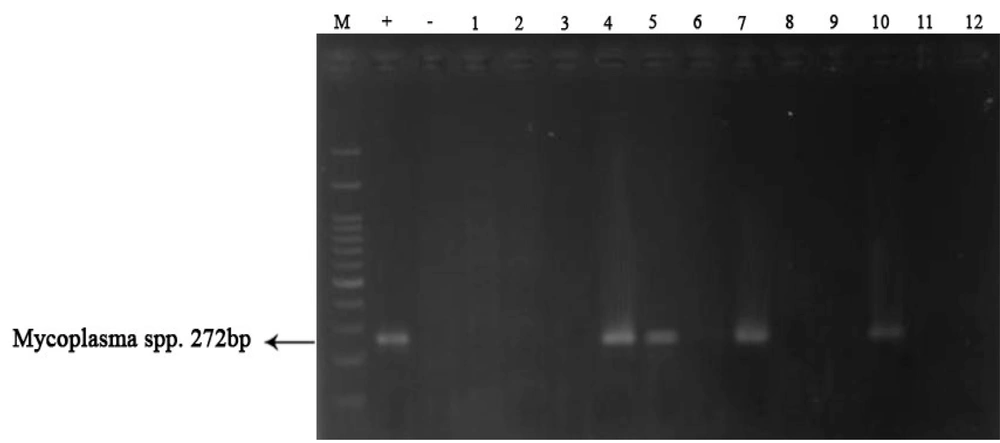
Figure 1.
Amplification of a fragment of the 16S rRNA gene for the detection of the Mycoplasma genus. Lanes, from left to right: 100 bp DNA ladder (Fermentas), positive control (Mycoplasma genus DNA), negative control (no template), and clinical samples numbered 1 - 12.
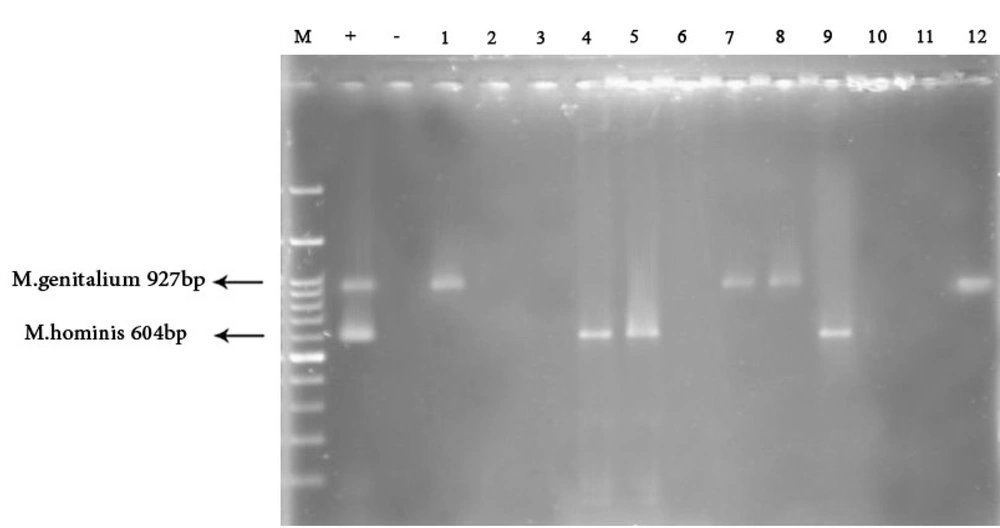
Figure 2.
Multiplex polymerase chain reaction (PCR) for the species-specific detection of Mycoplasma hominis (604 bp) and M. genitalium (927 bp). Lanes, from left to right: 100 bp DNA ladder (Fermentas), positive control (M. hominis ATCC 23114), positive control (M. genitalium ATCC 33530), negative control (no template), and clinical samples numbered 1 - 12.
4.2. Antimicrobial Susceptibility Testing
Minimum inhibitory concentrations testing was performed on all 41 PCR-confirmed Mycoplasma-positive isolates using the standard 96-well broth microdilution method (19). Minimum inhibitory concentrations values were determined for erythromycin and azithromycin (macrolides) and moxifloxacin (fluoroquinolone). All tests were performed in duplicate to ensure reproducibility. Among M. genitalium isolates (n = 26), 6 strains showed resistance to macrolides, and only 1 strain was resistant to moxifloxacin. For M. hominis isolates (n = 15), 4 strains were resistant to macrolides, with no resistance observed to moxifloxacin. Thus, resistance to macrolides was more frequent in M. genitalium than in M. hominis, whereas resistance to moxifloxacin was rare, being detected in only a single M. genitalium isolate and absent in M. hominis. MIC results are presented in Table 4.
Table 4.
Minimum Inhibitory Concentrations Values (µg/mL) for Mycoplasma genitalium and Mycoplasma hominis Isolates Against Azithromycin, Erythromycin, and Moxifloxacin a
| Interpretation (R/S) | Moxifloxacin (µg/mL) b | Azithromycin (µg/mL) | Erythromycin (µg/mL) |
|---|---|---|---|
| M. genitalium | |||
| Azithromycin and erythromycin: R, moxifloxacin: S | 0.25 | 16 | 32 |
| Azithromycin and erythromycin: R, moxifloxacin: S | 0.25 | 8 | 16 |
| Azithromycin and erythromycin: S, moxifloxacin: S | < 0.25 | 4 | 8 |
| Moxifloxacin: R, azithromycin and erythromycin: R | 0.5 | 16 | 32 |
| Azithromycin and erythromycin: S, moxifloxacin: S | < 0.25 | 8 | 16 |
| Azithromycin and erythromycin: R, moxifloxacin: S | 0.25 | 32 | 64 |
| M. hominis | |||
| Erythromycin: R, others S | < 0.25 | 4 | 16 |
| Azithromycin and erythromycin: R, moxifloxacin: S | < 0.25 | 8 | 16 |
| Azithromycin and erythromycin: R, moxifloxacin: S | 0.25 | 16 | 32 |
| Azithromycin and erythromycin: S, moxifloxacin: S | < 0.25 | 4 | 8 |
Abbreviations: R, resistant; S, susceptible.
a MIC values reflect the lowest concentration that inhibited visible growth.
b “<” and “>” indicate results below or above the tested concentration range.
4.3. Statistical Analysis
Descriptive statistics showed that the median age of infertile men was 29 years (IQR: 5; range 20 - 42), while infertile women had a median age of 28 years (IQR: 7; range 21 - 42). Chi-square tests were used to evaluate associations between categorical variables. Men reported higher rates of smoking, alcohol, and tobacco use compared to women (P < 0.05). The overall prevalence of Mycoplasma infections was similar between genders: 22.0% of men and 19.0% of women tested positive (P = 0.599). Specifically, M. genitalium was detected in 15.0% of men versus 12.0% of women (P = 0.535), and M. hominis in 8.0% of men versus 7.0% of women (P = 0.788). These differences were not statistically significant, suggesting no meaningful biological disparity between sexes. Health status was comparable across genders: 49.0% of men and 51.0% of women were classified as infertile (P = 0.777) (Table 5). All statistical analyses were conducted using SPSS version 29. Parametric tests were applied for normally distributed variables, and non-parametric tests for non-normally distributed or qualitative variables. A P-value < 0.05 was considered statistically significant.
Table 5.
Comparison of Mycoplasma Infection Prevalence and Health Status by Gender (N = 100) a
| Characteristic | Female | Male | P-Value |
|---|---|---|---|
| Mycoplasma | 19 (19.0) | 22 (22.0) | 0.599 |
| M. genitalium | 12 (12.0) | 15 (15.0) | 0.535 |
| M. hominis | 7 (7.0) | 8 (8.0) | 0.788 |
| Fertility status | 49 (49.0) | 51 (51.0) | 0.777 |
a Values are expressed as No. (%).
5. Discussion
The present study provides a comprehensive molecular assessment of M. hominis and M. genitalium among both fertile and infertile men and women in southern Iran, representing the first regional investigation to integrate species-level differentiation with antimicrobial susceptibility profiling. The overall prevalence of Mycoplasma infections was 20.5%, with 15.0% of men and 12.0% of women testing positive for M. genitalium, and 8.0% of men and 7.0% of women positive for M. hominis (differences were not statistically significant, P > 0.05). These findings are largely consistent with several prior reports, suggesting that the prevalence rates observed in our cohort align with trends seen in similar populations. For instance, Tam Le et al. reported a low but detectable presence of M. genitalium among infertile men (0.79%) (4), while Doroftei et al. found M. hominis prevalence of approximately 5.7 - 28.46% among infertile women (20). Similarly, Heidari Pebdeni et al. reported associations between M. genitalium and semen quality, with prevalence values broadly comparable to our study (21). The concordance between our findings and these studies supports the validity of our molecular detection approach and suggests that the prevalence of these pathogens in the Middle Eastern population is within a comparable range to other international cohorts.
Despite these consistencies, several discrepancies with other studies remain. For example, Tjagur et al. reported a much lower prevalence of M. genitalium in infertile men (1.1%) (1), while Abdo et al. observed a high seroprevalence of M. hominis (49%) among women attending fertility clinics in Abu Dhabi (6). These differences likely reflect a combination of regional, demographic, and methodological factors. Geographic and population-specific characteristics including environmental conditions, sexual behaviors, access to healthcare, and local microbiota play a critical role in shaping infection prevalence. Methodological differences, such as the use of conventional culture, commercial kits, or PCR, can also significantly influence detection sensitivity, as highlighted by Ozturk et al., who reported variability in M. hominis detection across different diagnostic kits (19).
Antimicrobial susceptibility analysis showed that macrolide resistance was more common in M. genitalium (6/26, 23%) compared to M. hominis (4/15, 27%). Resistance to moxifloxacin was rare, detected in only a single M. genitalium isolate (3.8%). These findings align with recent reports by Yu et al. and Chua et al., indicating an increasing trend of macrolide resistance in M. genitalium (22, 23). The observed differences in resistance profiles highlight the importance of conducting species-specific antimicrobial testing to guide appropriate therapy and minimize the risk of treatment failure. Lifestyle and demographic factors may also contribute to prevalence differences. In our cohort, infertile men reported higher rates of smoking, alcohol, and tobacco use compared to women, but these differences were not statistically linked to Mycoplasma infection prevalence.
Our study’s cross-sectional design limits causal inference and the ability to evaluate temporal patterns of infection. Additionally, the relatively small sample size and the absence of screening for other sexually transmitted infections, such as Chlamydia trachomatis, Neisseria gonorrhoeae, and Trichomonas vaginalis, constrain the generalizability of our findings. Consequently, it is not possible to determine whether observed associations are independent of co-infections. Future longitudinal studies with larger cohorts, broader pathogen screening, and mechanistic analyses are warranted to clarify causal pathways and optimize treatment strategies.
5.1. Conclusions
This study provides updated molecular data on the presence of M. hominis and M. genitalium among fertile and infertile individuals in southern Iran, along with their susceptibility patterns to commonly used antibiotics. The findings underscore the value of sensitive molecular diagnostic methods for improving detection accuracy and supporting more informed clinical management. Given the cross-sectional design, relatively small sample size, and the lack of screening for other sexually transmitted infections, the interpretation of these results should be made with caution. Future research with larger cohorts, longitudinal follow-up, and more comprehensive evaluation of co-infections will help clarify the role of Mycoplasma species in reproductive health and the dynamics of infection.