


1. Background
2. Objectives
3. Methods
3.1. Culture Media and Reagents
3.2. Sterilization Procedures
3.3. Preparation of ABTS⁺ Radical Solution
3.4. ABTS⁺ Radical Scavenging Assay
3.5. Calculation of Radical Scavenging Activity
3.6. IC₅₀ Determination and Statistical Analysis
4. Results and Discussion
4.1. Baseline ABTS⁺ Radical Scavenging Values of Common Microbial Media
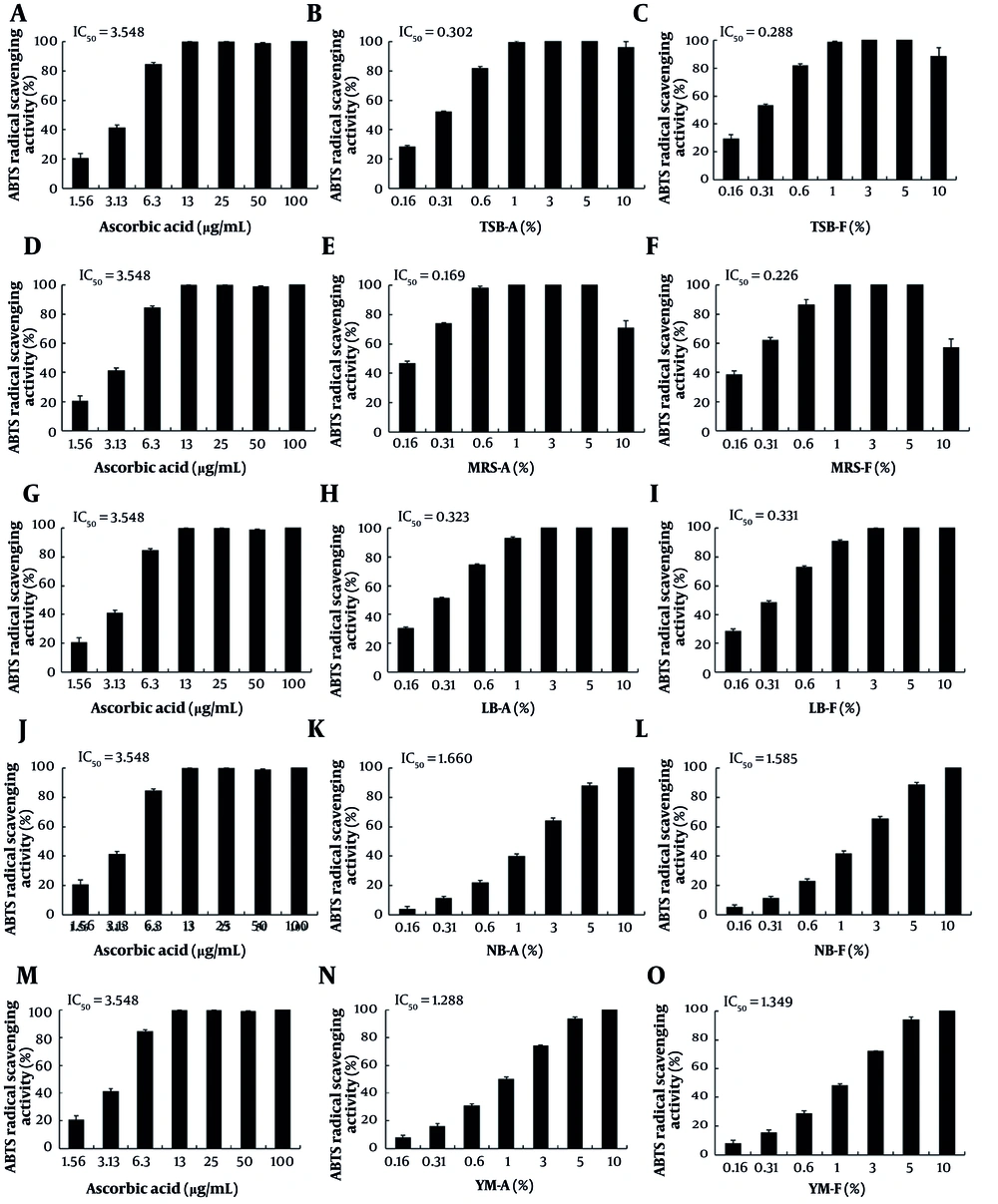
AABTS⁺ radical scavenging activities of culture media and control antioxidant; ABTS⁺ radical scavenging activities of ascorbic acid standards and five commonly used microbial culture media prepared by autoclave sterilization (A) or 0.22 μm membrane filtration (F). Ascorbic acid standards are shown in panels (A, D, G, J). Culture media include TSB (B, C), MRS broth (E, F), LB broth (H, I), NB (K, L), and YM broth (M, N, O). Samples were tested at increasing concentrations (%, v/v), and ABTS⁺ radical scavenging activity was measured at 734 nm after 15 min of incubation in the dark. The half-maximal inhibitory concentration (IC₅₀, % v/v) is indicated in each panel. Data represent mean ± SD (n = 3).
| Medium | Autoclave, IC₅₀ (%) | Filteration, IC₅₀ (%) |
|---|---|---|
| Tryptic soy broth | 0.302 | 0.288 |
| MRS broth | 0.169 | 0.266 |
| LB broth | 0.323 | 0.331 |
| Nutrient broth | 1.660 | 1.585 |
| YM broth | 1.288 | 1.349 |
a The half-maximal inhibitory concentration (IC₅₀) values (%v/v) were determined for autoclaved and filter-sterilized media. Lower IC₅₀ values indicate stronger intrinsic antioxidant capacity.
