1. Background
The procedure of plant pathogen recognition entails looking for obvious signs of disease in plants, gathering plant samples for additional laboratory examination, or employing remote sensing methods to find pathogens (1, 2). The goal of plant pathogen determination is to find plant pathogens as soon as possible so that control measures could be put in place to lessen their effects on crop productivity (3). Timely recognition and diagnosis of plant pathogens and diseases facilitate the implementation of appropriate control measures, thereby reducing their adverse effects on agricultural productivity (4). The ubiquitous bacterium Pseudomonas aeruginosa is usually discovered in soil, water, damp surfaces, plants, animals, as well as people. Individuals with weakened immunity are susceptible to fatal diseases caused by this opportunistic pathogen (5). Furthermore, P. aeruginosa-associated chronic obstructive lung infections are primarily caused by synthesis of biofilms (6). By safeguarding P. aeruginosa from the host immune system alongside antibacterials, biofilms promote long-term colonization (7). Extracellular DNA, proteins, along with exopolysaccharides are among the extracellular polymeric components that make up the complex bacterial communities56 referred to as biofilms. The biofilm matrix's exopolysaccharide constituents may hinder antibacterial penetration as well as fend off host immune cells' phagocytosis (8). Pel, Psl, as well as alginate, are three exopolysaccharides that most P. aeruginosa strains are genetically capable of producing (9). Also, biofilms play a significant role in the horizontal transfer of genes that spread antibiotic resistance (10). Pseudomonas aeruginosa is capable of causing disease in plants as soft rot in Arabidopsis, and many of its virulence mechanisms are active across plant and animal hosts. Genes like mexR control efflux pumps that remove toxic compounds. In a plant infection environment, bacteria face plant defense chemicals and stress conditions. Efflux systems could help bacteria survive those conditions, so regulators like mexR might indirectly influence colonization, stress tolerance, or survival inside plant tissue — even if they are not classical virulence genes (11). Regrettably, this bacterium has found extensive reservoirs in agricultural soil as well as plants (11). The majority of P. aeruginosa strains found in agricultural systems aid in plant growth and defense (12, 13). But some additionally lead host plants to wilt and rot. There is no strong, well-characterized evidence directly linking mexR to plant pathogenicity or colonization in Arabidopsis in the way some known plant virulence regulators have been studied (14) Most research on mexR focuses on antibiotic resistance and efflux pump regulation in human pathogenic bacteria. From a bacterial perspective, plant defense molecules function similarly to antibiotics. The MexAB-OprM efflux pump, regulated by mexR, belongs to the RND (Resistance-Nodulation-Division) family. Although commonly studied in clinical antibiotic resistance, these pumps evolved primarily as broad-spectrum detoxification systems (15). Additionally, P. aeruginosa infects plants, causing soft rot symptoms in lettuce (Lactuca sativa) and thale cress (Arabidopsis thaliana) (16, 17). It has been demonstrated to be a powerful root pathogen of Arabidopsis (18). According to molecular research on P. aeruginosa pathogenesis, the bacterium needs comparable subsets of virulence factors to infect plants and animals (17, 19). Arabidopsis is a useful model for studying the molecular underpinnings of pathogenesis, which may help find new compounds for treating infections (20). An excellent option for a plant host has been Arabidopsis. It has a fully sequenced genome, is genetically tractable, and has a wide variety of mutant strains. Lastly, the rules and ethical issues surrounding animal experiments are eliminated when using plant infection models (21). Pseudomonas aeruginosa genes that contribute to virulence have been identified effectively using the widely employed plant model, Arabidopsis thaliana. Additionally, these genes are crucial for mammalian infection, indicating that this bacterium possesses a unique set of virulence factors (22). Bacterial cells can expel intracellular toxins, such as antibiotics, thanks to efflux pumps. The regulatory gene mexR controls the MexAB–OprM efflux pump, which is one of the biggest MDR efflux pumps with high expression levels in P. aeruginosa (23). In P. aeruginosa, mexR encodes a transcriptional repressor that regulates the MexAB-OprM efflux pump system. This system is mainly known for antibiotic resistance. Arabidopsis thaliana is widely used as a model system to study plant-microbe interactions. The goal of this study was to identify the mexR gene of P. aeruginosa related to infection and damage in Arabidopsis tissues.
2. Objective
Arabidopsis: Innovating Science™ Arabidopsis Seeds PK/30(IS3731), Plastic trays with clear domed lids, plastic insert boxes for plant growth, potting soil, Agarose or Phytoblend agar, Hoagland’s nutrient solution, Gnatrol WDG, and a plant growth chamber using regulated humidity and lighting.
Bacterial culture: Miller Lysogeny Broth (LB) medium or Pseudomonas agar base medium with C-N supplement (Oxoid, Hampshire, UK), suitable antibiotics (Norfloxacin), and sterile solutions like 10 mM MgSO4 are necessary for the culture and testing of specific strains of P. aeruginosa. Pseudomonas aeruginosa strains were from clinical, environmental, and plant-derived sources. Glass tubes with caps, centrifuge tubes, syringes, safety gear (gloves and goggles), plastic pestles and grinders, and 37°C incubators are examples of necessary equipment. For experimental procedures, a spectrophotometer calibrated for108 absorbance readings at 595 - 600 nm and a microfuge are also necessary.
3. Methods
3.1. Arabidopsis Growth
The seeds were soaked in water at 4°C for two to five days to increase the germination rate. To keep the seeds suspended, 0.1% agarose or Phytoblend agar was added. To prevent fungus gnats, the soil was prepared by filling boxes with potting soil, soaking it in water and Hoagland's solution, draining it, and then sprinkling it with Gnatrol. Using a Pasteur pipette, the seeds were evenly sown, covered with perforated lids, and incubated at 20 ± 2°C, 70% humidity, and a 12-hour photoperiod. The lids were removed after a week of germination, and growth continued for an additional week. Seedlings that were 5 mm tall were placed into fresh trays, 3 cm apart. Leaves were checked to be healthy after three weeks so that infection could be scheduled using plants that were four to six weeks old for assays (22).
3.2. Inoculum Preparation
One colony from an antibiotic-treated LB-agar plate was selected and inoculated in three millilitres of LB broth to carry out bacterial culturing. The culture grew overnight at 37°C, was diluted 1:100 in fresh LB, and then incubated at 37°C with stirring for about five hours until it reached the early stationary phase (OD600 = 3.0). Next, the cells were pelleted at 5,000 x g for five minutes, and then washed twice in 10 mM MgSO4, adjusting the OD600 to 0.2. Lastly, this suspension was diluted 1:100 and 1:1,000 in 10 mL of 10 mM MgSO4. The 1:1,000 dilutions yielded about 2 × 10⁶ CFU/mL.
3.3. Infection
Twelve plants per strain were used for plant infection, with three to four older leaves marked on the outside of the rosette. A lamp was used to keep the stomata open while the work was being done in a well-lit area. The marked leaf's abaxial side was soaked with a 1 mL syringe filled with bacterial suspension, and any extra liquid was drained. To avoid soil contact, toothpicks were used to support the infected leaves. To prevent cross-contamination, separate trays were used for each strain, with a ventilated cover for humidity and water in the tray bottom. The inoculated plants were kept in an incubator with a twelve-hour photoperiod, high humidity, and 30°C.
3.4. Evaluating Bacterial Proliferation and Symptoms
Daily symptoms were recorded in order to evaluate the infection over a period of five days. Severe symptoms appeared as chlorosis and a water-soaked reaction zone two to three days after inoculation. Five days after inoculation, the entire leaf had soft rot. In moderate symptoms, the majority of the tissue surrounding the location of inoculation was softened due to moderate water soaking as well as chlorosis. In weak symptoms, chlorosis and localized water soaking appeared in the tissue surrounding the injection site. There were no signs of soft rot, just chlorosis near the injection site in the case of no symptoms. At each time point, beginning at t = 0, three to four leaves were chosen from each plant set for bacterial counting. To extract bacteria, the leaves were separated, and two 0.28 cm² circles were cut from one with a cork cutter and ground in 0.3 mL of 10 mM MgSO4. To count colony-forming units (CFU), serially dilute the samples, plate them in triplicate on LB- agar, and incubate at 30°C.
3.5. DNA Extraction
The QIAamp DNA mini kit had been utilized to extract DNA in accordance with the manufacturer's instructions (Qiagen, Germany, GmbH). The primers (24) utilized: Forward 5'-GCGCCATGGCCCATATTCAG-3'; Reverse 5'-GGCATTCGCCAGTAAGCGG-3'.
3.6. Amplification of mexR Gene from DNA of Pseudomonas aeruginosa by PCR
PCR amplification was performed in a 50-µL reaction mixture containing 1-µL extracted P. aeruginosa (200 mg) DNA, 5 Ml of 10X PCR buffer, 1-µL dNTPs (40 mM), 1-µL (IV Ampli Taq DNA polymerase) and 1-µL (20 PM) of the forward and reverse primers. The volume of the reaction mixture was completed to 50 -µL using DDW. Forty- µL paraffin was added, and the thermal cycler was adjusted as follows:
- Initial denaturation: 94°C for 4 minutes
First cycle: (1) Denaturation: 94°C for 60 seconds; (2) Annealing: 57°C for 45 seconds; (3) Extension: 72°C for 45 seconds.
This cycle was repeated 35 times
Final extension: 72°C for 10 minutes
Electrophoresis on a 2.0 % agarose gel stained with Bromophenol blue was used to separate the PCR products. The gel was transferred to the transilluminator to observe the amplified gene fragment mexR (385 bp) against the molecular weight marker (100bp-1.5 kb DNA ladder)
4. Results
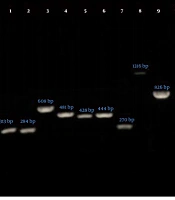
Water soaking as well as yellow discoloration of infected leaves were among the signs that Arabidopsis leaves exhibited two days after infection (Table 1). Throughout day zero to day two, an increase in CFUs was observed; from day 2 to 5, only slight increases were present (Table 2). Out of (15) P. aeruginosa strains, 3 strains had been positive for the gene (Figure 1).
Table 1.
Daily Symptoms Obtained by Pseudomonas aeruginosa Infection
| Day | Symptoms |
|---|---|
| 0 | None |
| 1 | chlorosis and localized water soaking appeared at the tissue surrounding the injection site |
| 2 | Water soaking in the majority of tissue and chlorosis |
| 3 | Water soaking and chlorosis |
| 4 | Water soaking and cholosis |
| 5 | The entire leaf has soft rot |
Table 2.
The Mean CFU Throughout Days 0 - 5
| Day | CFU |
|---|---|
| 0 | 2.5 × 10³ |
| 1 | 5.21 × 10³ |
| 2 | 7.36 × 10³ |
| 3 | 8.52 × 10³ |
| 4 | 9.90 × 10³ |
| 5 | 9.98 × 10³ |
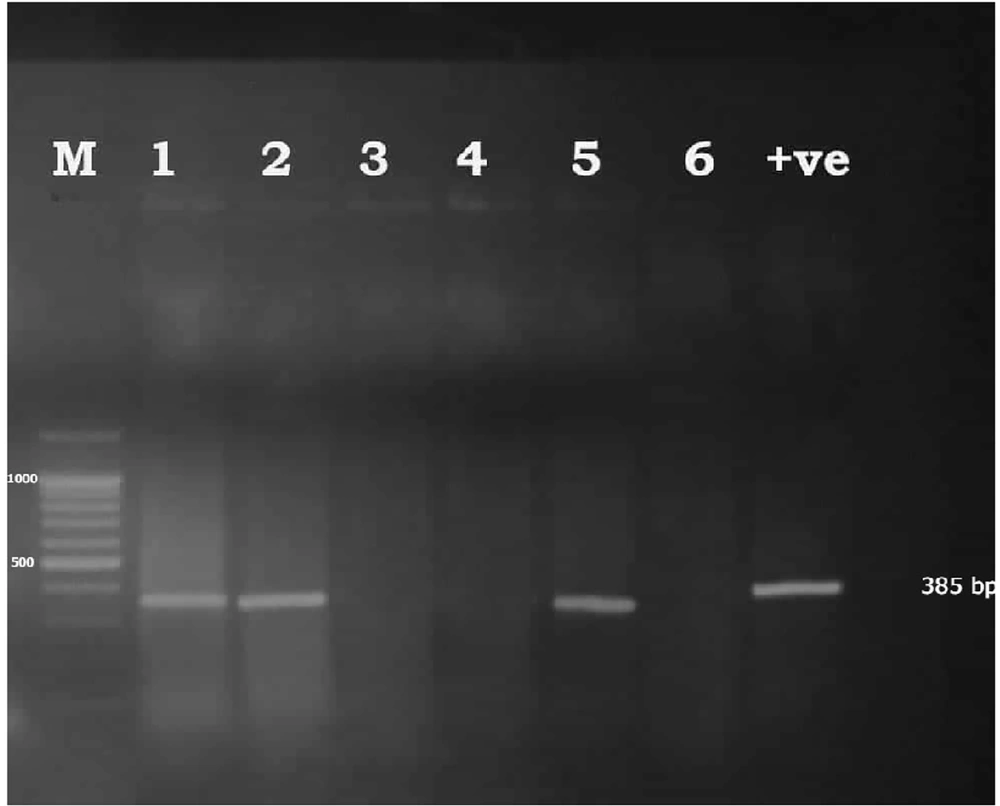
Figure 1.
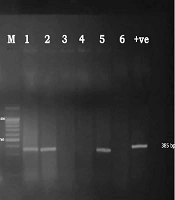
Agarose gel electrophoresis showed amplification of the 385 bp fragment of220 mexR gene from P. aeruginosa.221 M: (100bp-1.5 kb DNA ladder); Lanes 1, 2 and 5: Positive mexR; Lanes 3 and 4: Negative mexR; Lane 6: Control negative; Lane 7: Control positive
5. Discussion
The present study investigated the role of the mexR gene in Pseudomonas aeruginosa infection of Arabidopsis thaliana. Disease symptoms, including chlorosis and water-soaking, became visible two days after inoculation and progressed to soft rot by day five, indicating successful colonization of plant tissue. Bacterial population analysis showed a marked increase in CFU during the early stages of infection, followed by a plateau phase, suggesting that bacterial proliferation stabilizes once infection is established. PCR screening revealed that only three out of fifteen P. aeruginosa strains carried the mexR gene. However, the infection symptoms and bacterial growth patterns observed in Arabidopsis did not demonstrate a clear distinction between mexR-positive and mexR-negative strains. This suggests that the presence of mexR alone is not sufficient to enhance virulence or bacterial proliferation in plant tissue (18). Previous studies have primarily linked mexR to antibiotic resistance through regulation of efflux pump systems rather than direct involvement in pathogenicity. The findings of this study are consistent with this understanding, indicating that while mexR may contribute to bacterial stress tolerance, it does not appear to play a dominant role in plant infection severity. Plant pathogenicity in P. aeruginosa is likely governed by multiple virulence factors acting together rather than a single regulatory gene (25). The present study evaluated the ability of P. aeruginosa strains to infect Arabidopsis thaliana and examined whether the presence of the mexR gene is associated with disease severity or bacterial proliferation in plant tissue. Infection assays demonstrated that P. aeruginosa successfully colonized Arabidopsis leaves, as evidenced by the appearance of chlorosis and water-soaking symptoms within two days of inoculation and progression to soft rot by day five. These observations confirm that Arabidopsis is a suitable model for studying P. aeruginosa–plant interactions. Quantification of bacterial growth revealed an increase in colony-forming units (CFU) from day 0 to day 2, followed by a slower increase and stabilization from day 2 to day 5. This pattern suggests that bacterial multiplication occurs primarily during the early stages of infection, after which population growth may be limited by host responses or nutrient availability within plant tissues. Similar infection dynamics have been reported in previous plant–bacteria interaction studies, where early colonization is critical for disease establishment (24, 26). PCR analysis showed that only three out of the fifteen tested P. aeruginosa strains carried the mexR gene. Importantly, no clear differences in symptom development or bacterial burden were observed between plants infected with mexR-positive strains and those infected with mexR-negative strains. These findings indicate that the presence of mexR alone does not confer enhanced virulence or increased colonization capacity in Arabidopsis. Therefore, mexR does not appear to be a primary determinant of plant pathogenicity in this experimental system. Previous studies have mainly characterized mexR as a transcriptional regulator involved in antibiotic resistance through control of multidrug efflux pumps. While efflux systems may contribute indirectly to bacterial fitness and stress tolerance, the results of this study suggest that mexR is not sufficient by itself to intensify disease symptoms or bacterial proliferation in plant hosts. Plant infection by P. aeruginosa is likely governed by multiple virulence factors and regulatory networks acting in combination rather than by a single gene (27). Overall, this study highlights that although P. aeruginosa can effectively infect Arabidopsis thaliana, the contribution of mexR to plant disease development appears limited under the conditions tested. Further investigations focusing on additional virulence-associated genes, gene interactions, and mutant analysis are required to better understand the molecular mechanisms underlying P. aeruginosa pathogenicity in plants (27). Arabidopsis and sweet basil are distinct kinds of plants whose roots could be infected by P. aeruginosa clinical strains PAO1 as well as PA14. The development of biofilm colonizing the root surface was linked to P. aeruginosa-induced plant death from infection. The phenomenon is comparable to P. aeruginosa biofilms that develop on lung tissues and probably have an altered metabolism that makes them resistant to antibacterial therapy in cystic fibrosis cases (28). On various healthy plant tissues, such as the stems of maize, sweet pepper fruits, eggplant, and tomatoes, several isolated Pseudomonas species have lately demonstrated signs of soft rot and water-soaked areas (28). Pseudomonas aeruginosa is one of the organisms that cause soft rot disease in certain vegetables as well as ornamental crops, but it has received very little attention (29). Because the Arabidopsis model is genetically tractable and there are similarities among plant and animal innate immunity mechanisms, it is advantageous to evaluate host-pathogen interactions from both the bacterial as well as plant host perspectives (30). In our study, two days after infection, Arabidopsis leaves showed signs of water soaking and yellow discoloration. Arabidopsis thaliana is infected by Pseudomonas aeruginosa, which causes both local and systemic infections with symptoms like water soaking, yellowing, and plant tissue rotting. In order to facilitate the spread of bacteria and the emergence of symptoms, the process of infection involves attachment to the leaf surface, entry through stomata or wounds, colonization of intercellular spaces, and disruption of plant cell structures (31). Chlorosis and water soaking appear two to three days after Pseudomonas aeruginosa infects Arabidopsis. Soft rot and tissue maceration result from bacterial growth over the next few days. In particular, the first signs are chlorosis and water soaking; by four to five days, the symptoms get worse and the leaves collapse as bacteria multiply in the leaf tissues (21). According to Fouad et al.'s study, P. aeruginosa is a phytopathogen linked to common bean seeds. Biochemical tests, molecular analysis of the 16S rRNA gene, and phenotypic traits were used to identify the bacterial pathogen. Pseudomonas aeruginosa can cause clear signs of pathogenicity and trigger defense-related reactions, such as elevated POX and PAL activity and PAL gene upregulation (29). Pseudomonas aeruginosa uses a variety of bacterial genes that encode motility, secretion systems, enzymes that break down plant tissue, and toxins to infect Arabidopsis. Together, these elements facilitate attachment, invasion, colonization, and tissue damage that result in disease symptoms as well as systemic infection in Arabidopsis (21). The mexR gene was found in 3/15 (20.0%) of P. aeruginosa isolates in this study, which is concerning because mexR mutations may activate the mexAB–oprM operon and increase resistance to various antibiotics (32). As a result of mutations obtained in the repressor gene mexR, hyperexpression of mexAB–oprM has been found in multidrug resistant clinical isolates (33).
5.1. Conclusions
This study demonstrates that P. aeruginosa can successfully infect Arabidopsis thaliana and induce progressive disease symptoms, including chlorosis, water-soaking, and soft rot. Among the fifteen strains tested, three were positive for the regulatory gene mexR, but no clear differences in symptom severity or bacterial proliferation were observed between mexR-positive and mexR-negative strains. These findings suggest that mexR alone is not a primary determinant of plant pathogenicity in P. aeruginosa. The results highlight the need for further research on additional virulence-associated genes and their interactions to better understand the molecular mechanisms underlying bacterial colonization and disease development in plants.