1. Background
The potential for hospital-acquired infections increases when patients with unidentified community colonization are placed in situations where long-term devices are used, surgical wounds are frequent, or patients require intensive nursing interventions. In an active surveillance program, a patient is screened for the presence of a selected organism, regardless of whether or not the patient is currently exhibiting signs and symptoms of infection (1).Several studies worldwide have reported the rate of nasal carriage of Staphylococcus aureus strains, varying from 16.8% to 90% (2-5). A causal relationship between S. aureus nasal carriage and infection is supported by the fact that the nasal strain and the infecting strain share the same genotype (6). Colonizing strains may thus serve as endogenous reservoirs for overt clinical infections or may spread to other patients (7).
In recent years, the widespread use of antibiotics has led to the emergence of strains that systematically acquire multiple resistance genes. Methicillin-resistant S. aureus (MRSA) is an opportunistic bacterial pathogen frequently isolated in hospital and community environments (8). Since the first report in 1961, MRSA has been considered a major nosocomial pathogen causing severe morbidity and mortality worldwide; its related infections are an important clinical and public health problem (9, 10). Hospital-acquired MRSA (HA-MRSA) infections were first observed during the mid-1980s, and their prevalence has continued to increase (11). The emergence of MRSA, which is also often multidrug-resistant, renders the treatment of its related infections extremely challenging (12). For example, a recent study noted that more than 50% of hospital-associated S. aureus isolates are resistant to all beta-lactam antibiotics, including methicillin and oxacillin (13). Such isolates are also typically resistant to other antibiotics.
2. Objectives
Given this background, the current study aimed to identify MRSA nasal carriage patients and their drug resistance patterns in the Kermanshah Hospital, western Iran by disc diffusion, E-test, and PCR.
3. Materials and Methods
3.1. Study Design, Population, and Location
This cross-sectional study was conducted from October 2009 to August 2010 using 1269 non-repetitive isolates from all patients screened after more than 48 h of admission, from 7 different wards of Imam Reza hospital, which is the largest hospital in western Iran with 514 tertiary care beds, that are in ten health wards (Emergency, Pediatrics, Internal Medicine, ICU Infectious diseases, CCU and infants).
3.2. Specimen Collection
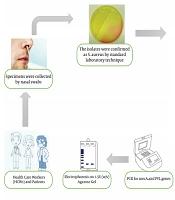
Sampling was performed twice for each patient. First sampling was performed at admission to hospital and second sampling, 48-72 hours post-admission. Patients, who were positive in the first step, were not considered. Healthcare-associated isolates (HAIs) were defined according to criteria established by The Center for Disease Control (CDC) (14). Sampling was performed by rotating a sterile cotton swab pre-wetted with sterile saline five times on the vestibule of both anterior nares (2, 15). Swabs were transported in Amies medium (Mast, Merseyside, UK) and processed within 2 h of collection. All swabs were collected by the same investigator during this study.
3.3. Culture Methods
Cotton swabs were inoculated directly on mannitol salt agar (MSA) (Merck, Germany). Each distinctive morphotype of mannitol-fermenting colonies was selected from the MSA plate, subcultured to a blood agar plate (Merck, Germany), and incubated at 37ºC in a humidified incubator. S. aureus was identified by colonial morphology, Gram’s staining, and the production of catalase, DNase, and coagulase in test tubes. Biochemical tests were performed as per the standard procedure followed routinely in our laboratory (7, 16, 17).No dual isolation was observed or required from any of the swab cultures. All S. aureus isolates were frozen at –70ºC for additional testing of organism characteristics.
3.4. Antimicrobial Susceptibility Testing
Antibiotic sensitivity tests were assessed by Kirby Bauer’s disc diffusion method, according to the guidelines published by the Clinical Laboratory Standards Institute (18). All isolates were tested by disc diffusion against a panel of antimicrobial agents including azithromycin (15 μg), chloramphenicol (30 μg), ciprofloxacin (5 μg), clindamycin (2 μg), cloxacillin (5 μg), doxycycline (30 μg), erythromycin (15 μg), gentamicin (10 μg), penicillin (10 ug), rifampicin (5 μg), trimethoprim-sulfamethoxazole (1.25 - 23.75 μg), and vancomycin (30 μg). A mupirocin (5 μg) disk was also tested, as previously described by Prates et al (17).
All the disks were obtained from MAST (Mast, Merseyside, UK). Two standard strains, MRSA (ATCC 43300) and Methicillin-sensitive S. aureus (ATCC 25923) were included in each batch of each method. Multidrug-resistant S. aureus isolates were defined as isolates resistant to three or more antimicrobial classes (19). All confirmed S. aureus isolates were subsequently tested for methicillin resistance by using Oxacillin Strips (MAST, Merseyside, UK) according to the manufacturer’s instructions.
3.5. Minimal Inhibitory Concentration (MIC)
To analyze the sensitivity patterns of MRSA strains more precisely, the MIC of oxacillin was assessed by both E-test® oxacillin strips (AB-Biodisk, Solna, Sweden) according to the manufacturer’s instructions, and the broth microdilution method using Oxacillin powder (Sigma Cat. No.28221) as recommended by the Clinical Laboratory Standards Institute (8, 17).
3.6. Detection of mecA by Polymerase Chain Reaction (PCR)
The existence of the mecA gene was confirmed for all the methicillin-resistant isolates by boiling the bacterial cells and performing PCR. The mecA gene was detected using mecA sense 5′GTAGAAATGACTGAACGTCCGATAA3′ and mecA antisense 5′CCAATTCCACATTGTTTCGGTCTAA3′ primers. The cycling parameters used were as follows: 94 °C for 4 min followed by 30 cycles of 94 °C for 45 sec, annealing at 50 °C for 45 sec, extension at 72 °C for 1 min, and a final 3-min incubation at 72 °C. The amplification products (310 bp) were analyzed by electrophoresis in 1% agarose gel stained with ethidiumbromide (8).
3.7. D-Test
Inducible clindamycin resistance was detected by the double-disk diffusion test (D test) performed by placing the clindamycin and erythromycin disks 15 mm apart in the culture (7). For both MSSA and MRSA, we defined multi-drug resistant (MDR) isolates as those resistant to three different antibiotics, i.e. co-trimoxazole, ciprofloxacin, and erythromycin (20).
3.8. Statistical Analysis
Data were entered into the Microsoft Access XP software and exported into the SPSS statistical software, version 16.0 (SPSS), which was used for data analyses. The categorical data were compared using a chi-squared test or Fisher’s exact test. All p-values were two-sided with P< 0.05 being considered statistically significant.
4. Results
4.1. Population Study
Nasal screening revealed that 223 (17.57%) of the 1269 patients studied, acquired S. aureus from the hospital. Of these, 114 (51.1%) were males and 109 (48.9%) were females, with ages ranging from 1 month to 84 years and from 1 month to 85 years, respectively. The mean age was 34.51 ± 27.15 years for males and 38.69 ± 24.6 years for females. The age of the subjects was significantly associated with S. aureus carriage (P < 0.001) with higher prevalence in the first decade of life (23.3%). The carriage prevalence in the next decades were 6.7%, 12.1%, 10.3%, 8.5%, 14.8%, 11.7%, and 12.6, respectively.
4.2. Antibiotic Sensitivity Pattern
Of the 1269 nasal specimens submitted for culture and identification, 82 (6.5%) were positive for MRSA, 141 (11%) were positive for MSSA, and 1046 (82.5%) were negative for HA- S. aureus . Of the 223 nasal carriers of HA- S. aureus , 82 (36.8%) carried MRSA and 141 (63.2%) carried MSSA. The percentage and distribution of culture-positive carriage in relation to the patients and the wards are shown in Table 1. The maximum MRSA carriage rate was observed for the infant wards (80%). There was a significant difference between the nasal carriage of MRSA and MSSA (P = 0.032) when different wards were compared.
Table 1.
Distribution of Nasal Carriage of MRSA and MSSA Among Patients by Wards, P = 0.0001
| Ward | MRSA, N = 82, No. (%) | MSSA, N = 141, No. (%) | Total |
|---|---|---|---|
| ICU | 9 (47.4) | 10 (52.6) | 19 (100) |
| Surgery | 16 (28.1) | 41 (71.9) | 57 (100) |
| Internal Medicine | 21 (42.9) | 28 (57.1) | 49 (100) |
| Gynecology | 7 (22.6) | 24 (77.4) | 31 (100) |
| Infectious | 6 (40) | 9 (60) | 15 (100) |
| Pediatric | 7 (21.9) | 25 (78.1) | 32 (100) |
| Infant | 16 (80) | 4 (20) | 20 (100) |
| Total | 82 (36.8) | 141 (63.2) | 223 (100) |
The in-vitro antibiotic sensitivity patterns for the 82 isolates of MRSA and the 141 isolates of MSSA isolates are shown in Table 2. Most of the isolates, barring MRSA, were sensitive to most of the FDA-recommended antibiotics(18). In our study, all the isolates (MRSA and MSSA) were resistant to penicillin; however, none were resistant to vancomycin or mupirocin.
Table 2.
Antibiotic Susceptibility of S . aureus Isolates (MRSA and MSSA) by Kirby-Bauer Method
| Antibiotic | MRSAa, N = 82, No. (%) | MSSAa, N = 141, No. (%) | P Value | ||||
|---|---|---|---|---|---|---|---|
| Ra | Ia | Sa | R | I | S | ||
| Azithromycin | 77 (93.9) | 0 (0.0) | 5 (6.1) | 24 (17) | 6 (4.3) | 111 (78.7) | < 0.001 |
| Chloramphenicol | 6 (7.3) | 0 (0.0) | 76 (92.7) | 5 (3.5) | 6 (4.3) | 130 (92.2) | < 0.001 |
| Ciprofloxacin | 75 (91.5) | 2 (2.4) | 5 (6.1) | 15 (10.6) | 9 (6.4) | 117 (83) | 0.083 |
| Clindamycin | 48 (58.5) | 0 (0.0) | 34 (41.5) | 14 (9.9) | 3 (2.1) | 124 (87.9) | < 0.001 |
| Cloxacillin | 75 (91.5) | 0 (0.0) | 7 (8.5) | 11 (7.8) | 0 (0.0) | 130 (92.2) | < 0.001 |
| Doxycycline | 58 (70.7) | 8 (9.8) | 16 (19.5) | 22 (15.6) | 14 (9.9) | 105 (74.5) | < 0.001 |
| Erythromycin | 73 (89) | 1 (1.2) | 8 (9.8) | 14 (9.9) | 22 (15.6) | 105 (74.5) | < 0.001 |
| Gentamicin | 58 (70.7) | 9 (11) | 15 (18.3) | 4 (2.8) | 3 (2.1) | 134 (95) | < 0.001 |
| Mupirocin | 0 (0.0) | 0 (0.0) | 82 (100) | 0 (0.0) | 0 (0.0) | 141 (100) | -b |
| Penicillin | 82 (100) | 0 (0.0) | 0 (0.0) | 141 (100) | 0 (0.0) | 0 (0.0) | < 0.001 |
| Rifampicin | 16 (19.5) | 1 (1.2) | 65 (79.3) | 1 (0.7) | 2 (1.4) | 138 (97.9) | < 0.001 |
| Sulfamethoxazole - Trimethoprim | 72 (87.8) | 1 (1.2) | 9 (11) | 22 (15.6) | 2 (1.4) | 117 (83) | |
| Vancomycin | 0 (0.0) | 0 (0.0) | 82 (100) | 0 (0.0) | 0 (0.0) | 141 (100) | - b |
a Abbreviations: MRSA, Methicillin Resistant S. aureus; MSSA, Methicillin Sensitive S. aureus, R, Resistant; I, Intermediate; S, Sensitive. The statistical analysis of the two groups (MRSA, MSSA) are defined.
b No statistics are computed because penicillin, mupirocin and vancomycin are constants.
An antimicrobial susceptibility study of MRSA isolates revealed a high resistance to azithromycin (93.9%), ciprofloxacin and cloxacillin (91.5%), erythromycin (89%), SXT (87.8%), doxycycline, and gentamicin (70.7%). A lower resistance was observed against clindamycin (58.5%), rifampicin (19.5%), and chloramphenicol (7.3%). High resistance was observed against azithromycin (17%), doxycycline and sulfamethoxazole-trimethoprime (15.6%), and ciprofloxacin (10.6) for MSSA strains. MRSA isolates showed a higher sensitivity to chloramphenicol (92.7%) and rifampicin (79.3%). Only a low percentage of the MRSA isolates were resistant to chloramphenicol (7.3%) and rifampicin (19.5%).A significant difference was observed between MRSA and MSSA strains regarding azithromycin, ciprofloxacin, clindamycin, cloxacillin, doxycycline, erythromycin, gentamicin, rifampicin and sulfamethoxazole-trimethoprime resistance (P < 0.001). Most MRSA isolates (56.1%) had MIC ≥ 2048 µg/mL for oxacillin detected by micro-dilution methods.
Frequency of oxacillin MICs for 4, 16, 32, 64, 128, 256, 512, and 1024 µg/mL were 3.7%, 2.4%, 1.2%, 3.7%, 3.7%, 4.9%, 9.8%, and 14.6% respectively. Four MSSA isolates (2.8%) and 66 MRSA isolates (80.5%) were MDR and resistant to 3 different antibiotics, namely co-trimoxazole, ciprofloxacin, and erythromycin (P = 0.0001). Constitutive, erythromycin-inducible clindamycin resistance and MS phenotype frequency were 61.1%, 22.2%, 16.7% and 31.2%, 31.2%, 37.5% for MRSA and MSSA strains respectively (P = 0.0001).
5. Discussion
Most previous studies have investigated the prevalence of carriers in community-acquired SA; however, the current study is a widespread Iranian study reporting HA- S. aureus nasal carriage rates in hospital patients (21, 22). Our study found the prevalence of HA-MRSA nasal carriage in the studied hospital to be 6.5% (82/1269), which was lower than that observed by similar studies in USA, Nepal, Korea, and another investigation in Iran regarding community-acquired MRSA (23-25). This lower frequency was probably due to the difference in the sampling site. The overall carriage rate for S. aureus (17.6%) was less than that found in another Iranian study (36.9%) and higher than that observed in Nepal (12.5%), Croatia (22%), Taiwan (75–84%), India (31–33%), Pakistan (83%), Malaysia (40%) and Korea (12.8%) (15, 25, 26).
The maximum MRSA carriage rate was found in infant wards (80%), probably because the environmental workers or nurses in these wards are carriers of or are infected with the MRSA bacteria. Askarian and coworkers in a similar study showed that 43.8% of the MRSA carriers were working in several surgical units and the emergency department (2). It should be noted that the prevalence of nasal carriage varies depending upon the quality of sampling, culture techniques, and the population studied. The prevalence of colonization with S. aureus has previously been shown to be age dependent (9, 11, 18, 20, 27). Accordingly, the frequency varies across different age groups in our study, with a higher frequency in the first 10 years of life.
As far as we are aware, the present study is the first from Iran to evaluate the susceptibility of HA-S. aureus strains, isolated from hospitalized patients, to different antibiotics. Strategies to identify MRSA colonization followed by successful decolonization may be required for patients at high risk of MRSA infection (28). In a majority of studies conducted over the years, there has been a clear indication of the progressive development of antimicrobial resistance to several antibiotics. The antimicrobial susceptibility pattern of MRSA isolates also varies with place and time. A high resistance to ciprofloxacin has been previously reported for MRSA isolates, ranging from 46% to 99%, (13, 15, 17) whereas in our study, this was 91.5%(16). This high resistance could be because of the extensive use of ciprofloxacin in Iran.
Similarly, varying levels of resistance against erythromycin have been reported worldwide (0–74.5%) (25, 27, 29-32). However, the resistance rate in Iran is considerably higher (89%), as observed in our study (21).In the present study, 87.8% of the MRSA isolates were resistant to co-trimoxazole, 91.5% to cloxacillin, and 93.9% to azithromycin. The resistance rate to co-trimoxazole varies from 19.3 – 69% in Iran (21, 24). However, methicillin resistance is known to be related to resistance toward other antibiotics (2), and this is a major problem in the treatment of S. aureus infections. As expected, all the MRSA isolates observed in this study were resistant to most antimicrobial agents tested. This finding may be important for the empirical treatment of severe infections. However, it is important to note that the present results were for carriage state and not clinical infection.
All the S. aureus isolates recovered from nasal carriers, both MRSA and MSSA, were susceptible to vancomycin and mupirocin, possibly because of the limited use of these antibiotics in Iran. Although our antibiogram results were similar to those of other studies, it should be considered that antimicrobial resistance not only varies from place to place and time to time but also depends on a number of factors such as use, abuse, availability, and consumption of antibiotics. Lastly, the existence of the mecA gene in all 82 methicillin-resistant isolates was observed by PCR. This was not observed in the oxacillin-sensitive S. aureus strains. Our results emphasize the need for continuous monitoring of antimicrobial resistance development in S. aureus isolates that are implicated in hospital-acquired infections. It cannot be overlooked that MRSA continues to emerge as a serious public health problem globally.
Our study has certain limitations. First, the persistence of MRSA colonization could not be determined in the study and the incidence of subsequent MRSA infection could not be measured. Second, this study was conducted at a single site and therefore may not reflect colonization rates throughout the country, although the institution where the study was performed was the largest in western Iran. In conclusion, our results demonstrate that nasal colonization by S. aureus was common in hospitalized patients in western Iran, emphasizing the need for continuous monitoring of the antimicrobial susceptibility pattern of S. aureus isolates, including MRSA, for the selection of appropriate therapy. Nasal MRSA colonization carries a significantly high risk of infection; therefore, in order to limit staphylococcal nosocomial infections, nasal carriers among hospital patients should be identified and appropriately treated.