1. Background
Tuberculosis (TB) is caused by the Mycobacterium tuberculosis, a member of the M. tuberculosis complex (MTBC). According to the World Health Organization (WHO), in 2010, there were an estimated 12.0 million prevalent cases of TB (equivalent to 178 cases per 100000 individuals) and approximately 1.4 million people died of TB during that year. Most of the cases in 2009 (55%) occurred in Asia (1). According to the “Administration of Tuberculosis and Leprosy Control” of the Ministry of Health and Medical Education in Iran, in 2010, a total of 10485 old and new cases of TB were reported in Iran and of these cases, 326 patients (around 2.2%) were HIV positive (2). The diseases caused by Mycobacterium complex have become more important in the recent years, particularly in association with the worldwide pandemic situation caused by Human Immunodeficiency Virus (HIV). In 2010, an estimated 1.1 million deaths occurred among HIV-negative women with TB. This was equivalent to 15 deaths per 100000 individuals. In addition, there were an estimated 0.35 million deaths among TB cases that were HIV-positive. According to WHO, the incidence of pulmonary tuberculosis in HIV-positive patients in Iran was 0.38 (0.28-0.51) per 100000 individuals in 2012 (3).
Some opportunistic microorganisms such as Nocardia spp. can mimic pulmonary tuberculosis particularly in immunocompromised patients. Nocardia spp. are Gram-positive (weakly acid fast) and filamentous with a branching appearance and are not part of the normal human bacterial flora. To date at least sixteen species capable of producing disease in humans have been identified (4). Pulmonary disease is the predominant clinical presentation of this microorganism and can be fatal if untreated. Untreated pulmonary nocardiosis is similar to tuberculosis and N. asteroids is the most frequent cause of pulmonary infection in humans (85%) (5). Since the clinical and radiological manifestations are non-specific, pulmonary nocardiosis could be mistaken with other infections or other bacterial pneumonia. In addition, nocardiosis may be under reported because it is not among the AIDS-defining criteria (6).
Diagnosis of pulmonary nocardiosis is dependent on the isolation or demonstration of the organism from respiratory secretions such as sputum or tissue specimens. Nocardia as a M. tuberculosis is a slow growing organism that requires prolonged incubation for at least 4-6 weeks (7). The diagnosis of nocardiosis is currently based on direct examination and conventional culture; serology is usually not useful. Treatment of nocardiosis is different from tuberculosis regarding therapeutic agents, route of administration and duration of therapy (8). Sulfonamides have been the agents of choice for the treatment of nocardiosis, however combination therapy with two or more agents is recommended. Although nocardiosis is an uncommon illness, co-infection of this disease with tuberculosis has been reported (9).
2. Objectives
The aim of this study was to assess the presence of Nocardia spp. and M. tuberculosis in sputum specimens of patients with pulmonary tuberculosis. In the meantime, 32 HIV-infected patients who were suspected of having pulmonary tuberculosis were included in this study in order to evaluate concomitant infection in these patients.
3. Patients and Methods
3.1. Sputum Collection and Processing
A total of 189 sputum samples were obtained from the reference mycobacteriology laboratory, Ahvaz Jundishapur University of Medical Sciences from March 2011 to April 2012. All specimens were obtained from patients with suspected pulmonary tuberculosis. Among 189 specimens, 32 were collected from hospitalized HIV-positive patients. All specimens were processed immediately according to standard routine diagnosis procedures by the NaOH/N-Acetyl-L-cysteine (NALC) method. Next, concentrated specimens were used for smear preparation, culture and PCR assay (10, 11). Furthermore, 250 µL of each concentrated sputum specimen was inoculated onto Lowenstein-Jensen (L-J) media (Merck, Germany). All cultures were incubated at 37°C with 5% CO2 and humidity. Nocardia spp. are acid fast and can survive the decontamination of clinical specimens with sodium hydroxide and NALC methods, thereby, they can grow on L-J medium. Suspicious colonies were examined with acid-fast and Gram staining methods. Cultures were examined weekly and after 8 weeks of incubation, cultures, which showed no growth, were reported negative and discarded. For microscopic examination, using a disposable Pasteur pipette, one drop of the sediment of the sputum specimen was spread on each clean microscope slide and after air drying and fixation by heat, the smears were stained by Ziehl-Neelsen and Gram staining (10).
3.2. DNA Extraction and PCR Assay
After decontamination, the chromosomal DNA was extracted using proteinase K and phenol:chloroform, and then precipitated by ethanol and isopropanol, according to standard procedures (12). The purified DNA was amplified with specific pairs of primers IS1 (5’CTCGTCCAGCGCCGCTTCGG 3’) and IS2 (5’CCTGCGAGCGTAGGCGGTGG 3’) for M. tuberculosis complex strains Ann Microbiol. The PCR protocols were optimized to 35 cycles consisting of 45 seconds at 94°C for denaturation, 30 seconds at 68°C for annealing and 30 seconds at 72°C for extension, followed by a final 5 minute extension at 72°C.
Primers NG1 (5’CTCGTCCAGCGCCGCTTCGG3’) and NG2 (5’CCTGCGAGCGTAGGCGGTGG3’) were used to amplify a Nocardia genus specific 590-bp fragment of 16S rRNA. The PCR protocols were optimized to 40 cycles consisting of 45 seconds at 94°C for denaturation, 30 seconds at 57°C for annealing and 30 seconds at 72°C for extension, followed by a final 5 minute extension at 72°C. Both reactions were performed in a final volume of 25 µL. PCR was performed as described by Eisenach et al. and Couble et al, respectively (13, 14). Primers oligonucleotides for PCR were purchased from TaG Co. (Copenhagen-Denmark).
Amplification with these primers was observed by electrophoresis on 2% (w/v) agarose gel stained with ethidium bromide (Figure 1). The N. asteroides ATCC 19247 and M. tuberculosis H37RV were used as positive reference strains. Two PCRs for each sample were performed in separate tubes with two pairs of primers. One set was dedicated to the M. tuberculosis complex, whereas the other set was for Nocardia spp. For each round of PCR, ddH2O was used as the negative template. The investigators were blinded to clinical data during the experiment for detection of microbial agents’ co-infection. All specimens were unnamed and labeled by a secure code in the reference mycobacteriology laboratory.
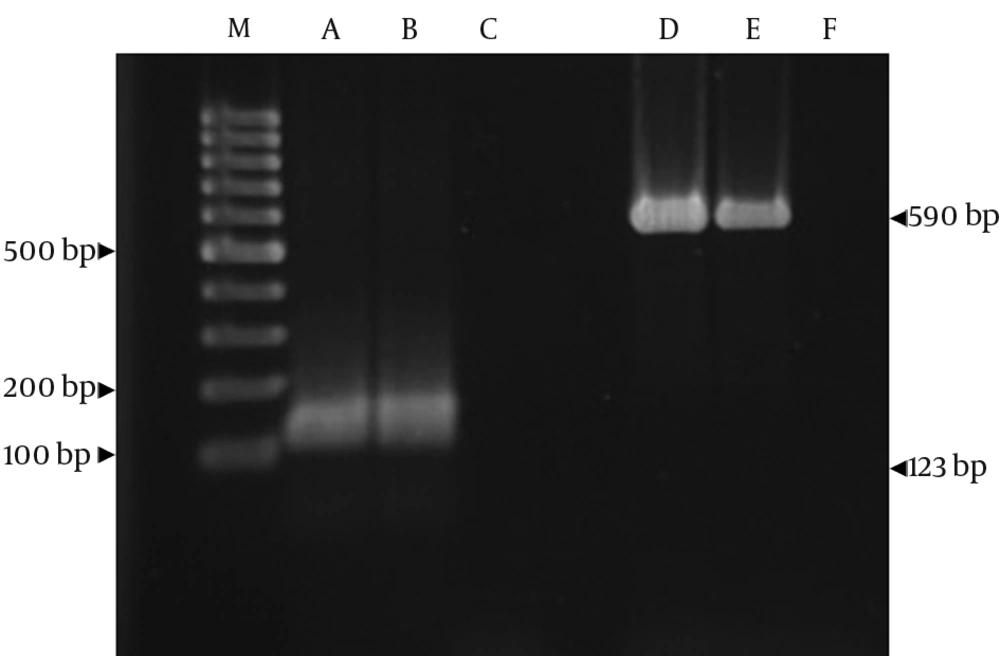
Figure 1.
A: Clinical sample of M. tuberculosis. B and C: Positive and negative controls. D: Clinical sample of Nocardia. E and F: Positive and negative controls. M; 100 bp DNA size marker
4. Results
4.1. Specimens
Among the 157 outpatients, 7.6% (12/157) of specimens had positive results for acid fast bacilli by acid fast staining but none of the samples were positive for Nocardia spp. After cultures evolution, 10.1% (16/157) of specimens had positive results for MTBC while no specimens grew Nocardia spp. During microscopic examination by the Gram staining method, we couldn’t find any particle morphologically similar to Nocardia. Out of 157 samples, 7% (11/157) were positive by PCR for MTBC and none of the samples was positive for Nocardia by PCR. Among 32 samples in HIV-infected patients, four (12.5%) were culture positive for M. tuberculosis and none of them were positive for Nocardia. Furthermore, these four samples were positive by acid fast staining and PCR assay. Out of these four samples, two were positive for Nocardia spp. by the PCR method. Based on our data the prevalence of nocardiosis and also concomitant infection with tuberculosis in our study was 6.25% (2/32) in HIV-infected patients and 1.05% (2/189) for all cases.
5. Discussion
As clinical manifestation of pulmonary tuberculosis and nocardiosis are similar, laboratory tests are required in order to distinguish of nocardiosis from tuberculosis. Nocardia is a slow growing bacteria and the contamination risk of the culture with other bacteria and fungi is high. Therefore, the suggested approach for this problem is molecular techniques, since they are more sensitive than conventional diagnostic methods (15). As two samples were positive for Nocardia spp. and MTBC using the PCR method, it is suggested that concurrent pulmonary tuberculosis and nocardiosis may developed coincidently. Nocardiosis has been reported to be more prevalent in HIV infected patients. In these patients, the incidence of nocardiosis is approximately 140 folds higher than in the general population. Infection with opportunistic agents such as Nocardia is attributed to suppression of cell mediated immunity (16).
It has been suggested that, the most common condition predisposing patients to nocardiosis is underlying chronic lung disease. In this study it was found that the coincidence of pulmonary tuberculosis and nocardiosis was 1% for the entire study population and 6.25% among HIV-infected patients. The incidence of pulmonary nocardiosis in HIV-infected patients has been previously reported by some investigators. Pulmonary nocardiosis in HIV-infected patients with suspected pulmonary tuberculosis was reported to be 3% by Alnaum et al.; they reported an average of 3-4% for this infection (17). Some reports indicate that greater than two-thirds of the patients diagnosed with pulmonary nocardiosis were initially diagnosed as having tuberculosis and about 5% of the patients with proven pulmonary tuberculosis were shown to have co-infection with Nocardia (18).
Out of 140 sputum samples from African HIV-positive individuals clinically suspected of having tuberculosis (TB), the frequency of nocardiosis was reported as 3.6% (19). In areas where HIV-associated TB is common, some patients diagnosed as smear negative pulmonary tuberculosis, might also suffer from nocardiosis. Only a few case reports of concomitant infection of Nocardia and TB have been published in the literature (20). A prevalence of 1.4% for pulmonary nocardiosis was reported in a tuberculosis and chest diseases hospital in Amritsar by Singh et al. (21). Although, Pintado et al. indicated that the overall incidence of nocardiosis among HIV-infected patients is between 0.1 and 0.4%, and is associated with high morbidity and mortality rates (18). Concurrent infection of pulmonary nocardiosis with other microorganisms is not rare. Concurrent pulmonary aspergillosis and nocardiosis was reported in an immunocompromised patient following long-term steroid therapy (22).
In this study Nocardia was not distinguished in sputum specimens using conventional methods, however, positive samples were determined using the PCR assay. Our study showed that the PCR technique was more sensitive than conventional methods in detection of Nocardia. Accordance of molecular techniques with conventional methods has been reported as 70 to 90% by several studies (22, 23).
In Iran, several studies investigated pulmonary nocardiosis or tuberculosis in patients with various clinical symptoms. Recently, Aminzade et al. reported concomitant pulmonary nocardiosis and tuberculosis in a patient with rheumatoid arthritis (24). In a study by Eshraghi and Amin, Nocardia asteroides was isolated from only one patient suffering from Cushing’s syndrome with bronchogenic carcinoma amongst 142 patients with advanced symptomatic pulmonary disease in Tehran, Iran (25). In another study from Iran (Shojaei et al.) clinical isolation of N. cyricigeorgica from patients with various clinical manifestations was performed (26). To the best of our knowledge, this is the first study reporting co-infection of nocardiosis and tuberculosis in HIV-positive patients in Iran.
Concurrent Pulmonary tuberculosis and nocardiosis is much more frequent in HIV-infected patients and can be fatal. Although nocardiosis resembles tuberculosis, first line anti-tuberculous drugs are not efficient for its treatment. Therefore, it is important to establish a potent diagnosis method with high sensitivity and specificity such as molecular methods to improve the speed of diagnosis of nocardiosis.