
1. Background
Today, sexually transmitted infections (STIs) are a main global public health problem which are among the 10 major causes of unpleasant disease in young adult men worldwide (1). While Chlamydia trachomatis (CT) known as a common bacterial cause of STIs with adverse effects (e.g. infertility), many countries have not national standard program for routine screening of male CT infections (2).
The development of current screening tests for noninvasive specimens (such as nucleic acid amplification tests (NAATs) in urine samples) with high accuracy and reliability, leads to early detection of infection in people and improvement of health outcomes in many countries (3). Infected men are more efficient in transmitting of CT to their partners with 40 to 64% spreading, compared with women that are about 21 to 35 %. Because of the burden of illness caused by asymptomatic chlamydial infections and their side effects(4, 5), detection of symptomatic/asymptomatic infected men, identification of high risk people and contact tracing of men are part of attempts to prevention and control this infection (6).
2. Objectives
The main aim of this study was to determine the prevalence of chlamydial infection in men and general population to understand the necessity of screening and comparing the related risk factors in 2 groups.
3. Material and Methods
A total of 200 males who were sexually active (15 – 50 years old), referred to Mehrad hospital in Tehran, Iran were enrolled in this study. Participants were divided in two groups including symptomatic males with urogenital signs (symptoms referable to urinary-genital tract) and asymptomatic males with no genitourinary signs. The research ethics board at Tehran University of Medical Sciences approved this study and all participants signed a consent form. Exclusion criteria included antibiotic consumption in the past 3 weeks, catheter usage and illness severity that precluded study interview (7). Personal and clinical information including age, marital status, educational level, smoking habit, history of STIs, condom usage etc. was recorded in questionnaire.
Ten milliliter of First void urine (FVU) from each person who had not urination at least for the last 2 hours, were collected in a sterile container. Biochemical analysis was done with Dipstick test on 5 mL of urine and remained samples stored at 4°C for one night to reduce the inhibitors, then centrifuged (6000 g, 30 minutes) and pellets washed with phosphate buffer saline (PBS) twice (8). DNA was extracted using DNG-Plus (Cinnagen, Tehran, Iran) according to the manufacturer instructions and stored at -70°C until use for polymerase chain reaction (PCR) (9). PCR with a final volume of 20 µL (2 µL of Master mix PCR solution, 0.5 µL forward primer, 0.5 µL reverse primer, 1 µL DNA and 16 µL water) performed over 30 cycles, including denaturation at 94°C for 40 seconds, annealing at 58°C for 45 seconds and extension at 72°C for 40 seconds, followed by a final extension step at 72°C for 8 minutes.
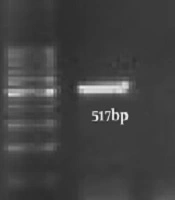
Each batch of diagnostic process was evaluated by positive and negative control (CT Serovar L2 ATCC VR 902 B and water respectively). PCR products were analyzed on 1% agarose gel through 0.5% TBE buffer and were visualized by ethidium-bromide under UV transilluminator. Statistical analyses were estimated using SPSS for windows (version 15. Chicago, Ltd, USA). Chi-square test with the level of significance defined as a P ≤ 0.05 and common odds ratio (95% CI) were used for possible association of variables. Table 1 shows the primers used in this study.
Table 1.
Primer Sequences for Detection of Cryptic Plasmid Gene
| Primer | Sequence |
|---|---|
| KL1 Sequences | 5´-TCC GGA GCG AGT TAC GAA GA-3´ |
| KL2 Sequences | 5´-AAT CAA TGC CCG GGA TTG GT-3´ |
4. Results
The prevalence of CT among 200 men recruited in this study was 8.5% (17/200). In total, 64.70% of the infected men were married and 52.9% of them were ≥ 25 years old (mean age = 34 years). Also the 58.8% of infected males had high school or diploma degree. The rate of infection in symptomatic participants was 11%, the most common symptoms reported in this group were urethral discharge, urinary frequency and dysuria consecutively. Finally, in asymptomatic males who recruited randomly with no genitourinary signs or symptoms, 6 specimens (6%) were positive.
No statistically significant difference was found between two groups applied in this study. Important medical variables, behavioral determinants and biochemical urinalysis of the men with positive CT infection are shown in Table 2, which also illustrates the results of statistical analysis for each group.
Table 2.
Important Variables in Men With Chlamydial infection
| Cause | Yes, No. (%) | No, No. (%) | P value | 95% CI | Odd’s Ratio |
|---|---|---|---|---|---|
| History of STIs | 1.559 | 0.569-4.273 | |||
| SM a | 4 (36.3) | 7 (63.6) | NS a | ||
| AM a | 3 (50) | 3 (50) | NS | ||
| Smoking | 0.504 | 0.139-1.832 | |||
| SM | 2 (18.1) | 9 (81.8) | NS | ||
| AM | 1 (16.6) | 5 (83.3) | NS | ||
| Even Heard CT Infection | 1.254 | 0.379-4.149 | |||
| SM | 3 (27.2) | 8 (72.7) | NS | ||
| AM | 1 (16.6) | 5 (83.3) | NS | ||
| Condom Usage | 0.329 | 0.116-0.139 | |||
| SM | 4 (36.3) | 7 (63.6) | NS | -- | -- |
| AM | 2 (33.3) | 4 (66.6) | ≤ 0.05 | -- | -- |
| WBC in Urine b | -- | -- | |||
| SM | 5 (45.4) | 6 (54.5) | NS | -- | -- |
| AM | 2 (33.3) | 4 (66.6) | NS | -- | -- |
| RBC in Urine b | -- | -- | |||
| SM | 3 (27.2) | 8 (72.7) | NS | -- | -- |
| AM | 1 (16.6) | 5 (83.3) | NS | -- | -- |
a Abbreviations: AM, Asymptomatic Men; SM, Symptomatic Men; NS, Not Significant
b Yes means High and No means few to moderate in Dipstick test
5. Discussion
The most important aspect in diagnosis of STIs is maintaining a high level of awareness. Chlamydial infection is the most frequently reported STIs that at least 50% of infected men are asymptomatic and commonly coexist with gonorrhea infections. Also it is one of the causes of nongonococcal urethritis (10). Although people < 25 years old are considered as a most prevalent group, but in this study, a high frequently of infection detected in men ≥ 25 years old (52.9%) which is maybe related to high old range of recruited people in this study.
Based on previous reports, the prevalence of Chlamydia infection in Iranian men differs from 6 to 10% (11, 12). Our results are similar to two studies carried out in Tehran which reported that 8.8% and 8.4% of male patients were infected with CT (13, 14). In general, the reported prevalence was 4.19% in the United States and 2.6% in China which are lower than our result of asymptomatic males (15, 16). Also infection rates were about 12.4% and 13.1% among the male referred to STIs clinics in Kuwait and Brazil respectively which are higher than our findings (17, 18).
We found it noticeable that CT infection detected in males who did not use condom, are three times more than those who used condom (OR = 0.33). This finding is similar to a study conducted in United States which indicated that condom usage is significantly associated with a 90% reduction in the total prevalence (19). Although there are established studies linking that high burden of illness occurrence by CT at high risk population and many recommendations for routine screening to reduce healthcare costs in society, but there is no strategy for screening of males in Iran. Finally, we found it reasonable to suggest that all sexually active males with any genitourinary symptoms be offered to screen the CT infection with sensitive and fast diagnostic assays such as NAATs.