
1. Background
Urinary tract infections (UTIs) are common bacterial infections associated with considerable morbidity and health care cost (1). Escherichia coli strains capable of causing disease outside the gastrointestinal tract belong to a diverse group of isolates referred to as uropathogenic E. coli (UPEC) (2). UPEC expresses a multitude of virulence factors to break the inertia of the mucosal barrier (3). The ability of these bacteria to adhere to host epithelial cells is considered a prerequisite for the establishment of infectious diseases, mainly through expression of fimbriae (4, 5). UPEC generally possesses type 1 and P fimbriae (6). Type 1 fimbriae are characterized as having the ability to agglutinate chicken and guinea pig erythrocytes in the absence of D mannose (7). They consist of a major protein, FimA, associated with ancillary proteins FimF, FimG, and the adhesin protein FimH, encoded by the fim gene cluster (8-10). This type of fimbria is common among Enterobacteriaceae, also several variants have been strongly associated with UPEC (11). Their role in infection is unclear, although it has been suggested that they may be involved in the initial stages of colonizing in the upper respiratory tract (11, 12).
Of the adhesion-encoding genes studied, pap, sfa, and afa are prevalent in E. coli strains associated with urinary tract infections (pyelonephritis) in humans (13, 14). The pap gene cluster consists of 11 genes encoding the main component of the pilus rod (PapA), which determines 11 different serogroups, and a terminally located adhesion, PapG (15, 16). The afimbrial adhesion from a pyelonephritic E. coli isolate is P-independent, X-binding adhesion, expressed by the afa-1 operon (17) mediating the specific binding to uroepithelial cell and human erythrocyte-receptors (18). The nature of the receptor on the eukaryotic cell surface is still unknown. The S fimbriae are mannose-resistant adhesions, encoded by the sfa operon of uropathogenic E. coli (9). The presence of S fimbriae is also correlated with pathogenicity of E. coli in human meningitis and septicemia (19). The distribution pattern of afimbrial adhesin, S fimbriae and group II capsule synthesis such as foc and afa in the UPEC strains is still unclear in different parts of Iran. The purpose of this study was to compare the occurrence of fim, pap, sfa, and afa genes in E. coli strains isolated from patients with urinary tract infection residing in the southeast of Iran.
2. Objectives
This study aimed to evaluate the prevalence of different operons encoding for virulence factors among E. coli strains isolated from the urine of the patients with UTI.
3. Materials and Methods
3.1. Bacterial Isolates
One hundred non-duplicate E. coli isolates were recovered by urine culture from 250 consecutive adult patients with community-acquired pyelonephritis or cystitis over a period ranging from April to September 2013 in Zabol, Iran. The isolation and identification of E. coli isolates were performed by standard bacteriological and biochemical tests using Gram staining, catalase test, indole, methyl red, Voges-Proskauer test, nitrate reduction, urease production, Simmons citrate agar, and various sugar fermentation tests (20-22). The bacteria were maintained in Tryptic Soy Broth (TSB) (Sigma; The USA) with Glycerol at -70°C.
3.2. Clinical Data
The diagnosis of acute pyelonephritis and cystitis was based on the cytobacteriologic examination of urine and clinical investigation. UTI was defined as the presence of a positive urine culture (≥ 105 colony-forming units (cfu)/mL) and pyuria (≥ 104 leukocytes/mL of clean voided urine) (13). Diagnostic criteria for acute pyelonephritis were dysuria, temperature of ≥ 38.5°C, leukocyturia of > 105 mL, and no other identifiable source of infection (23).
3.3. Bacterial Culture and DNA Extraction
DNA extraction was performed using an optimized boiling method. E. coli strains were grown in Luria-Bertani (LB) Broth (Lonza; The USA) at 37°C overnight. Bacteria were pelleted from 1.5 mL LB broth and suspended in 200 ul of sterile distilled water, then incubated at 100°C for 10 minutes and centrifuged. One hundred microliters of the supernatant was stored at -20°C as a template DNA stock (13).
3.4. Polymerase Chain Reaction Amplification
Specific primers were used to amplify sequences of the fim, pap, sfa/foc, and afa operons. Details of primer sequences, predicted sizes of the amplified products, and specific annealing temperatures are shown in Table 1. Detection of adhesin-encoding operons (pap, sfa, and afa) and fim sequences was done by multiplex PCR.
Table 1.
Primers and Cycling Conditions Used for Amplification of Fimbriae Genes
| Gene | Sequence (5’ to 3’) | Size, bp | Cycling Conditions | Reference |
|---|---|---|---|---|
| fim | GTTGTTCTGTCGGCTCTGTC TAAATGTCGCACCATCCAG | 400 | 95°C for 4 min; 35 cycles of 95°C for 30 s, 55°C for 30 s, 72°C for 40 s; 72°C for 3 min | (24) |
| pap | GACGGCTGTACTGCAGGGTGTGGCG ATATCCTTTCTGCAGGGATGCAATA | 328 | 95°C for 4 min; 35 cycles of 95°C for 60 s, 65°C for 60 s, 72°C for 60 s; 72°C for 2 min | (25) |
| sfa | CCGTAAAGATGTCTGCGAG AGCAAGTCTGGCAACGAG | 100 | 95°C for 4 min; 35 cycles of 95°C for 30 s, 53°C for 30 s, 72°C for 40 s; 72°C for 3 min | (24) |
| foc | GGTGGAACCGCAGAAAATAC GAACTGTTGGGGAAAGAGTG | 388 | 95°C for 4 min; 35 cycles of 95°C for 60 s, 58°C for 60 s, 72°C for 120 s; 72°C for 10 min | (26) |
| afa | GCTGGGCAGCAAACTGATAACTCTC CATCAAGCTGTTTGTTCGTCCGCCG | 750 | 95°C for 5 min; 35 cycles of 95°C for 60 s, 60°C for 30 s, 72°C for 180 s; 72°C for 7 min | (25) |
The reactions (25 μL) consisted of 10-pmol/L of each primer, 2 μL templates DNA, and 12.5 μL of a ready-to-use 2X PCR Master Mix Red (Ampliqon; Denmark) (27), with the following amplification conditions: an initial denaturation at 94°C for 10 minutes, followed by 35 DNA cycles of denaturation at 94°C for 2 minutes, annealing at a specific temperature for 30 seconds (Table 1), and extension at 72°C for 1 minute. A 5 µL aliquot of the PCR product underwent gel electrophoresis on agarose 2%, followed by staining with ethidium bromide solution. Amplified DNA elements of specific sizes were detected by UV-induced fluorescence and the size of the amplicons was estimated by comparing them with the 1 kb DNA ladder (Promega; Madison, WI, the United States of America) included on the same gel (Figure 1). The phylogenetic group to which the E. coli strains belonged was determined by a PCR-based method as described previously (28). The data of the 3 amplifications resulted in the assignment of the strains to phylogenetic groups as follows: chuA+, yjaA+, group B2; chuA+, yjaA-, group D; chuA-, TspE4.C2+, groupB1; chuA-, TspE4.C2-, group A (28).
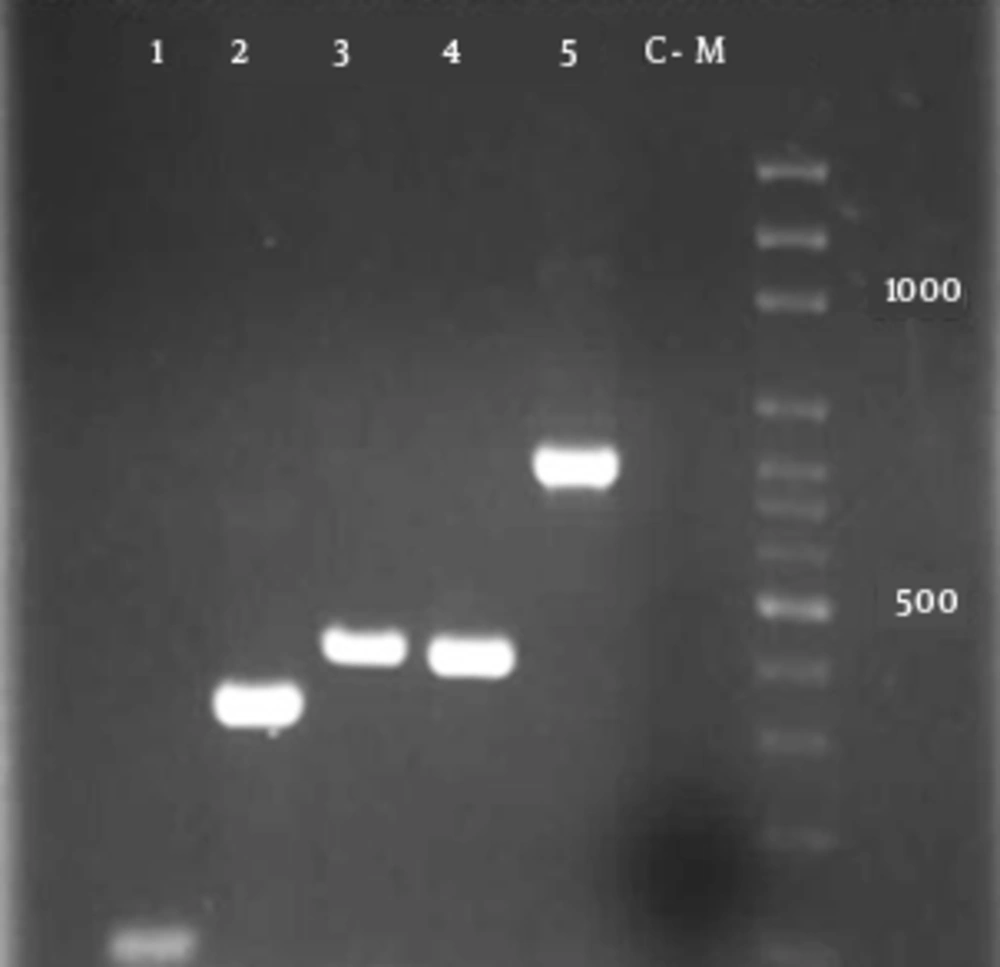
Figure 1.
Lane M: Molecular weight marker 100 bp DNA ladder; Lane 1: amplified sfa 100 bp; Lane 2: amplified pap gene 328 bp; Lane 3: amplified fim gene 400 bp; Lane 4: amplified foc gene 388 bp and Lane 5: amplified afa gene 750 bp.
4. Results
The frequencies of the studied virulence genes are reported in Tables 2 and 3. With regard to adhesin virulence determinants, fim gene was the most common virulence gene and detected in 95% (95 out of 100) of the UTI isolates. Next, pap gene was present in 57% (57 out of 100) of isolates and sfa gene in 81% of isolates. Finally, afa and foc genes were found in 12% and 16% of isolates, respectively. One isolate was negative for all virulence genes. Based on the distribution of the various targeted sequences, all studied strains exhibited 16 virulence gene patterns, referred to as Ec (Table 2). Ec5 was characterized by the presence of fim operon only, and was the most noted pattern, found in 8 isolates. However, among 95% of isolates that were fim-positive, 2% harbored the foc gene and the other 85% exhibited distinct diversity of gene patterns (Ec1 - 4, Ec6, Ec8 - 9, and Ec12 - 15). Out of 100 UPEC isolates tested by PCR, 36% carried sequences related to the 3 adhesion-encoding (fim, sfa, and pap) operon families.
When the strains recovered from all the populations were considered, B2 and D group strains were the most common (55 and 22%, respectively), followed by A group strains (17%). B1 group strains were rare (6%) (Table 3). Most of the known extraintestinal VFs (pap, sfa, and fim genes) were concentrated within groups B2 or D, whereas foc gene was more broadly distributed between phylogenetic groups B2 and A (Table 3). Of the isolates tested, a few isolates belonged to either phylogenetic group (A, B1, and D) were positive for pap, afa, foc and sfa operons, compared to phylogenetic group B2. Evaluation of the foc operon indicated its presence in 1% and 16% of isolates belonged to phylogenetic groups A and B2, respectively, but it was not observed in phylogenetic groups B1 and D isolates (Table 3).
Table 2.
Virulence Patterns Identified Among the Studied Strains
| Pattern | Virulence Gene | ||||||
|---|---|---|---|---|---|---|---|
| fim | sfa | pap | foc | afa | No. of Strains | Phylogenetic Group | |
| Ec1 | + | + | + | + | + | 1 | B2 |
| Ec2 | + | + | + | + | - | 9 | B2 |
| Ec3 | + | + | + | - | - | 36 | A, B1, B2, and D |
| Ec4 | + | + | - | - | - | 21 | A, B1, B2, and D |
| Ec5 | + | - | - | - | - | 8 | A, B1, B2, and D |
| Ec6 | + | - | + | + | - | 1 | B2 |
| Ec7 | - | + | + | + | + | 2 | B2 and A |
| Ec8 | + | + | + | - | + | 2 | B2 and D |
| Ec9 | + | + | - | + | - | 3 | B2 |
| Ec10 | + | - | + | - | - | 5 | B2 and D |
| Ec11 | - | + | - | - | + | 2 | A and D |
| Ec12 | + | + | - | - | + | 5 | B2, D, and A |
| Ec13 | + | - | - | + | - | 2 | B2 and A |
| Ec14 | + | - | - | - | + | 1 | B2 |
| Ec15 | + | - | + | - | + | 1 | B2 |
| Ec16 | - | - | - | - | - | 1 | A |
| Total | 95 | 81 | 57 | 16 | 12 | 100 | |
Table 3.
Phylogenetic Distribution of Virulence Genes
| Ph. Group (N) | Virulence Gene | ||||
|---|---|---|---|---|---|
| Fim | sfa | pap | foc | afa | |
| A (17) | 14 | 12 | 2 | 1 | 2 |
| B1 (6) | 5 | 5 | 3 | 0 | 0 |
| B2 (55) | 55 | 46 | 46 | 16 | 5 |
| D (22) | 21 | 18 | 6 | 0 | 5 |
| TOTAL (100) | 95 | 81 | 57 | 17 | 12 |
5. Discussion
Escherichia coli causes the vast majority of UTIs in both ambulatory and hospitalized patients (29). The degree of severity depends on the virulence of the responsible strains and susceptibility of the host, particularly if there is a concomitant urological illness. A better knowledge of the virulence characteristics of the microorganism causing the infection will allow the clinician to anticipate, up to a point, the evolution of infection in the patient. To the best of our knowledge, our study was the first to demonstrate associations between E. coli adhesin-encoding operons and UTI in Iran. Several virulence determinants contribute to the pathogenicity of E. coli in UTI (17, 19, 27). They are the product of different genes, which can be detected by PCR method (9, 22). However, there is always the possibility of mutation at the level of the corresponding gene, leading to the absence of its detection. Therefore, a positive PCR shows the presence of the virulence gene, but a negative PCR does not rule out the presence of the corresponding operon. However, this phenomenon remains scarce.
Genes coding for adhesive systems represent the most common factors for the virulence of E. coli in UTI. The distribution of adhesin-encoding operons in our strains was in agreement with other published data (30-32). The present data indicate the crucial role of these adhesin-encoding operons in E. coli-associated UTI (33, 34). Moreover, an important role of pap adhesion genes in the pathophysiology of UTIs caused by E. coli has been reported in several studies (32, 35). In addition, the presence of foc and afa virulence genes was 16% and 12%, respectively. The presence of combined pap and afa virulence genes was observed in 50% of isolates, indicating high presence of virulence genes in isolates collected from patients with UTIs in Iran as described (32, 36). The presence of higher number of observed combined pap and sfa genes was in accordance with other reports (30-32). The higher number of isolates having pap and sfa genes together as compared to other combinations could be due to the localization of these genes on the same pathogenicity island of UPEC strains (37). Our results show a higher frequency of fim operon compared to the rest of the genes, which may indicate a crucial role of the virulence genes in E. coli causing UTI.
Regarding P fimbriae, our results are inconsistent with those of many studies, indicating that among patients with UTIs, 57% possess P fimbriae (13, 32). The difference of occurrence in the percentage of the structural adhesins (P fimbriae) may be due to the different environmental niches prevailing at the two different host sites, as described previously (38). In contrast to other studies, the sfa operon was observed in 80% in UTIs isolates (13, 35, 39). This may indicate that sfa operon plays an important role in causing UTI in Zabol, southeast of Iran. In addition, we propose a more significant role for fim, pap, and sfa operons in the generation of UTI. Based on the distribution of the various target sequences, the strains studied exhibited 16 most common virulence patterns, referred to as Ec followed by an Arabic numeral (Table 2). The UTIs isolates exhibited a great diversity of gene patterns, showing Ec1, Ec2, Ec3, and Ec16 patterns that were in agreement with other report (13, 40). The presence of the foc operon together with the pap operon was detected in the same strains as the Ec1, Ec2, Ec6, and Ec9 pattern (Table 2); this association had been previously reported (13). A codependence of these virulence factors in a particular pathogenic pathway has been discussed (40) but needs to be confirmed.
When phylogenetic analysis of these virulence factors is done, a striking difference was observed between the foc operon on one hand, and the other pathogenic determinants, including the fim, sfa, and pap operon, on the other hand. The foc operon is strictly restricted to strains of the phylogenetic B2 group (16 out of 17) and phylogenetic A group (1 out of 17) (Table 3). Similarly, Maslow et al. (41) reported that within adult bloodstream isolates, the presence of this operon was restricted to one cluster. In contrast, the other pathogenic determinants, although being predominant in the B2 group, are also distributed among the other phylogenetic groups. It can be proposed that most of the genes needed for causing neonatal meningitis belonged to the E. coli B2 phylogenetic group initially and horizontal transfer of these genes has occurred toward the more genetically distant groups.
In conclusion, our study showed that: 1) a high prevalence of fin, pap, and sfa operon may be responsible for UTIs, 2) the characterization of E. coli strains isolated from UTI is of great interest to improve our knowledge regarding their virulence genetic determinants, (3) further studies are needed to identify E. coli virulence factors responsible for UTI and to determine the physiopathology of these infections to consider possible preventive measures.