1. Background
Demodex species that mostly live in the hair follicle of the human face were detected in various places of the human body, such as chin, external ear canal, cheeks, back, buttocks, nipples, and penis. It has been stated that the pathogenicity may increase against these mites because of poor skin hygiene, oily skin, increasing of age and suppressed immune system (1, 2).
It has been reported that the Demodex species which can be infested in human are found common all over the world regardless of racial differences (2-4). Approximately, 80% - 90% of people were reported to be infected by Demodex. However, the incidence was higher in women than in men (5). Coexistence of various risk factors that play a role in the development of cardiovascular disease, and it’s being thought to share a common pathogenesis is defined as metabolic syndrome (MetS) (6).
Metabolic syndrome is a group of diseases in which multiple cardiovascular risk factors heap together and arises due to genetic and environmental factors in an individual. The main components of MetS are ranked as hyperglycemia, hypertension, dyslipidemia, visceral obesity, and hypercoagulability. Due to lifestyle changes in developed and developing countries, MetS has become an epidemic and it leads to an increase in cardiovascular diseases caused by atherosclerosis (7, 8).
Metabolic syndrome is an important risk factor in women for chronic diseases (9). Also, MetS is a major public health problem that settled in the first place among the causes of death in the world and in Turkey because of reducing the quality of life and being risk for cardiovascular diseases, its incidence is increasing day by day. The incidence of MetS varies depending on lifestyle and eating habits of society. The incidence of MetS in Turkey is quite high as it is 25% for males and 40% for females. These rates increase with age, while the rate is 6.7% in the 20 - 29 age group, it increases to 43.5% for the 60 - 90 age group. According to Turkey metabolic syndrome research (METSAR), which is a study conducted to research MetS in Turkey, more than one-third of the population over the age of 20 (35%) are faced with the problem of MetS (10).
2. Objectives
The aim of this study was to determine the prevalence of Demodex species in healthy women and the relationship between the incidence of Demodex and MetS.
3. Patients and Methods
Women aged 20 years and over who reside in the central district of Malatya Province, Turkey, consisted of the population of the research. The number of women 20 years and older was identified as 151,498 in 5% confidence interval of sample size,while the design effect was 1.5 it was calculated as 552 individuals and while the design effect was 2 it was calculated as 736 individuals. The sample size formula is (N× t2× p × q /d2× (N- 1) + t2× p × q).
(1)
The World Health Organization 30 cluster sampling method was used to select the samples. Thus, all the family health centers in the city center, the regional population served by the health centers, and the region’s geographical borders (neighborhoods, streets, and villages) were determined primarily. Health home region was determined as a cluster unit and the 30 clusters to be the samples were selected using the systematic sampling method after the receipt of cumulative total of the population of the health home.
There are 25 health centers and 239 health stations in the center of Malatya. Health stations were enumerated and a table is formed by taking the cumulative population that they are connected. Approximately, 20 to 25 people were reached from each cluster. The women aged ≥ 20 years who were not pregnant or lactating were included in the study. By reaching a total of 669 subjects, 90.89% of the largest sample were accessed.
3.1. Collection of Samples for the Metabolic Syndrome
The blood pressure measurements were performed with a sleeved sphygmomanometer while the subjects were sitting in upright and back supported position and from their right arms. The subjects refrained from smoking and ingesting caffeine (coffee and cola) for 30 minutes. Measurements of both right and left arms were performed, after two minutes a second measurement was taken from the higher measured arm. If the difference between the first and second measurements was greater than 5 mmHg, a third measurement was provided and the average of two measurements was taken.
The waist circumference was measured with a backed tape measure with constant voltage from the middle part of the body that is between the lower rib border and process spine iliac superior anterior, over the hub parallel to the floor while the patient was standing and this area of the patient’s was naked. The body mass index was calculated by dividing the weight of body in kilograms by the square of height in meters.
3.2. Biochemical Parameters and Analysis Methods
The levels of fasting blood sugar (glucose), triglycerides, total cholesterol, and high density lipoprotein (HDL) cholesterol were analyzed using the Abbott-Aeroset auto analyzer (Abbott Laboratories, Abbott Park, IL, USA) and the original Abbott kits (Abbott Wiseba, Germany) which was available in the Turgut Ozal Medical Center Biochemistry Laboratory. In the analysis, the following measurement methods were used in sequence:(1) For the measurement of glucose, the enzymatic UV hexokinase/G-6-PDH (glucose-6-phosphate dehydrogenase) analysis method was used; (2) for the triglyceride measurement, the enzymatic colorimetric glycerol phosphate oxidase analysis method was used; (3) total cholesterol was measured using the enzymatic colorimetric cholesterol oxidase analysis method; (4) for the measurement of HDL-cholesterol, accelerated with specific poly anion detergent, no precipitated, direct, uniform measurement method was used.
Each subject included in the study filled out and signed a patient information form and after that the samples were collected from the face of each subject using a standard superficial skin biopsy method and then by turning it into preparations with Entellan, it was examined with x40 and x100 magnifications under a light microscope, the Demodex spp. density was evaluated in square centimeters.
3.3. Collection of Samples With Standard Skin Surface Biopsy
Patients’ information is written on the lam. Before sampling, it has been paid attention that there will not any substances on the woman’s face, such as creams, lotions and so on and the skin to be taken should be dry. A drop of cyanoacrylate containing adhesive was added to the lam then the adhesive side was pressed on the patient’s skin and kept for about 1 minute. The slide was removed slowly from the skin with a single move at the end of time and then by turning it into preparations with Entellan it was examined with ×40 and ×100 magnifications under a light microscope. Demodex spp. density was evaluated per cm2 in the prepared samples (5).
3.4. Statistical Analysis
For the statistical analysis of the data obtained in this study, SPSS (Inc. Chicago, Illinois, USA) was used. The chi-square test and Fisher’s exact test were used for statistical analysis. For all evaluations, P values < 0.05 were considered statistically significant.
4. Results
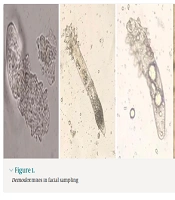
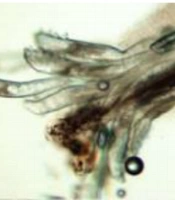
In the study, 669 women were examined in terms of Demodex mites and in 39.2% of them the parasites were detected. Only 3 of the samples were Demodex brevis and the others were identified as Demodex folliculorum. In the analysis of chi-square, no significant relationship was found between the incidence of the parasite, age, education level, occupation, marital status, family type, and MetS. However, there is a significant relationship between diastolic pressure and those who fed with fatty foods and the incidence of the parasite (P < 0.05). The incidence of parasite is given in Table 1.
Table 1.
Distribution of Demodex According to Various Variables a
| Survey Questions | Demodex | |||
|---|---|---|---|---|
| + | - | Total b | P | |
| Age, y | 0.326 | |||
| 20 - 29 | 42 (38.3) | 66 (61.7) | 107 | |
| 30 - 39 | 84 (37.1) | 141 (62.9) | 224 | |
| 40 - 49 | 72 (45.6) | 86 (54.4) | 158 | |
| 50 - 59 | 42 (39.8) | 62 (60.2) | 103 | |
| ≥ 60 | 25 (32.5) | 52 (67.5) | 77 | |
| Educational status | 0.763 | |||
| Literate | 80 (39.4) | 123 (60.6) | 203 | |
| Primary education | 98 (37.6) | 159 (62.4) | 255 | |
| Secondary education | 19 (34.5) | 36 (65.5) | 55 | |
| High school | 40 (41.7) | 56 (58.3) | 96 | |
| University | 28 (45.0) | 33 (55.0) | 60 | |
| Profession | 0.265 | |||
| Housewife | 220 (38.3) | 350 (61.7) | 567 | |
| Other | 45 (44.1) | 57 (55.9) | 102 | |
| Marital status | 0.295 | |||
| Married | 226 (10.5) | 329 (59.5) | 553 | |
| Single | 16 (31.9) | 32 (68.1) | 47 | |
| Widowed | 23 (33.3) | 46 (66.7) | 69 | |
| Living situation | 0.091 | |||
| Nuclear family | 223 (40.7) | 322 (59.3) | 543 | |
| Extended family | 42 (32.5) | 85 (67.5) | 126 | |
| Metabolic syndrome | 0.326 | |||
| No | 174 (38.0) | 281 (62.0) | 453 | |
| Yes | 83 (40.4) | 121 (59.6) | 203 | |
a The values are presented as No. (%).
b % = 100.
5. Discussion
Demodex is the most common mite in humans, and there are various opinions about its pathogenicity (2, 3). Demodex infection can be transmitted directly by close contact with the infected people. In addition, it can be transmitted indirectly by contaminated towels, combs, blankets, and bath sponge and night clothes (5).
There are various studies about the epidemiology of the parasite. Of these in the studies about the incidence of D. folliculorum and D. brevis in female patients; Roihu et al. (11) 30%, Baysal et al. (12) 67% (11.9%), Aycan et al. (13) 49.6%, Nutting et al. (14) 80%, Yagdiran et al. (15) 56.3%, Kemal et al. (16) 24.1%, Moravvej et al. (17) 40.8%, Georgala et al. (18) 71.7% and, Hu and Wang (19) 48.7% mite positivity have determined. On the other hand, the researchers have reported that there is no significant difference between the sexes in the percentage incidence of the parasite. In the study, 669 women were examined in terms of Demodex positivity and 39.2% of parasites were detected. Although this positivity rate was similar to other studies, all of the study group was consisted of healthy women.
In the studies on healthy students, the author and colleagues (20) carried out investigation on 75 females, 96 males, a total of 171 healthy university students between 19 and 30 years old in terms of Demodex spp. using the cellophane tape method and found positivity (2.9%) in 5 of 96 male students. Again, Zhao et al. (21) investigated Demodex positivity in 756 students between the ages of 13 - 22. The researchers compared Demodex positivity with socio-demographic characteristics. In conclusion, they have reported that there is no significant relationship between gender, place of residence, plumbing, daily face care and using facial cleanser. However, the researchers have found a significant relationship between age, type of skin and skin disorders with the incidence of Demodex in the same study. Ding et al. (22) examined the secretion of the external auditory canal of 613 high school students and found Demodex in 11.58% of them. In this study, the rate was found as 39.2% in the healthy women aged 20 years and over. Again, the Demodex positivity in 40-49-year old people was found higher than the other age groups (45.6%). However, no significant relationship was detected in chi-square analysis. This situation may be due to the methods used and the selected age group.
Clinically significant symptoms have been detected in the studies on the patients with Demodex positive. According to the researchers, the causes of this condition were that the importance of density in the pathogenicity of the Demodex, (23). In the accessible source information, Zhao et al. (23) found 43% of positivity in 860 patients who diagnosed with Demodex dermatitis. Researchers found a significant relationship between rosacea, steroid-induced dermatitis, seborrhoeic dermatitis and primary and irritation with Demodex positivity. Similarly, Yucel and Yilmaz (24) found parasite in patients with rosacea as 60.7%. Ozcelik et al. (25) found parasite in 6 patients with chronic renal failure. Researchers have reported that the Demodex may be a factor in eye diseases such as blepharitis. However, Karaman et al. (26) have reported that parasites can be seen on hair skin in pathological conditions and it may play a role in the pathogenesis of the disease. Firat et al. (27) found 74.7% of the parasite between health care workers without any complaints. In the study, the epidemiology of the parasite has been identified in healthy women in the province of Malatya.
Different methods have been used in the studies. In diagnosis, many methods are used such as object slide with cellophane, skin samples, punch biopsy and Standart Skin Surface Biopsy (SSSB). In order to determine the pathogenicity of parasite, measuring the mite density in cm2 is important. In the studies it has been reported that SSSB is an effective method for determining the mite density in cm2 (21). Standart skin surface biopsy (SSSB) method is used in the study, which is effective in the diagnosis of parasite.
The SSSB method which is reported to be effective in the diagnosis of parasite has been used in the study. In the analysis of chi-square, no significant relationship was found between the incidence of the parasite, age, education level, occupation, marital status, family type and MetS. However, there was a significant relationship between diastolic pressure and those who fed with fatty foods and the incidence of the parasite.
According to the results of the present study, the MetS has no effect on the frequency of occurrence of the parasite, however; weight, fatty foods, and high diastolic pressure are associated with the frequency of occurrence of the parasite. The effects of these factors to the frequency of occurrence of the parasite should be supported by further study designs.