
1. Background
Streptococcus agalactiae (Group B streptococcus, GBS) is a leading cause of neonatal sepsis, meningitis, and pneumonia in infants (1, 2). Pregnant women who carry GBS in their vaginas are at risk of infecting their infants with GBS (3). Vaginal colonization occurs in 11-30% of all pregnant women, and 50% - 75% of their infants become colonized, usually during labor or birth. The intrapartum colonization is strongly associated with early onset GBS sepsis, with a fatality rate of approximately 4% and serious morbidities including sepsis, pneumonia, meningitis, osteomyelitis, and septic arthritis (4).
GBS capsular polysaccharide (CPS), which is recognized to be the main virulence factor, has recently been classified into ten serotypes: Ia, Ib and II- IX (Johri et al. 2006 and Slotved et al. 2007) (5, 6). In addition, the surface proteins of GBS are virulence factors that could be used as vaccine candidates, including Alpha-c, Rib, Alp2, Alp3, Alp4, and Epsilon protein (7-10).
GBS serotype III is the major cause of meningitis in late onset disease (LOD), and subtype III-2 was more virulent based on previous studies (11); in early onset disease (EOD), the GBS serotype Ia is common (12). The GBS serotype distribution has geographic differences and understanding it is important for the future development and consideration of a protective vaccine (13).
2. Objectives
Since the serotyping and genotyping data of GBS is limited in Iran, therefore the determination of GBS prevalence and distribution of capsular serotypes, serotype III subtypes, together with surface proteins, among the women referred to our gynecology clinic were the main aim of this study.
3. Patients and Methods
3.1. Study Population and Bacterial Isolation
The investigation was conducted on 650 (237 pregnant and 413 non-pregnant) women aged 15 - 40 years who attended the gynecology clinic in Yazd, Iran between April 2013 and April 2014. Appropriate informed consents were achieved before recto-vaginal swab samples were collected. The swabs were placed into sterile tubes that contained 3 - 4 drops of normal saline and then transferred to a microbiology laboratory. The swabs were immediately inoculated on blood agar medium (Merck, Germany) and incubated at 35°C for 24 hours.
3.2. GBS Isolates Confirmation
Plates were inspected for β-hemolytic colonies and Streptococci were identified according to standard laboratory procedures. In brief, colonies were observed for β-hemolysis, and a bacitracin test was done on β-hemolytic colonies. Bacitracin-resistant colonies were identified as group B Streptococci (GBS). Further differential tests, including CAMP and hipurate hydrolysis, were performed on each isolate.
Gram positive Streptococcus with positive CAMP and hyporate but negative for catalase was reported as GBS for further study.
Reference strain set 389 (Ia/ Alpha-c), 337 (Ib/ Alpha-c), 698 (II/ Alp4), 453 (III/ Rib), 669 (IV/ Epsilon), 1523 (V/Alp3), 1571 (VI/ Epsilon), 1603 (VII/ Alp3), and 1608 (VIII/ Alp3), from the centre for infectious diseases and microbiology laboratory services, institute of clinical pathology and medical research, Westmead, New South Wales, Australia were used as mPCR-positive controls.
3.3. DNA Extraction
After overnight inoculation of GBS, DNA was extracted from blood agar medium using a DNA purification kit (Gen All, South Korea) according to the manufacturer’s instructions.
3.4. Molecular Detection of GBS
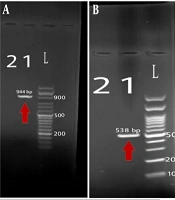
Molecular detection was performed based on Poyart et al. (2007) (14), using the specific primer pairs of dlts-F and dlts-R (Table 1). Amplifications were done using 1X PCR buffer (10X, CinnaGen, Iran), 1.5 mM MgCl2 (50 mM, CinnaGen, Iran), 0.2 mM dNTPS (10 mM, CinnaGen, Iran), 10 pmol of each primer (dltS) (Takapouzist, Iran), and two units of Taq DNA polymerase (5 U/mL, CinnaGen, Iran). The PCR program was done by a first denaturation at 94°C for 5 minutes, followed by 35 cycles of denaturation at 94°C for 1 minute, annealing at 55°C for 1 minute, and an extension at 72°C for 1 minute. The final extension was done at 72°C for 5 minutes. The amplicons were analyzed using 1% agarose gel and visualized with a gel imager (Life Technologies, USA).
Table 1.
CPS Type-Specific Primers and Amplicon Size of PCR Products (14)
| Primer Name | Sequence | Gene Target (s) | Amplicon Size (s), bp |
|---|---|---|---|
| Ia-F | GGTCAGACTGGATTAATGGTATGC | cps1aH | 521 and 1,826 |
| Ia-R | GTAGAAATAGCCTATATACGTTGAATGC | cps1aH | |
| Ib-F | TAAACGAGAATGGAATATCACAAACC | cps1bJ | 770 |
| Ib-R | GAATTAACTTCAATCCCTAAACAATATCG | cpsIbK | |
| II-F | GCTTCAGTAAGTATTGTAAGACGATAG | cps2K | 397 |
| II-R | TTCTCTAGGAAATCAAATAATTCTATAGGG | cps2K | |
| III-F | TCCGTACTACAACAGACTCATCC | cps1a/2/3I | 1,826 |
| III-R | AGTAACCGTCCATACATTCTATAAGC | cps1a/2/3J | |
| IV-F | GGTGGTAATCCTAAGAGTGAACTGT | cps4N | 578 |
| IV-R | CCTCCCCAATTTCGTCCATAATGGT | cps4N | |
| V-F | GAGGCCAATCAGTTGCACGTAA | cps5O | 701 |
| V-R | AACCTTCTCCTTCACACTAATCCT | cps5O | |
| VI-F | GGACTTGAGATGGCAGAAGGTGAA | cps6I | 487 |
| VI-R | CTGTCGGACTATCCTGATGAATCTC | cps6I | |
| VII-F | CCTGGAGAGAACAATGTCCAGAT | cps7M | 371 |
| VII-R | GCTGGTCGTGATTTCTACACA | cps7M | |
| VIII-F | AGGTCAACCACTATATAGCGA | cps8J | 282 |
| VIII-R | TCTTCAAATTCCGCTGACTT | cps8J | |
| dltS-F | AGGAATACCAGGCGATGAACCGAT | dltS | 952 |
| dltS-R | TGCTCTAATTCTCCCCTTATGGC | dltS |
3.5. Molecular Serotyping
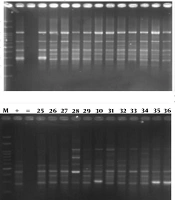
Molecular serotyping was performed using two sets of multiplex PCR reactions (Table 1). Amplification of both multiplex reactions were done using 1X PCR buffer (10X, CinnaGen, Iran), 1.5 mM MgCl2 (50 mM, CinnaGen, Iran), 0.2 mM dNTPS (10 mM, CinnaGen, Iran), 10 pmol of each primer (Takapouzist, Iran), and two units of Taq DNA polymerase (5 U/mL, CinnaGen, Iran). The PCR program was carried out by the first denaturation at 94°C for 5 minutes, followed by 35 cycles of denaturation at 94 °C for 1 minute, annealing at 49.5°C and 60 °C for the first and second set, respectively, for 1 minute; and an extension at 72°C for 1minute. The final extension was done at 72 °C for 5 minutes (Applied Biosystems, ABI, Foster City, CA, USA). The amplicons were analyzed using 1% agarose gel and visualized with Gel imager (Life Technologies, USA).
3.6. Subtyping of Serotype III
The subtyping of 50 serotype III isolates was performed using nested PCR targeting the 3’ end of cpsD-cpsE-cpsF and the 5’ end of the cpsG region, with cpsES1-cpsGA1 as the outer, and cpsES2-cpsGA0 as the inner controls (Table 2) (15). If amplification failed to yield results, the nested PCR was further repeated using two pairs of inner primers cps ES2/cps FA and cps FS/ cps GA0 (Table 2) (Takapouzist, Iran) (15). PCR products were subjected to sequencing in a 790 bp region between the 3' end of cpsE-cpsF and the 5' end of cpsG. The inner primers were used as the sequencing primers.
Table 2.
Oligonucleotide Primers and Amplicon Sizes of Nested PCR Products (15)
| Primer | Target | Tm, ◦Ca | GenBank Accession Numbers | Sequenceb |
|---|---|---|---|---|
| cpsES1 | cpsE | 77.8 | AF163833 | 5928 CAGAAGCGACGCCTTAGTTTTAAGCCAGGAATCAC5962 |
| cpsES2 | cpsE | 73.1 | AF163833 | 5971GGCAAATATCTGGTAGAAATAATATYACTGATTTTGATGAAATCG6015 |
| cpsFAc | cpsF | 73.2 | AF163833 | 6469GTCGAAAACCTCTATA/GTAAAC/TGGCTTACAA/GCCAAATAACTTACC6425 |
| cpsGA0 | cpsG | 71.1 | AF163833 | 6795GCTTCTYTCATGTAASAGTTCATATCATCATATGAGAGAAATTTTG6740 |
| cpsGA1 | cpsG | 74.5 | AF163833 | 6809CCGCCA/GTGTGTGATAACAATCTCAGCTTC6781 |
aThe primer Tm values were provided by the primer synthesizer (Sigma-Aldrich).
bThe numbers represent the numbered base positions at which primer sequences start and finish (numbering start point 1 refers to the start point 1 of the corresponding gene GenBank accession number).
cFrom Kong et al. 2002 (11)
3.7. Surface Protein Genes Genotyping
Protein subtyping was performed using a multiplex PCR reaction (Table 3) (17). Amplification was done using 1X PCR buffer (10X, CinnaGen, Iran), 1.5 mM MgCl2 (50 mM, CinnaGen, Iran), 0.2 mM dNTPS (10 mM, CinnaGen, Iran), 10 pmol of each primer (Takapouzist, Iran), and two units of Taq DNA polymerase (5 U/mL, CinnaGen, Iran). The PCR program was done by first denaturation at 94°C for 5 minutes, followed by 30 cycles of denaturation at 94°C for 45 seconds, annealing at 56°C for 30 seconds, and extension at 72°C for 35 seconds. The final extension was done at 72°C for 5 minutes. The amplicons were analyzed using 1.5% agarose gel and visualized with a gel imager (Life Technologies, USA).
Table 3.
Nucleotide Primer Sequences and Amplicon Sizes Expected for Each S. agalactiae Surface Protein Gene Considered (17)
| Primer | Sequence (5-3) | Gen Bank Accession Number | Position From Start Codon, nta | Amplicon Size, bp |
|---|---|---|---|---|
| Universal forward | TGATACTTCACAGACGAAACAACG | 30 | ||
| Alpha-C reverse | TACATGTGGTAGTCCATCTTCACC | M97256 | 428 | 398 |
| Rib reverse | CATACTGAGCTTTTAAATCAGGTGA | U583333 | 325 | 295 |
| Epsilon reverse | CCAGATACATTTTTTACTAAAGCGG | U33554 | 230 | 200 |
| Alp2/3 reverse | CACTCGGATTACTATAATATTTAGCAC | AF208158 | 364 | 334 |
| Alp 4 reverse | TTAATTTGCACCGGATTAACACCAC | AJ488912 | 140 | 110 |
ant, nucleotides.
3.8. Statistical Analysis
The chi-square test was used to evaluate the prevalence of isolates and a P ≤ 0.05 was considered significant by SPSS 16.
4. Results
Our study showed that, from 650 tested recto-vaginal swabs, 100 (15.4%) were positive for GBS. Thirty of 237 (12.6%) pregnant and 70 of 413 (16.9%) non-pregnant women were GBS positive. There was no significant difference between the positive rates between pregnant and non-pregnant women (P = 0.15).
Serotype III (50%) was the most common serotype, followed by serotype II (25%), Ia (12%), V (11%), and Ib (2%) (Table 1). Serotypes IV, VI, VII, and VIII were not detected, and there were no nontypeable isolates. Among 50 serotype III isolates, 49 were subtypes III-1, and one was subtype III-3 (Table 4).
Table 4.
Distribution of Capsular Polysaccharide Serotypes and III Subtype and Their Associated Surface Proteins Among Pregnant and Non-Pregnant Women
| Serotype | Pregnant, % | Non Pregnant, % | Protein Encoding Gene, (N) | Total, % |
|---|---|---|---|---|
| Ia | 5 (16.7) | 7 (10) | alpha-c (1), rib(1), epsilon (9), alp 2/3 (1) | 12 (12) |
| Ib | 2 (6.7) | 0 (0) | alpha-c (2) | 2 (2) |
| II | 6 (20) | 19 (27.1) | Rib (4), epsilon (21) | 25 (25) |
| III | 15 (50) (III-1 = 15)a | 35 (50) (III-1 = 34, III-3 = 1)a | (rib (47), alp 2/3 (2)), alp 2/3 (1) | 50 (50) (III-1 = 49, III3 = 1) a |
| V | 2 (6.7) | 9 (12.9) | Rib (1), epsilon (8), alp 2/3 (2) | 11 (11) |
| Total | 30 (30) | 70 (70) | 100 (100) |
aIII-1 to III-4 subtypes were named based on Kong’s previous publication (Kong et al. 2002) (11)
The distribution of the surface protein genes tested was as follows: rib (53%), epsilon (38%), alp 2/3 (6%), and alpha-c (3%). Alp4 was not found in this study. The relationship between the surface protein genes were significantly associated with CPS molecular serotypes (P = 0.000) and serotype III subtypes, as are shown in Table 4.
5. Discussion
Very limited GBS prevalence data were previously known in Iran. In a previous study 9.1% of women were found to be carriers of GBS (12), but the present work showed that this rate is more likely 15.4% (100/650). Generally, Iran’s GBS prevalence was similar as other countries, such as Turkey (9.2%), Israel (12.3%), Lebanon (17.7%), Germany (23%), Sweden (25.4%), the Philippines (7.5%), and France (8%) (12).
These discrepancies may be due, in part, to geographical areas and the periods when the studies were performed (18).
In the present study, analyzing serotypes revealed that serotype III (50%) was the most followed by II, Ia, V, and Ib. Beigverdi et al. from Tehran, Iran, showed that serotype III was predominant (65.8%), followed by capsular type II (14.6%), Ib (7.3%), and V (4.9%), and no serotype Ia was reported in their study (19). Kong et al. showed that serotype III, followed by Ia and V, were the most common serotypes in Australia (16). Different surveys performed in Japan revealed that serotypes VI and VIII were predominant among the female Japanese population (12, 20, 21). Researchers showed that the most invasive GBS infections (LOD) in infants, including all meningitis cases, are caused by serotype III (7, 22). Available data reviewed by Sadowy et al. represented that the prevalence of GBS serotype III could range from 29% - 54%, which is directly due to geographical area (23).
In the present study, the most common surface protein genes were rib, epsilon, alp 2/3, and alpha-c. GBS strains with alp 4 were not detected, and several protein genes were significantly associated (P = 0.000) with particular serotypes (Table 4).
Our study represented that a majority of rib is associated with serotype III, and some with serotype II, V, and Ia strains. When the results were compared to other reported data, it was found that serotype distribution among our cases corresponds to others, except serotype Ia, which was not detected in others’ studies (3, 8, 10, 24).
The epsilon was mostly found in serotypes II, Ia, and V strains. Serotypes II and Ia were found to be similar to others (10, 24-26). We noticed that there were eight serotype V detected with epsilon in our work, which was found more commonly than other investigators had reported.
As Table 4 shows, alp 2/3 were found in serotypes III, V, and Ia. When other works were studied, it was found that alp 2/3 was together with serotype V and less frequently serotypes III and Ia (3, 24). In addition, alpha-c were found in serotypes Ia and Ib. This finding was similar to other reported data (3, 7, 24).
As Table 4 shows, the subtyping of serotype III resulted in 49 III-1 and one III-3. A similar work by Kong et al. (2002) (27) indicated that there were four subtypes of serotype III, including III-1 to III-4. They concluded that subtypes III-1 and III-2 were associated with rib and are more common in GBS human isolates, and III-3 is with alp 2 (11). We found similar results in this study.
The present study employed a molecular method, so nontypeable isolates were not found. A previous study, from Lebanon, engaged in serotyping GBS by latex agglutination and indicated 26.2% of NT within the tested samples (28). In the future, the issue deserves further investigation, to see whether Iranian isolates also have non-serotypeable isolates, and to determine if they can be identified by conventional assays, like using latex agglutination.
In conclusion, GBS were found in 15.4% of Iranian pregnant and non-pregnant women who attended the Yazd university hospital clinic. GBS serotype III (50%) was the predominant serotype, and Ia, V, Ib and II were also found. These serotypes and protein components (mostly rib) should be included in any GBS conjugate vaccine composed for the study population.