1. Background
Helicobacter pylori mainly cause peptic ulcers, gastritis, gastric adenocarcinoma, and malignant mucosa-associated lymphoid tissue (MALT) lymphomas. This bacterium infects a huge population worldwide (50%) and prevails mostly in the developing countries (1-4). A combination of two or three antibiotics and a proton pump inhibitor is suitable to treat H. pylori, but this combination has some disadvantages including antibiotic resistance, long-term complications of antibiotic treatments, poor patient compliance, re-infection, high costs, and side effects (2, 3, 5, 6).
Vaccination strategies are reliable and effective to prevent H. pylori colonization (7, 8). The epitope-based vaccination is a relatively new strategy designed to fight pathogens including HIV, malaria, tuberculosis and H. pylori. Usually, bioinformatics tools introduce the amino acid sequences (8 - 10 amino acids) of proteins as epitopes. In this method, selected epitope sequences of the pathogen binding to the major histocompatibility complex (MHC) to stimulate T-cell responses are assayed. Therefore, it is important to choose epitopes derived from conserved peptide sequences. This can be facilitated by bioinformatics approaches that enhance the selection of potential epitopes that can be tested experimentally (9-11). Epitope-based vaccination is advantageous because of these factors: lack of infectious substance, no cold chain required during transport, large-scale production, stability, and lack of carcinogenesis potency (12). Catalase is considered a suitable antigen for immunization. It is highly expressed on bacterial surfaces and is important for H. pylori since it facilitates survival of the bacterium in microaerophilic environments, and the conserved sequence of H. pylori catalase (98% - 100% similarity is observed in enzymatic sequences of all strains) makes it significant for vaccination research (11, 13, 14).
2. Objectives
The current study aimed to investigate the T-cell production of IFN-γ and IL-4 against the designed epitopes of the catalase protein. The responses of T-cells (IFN-γ and IL-4 production) against the catalase of H. pylori were determined. Then the quality of the immune responses against intact catalase and three epitopes of catalase were compared.
3. Materials and Methods
Specific sequences of the catalase and prediction of T-cell epitopes from these sequences were identified according to the published data (11). The selected epitope MVNKDVKQTTKKVLLQSTWFLKKFHPFDVTKI was synthesized (Canpeptid, Canada). Purity of the peptide was 95.3% and the quantity was 10 mg. Solubility of the synthesized epitope was 1 mg in 1 mL H2O (concentration: 1 mg/mL).
3.1. Amplification of the Catalase Gene
PCR was performed using the following compounds: 3µL 10× buffer, 0.3 µL Taq polymerase (5 u/µL), 1µL forward primer (10 ρm), 1 µL reverse primer (10 ρm), 0.6 µL dNTP (10 mM) ,0.9 µL MgCl2 (50 mM), 4.6 µL template (0.65 µg/µL), and H2O to 30 µL. Conditions (35 cycles): initial denaturation at 94˚C for 10 minutes, denaturation at 94˚C for 1 minute, annealing at 55˚C for 40 seconds, extension at 72˚C for 90 seconds and final extension at 72˚C for 5 minutes .After amplification, the PCR product was purified using a PCR purification kit (Qiagen, Germany). Then primers were designed (Allel ID software) and synthesized (TAG Copenhagen Denmark).
Fw: 5'-AAAAAGGAATTCCATATGGTTAATAAAGATGTGAAACAAA-3'
R: 5'-AAAAAACGCGGATCCTTAAACTCCCTCAGCGTATTTG-3'
The length of the amplified DNA fragment encoding H. pylori catalase was 1437 base pair.
3.2. Vector Selection and Catalase Gene Cloning
The pET15b vector (Novagen, USA) was selected. PCR product and pET15b vector were digested using restriction endonucleases BamHI and NdeI (Fermentas, Germany) and ligated with T4 DNA ligase (Fermentas, Germany). The recombinant plasmid was transformed to Escherichia coli BL21 (DE3). The positive clones were screened by PCR, double digestion, and sequencing (2, 3).
3.3. Recombinant Helicobacter pylori Catalase
Cultures of transformed BL21 (DE3) were carried out overnight in 10 mL LB broth by ampicillin (100 µg/mL) at 37˚C. On the following day, the bacteria cultures were diluted in LB broth and grown until OD 600 nm = 0.6; then IPTG was added to a final concentration of 1 mM. After 4 hours, the cells were harvested by centrifugation. The pellet was lysed, and catalase was purified from bacterial lysate by Ni-NTA spin kit (Qiagen, Germany). The concentration of the purified protein was 2.42 mg/mL (DNA Star software). The purified products were analyzed by 12% SDS-PAGE (2, 3, 6, 14, 15).
3.4. Confirmation of Recombinant Helicobacter pylori Catalase
Further confirmation of the identity of purified catalase was obtained by western blotting with a mouse monoclonal [HIS.H8] to 6 His tag (Abcam, Canada) (2, 6, 14, 15). LPS content was assayed by a limulus amebocyte lysate (LAL) kit (Lonza), which was about 0.5 endotoxin units Eu/mL of solution. Finally the endotoxin was removed with an endotoxin removing kit (Norogen, Biotek) and the residual LPS content was under 0.1 Eu/mL (3).
3.5. Identification of the Infected and Healthy Individuals
Patients infected with H. pylori (n = 11) and individuals without an H. pylori infection (n = 11) were identified according to the protocol of an enzyme immunoassay kit (H. pylori Antigen, cat. no. 6010, Generic assay, Dahlewitz, Germany) to determine the H. pylori antigen in fecal specimens. Anti-H. pylori IgG and IgM in the serum of these individuals were assayed by an ELISA kit (Anti-H. pylori IgG and IgM, Monobind, CA, USA) (16).
3.6. Lymphocyte Proliferation Assays
Peripheral blood mononuclear cells (PBMC) were separated from the blood samples of 22 subjects by centrifugation on a Ficoll-Hypaque gradient (2500 rpm for 20 minutes) (Sigma, USA). Then, PBMC were collected, washed twice, pelleted, and resuspended in an RPMI 1640 medium (Sigma, USA) supplemented with 100 μg/mL penicillin/streptomycin (Gibco, UK) and 10% heat-inactivated fetal bovine serum (FBS) (Gibco, UK). PBMC (1×10⁵) were cultured in 96-well round-bottomed plates. The catalase enzyme and epitopes at a final concentration of 10 μg/mL (2, 3, 5, 17) were added to each well. Total volume of each well was 200 μL; therefore each antigen was used in 2 μg wells. A negative control consisted of PBMC in the medium alone and positive controls were considered as cells plated in 5 μg/mL PHA. Tests were carried out in duplicate. The plates were incubated at 37°C in a 5% CO2 humidified incubator for two days. Then the amount of lymphocyte proliferation in response to antigens was assayed by a cell proliferation ELISA BrdU kit (Roche, Germany), according to the protocol. Before the cell proliferation test (after centrifuge), aliquots of 120 µL of the cell free supernatants were removed and stored at -20ºC and later tested for cytokines IFN-γ and IL-4 by ELISA (1, 15).
3.7. Cytokine Production Assays
IFN-γ and IL-4 responses were calculated in ρg/mL from the mean of duplicate ELISA wells. Lymphocyte culture supernatants (120 µL each) were collected after 48 hours and tested by ELISA. Cytokines were quantified by IFN-γ and IL-4 specific ELISA kits (Abcam, Canada). All assays were performed according to the manufacturers’ protocol (1-3).
3.8. IFN-γ Specific ELISpot Assay
The frequency of catalase and epitope-specific T-lymphocytes was determined by an IFN-γ specific ELISpot assay. ELISpot assays were performed in 96-well micro titer plates coated with anti-human IFN-γ (Abcam, Canada). Separated PBMC (1 × 10⁵/well) were transferred to ELISpot plates. Epitopes and catalase enzymes were added to the wells at a final concentration of 10 μg/mL and incubated for 24 hours according to manufacturer’s protocol. Negative and positive controls comprised of cells with no antigens and cells with 1 ηg/mL PMA and 500 ηg/mL ionomycine, respectively. ELISpot plates were developed with biotin anti-IFN-γ, streptavidin alkaline phosphatase, and BCIP/NBT, (Abcam, Canada). The responses were considered positive when a number of spots, at least twice the negative controls (stimulation index ≥ 2), were observed and also there were contained greater than 20 spots per one million cells over the negative control (one response over negative control per 50,000 PBMC). Tests were carried out in duplicate (17).
3.9. Statistical Analysis
Data were expressed as the mean ± standard deviation (SD) and processed by Wilcoxon signed-rank and Mann-Whitney tests. A value of P < 0.05 was considered statistically significant.
4. Results
4.1. Amplification of Catalase Gene by PCR
The catalase gene was amplified by PCR using the designed primers. The detectable band showed the catalase gene (1437 bp).
4.2. Confirmation of the Catalase Gene in pET15b
After cloning, the existence of catalase gene in pET15b was confirmed by: 1- PCR and detection of band 1437 bp (Figure 1A); 2- Double digestion with BamHI and NdeI to detect two bands of catalase gene and pET15b plasmid (1437 bp and 5708 bp) (Figure 1B) and 3-Sequencing (Bionear Korean Company).
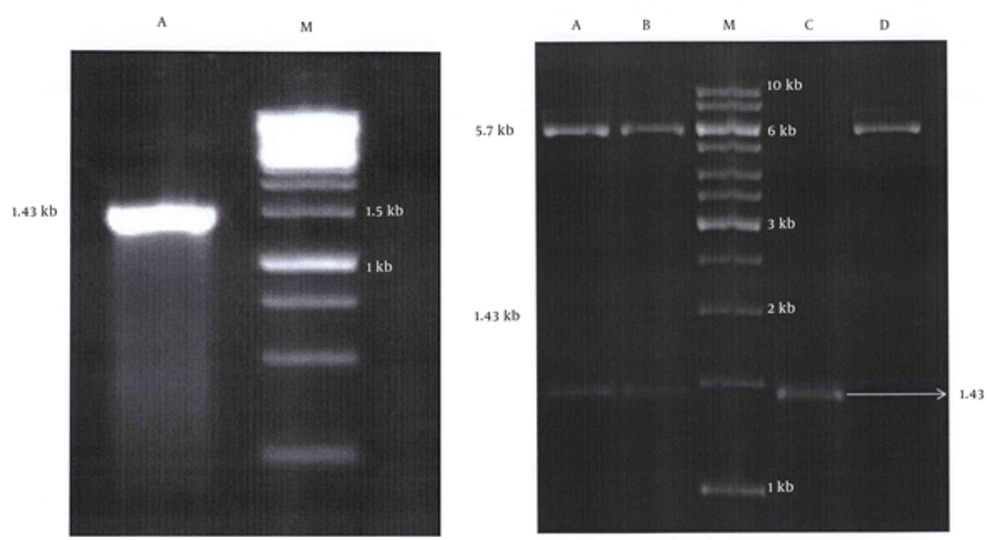
Figure 1.
A, confirmation of the catalase band by PCR after cloning; B, catalase and pET-15b bands after double digestion; columns A and B, double digestion products; column C, PCR product control; column D, plasmid control; column M, Marker.
4.3. Purification of the Recombinant Catalase
After expression and purification, the purified recombinant catalase was assayed by SDS-PAGE (Figure 2A). The catalase band (53 KDa) was detected. Finally, confirmation of the recombinant catalase was performed by western blot (anti-his-tag) and detection of catalase band (53 KDa) (Figure 2B).
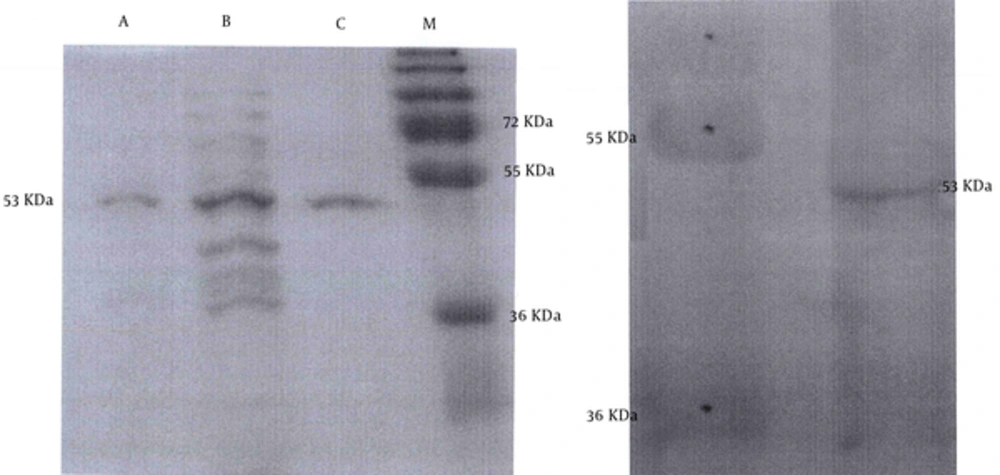
Figure 2.
A, Single band of catalase enzyme (SDS-PAGE) after purification columns; A and C, pure protein; column B, lysate before purification; column M, Marker; B, confirmation of catalase enzyme expression by western blot.
4.4. Selection of the Infected and Healthy Individuals
Eleven healthy and eleven infected patients were identified based on the presence of H. Pylori antigen in their feces and IgG and IgM in their serums.
4.5. T-Cell Proliferation Responses to Recombinant Catalase and Predicted Epitopes
PBMCs isolated from blood specimens were induced by recombinant catalase and epitopes. To identify the catalase and peptide antigens, they were recognized by CD4+ T-cell. T-cell proliferation responses to recombinant catalase and epitopes were assayed by the cell proliferation kit as described. Responses of T-cell to peptide and catalase are shown in Table 1. Results of the cell proliferation test were reported according to the ratio of optical density (OD) parameter response of stimulated cells by epitopes or catalase to OD of negative controls for infected or healthy individuals. Totally, 13 out of 22 individuals (four infected and nine healthy) responded to the recombinant catalase (59%) and 13 out of 22 individuals (four infected and nine healthy) responded to peptide (59%). Results are reported as the mean ± standard deviation (SD). Also results are based absorbance (OD): Mean ± SD for responses of four infected individuals to the peptide was 2.28 ± 1.4. Mean ± SD for responses of four infected individuals to recombinant catalase was 1.84 ± 0.52. Mean ± SD for responses of nine healthy individuals to peptide was1.67 ± 0.85 and Mean ± SD for responses of nine healthy individuals to recombinant catalase was 2.32 ± 2.7.The differences between the means of T-cell proliferation against peptide and recombinant catalase in the infected and healthy groups were not significant (P > 0.05).
Table 1.
T-cell Proliferation Responses to Epitopes and Recombinant Catalase in the Infected and Healthy Individuals
| Na | Missingb | Absorbancec | Min - Max | |
|---|---|---|---|---|
| Epitopes | ||||
| Group 1d | 4 | 7 | 2.28 ± 1.4 | 0.712 - 1.944 |
| Group 2e | 9 | 2 | 1.67 ± 0.85 | 0.52 - 2 |
| Catalase | ||||
| Group 1d | 4 | 7 | 1.84 ± 0.52 | 0.417 - 1. 35 |
| Group 2e | 9 | 2 | 2.32 ± 2.7 | 0.477 - 1.2 |
aNumber of the individuals who responded.
bNumber of the individuals who didn’t respond.
cValues are presented as mean ± SD.
dInfected individuals.
eHealthy individuals.
4.6. Cytokine Products Induced by Epitopes
As shown in Table 2, after the stimulation of PBMCs in epitopes and catalase, the levels of cytokines IFN-γ and IL-4 in response to epitopes and catalase were detected by an ELISA test. Results are reported as the mean ± standard deviation (SD).
Table 2.
Results of Cytokine Production Against Epitopes and Catalase in the Infected and Healthy Individuals
| Variables | Na | Missingb | Amount of Cytokinec | Min - Max |
|---|---|---|---|---|
| Epitopes | ||||
| IL.4 production ρg/mL | ||||
| Group 1 | 11 | 0 | 0.193 ±.43 | 0.000 - 1.178 |
| Group 2 | 11 | 0 | 0.889 ± 2.6 | 0.000 - 8.800 |
| IFN.γ production ρg/mL | ||||
| Group 1 | 11 | 0 | 19.89 ± 16.12 | 0.000 - 47.100 |
| Group 2 | 11 | 0 | 28.40 ± 17.99 | 0.055 - 61.300 |
| Recombinant Catalase | ||||
| IL.4 production ρg/mL | ||||
| Group 1d | 11 | 0 | 1.47 ±.937 | 0.000 - 3.25 |
| Group 2e | 11 | 0 | 1.45 ± 1.19 | 0.000 - 3.4 00 |
| IFN.γ production ρg/mL | ||||
| Group 1d | 11 | 0 | 20.8 ± 15.3 | 0.846 - 40 |
| Group 2e | 11 | 0 | 25.28 ± 15.7 | 0.000 - 46 |
aNumber of the individuals who responded.
bNumber of the individuals who didn’t respond.
cValues are presented as mean ± SD.
dInfected individuals.
eHealthy individuals.
4.7. Determination of the Epitope-Specific T-Lymphocytes With IFN-γ Specific ELISpot Assay
Of the 22 individuals, 11 (five infected and six healthy) responded positively to the catalase measured by ELISpot (50%) and 12 (four infected and eight healthy) responded positively to the epitopes measured by ELISpot (54%) (Table 3). The differences between the mean of both groups (infected and healthy) were not significant as determined by the Mann-Whitney test (Table 4). According to the Wilcoxon signed-rank test, the differences between the means of cell proliferation, ELISpot, IL-4 and IFN-γ production against epitopes and recombinant catalase in the healthy group were not significant (P > 0.05) (Table 5). The differences between the means of cell proliferation, ELISpot, IL-4, and IFN-γ production against epitopes and recombinant catalase in the infected group were not significant (P > 0.05) (Table 6). The differences between the means of IL-4 production against catalase epitopes and recombinant catalase in the infected group, however, are significant (P < 0.05) (Table 6).
Table 3.
Results of IFN-γ Specific ELISpot Assay in the Infected and Healthy Individuals
| Na | Missingb | Number of Spotsc | Min - Max | |
|---|---|---|---|---|
| Epitopes | ||||
| Group 1d | 4 | 7 | 103.7 ± 131.8 | 15 - 300 |
| Group 2e | 8 | 3 | 143.6 ± 136.6 | 7 - 300 |
| Catalase | ||||
| Group 1d | 5 | 6 | 79.4 ± 125 | 10 - 300 |
| Group 2e | 6 | 5 | 120.3 ± 139.8 | 7 - 300 |
aNumber of the individuals who responded.
bNumber of the individuals who didn’t respond.
cValues are presented as mean ± SD.
dInfected individuals.
eHealthy individuals.
Table 4.
Comparison of Cytokine Production and Cell Proliferation Between the Infected and Healthy Groups
| Variables | Epitope | Catalase | ||
|---|---|---|---|---|
| Z | P Values | Z | P Values | |
| IL.4 | -0.098 | 0.922 | -0.231 | 0.817 |
| IFN.γ | -1.149 | 0.250 | -0.460 | 0.646 |
| ELISpot | -0.87 | 0.931 | -0.553 | 0.580 |
| Cell proliferation | -1.346 | 0.193 | -1.543 | 0.133 |
Table 5.
Comparison of Cytokine Production, ELISpot and Cell Proliferation Against Epitope and Recombinant Catalase Among Healthy Individuals
| Cat–Epitope | Z | P Values |
|---|---|---|
| IL-4 | -1.48 | 0.139 |
| IFN-γ | -0.178 | 0.859 |
| ELISpot | -1.34 | 0.180 |
| Cell proliferation | -0.267 | 0.790 |
Table 6.
Comparison of Cytokine Production, ELISpot and Cell Proliferation Against Epitope and Recombinant Catalase Among the Infected Individuals
| Cat–Epitope | Z | P Values |
|---|---|---|
| IL-4 | -2.59 | 0.009 |
| IFN-γ | -0.445 | 0.657 |
| ELISpot | -1 | 0.317 |
| Cell proliferation | -0.711 | 0.477 |
5. Discussion
Helicobacter pylori are invasive bacteria (18, 19) that cause gastritis, peptic ulcer, and gastric cancer. Around 50% of the people worldwide are infected by H. pylori. Prevalence in the developing countries range from 20% to more than 80%. Less than 20% of the infected individuals will develop a gastroduodenal disease. In 1994, World Health Organization (WHO) classified H. pylori as a grade I carcinogen (1, 4, 6, 11, 16, 20-23). Helicobacter pylori is successfully eradicated by antibiotics together with a proton pump inhibitor, however, there are potential problems (1-3, 5, 13).
Chronic gastritis has no symptoms in many cases and may lead to cancer (3). Therefore, the prevention and treatment of H. pylori infection should be considered in the healthcare policy, especially in the developing countries where infection is highly prevalent (6, 24, 25). Furthermore, studies regarding the transmission of H. pylori infection within the family have supported the necessity of prevention and treatment, especially in children (23, 26). Vaccination is considered the most economic and efficient method for prevention and treatment, particularly in the developing countries (27, 28). Protective immune responses based on epitopes can play an important role in prevention and treatment. Epitopes that mediate APC are recognized by CD4+ T-cells and can be used as suitable vaccination tools for (11).
Currently, catalase is a suitable vaccine candidate (5, 6, 13, 14, 29). It is a highly conserved enzyme sequence with a similarity of approximately 98%-100% in different H. pylori isolates (11). Expression of catalase is high, and this enzyme is an important virulence factor of H. pylori (11, 14). Therefore, catalase can be a good vaccine candidate against H. pylori. The results of recombinant catalase and epitopes effects (479 amino acids) on PBMC cultures from 22 individuals were assayed. It is necessary to explain that the size of the H. pylori catalase gene is 1515 bp and the size of the catalase enzyme is 505 amino acids. Designed primers, however, covered 1437 bp, because the quality of the reverse primer was important to the study and in 3' end of the catalase gene there were high amounts of T and A bases.
Propred software showed that a loss of almost 200 end nucleotide from the catalase gene was not effective in immune responses, because in this sequence there were no epitopes (11). Enzyme activity did not consider in this study, but immune responses were significant. Therefore, even if the elimination of the end nucleotides was effective on activity, it was not sufficient for the study. Thus, 1437 bp were considered from the gene for amplification. To check the difference between the responses of infected and healthy individuals (prophylactic and protective effects), responses in both groups were assayed. According to the Mann-Whitney test, the differences between the cell proliferation means of the two groups (infected and healthy) were not significant (P > 0.05). The result of the ELISpot test also showed that the differences between the means of both groups were not significant, as determined by the Mann-Whitney test (P > 0.05).
According to the IFN-γ and IL-4 ELISA assay, the differences between the means of production of IFN-γ and IL-4 by T-cells in both groups (infected and healthy) were not significant (P > 0.05), as determined by Mann-Whitney test. On the other hand, it was noticed that the IFN-γ production mean in the subjects was more than that of IL-4. The current investigation did not observe significant differences between the production of IFN-γ and IL-4 in the healthy and infected groups. According to the Wilcoxon signed-rank test, differences between the means of cell proliferation, ELISpot, IL-4, and IFN-γ production against catalase epitopes and recombinant catalase in the healthy group were not significant (P > 0.05) (Table 5). Additionally, the differences between the means of cell proliferation, ELISpot, IL-4, and IFN-γ production against catalase epitopes and recombinant catalase in the infected group were not significant (P > 0.05) (Table 6). The differences between the means of IL-4 production against catalase epitopes and recombinant catalase in the infected group were significant (P < 0.05) (Table 6). Therefore, according to the current study results, epitopes in patients induce the humoral immune system less than the recombinant catalase. Higher amounts of humoral immune response indicate that a further part of immune system is assigned to humoral responses. Since the confrontation of patients with contracted H. pylori and its catalase enzyme have memory cells in their immune system; therefore, production of IL-4 is higher when they encounter the whole catalase enzyme.
Despite the fact that the healthy individuals had no H. pylori infection (there were no memory cells), they had a similar production rate of IFN-γ. Therefore, epitopes, in spite of their short length, conduct the immune system toward the cellular immune system similar to the recombinant catalase and are even more effective. Some studies state that protection against H. pylori infection is independent of IL-4 but is mediated by predominant Th1-type immune responses (IFN-γ) (15, 30-34). Some of them even believed that IgA antibodies impair resistance against H. pylori infection (35). But some studies believed that Th2 responses with representation of IL-4 secretion interfere with H. pylori infection. Some studies demonstrated that patients infected by parasites show low incidence of H. pylori infection (36-38). Also some researchers showed that equivalent Th1-Th2 responses may have important role in protection against H. pylori infection (1). But whether Th1 or Th2 type immune responses are responsible for the protective immunity is still in distinctive.
The current study results were in accordance with the studies that mentioned Th1 responses are predominant against H. pylori. It is interesting to note that a short sequence of catalase epitopes (32 amino acids) could cause a significant response (more than 50% positive responses and even better than a whole catalase) in the studied population (22 individuals). Since more than 50% of the positive cellular immune responses of the assayed subjects to the peptide in cell proliferation, ELISpot tests, and predominant IFN-γ response, it is suggest that the predicted epitopes of catalase H. pylori are efficient antigens for protection. To study H. pylori epitopes effects better, they can serve as a composition of different H. pylori antigens epitopes. These studies can help control H. pylori infection, particularly in the developing countries like Iran. It is also suggested that these experiments be performed on the PBMC of a large population as an epidemiologic research.
In a study on a larger population, it is possible to obtain significant differences between the responses of the two groups (infected and healthy). For example, in the current research, seven out of eleven samples from the infected individuals in the T-cell proliferation test did not respond to epitopes, whereas only two out of eleven samples from the healthy individuals did not respond to epitopes. This could have occurred because of a previous encounter of the infected individuals with H. pylori and the activation of memory cells in both the humoral and cellular immune systems. In this case, the immune responses of the infected individuals compared to those of healthy individuals are assigned a lesser part of the immune system than the cellular immune system. Differences between the responses in 11 samples of each group were not significant, but in a larger population they may be significant. Of course, the current study was not large enough and comprehensive to conclude for vaccine comment; therefore, authors are going to continue the study in their future researches including animal models and human phases. Authors designed seven epitopes MVNKDVKQTTKKVLLQSTWFLKKFHPFDVTKIKKWVKFHFHTMQKKVKHLTNEEAKKYRADDSDYYKKY YRSLPADEK (GenBank accession number: Cat JQ361787) to study and compare the immune responses against the ones for future studies.